
Starting a candle brand can cost anywhere from $3,000 to more than $50,000, depending on how customized the product is, how many units are ordered, and whether the launch uses stock components or fully proprietary packaging, fragrance and vessels.
For a relatively simple private label launch using a stock glass jar, an existing fragrance, a printed label and a standard folding carton, a buyer may be able to start with approximately 300 to 500 candles and a total purchasing budget of $3,000 to $8,000.
A professionally developed collection with several fragrances, custom-colored vessels, premium gift boxes, third-party testing and international freight may require $10,000 to $30,000.
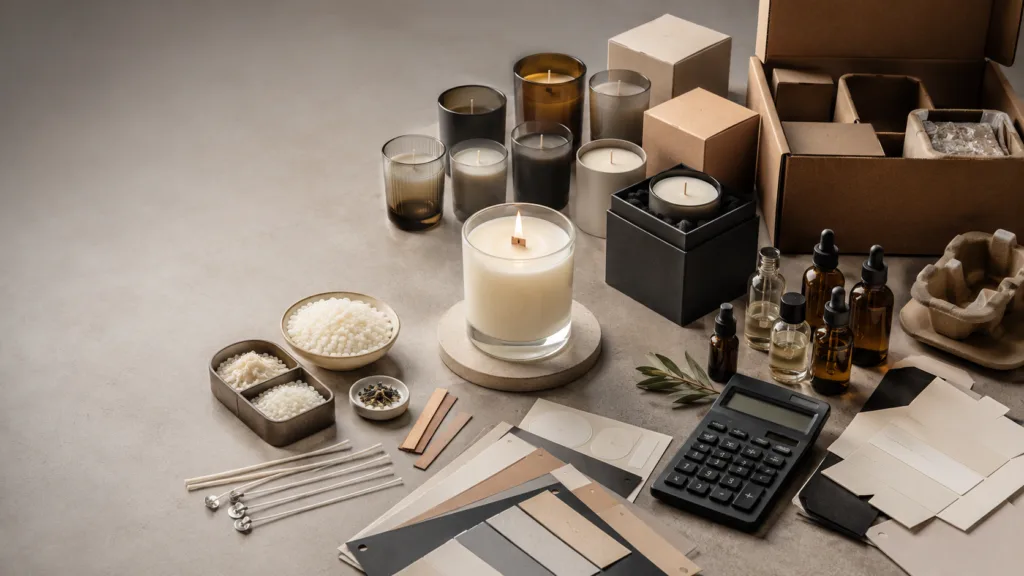
A fully customized brand using proprietary molds, custom fragrance development, rigid gift packaging and several thousand units can easily exceed $30,000 to $50,000 before marketing, warehousing and retail distribution expenses are included.
The important question is therefore not simply, “How much does a candle cost?” It is:
What level of customization, product quality and order volume can support the brand’s target retail price and sales channel?
This guide breaks down every major private label candle cost, including samples, molds, wax, fragrance, vessels, packaging, testing, logistics, tariffs and hidden expenses.
1. Private Label Candle Cost: The Quick Answer
For a standard 8- to 10-ounce container candle, practical factory planning ranges often look like this:
| Order Quantity | Estimated EXW Unit Cost | Estimated Startup and Development Costs | Typical Total Project Budget |
|---|---|---|---|
| 300 units | $4.80–$7.80 | $600–$2,000 | $3,000–$6,000 |
| 500 units | $3.80–$6.50 | $600–$2,500 | $4,000–$8,000 |
| 1,000 units | $3.10–$5.50 | $800–$3,500 | $6,000–$12,000 |
| 3,000 units | $2.40–$4.50 | $1,000–$6,000 | $10,000–$25,000+ |
These figures are planning estimates rather than universal market prices. They assume a conventional container candle using a stock vessel, one wick, approximately 220 to 300 grams of wax, standard fragrance oil and individual retail packaging.
The price rises when the project requires:
- A proprietary glass or ceramic vessel
- A custom fragrance formula
- Multiple colors or fragrances
- Wooden or metal lids
- Rigid gift boxes
- Special inserts
- Embossing, hot foil or UV printing
- Natural waxes such as coconut or beeswax blends
- Independent laboratory testing
- Air freight or small-volume international shipping
The lowest-priced factory quotation is not always the lowest-cost project. A cheaper candle that fails burn testing, arrives with broken vessels or delivers weak scent performance can create far greater losses than a slightly higher initial unit price.
2. The Current Private Label Candle Market Opportunity
Private label candles now sit at the intersection of home décor, wellness, gifting and personal fragrance.
Grand View Research estimated the global scented candle market at approximately $2.3 billion in 2025, with projected growth to $3.5 billion by 2033. Premium scented candles represented the largest category share, while container candles accounted for more than half of the market. North America remained the largest regional scented candle market.
The broader home fragrance market was estimated at $13.2 billion in 2025 and is projected to expand to $26.5 billion by 2033. Research also points to growing demand for plant-based wax, recyclable containers, personalized interiors and premium fragrance experiences.
Pinterest’s 2026 “Scent Stacking” forecast highlights growing interest in personalized fragrance combinations rather than one fixed signature scent. For candle brands, this supports coordinated collections, layered scent stories and products designed to be used together.
Google Trends should be interpreted carefully when analyzing niche phrases such as “private label candle brand.” Google explains that Trends data is normalized from zero to 100 rather than showing absolute search volume, and low-volume terms may display limited data or statistical noise. Buyers should therefore compare broader terms such as “scented candles,” “candle business” and “custom candles” across target regions.
For mature wholesale buyers, the commercial opportunity is strongest when candles are developed as a repeatable collection rather than a single novelty item. A scalable brand normally has:
- A recognizable vessel or packaging system
- Several coordinated fragrances
- A clear target retail price
- Reliable reorder capacity
- Documented product specifications
- Consistent burn and scent performance
- Packaging suitable for retail or e-commerce fulfillment
3. How Candle Manufacturers Structure Pricing
A candle quotation usually contains two different types of cost.
Fixed Costs
Fixed costs are paid once or spread across the first production order. They may include:
- Product development
- Sample production
- Mold creation
- Packaging dies
- Printing plates
- Fragrance matching
- Artwork adjustment
- Laboratory testing
- Setup charges
These costs have a much greater effect on a 300-piece order than on a 3,000-piece order.
For example, a $1,500 mold adds:
- $5.00 per candle at 300 units
- $3.00 per candle at 500 units
- $1.50 per candle at 1,000 units
- $0.50 per candle at 3,000 units
Variable Costs
Variable costs increase with every unit produced. These generally include:
- Wax
- Fragrance
- Wick
- Vessel
- Lid
- Label
- Packaging
- Direct production labor
- Inner protection
- Export carton allocation
The most useful quotation is not simply one total price. Mature buyers should request a breakdown that separates:
- Product unit cost
- Packaging unit cost
- One-time setup costs
- Sample and development fees
- Freight and delivery terms
- Testing or certification costs
This makes future reorders easier to calculate.
4. Sample Fees and Product Development Costs
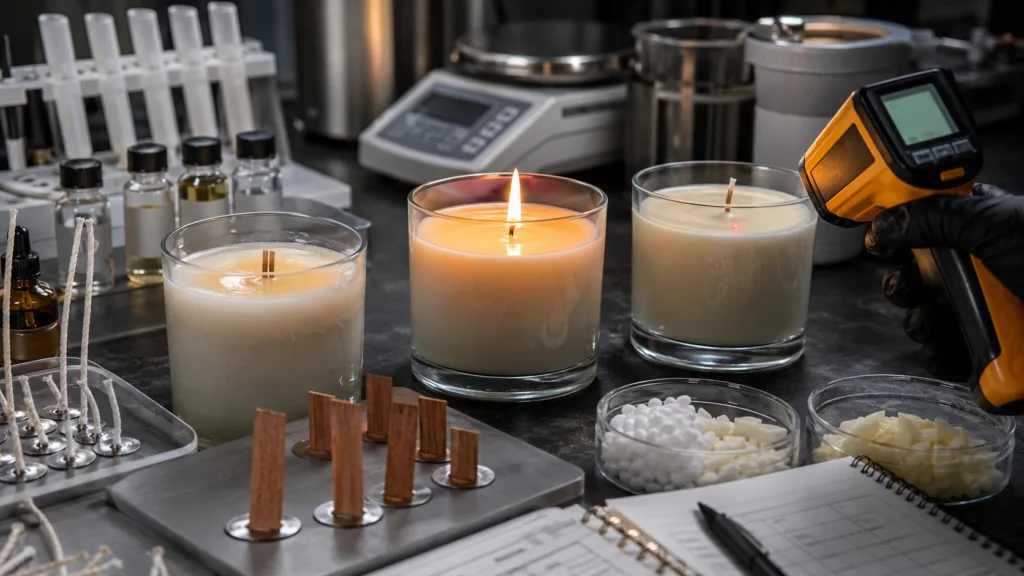
Samples are one of the first expenses in the cost to start a candle brand.
A sample is not just a smaller version of the bulk product. It is part of the technical development process. The manufacturer may need to test several wick sizes, wax blends, fragrance percentages and pouring temperatures before producing an acceptable result.
Typical Sample Cost Ranges
| Sample Type | Typical Planning Range |
|---|---|
| Existing candle with stock fragrance | $30–$100 |
| Branded sample with custom label | $50–$150 |
| Custom fragrance and wax sample | $100–$300 per round |
| Multiple wick or burn-test prototypes | $150–$500 |
| Proprietary perfumer-developed fragrance | $1,000–$5,000+ |
| International sample freight | $40–$250+ |
A factory may offer a free product sample, but international courier charges are usually paid by the buyer. Qualified bulk projects may also receive sample-fee credits after a production order is confirmed.
Why Several Sample Rounds May Be Necessary
One sample round is often insufficient when the project includes:
- An unusual vessel diameter
- A narrow or very deep container
- High fragrance loading
- Dark-colored wax
- Wooden wicks
- Essential-oil-heavy formulas
- Sculptural candles
- Mixed vegetable waxes
- Strong hot-throw requirements
A mature buyer should budget for two or three development rounds, even when the goal is to approve the first sample.
5. Custom Molds, Tooling and Setup Charges
Custom tooling is one of the largest potential private label candle costs.
A stock vessel only requires decoration. A proprietary vessel requires the manufacturer to create new production tooling.
Indicative Tooling Ranges
| Component | Typical Planning Range |
|---|---|
| Simple silicone candle mold | $100–$800 |
| Metal pillar-candle mold | $200–$1,500 |
| Custom ceramic vessel mold | $500–$3,000+ |
| Custom glass vessel mold | $2,000–$10,000+ |
| Custom metal tin tooling | $500–$3,000+ |
| Packaging die or cutting form | $50–$300 |
| Embossing or hot-foil plate | $50–$250 |
Actual tooling costs depend on size, cavities, surface texture, undercuts, production method and expected mold life.
When a Custom Mold Makes Financial Sense
Custom tooling becomes easier to justify when:
- The first order is at least 1,000 to 3,000 units
- The same vessel will be reordered
- Several fragrances share one container
- The vessel is central to brand recognition
- The retail price is high enough to absorb development costs
- The brand needs protection from direct visual comparison
For a startup testing demand, it is normally more economical to select an existing mold and customize its color, finish, label and packaging.
6. Wax Material Costs
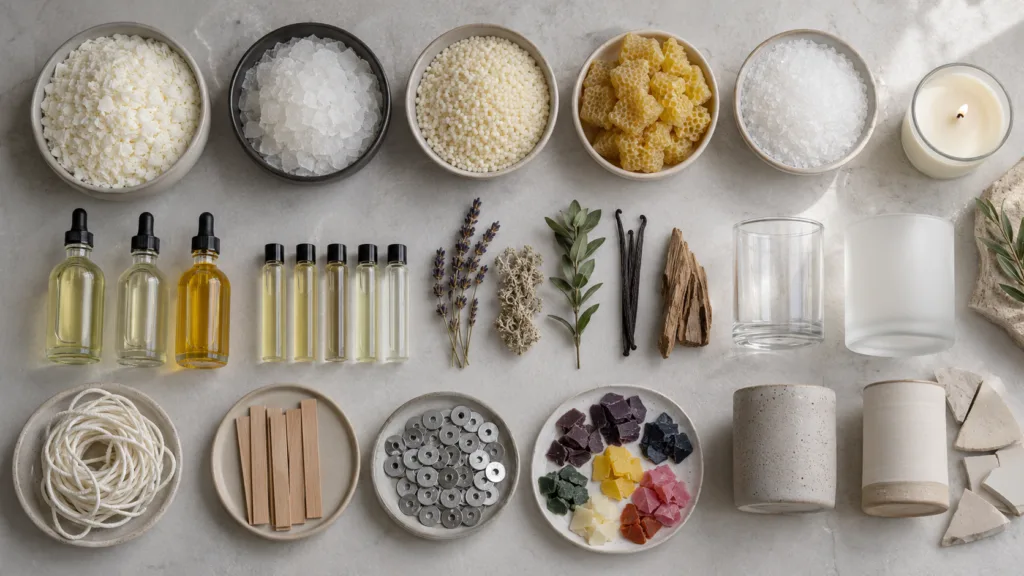
Wax affects cost, appearance, scent performance, burn behavior and marketing claims.
For a 220- to 300-gram candle, an indicative raw wax contribution may fall within these ranges:
| Wax Type | Approximate Wax Cost per Candle |
|---|---|
| Paraffin or paraffin blend | $0.45–$0.85 |
| Soy wax | $0.65–$1.15 |
| Rapeseed or vegetable blend | $0.75–$1.30 |
| Coconut-soy blend | $0.90–$1.60 |
| Beeswax blend | $1.30–$2.60+ |
These are manufacturing-planning ranges, not commodity quotations. Wax prices fluctuate according to origin, grade, certification, formulation and purchasing volume.
Paraffin Wax
Paraffin remains widely used because it offers:
- Strong fragrance throw
- Smooth appearance
- Stable supply
- Competitive pricing
- Predictable production behavior
A well-formulated paraffin candle is not automatically a low-quality candle. Its performance depends on wax grade, fragrance compatibility, wick selection and manufacturing control.
Soy and Vegetable Wax
Soy and vegetable blends can support natural or plant-based positioning. However, they may require additional development because of:
- Frosting
- Surface variation
- Adhesion issues
- Longer curing times
- Different fragrance compatibility
- Seasonal temperature sensitivity
Coconut and Premium Wax Blends
Coconut blends are frequently used in premium home fragrance collections. They can create an attractive appearance and smooth melt pool, but the higher raw material cost must be supported by the brand’s retail price.
The best wax is not necessarily the most expensive one. It is the wax that delivers the required burn, scent, appearance, stability and commercial margin.
7. Fragrance Oil and Custom Scent Development
Fragrance can be one of the most expensive ingredients in a candle.
A standard candle may use a fragrance load of approximately 6% to 12%, depending on the wax, oil, desired performance and safety limits. More fragrance does not automatically produce better hot throw.
Too much oil can cause:
- Wick drowning
- Excessive smoke
- Poor combustion
- Oil sweating
- Surface instability
- Unsafe flame behavior
- Reduced shelf stability
Fragrance Cost per Candle
For a standard container candle, fragrance may contribute approximately:
- $0.30–$0.70 for basic stock fragrance oil
- $0.60–$1.20 for higher-grade or more complex oil
- $1.00–$2.00+ for premium, natural-heavy or proprietary formulas
The final price depends on fragrance concentration and oil cost per kilogram.
Stock Fragrance Versus Custom Fragrance
Stock Fragrance
A stock scent is selected from the manufacturer’s existing fragrance library.
Advantages include:
- Lower MOQ
- Faster sampling
- Lower development cost
- Existing technical documents
- More predictable wax compatibility
Modified Fragrance
A stock scent can sometimes be adjusted by changing sweetness, woodiness, freshness or a specific note.
This provides greater differentiation without the full cost of creating a proprietary fragrance from zero.
Fully Custom Fragrance
A proprietary fragrance may require:
- A written scent brief
- Competitive references
- Several formulation rounds
- Evaluation in wax
- Stability review
- IFRA documentation
- Minimum fragrance-oil purchase quantities
IFRA describes its Standards as a globally recognized risk-management system that restricts, specifies or prohibits certain fragrance materials based on scientific assessment. An IFRA conformity document does not replace local legal compliance or finished-product safety assessment.
8. Candle Containers, Lids and Decorative Finishes
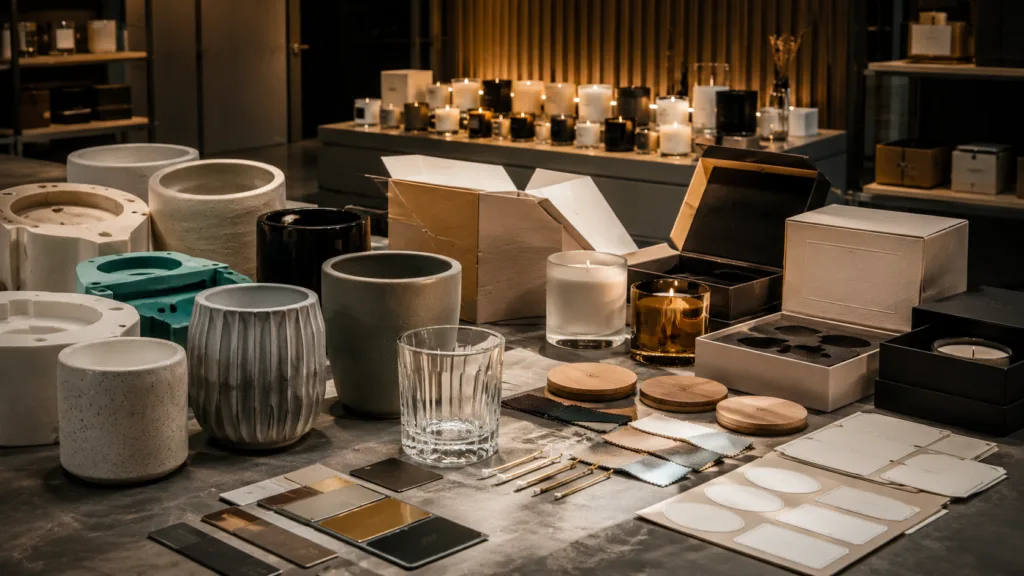
For many private label candles, the vessel costs more than the wax.
Typical Vessel Cost Ranges
| Vessel Type | Indicative Unit Cost |
|---|---|
| Standard clear glass jar | $0.45–$1.20 |
| Colored or frosted glass | $0.80–$2.00 |
| Heavy premium glass | $1.20–$3.50 |
| Metal candle tin | $0.40–$1.20 |
| Stock ceramic vessel | $1.50–$5.00 |
| Custom ceramic vessel | $2.50–$8.00+ |
| Natural wood vessel | $3.00–$10.00+ |
Decorative finishing can add:
- Spray color
- Frosting
- Electroplating
- Screen printing
- Decals
- Laser engraving
- Embossed logos
- Reactive glazes
- Matte or glossy coatings
Lid Costs
| Lid Type | Indicative Unit Cost |
|---|---|
| Basic metal lid | $0.15–$0.50 |
| Standard wood lid | $0.35–$1.20 |
| Engraved wood lid | $0.60–$1.80 |
| Heavy decorative lid | $1.00–$3.00+ |
Wooden components may also require moisture control, dimensional tolerances and additional inspection.
Buyers should never select a container based only on appearance. The vessel must be evaluated for heat resistance, wall thickness, internal diameter, base stability and compatibility with the candle’s wick system.
9. Labels, Boxes and Gift Packaging
Packaging can turn a basic candle into a retail-ready product, but it can also become one of the largest cost categories.
Common Packaging Costs
| Packaging Component | Indicative Unit Cost |
|---|---|
| Standard adhesive label | $0.05–$0.20 |
| Textured or metallic label | $0.15–$0.50 |
| Dust cover | $0.03–$0.15 |
| Basic folding carton | $0.25–$0.90 |
| Premium folding carton | $0.60–$1.50 |
| Molded pulp or paper insert | $0.15–$0.80 |
| EVA or foam insert | $0.30–$1.20 |
| Rigid gift box | $1.20–$4.00+ |
| Multi-candle gift set box | $2.00–$8.00+ |
Special processes raise custom candle pricing:
- Hot-foil stamping
- Embossing
- Debossing
- Spot UV
- Metallic paper
- Soft-touch lamination
- Magnetic closures
- Ribbon pulls
- Custom inserts
- Individual fragrance sleeves
Packaging MOQ Problems
A candle factory may accept 500 candles, while the packaging printer requires 1,000 boxes.
The buyer may need to:
- Purchase all 1,000 boxes and store the balance
- Pay a small-order surcharge
- Use a digital-printing method
- Simplify the packaging
- Share one universal box across several fragrances
For multi-scent collections, a universal outer box with fragrance-specific labels can significantly reduce inventory risk.
10. Burn Testing, Compliance and Quality Control
Testing is not an optional finishing step. It is part of product development.
Every combination of the following can affect candle behavior:
- Wax formula
- Fragrance
- Fragrance percentage
- Wick type
- Wick size
- Vessel diameter
- Vessel shape
- Dye
- Decorative elements
Changing the fragrance can require a new burn test, even when the vessel and wax remain unchanged.
Internal Burn Testing
A proper burn test should evaluate:
- Flame height
- Melt-pool diameter
- Melt-pool depth
- Vessel temperature
- Wick mushrooming
- Soot
- Visible smoke
- Self-extinguishing behavior
- Remaining wax
- End-of-life performance
- Cold throw
- Hot throw
U.S. Candle Standards
The U.S. Consumer Product Safety Commission lists several relevant voluntary ASTM candle standards, including:
- ASTM F2058 for candle fire-safety labeling
- ASTM F2179 for candle glass containers
- ASTM F2326 for visible emissions
- ASTM F2417 for candle fire safety
- ASTM F2601 for candle accessories
The National Candle Association also explains that ASTM F2417 addresses issues such as flame height, stability, secondary ignition and end-of-useful-life performance.
Testing Budget
A buyer may need to budget approximately:
- $200–$800 per product configuration for selected third-party tests
- $100–$500 for labeling or document review
- Additional fees for glass testing, chemical review or retailer-specific protocols
- Separate testing for different vessel, wick or fragrance combinations
Large retailers may have standards that exceed basic legal requirements.
11. Candle Cost Models at Different Order Quantities
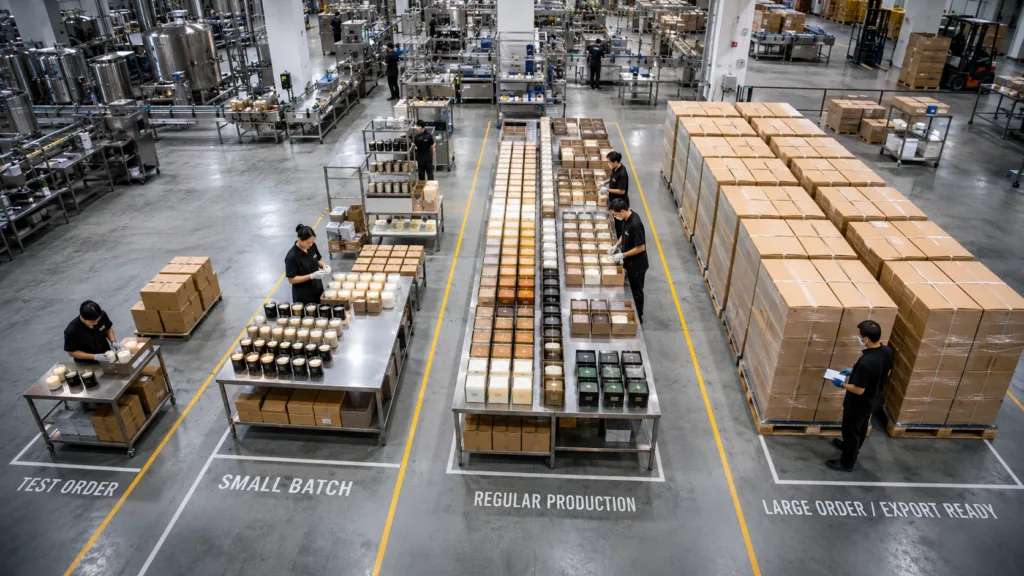
Quantity has a major effect on private label candle cost because fixed expenses are spread across more units.
The following model assumes:
- 250-gram scented candle
- Stock glass vessel
- One wick
- Standard lid
- Printed label
- Individual folding carton
- One to three fragrances
- Conventional export packaging
- EXW factory pricing
300-Unit Test Order
| Cost Component | Estimated Cost |
|---|---|
| Candle production | $1,440–$2,340 |
| Samples and development | $300–$900 |
| Packaging setup | $150–$400 |
| Testing and documentation | $250–$800 |
| Inspection and administration | $100–$300 |
| Estimated pre-freight total | $2,240–$4,740 |
Suitable For
- Market testing
- Influencer seeding
- Small e-commerce launch
- One fragrance
- Stock components
Main Limitation
At 300 units, the buyer pays a high effective cost for setup, sampling and packaging.
500-Unit Starter Collection
| Cost Component | Estimated Cost |
|---|---|
| Candle production | $1,900–$3,250 |
| Samples and development | $300–$1,000 |
| Packaging setup | $150–$500 |
| Testing and documentation | $300–$900 |
| Inspection and administration | $150–$400 |
| Estimated pre-freight total | $2,800–$6,050 |
This is often the practical starting point for a serious private label candle brand using stock vessels and customized branding.
1,000-Unit Commercial Order
| Cost Component | Estimated Cost |
|---|---|
| Candle production | $3,100–$5,500 |
| Samples and development | $400–$1,200 |
| Packaging setup | $200–$700 |
| Testing and documentation | $400–$1,200 |
| Inspection and administration | $200–$500 |
| Estimated pre-freight total | $4,300–$9,100 |
At this volume, buyers can usually access better component prices and more packaging options.
Better Uses of the Budget
A 1,000-piece order can be divided into:
- Two fragrances × 500 units
- Four fragrances × 250 units, when component MOQs permit
- One core fragrance with several packaging designs
- One retail candle and one gift-set configuration
3,000-Unit Scalable Brand Order
| Cost Component | Estimated Cost |
|---|---|
| Candle production | $7,200–$13,500 |
| Samples and development | $500–$2,000 |
| Packaging and tooling | $500–$3,000 |
| Testing and documentation | $600–$2,000 |
| Inspection and administration | $300–$800 |
| Estimated pre-freight total | $9,100–$21,300 |
Advantages
- Better material purchasing power
- Lower setup cost per unit
- More economical ocean freight
- Greater packaging customization
- Better access to proprietary colors and finishes
- Improved reorder consistency
Example Assumptions
A 3,000-unit order might contain three fragrances of 1,000 units each using one shared vessel and box structure.
Important Cost Note
A custom ceramic vessel, premium fragrance and rigid gift box can push the unit cost well above these ranges, even at 3,000 units.
12. International Shipping and Logistics Costs
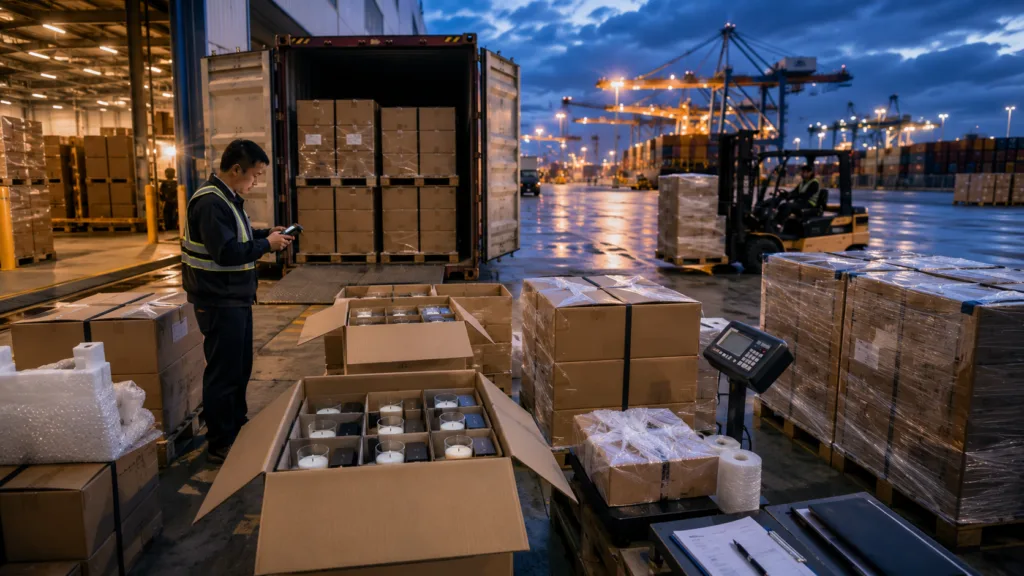
Factory cost and landed cost are not the same.
International logistics may include:
- Pickup from the factory
- Export declaration
- Origin handling
- Freight
- Fuel surcharge
- Port charges
- Customs clearance
- Duty
- Destination handling
- Final-mile delivery
- Liftgate or appointment fees
- Warehousing
- Cargo insurance
Air Freight
Air freight is useful for:
- Samples
- Urgent launches
- Small quantities
- Initial retail testing
- Replacement stock
However, candles are heavy and often packed in glass. Air shipment can add several dollars to the cost of each candle.
Ocean Freight
Ocean freight is usually more economical for commercial orders, but buyers must consider:
- Longer transit time
- Port congestion
- Minimum destination charges
- Customs processing
- Pallet or carton handling
- Delivery appointments
- Possible demurrage or storage
For less-than-container-load shipments, destination charges can represent a significant percentage of the total freight bill. A cheap ocean quote that excludes local charges may be misleading.
Packaging Efficiency
A slightly smaller gift box can reduce:
- Carton dimensions
- Chargeable volume
- Pallet count
- Container space
- Storage requirements
- E-commerce fulfillment fees
Packaging should therefore be designed for both presentation and logistics.
13. Import Duties, Tariffs and Taxes
Candles are generally classified under customs heading 3406, but the final classification, duty treatment and additional tariffs depend on:
- Importing country
- Country of origin
- Product composition
- Current trade policy
- Customs value
- Applicable trade agreements
- Importer status
A supplier should provide a commercial invoice, packing list, country of origin and proposed HS code. However, the importer remains responsible for confirming the final classification with a customs broker or local authority.
Costs That May Apply
- Standard customs duty
- Additional origin-based tariffs
- Import VAT or GST
- Merchandise processing fees
- Customs brokerage
- Bond fees
- Port security charges
- Customs examination fees
Do not calculate margins using factory price alone. Duty and tax should be added before the retail price is finalized.
14. Hidden Costs Buyers Frequently Overlook
A realistic candle startup budget should include a contingency of approximately 10% to 20%.
Common hidden costs include:
Fragrance Revision Fees
A fragrance that smells good in the bottle may perform differently in wax. Extra development rounds increase both sample and courier expenses.
Unused Packaging Inventory
Printers may require more boxes or labels than the candle factory’s MOQ.
Color Matching
Custom Pantone colors may require:
- Color sampling
- Spray setup
- Minimum batch quantities
- Additional inspection
- Reproduction tolerances
Breakage Allowance
Glass and ceramic candle projects should include a breakage and replacement reserve.
Quality Inspection
Third-party inspection can identify problems before final payment or shipment.
Payment and Currency Fees
International bank charges, card fees and exchange-rate changes can affect the final project cost.
Storage
Excess packaging, delayed launches or seasonal inventory may generate warehouse charges.
Product Photography
A professional launch may require:
- White-background images
- Lifestyle photography
- Video
- Packaging mockups
- Retail catalog assets
Barcodes and Retail Setup
Wholesale and retail buyers may require:
- GS1 barcodes
- Carton labels
- SKU labels
- FNSKU labels
- Retailer portals
- Compliance documents
- Product liability insurance
Rework
Incorrect labels, weak adhesive, damaged boxes or inconsistent wax surfaces may require manual rework before the products can be sold.
15. Calculating Landed Cost and Wholesale Margins
Use the following formula:
Landed cost per candle = product cost + packaging cost + allocated development cost + inspection + freight + duty + customs fees + final delivery
Example
Assume a 1,000-unit order has:
- Factory candle and packaging cost: $4.20 per unit
- Samples and development: $800
- Testing: $600
- Inspection: $300
- Freight and destination delivery: $1,600
- Duty and customs charges: $500
The landed cost is:
- Product: $4,200
- Development: $800
- Testing: $600
- Inspection: $300
- Freight: $1,600
- Customs: $500
- Total: $8,000
Landed cost per candle: $8.00
If the brand sells wholesale, the selling price must leave enough room for both the brand and retailer.
For example:
- Landed cost: $8
- Wholesale price: $16
- Suggested retail price: $32
This model creates an initial 50% gross margin at the wholesale level, before warehousing, sales commissions, marketing, returns and overhead are deducted.
A direct-to-consumer brand may sell at a higher multiple, but must absorb:
- Advertising
- Fulfillment
- Payment processing
- Customer acquisition
- Free-shipping thresholds
- Returns
- Damaged deliveries
A product with a strong retail price but poor contribution margin is not commercially scalable.
16. Choosing the Right Private Label Candle Manufacturer
The right supplier should do more than pour wax into a container.
A professional private label candle manufacturer should help the buyer evaluate:
- Target market
- Retail price
- Order quantity
- Vessel compatibility
- Wax selection
- Fragrance performance
- Wick system
- Packaging structure
- Safety testing
- Export requirements
- Production lead time
- Reorder strategy
Questions to Ask a Manufacturer
- What is included in the quoted unit price?
- Is the vessel an existing mold or a custom mold?
- Can the same packaging be used across several fragrances?
- How many sample rounds are included?
- What burn tests are completed before production?
- Can the supplier provide SDS and fragrance documentation?
- What is the MOQ per fragrance and per vessel color?
- Are packaging MOQs different from candle MOQs?
- What quality inspection is completed before shipment?
- Which shipping terms are available?
- How are damaged or defective products handled?
- Can the factory support future reorders at the same specification?
How Circe Home Supports Commercial Candle Projects
Circe Home works with wholesalers, retailers, importers, hospitality buyers and established home-fragrance brands that need more than a generic catalog candle.
Available development options include:
- Custom scented candles
- Natural and vegetable wax blends
- Private label fragrance collections
- Glass, ceramic and metal vessels
- Custom vessel colors and finishes
- Wooden lids and logo engraving
- Folding cartons and rigid gift boxes
- Multi-candle gift sets
- Burn testing and production quality control
- Compliance-ready documentation
- Export packaging
- Global shipping and warehousing support
For qualified bulk-order projects, Circe Home can help compare different cost models before sampling begins. This allows buyers to decide whether the first launch should use a stock vessel, a semi-custom design or a fully proprietary product.
The most efficient projects normally begin with a clear specification covering:
- Target quantity
- Candle dimensions
- Wax preference
- Fragrance direction
- Vessel material
- Packaging reference
- Target retail price
- Destination country
- Required launch date
A realistic brief allows the manufacturer to recommend the most commercially appropriate solution rather than simply quoting the most expensive option.
17. Frequently Asked Questions
How much does it cost to start a private label candle brand?
A basic private label candle launch may require approximately $3,000 to $8,000, while a professionally developed multi-scent collection may require $10,000 to $30,000. Fully custom vessels, proprietary fragrances and luxury gift packaging can push the investment above $50,000.
What is a typical private label candle MOQ?
A common MOQ is 500 to 1,000 units per design, although some stock-vessel projects may begin at 200 to 300 units. Custom ceramic, glass or wooden vessels often require higher quantities because of molding, coloring and production setup.
How much does a custom candle cost per unit?
A standard private label container candle may cost approximately $3 to $7 per unit at the factory, depending on quantity and specifications. Premium ceramic vessels, coconut wax, custom fragrance and rigid packaging may increase the price to $8, $12 or more before shipping and import costs.
Which candle costs should be included in a startup budget?
The budget should include samples, fragrance development, molds, wax, vessels, lids, labels, boxes, inserts, testing, quality inspection, international freight, customs duty, taxes, warehousing, barcodes, insurance and a 10% to 20% contingency for revisions or unexpected costs.
Final Takeaway
The cost to start a candle brand depends less on the word “private label” and more on the amount of original development behind the product.
A small stock-vessel project may be launched for several thousand dollars. A distinctive retail collection with proprietary fragrance, premium vessels, tested performance and export-ready packaging requires a larger investment.
The most effective way to control private label candle cost is to make the major commercial decisions before sampling:
- Define the target customer
- Establish the retail price
- Select a realistic opening quantity
- Separate essential customization from optional decoration
- Use one packaging system across several fragrances
- Include testing and logistics from the beginning
- Calculate landed cost rather than factory price
- Choose a manufacturer capable of supporting repeat orders
For mature buyers planning a bulk candle collection, Circe Home can develop a cost model based on your target quantity, vessel, fragrance, packaging and delivery market—helping you build a product that is not only attractive, but commercially sustainable.