
Choosing candle materials is not just a production detail. For a private label candle brand, materials decide how the product feels in the hand, how it smells on the shelf, how safely it burns, how much it costs to ship, how high the MOQ becomes, and whether the final item looks like a $6 candle, a $26 candle, or a $60 giftable product.
Most buyers start with a simple question: “Which wax is best?”
That is the wrong first question.
A better question is: What type of candle are you trying to sell, through which channel, at which price point, and with what level of customization?
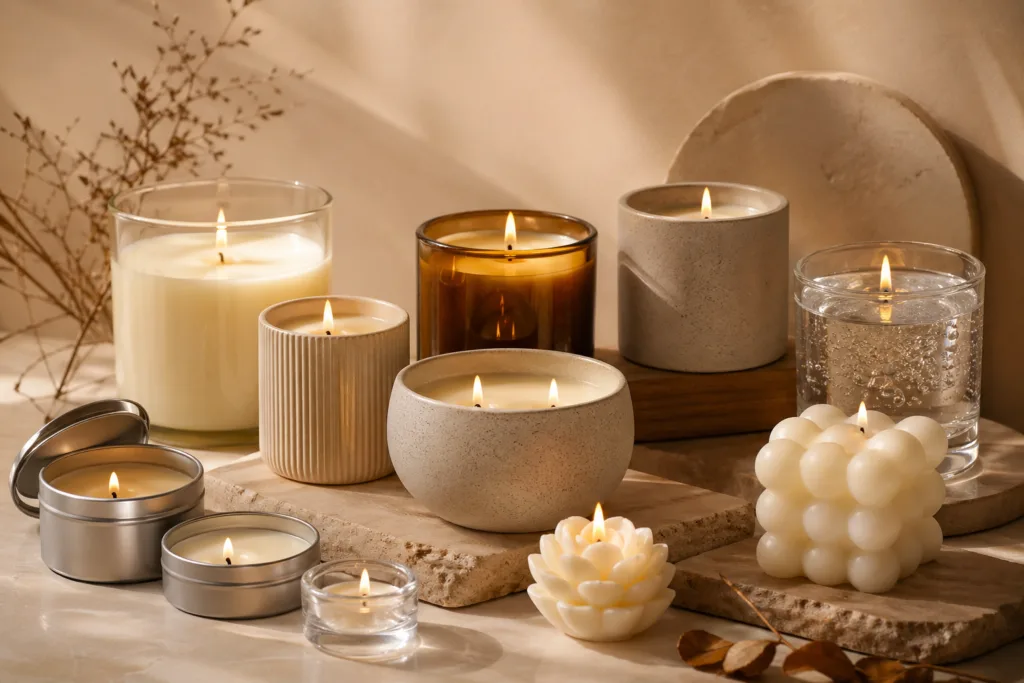
A candle for a hotel room is not built the same way as a candle for a luxury gift set. A candle for Amazon FBA is not built the same way as a candle for a boutique fragrance store. A 100-piece test order cannot use the same material strategy as a 5,000-piece retail launch. The material choice must match the commercial scenario.
This guide is written for private label buyers, home fragrance brands, retailers, importers, and sourcing teams who need to make practical material decisions before sampling or production. Instead of listing materials in a shallow way, we will connect each material to performance, MOQ, cost, branding, and order path.
The goal is simple: help you choose candle materials that can actually move from idea to sample, from sample to production, and from production to repeat orders.
1. The Real Material System Behind a Private Label Candle
A candle is not one material. It is a system.
A finished private label candle normally includes:
- Wax
- Fragrance oil
- Wick
- Vessel or mold
- Colorant or dye
- Label or direct decoration
- Dust cover, lid, or accessory
- Inner protection
- Retail box or gift box
- Warning label and compliance documents
- Shipping carton and export packaging
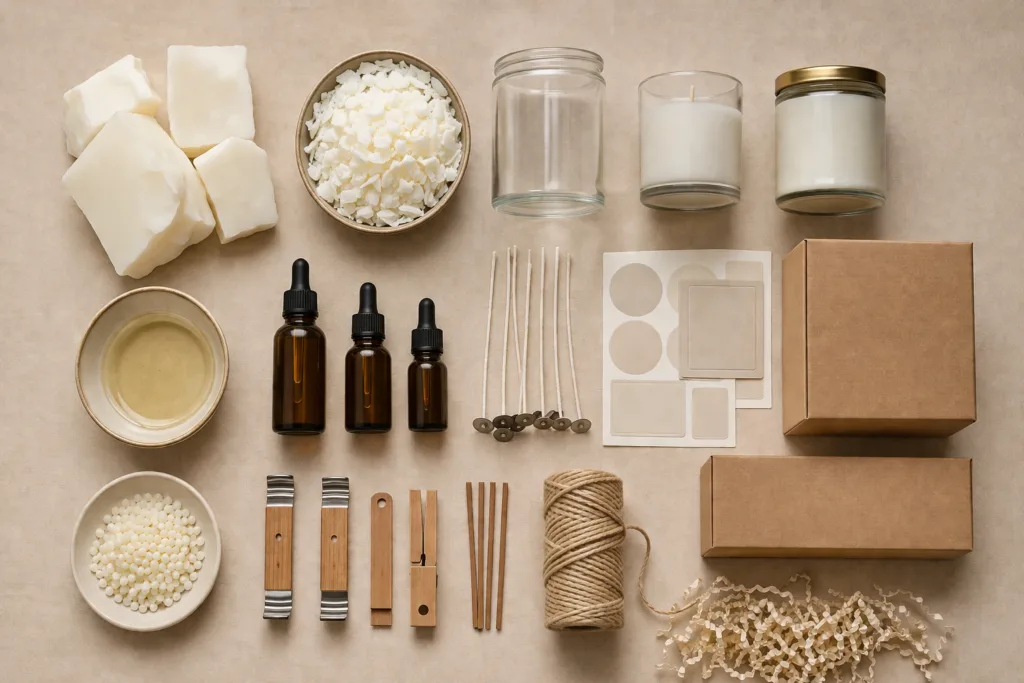
When buyers say they want a “luxury candle,” they often focus on the visible parts: the jar, the logo, the box, the fragrance name. But the hidden material decisions matter just as much. A beautiful jar with the wrong wick can tunnel. A premium fragrance with the wrong wax may have weak hot throw. A heavy ceramic vessel may look beautiful but push freight costs too high. A complicated gift box may turn a 300-piece test into a 1,000-piece production requirement.
That is why material selection should begin with use case, not aesthetics.
A strong candle development process follows this logic:
Scenario → Performance Requirement → Material Selection → MOQ Check → Sample Testing → Production Plan
For example:
- A hotel candle needs consistent burn, subtle fragrance, low safety risk, and stable repeat supply.
- A boutique retail candle needs strong shelf appeal, good cold throw, attractive packaging, and brand storytelling.
- A gift set needs premium unboxing, secure inserts, coordinated colors, and higher perceived value.
- An Amazon candle needs cost control, weight control, labeling accuracy, barcode readiness, carton strength, and predictable inventory.
- A luxury private label candle needs fragrance depth, refined wax appearance, premium vessel finishing, and packaging that supports a higher retail price.
The best candle material is not the most expensive one. It is the one that fits the sales channel and order strategy.
2. Wax Materials: The Base That Controls Burn, Texture, Cost, and Scent Throw
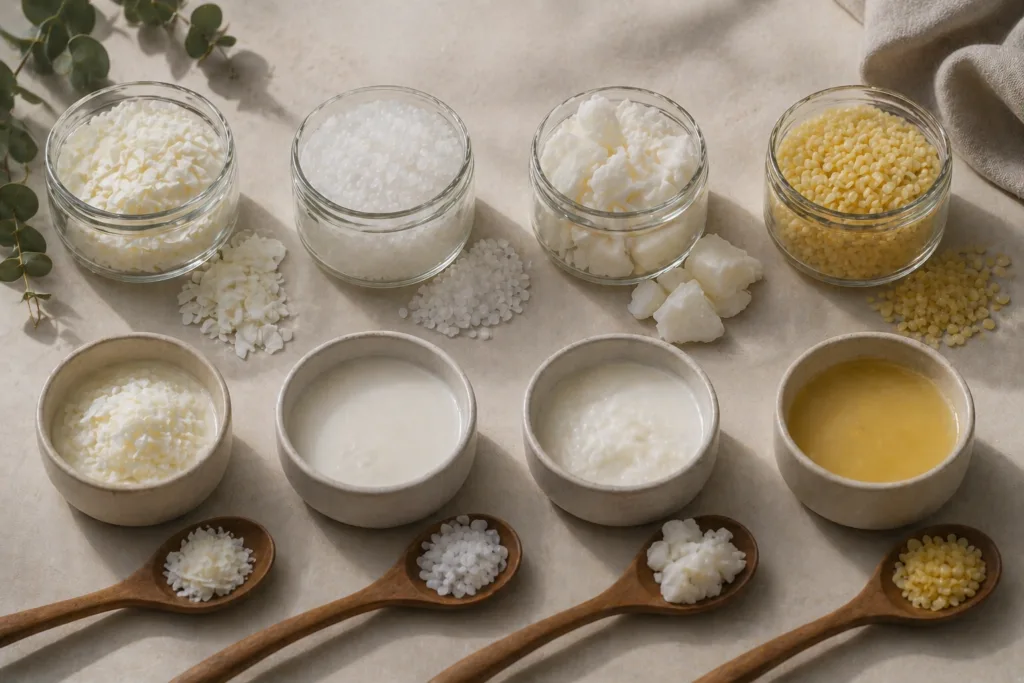
Wax is the foundation of a candle. It affects appearance, burn time, fragrance release, color, surface finish, and cost. But no wax should be judged alone. The same wax can perform differently depending on fragrance load, wick size, vessel diameter, dye, room temperature, and burn testing.
For private label development, the most common wax options are paraffin wax, soy wax, coconut wax, beeswax, palm wax, gel wax, and blended wax.
Paraffin Wax: Strong Throw and Cost Efficiency
Paraffin remains widely used because it offers strong fragrance throw, stable performance, smooth appearance, and competitive cost. It is especially useful when buyers need a powerful scent experience or need to control the unit price for larger retail programs.
Best for:
- Mass retail candles
- Strongly scented candles
- Decorative candles
- Cost-sensitive private label lines
- Gift sets where scent strength matters
Commercial advantages:
- Usually strong hot throw
- Good fragrance compatibility
- Smooth surface finish
- Easier color performance
- Competitive pricing for larger runs
Limitations:
- Petroleum-based origin may not fit eco-positioned brands
- Some consumers prefer plant-based wax stories
- Marketing language must be handled carefully depending on market positioning
Recommendation:
If your brand is focused on strong scent performance and price competitiveness, paraffin or a paraffin blend can be practical. For brands targeting “natural,” “eco,” or “plant-based” positioning, paraffin may create marketing friction even when the candle performs well.
Soy Wax: Plant-Based Story and Slow-Burn Positioning
Soy wax is popular in private label candles because it supports a plant-based brand story and is familiar to consumers. It often gives a softer, creamier appearance and is widely used for jar candles.
Best for:
- Boutique candles
- Wellness candles
- Natural-positioned collections
- Simple glass jar candles
- Mid-range private label launches
Commercial advantages:
- Strong consumer recognition
- Plant-based positioning
- Good fit for clean, minimal branding
- Often suitable for standard glass jar programs
- Good for buyers who want a softer, lifestyle-oriented product story
Limitations:
- Hot throw may be softer than paraffin depending on formula
- Frosting or surface changes may occur
- Performance can vary with fragrance oil
- Requires careful wick matching
Recommendation:
Soy wax is a safe choice for many private label buyers, especially when the brand wants an approachable premium image. But buyers should not assume that soy automatically means better performance. For stronger scent throw, a soy blend may work better than 100% soy.
Coconut Wax: Premium Feel and Luxury Texture
Coconut wax has become popular in premium candle development because it has a creamy texture, elegant appearance, and good fragrance performance when properly blended. It is often used in luxury-style candles, especially when the buyer wants a softer wax surface and a high-end product story.
Best for:
- Luxury candle lines
- Boutique fragrance brands
- Wellness and spa collections
- Premium gift sets
- High-margin private label projects
Commercial advantages:
- Creamy, luxurious appearance
- Good fragrance performance in many blends
- Strong premium storytelling
- Smooth surface finish
- Works well for higher retail price points
Limitations:
- Higher material cost
- Often used in blends rather than alone
- May require more careful temperature and production control
- Not ideal for very low-budget projects
Recommendation:
Coconut wax is a strong option when the buyer is building a premium product, not simply looking for the cheapest candle. It works best when paired with better vessels, refined fragrance design, and packaging that supports a higher perceived value.
Beeswax: Natural Premium, But Not Always the Easiest for Private Label
Beeswax has a strong natural identity and is valued for its traditional, premium, and craft associations. It can burn well and has a naturally warm tone, but it is not always the easiest material for highly scented private label candles.
Best for:
- Natural lifestyle brands
- Unscented or lightly scented candles
- Premium traditional collections
- Taper candles or specialty candles
- Brands that want a strong natural material story
Commercial advantages:
- Strong natural positioning
- Premium perception
- Often associated with longer burn and traditional quality
- Distinct natural color and character
Limitations:
- Higher cost
- Natural scent may interfere with fragrance design
- Color consistency can vary
- Supply and price may be less stable than industrial waxes
Recommendation:
Beeswax works well when the material itself is part of the brand story. It is less suitable when the buyer wants very precise fragrance duplication, pure white wax, low cost, or aggressive fragrance intensity.
Palm Wax: Crystal Texture and Decorative Effects
Palm wax can create unique crystalline textures and decorative visual effects. It is more niche and may be used for pillar candles, decorative candles, or textured designs.
Best for:
- Decorative candles
- Pillar candles
- Textured visual effects
- Specialty private label projects
Commercial advantages:
- Unique crystal-like surface
- Good for visual differentiation
- Can support distinctive product photography
Limitations:
- Sustainability concerns depending on sourcing
- Less suitable for brands that want simple eco claims without traceability
- Not always ideal for standard scented jar candles
Recommendation:
Use palm wax only when the visual effect is part of the product concept and sourcing can support the brand’s sustainability positioning.
Gel Wax: Transparent Visual Effect, Niche Application
Gel wax is used when transparency is the main design feature. It can create decorative effects with embedded objects, layered colors, or novelty designs.
Best for:
- Decorative candles
- Novelty candles
- Transparent visual concepts
- Seasonal gifts
Commercial advantages:
- Unique transparent look
- Strong visual shelf appeal
- Works for themed or decorative products
Limitations:
- Different safety and formulation requirements
- Not ideal for every fragrance
- Less suitable for minimalist luxury brands
- More niche than soy or blended wax
Recommendation:
Gel wax can be interesting for seasonal or decorative lines, but it is not the default choice for serious private label home fragrance brands.
Blended Wax: The Most Practical Choice for Many Private Label Buyers
In real manufacturing, many successful candles use wax blends. A blend may combine soy, paraffin, coconut, beeswax, or other waxes to balance scent throw, burn time, texture, cost, and surface finish.
Best for:
- Mature private label brands
- Buyers who care about performance more than pure material claims
- Gift sets
- Retail candles
- Stronger fragrance performance
- Better production stability
Commercial advantages:
- Better balance between cost and performance
- Can improve hot throw
- Can reduce surface issues
- Can be customized for different vessels
- Often more stable in production
Limitations:
- Marketing story may be less simple than “100% soy”
- Formula transparency must be managed professionally
- Requires supplier experience and testing
Recommendation:
For many B2B buyers, a well-tested wax blend is better than choosing a single wax for marketing reasons. If the candle must smell good, burn well, look stable, and ship internationally, blended wax is often the most practical solution.
3. Fragrance Materials: The Real Driver of Buyer Emotion

Wax affects performance, but fragrance creates memory. For private label candles, fragrance is often the reason a buyer says yes, reorders, or pays a higher price.
A fragrance material strategy includes:
- Fragrance oil type
- Fragrance concentration
- Cold throw
- Hot throw
- Fragrance family
- Stability in wax
- Regulatory documentation
- Brand storytelling
- Scent duplication or custom development
Fragrance Oil vs Essential Oil
Many buyers ask for “essential oil candles” because it sounds cleaner and more natural. But in commercial candle manufacturing, pure essential oils are not always the best solution. Some essential oils do not perform well under heat, some have weaker throw, and some can be expensive or unstable.
Fragrance oils, when sourced and tested properly, can offer better consistency, wider scent variety, stronger throw, and more stable production performance.
Best practice:
- Use essential oils when the brand story truly requires it.
- Use fragrance oils or fragrance blends when scent performance, consistency, and variety matter.
- Always test fragrance in the actual wax and vessel before production.
Fragrance Load: More Is Not Always Better
Fragrance load is usually expressed as a percentage of the wax weight. Many buyers assume that a higher percentage always means a stronger candle. This is not always true.
If the wax cannot hold the fragrance properly, too much fragrance can cause sweating, poor burn, wick issues, smoke, weak stability, or uneven performance. A candle with a balanced 8% fragrance load may perform better than one overloaded at 12%.
Typical commercial ranges vary by wax and formula, but many scented candles are developed within a practical fragrance-load range that balances throw, stability, safety, and cost.
What buyers should ask:
- What fragrance load is recommended for this wax?
- Has this fragrance been tested in this wax?
- How is the hot throw after a full burn test?
- Does the fragrance affect wick size?
- Are SDS/MSDS and IFRA-related documents available?
Cold Throw vs Hot Throw
Cold throw is how the candle smells before burning. It matters for retail shelves, gift sets, and unboxing.
Hot throw is how the candle smells while burning. It matters for customer satisfaction and repeat purchase.
A candle with excellent cold throw but weak hot throw may sell once but disappoint after use. A candle with good hot throw but weak cold throw may struggle in retail because buyers cannot smell the value immediately.
For private label brands, both matter.
Recommendation by channel:
- Retail boutique: strong cold throw and elegant fragrance story
- Hotel: controlled hot throw, not overwhelming
- Gift set: strong cold throw for unboxing and gifting
- Amazon: clear scent descriptions and reliable hot throw
- Luxury brand: layered fragrance with good dry-down, not just strong top notes
Fragrance Library and Scent Duplication
A mature candle manufacturer should not treat fragrance development as guesswork. A strong fragrance supply chain can offer:
- Existing fragrance library
- Market-proven scent directions
- Luxury-inspired scent references
- Seasonal fragrance collections
- Custom scent blending
- Scent duplication based on reference samples
- Multiple rounds of adjustment
- Documentation support
This matters because mature buyers often do not want “random lavender” or “basic vanilla.” They want a scent that fits their brand positioning, target customer, retail season, and price point.
For example:
- A spa brand may need eucalyptus, hinoki, white tea, lavender, cedar, or herbal citrus.
- A luxury gift brand may need amber, sandalwood, oud, fig, black tea, leather, or smoky vanilla.
- A holiday brand may need pine, cinnamon, cranberry, gingerbread, balsam, or warm spice.
- A boutique home decor brand may need soft linen, cashmere, white musk, iris, or minimalist floral notes.
The right supplier should help translate a brand idea into a manufacturable scent direction.
4. Wick Materials: Small Component, Big Performance Risk
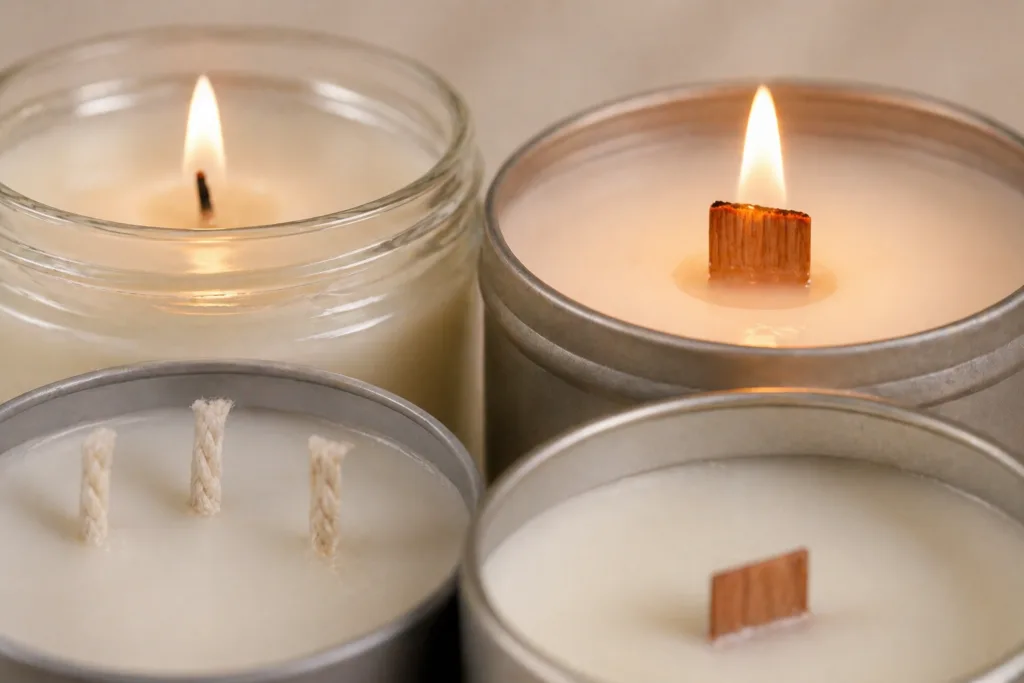
The wick is one of the most underestimated candle materials. It controls flame size, melt pool, burn speed, soot level, tunneling, mushrooming, and overall safety.
A candle with good wax and expensive fragrance can still fail if the wick is wrong.
Common wick options include cotton wicks, wood wicks, paper-core wicks, and specialty braided wicks.
Cotton Wicks
Cotton wicks are widely used because they are stable, familiar, and suitable for many jar candles.
Best for:
- Standard glass jar candles
- Soy wax candles
- Private label retail candles
- Hotel candles
- Gift sets
Advantages:
- Reliable performance
- Good consumer acceptance
- Easy to test across formulas
- Works with many wax blends
Limitations:
- Must be correctly sized
- May mushroom if mismatched with fragrance or wax
- Needs burn testing in final vessel
Wood Wicks
Wood wicks create a distinctive crackling sound and visual effect. They can support premium or cozy brand positioning.
Best for:
- Luxury candles
- Fireplace-inspired scents
- Winter collections
- Premium gift lines
Advantages:
- Strong sensory differentiation
- Premium storytelling
- Good visual identity
Limitations:
- More testing required
- Can be less stable across wax/fragrance combinations
- May not suit all vessel diameters
- Higher component cost
Wick Selection by Vessel Diameter
Wick choice depends heavily on the candle diameter. A wider vessel may need a larger wick or multiple wicks. A narrow vessel needs a wick that creates the right melt pool without overheating the glass.
Important testing points:
- Flame height
- Melt pool diameter
- Container temperature
- Sooting
- Tunneling
- Wax hang-up
- Burn time
- End-of-life safety
Recommendation:
Never approve a candle based only on how the unburned sample looks. A real sample should be burned, observed, and adjusted if necessary.
5. Vessel Materials: The Material That Defines Brand Perception and MOQ
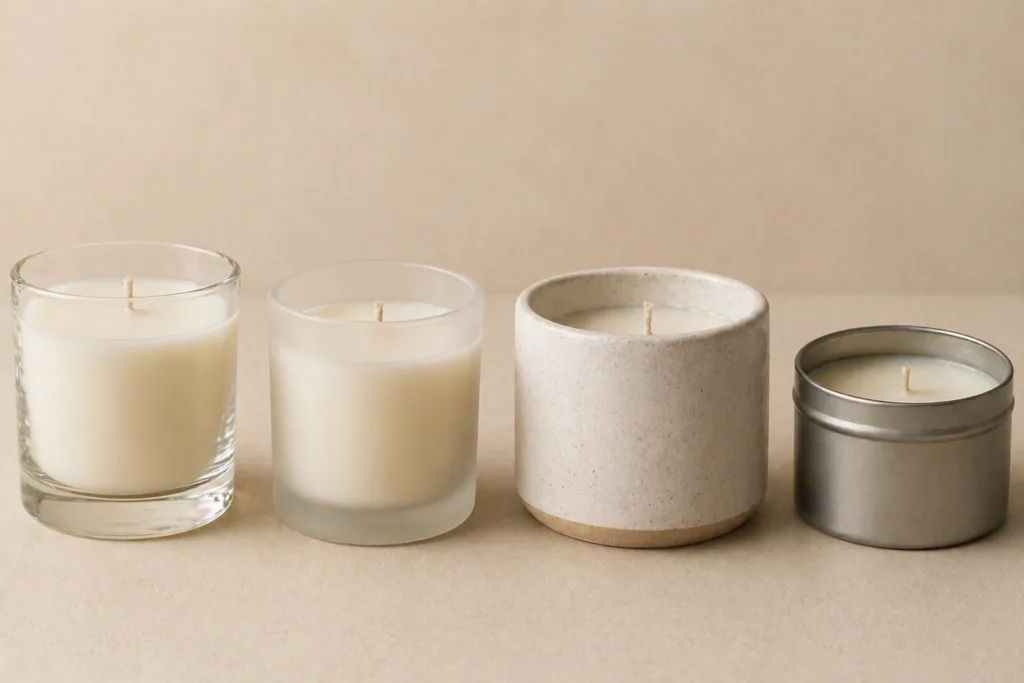
The vessel is where aesthetics, safety, cost, and MOQ collide.
Private label buyers often want custom ceramic shapes, custom glass molds, special finishes, metal lids, printed logos, and premium packaging. These are all possible, but each choice affects MOQ and cost.
Standard Glass Vessels
Standard glass is often the best starting point for private label candles because it balances appearance, MOQ, cost, and production speed.
Best for:
- Low to medium MOQ projects
- First private label launch
- Boutique candle lines
- Amazon FBA candles
- Retail test orders
- Fast sampling
Advantages:
- Lower MOQ than custom molds
- Faster production
- Many sizes available
- Suitable for stickers, labels, or some printing methods
- Easier cost control
Limitations:
- Less unique than custom vessels
- Shape options depend on existing molds
- Premium effect depends on decoration and packaging
Best order path:
For 100–500 pieces, use standard glass, simple branding, and a ready packaging structure. This allows buyers to test market response without forcing the project into a high custom MOQ.
Frosted Glass
Frosted glass gives a soft, premium look and works well for wellness, spa, and minimalist home fragrance brands.
Best for:
- Spa candles
- Wellness brands
- Minimalist private label candles
- Mid-range to premium collections
Advantages:
- Premium visual effect
- Soft light diffusion
- Good fit for neutral packaging
Limitations:
- Surface finish must be controlled
- Decoration compatibility should be checked
- May cost more than clear glass
Colored Glass
Amber, black, green, blue, smoky gray, and other colored glass vessels can create strong brand identity.
Best for:
- Apothecary-style candles
- Luxury masculine scents
- Botanical brands
- Seasonal collections
- Gift candles
Advantages:
- Strong shelf recognition
- Supports brand story
- Good perceived value
Limitations:
- Standard colors are easier than custom colors
- Custom color glass requires higher MOQ
- Color consistency should be checked in production
Ceramic Vessels
Ceramic vessels create a premium, decorative, home-decor feel. They are excellent for luxury candles but usually require higher MOQ, especially when the shape, glaze, color, or mold is custom.
Best for:
- Luxury home fragrance brands
- Interior design stores
- Premium gift sets
- Reusable vessel concepts
- Boutique decor collections
Advantages:
- High perceived value
- Strong decorative appeal
- Good for luxury pricing
- Can become part of the home decor product itself
Limitations:
- Higher MOQ
- Higher unit cost
- Heavier shipping weight
- Longer development time
- Custom molds and glazes require more planning
Best order path:
If the buyer needs 100–300 pieces, use existing ceramic styles if available. If the buyer wants a custom ceramic vessel, plan for a higher MOQ and a longer sampling cycle.
Tin Vessels
Tin candles are lightweight, practical, and cost-efficient. They work well for travel candles, promotional candles, and smaller formats.
Best for:
- Travel candles
- Promotional gifts
- Outdoor-inspired brands
- Lower price-point candles
- Subscription boxes
Advantages:
- Lightweight
- Lower breakage risk
- Cost-effective
- Easy to ship
- Good for smaller sizes
Limitations:
- Lower luxury perception than glass or ceramic
- Decoration options may be more limited
- Heat and finish should be tested
Custom Molded Glass or Special Shapes
Custom molded glass is possible, but it is not a low-MOQ solution. It usually requires mold development, higher order volume, longer timelines, and more quality control.
Best for:
- Established brands
- Large retail launches
- Signature vessel strategy
- High-volume private label programs
Advantages:
- Unique brand asset
- Strong differentiation
- Long-term product identity
Limitations:
- High MOQ
- Mold cost
- Longer development time
- Higher risk if the buyer has not validated demand
Recommendation:
Do not start with custom molded glass unless the brand has budget, volume, and a clear long-term plan. For most new private label buyers, start with existing vessels and customize through color, label, lid, fragrance, and packaging.
6. Packaging Materials: Where Perceived Value Is Created
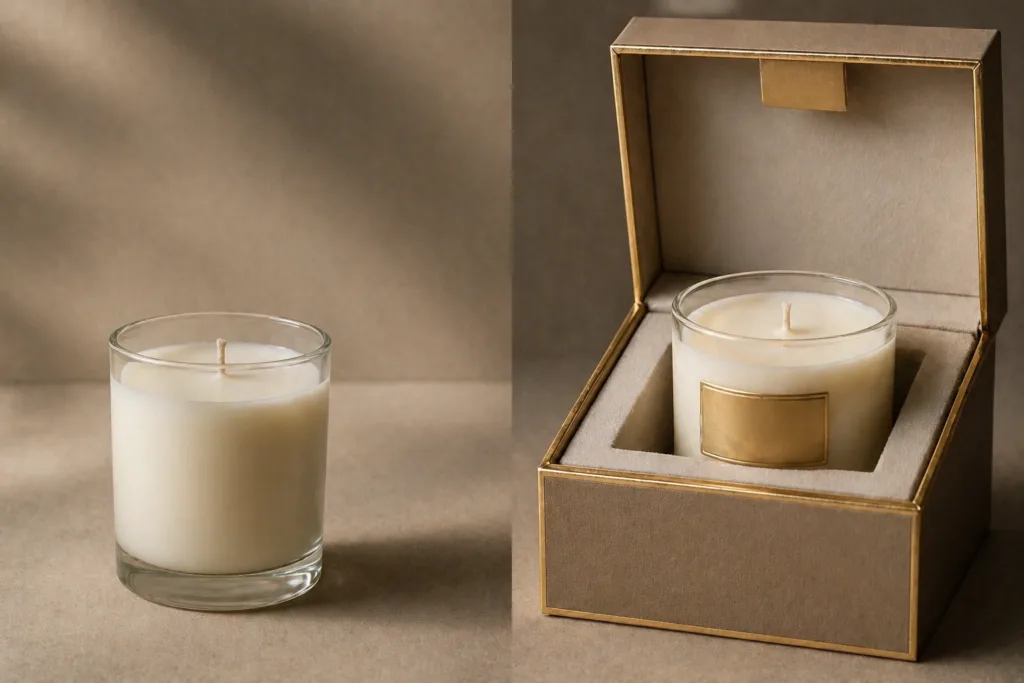
Packaging often decides whether a candle feels like a commodity or a giftable product. It also affects MOQ more than many buyers expect.
Common candle packaging materials include:
- Sticker labels
- Paper labels
- Folding cartons
- Rigid gift boxes
- Drawer boxes
- Lid-and-base boxes
- Paper sleeves
- Foam inserts
- Pearl cotton inserts
- Paper pulp inserts
- Tissue paper
- Dust covers
- Shipping cartons
Simple Labels: Best for Low MOQ and Fast Launches
For low MOQ projects, stickers or paper labels are often the most practical branding method.
Best for:
- 100–500 piece test orders
- Startup brands
- Market validation
- Simple private label candles
Advantages:
- Lower setup cost
- Flexible design
- Faster sampling
- Easier to revise
- Suitable for standard glass vessels
Limitations:
- Lower premium feel than direct printing or foil
- Label material must match vessel surface
- Not ideal for very high-end positioning alone
Folding Cartons: Practical Retail Packaging
Folding cartons are lighter and more cost-effective than rigid boxes. They work well for retail candles that need branded packaging without luxury box cost.
Best for:
- Retail candles
- Amazon FBA candles
- Mid-range private label lines
- Higher-volume programs
Advantages:
- Lower cost than rigid boxes
- Lightweight
- Easier to store and ship
- Good for retail branding
Limitations:
- Less premium unboxing
- Protection may be weaker than rigid boxes with inserts
- MOQ still applies for custom printing
Rigid Gift Boxes: Best for Premium and Giftable Candles
Rigid boxes create instant perceived value. A candle in a rigid lid-and-base box with a protective insert can feel much more premium than the same candle without packaging.
Best for:
- Luxury candle gift sets
- Holiday collections
- Corporate gifts
- Premium retail launches
- Boutique home fragrance brands
Advantages:
- Strong gift appeal
- Higher perceived value
- Better protection
- Supports foil stamping, embossing, textured paper, and premium finishes
Limitations:
- Higher MOQ
- Higher unit cost
- More storage volume
- Longer production time
- Multiple designs may increase setup complexity
Best order path:
Use rigid boxes when the buyer has a clear retail or gifting strategy. For small tests, consider a standard box structure with customized label or sleeve before moving into fully customized rigid packaging.
Inserts: The Hidden Material That Protects the Product
Inserts are not glamorous, but they matter. A glass candle in a premium box still needs protection during shipping.
Common insert materials:
- Foam
- Pearl cotton
- Paper pulp
- Cardboard structure
Foam and pearl cotton provide strong protection and are commonly used for heavier candles or gift boxes. Paper-based inserts support eco-positioning but may require more structural testing.
Recommendation:
For fragile glass or ceramic vessels, do not reduce protection too aggressively just to save a small amount. Breakage damages both margin and customer trust.
7. Decoration Materials: How Branding Changes MOQ and Cost
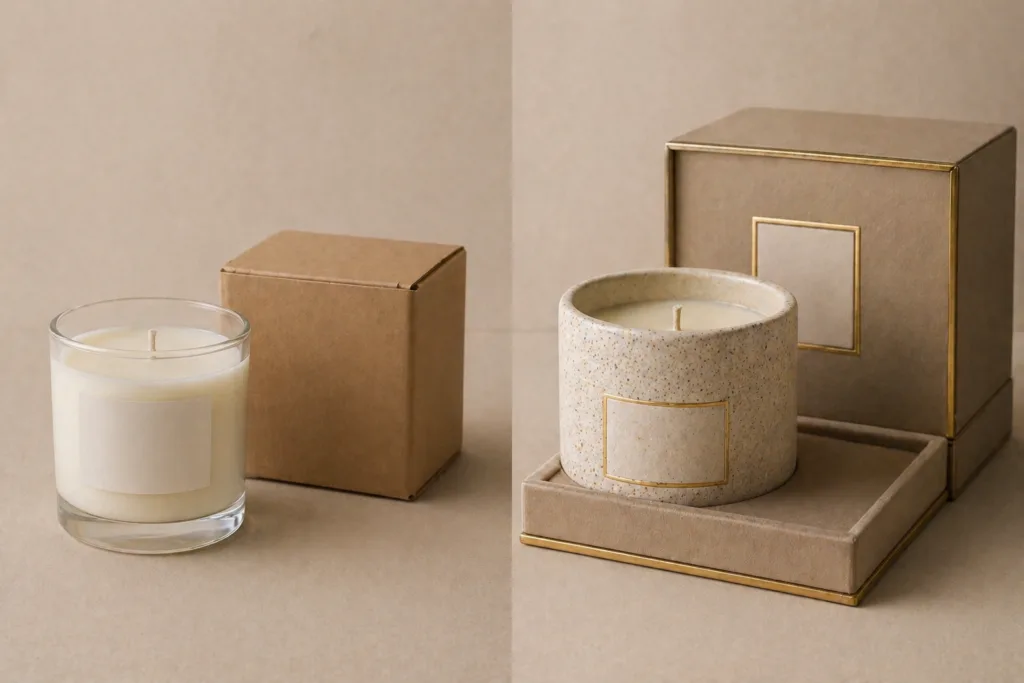
Branding is where many projects become more expensive than expected.
Common decoration methods include:
- Sticker label
- Heat transfer label
- Screen printing
- Direct printing
- Foil stamping
- Engraving
- Embossing or debossing on packaging
- Metal logo plate
- Custom lid engraving
Sticker Labels
Best for low MOQ, fast launch, and flexible branding.
Recommended when:
- Order quantity is small
- Buyer is testing a new brand
- Design may change later
- Budget is limited
Screen Printing or Direct Printing
Best for more polished branding on glass or ceramic.
Recommended when:
- Quantity is higher
- Design is stable
- Brand wants a cleaner look
- Buyer can accept higher setup requirements
Foil Stamping
Best for luxury packaging and premium shelf appeal.
Recommended when:
- Product is giftable
- Retail price supports premium packaging
- Design is finalized
- MOQ is high enough to absorb setup cost
Custom Lids and Accessories
Wood lids, metal lids, dust covers, hang tags, ribbons, and sleeves can make the product feel more complete. But each accessory adds sourcing, QC, and MOQ complexity.
Recommendation:
Use accessories strategically. A premium lid can improve perceived value, but too many small custom parts can slow down development and raise the MOQ.
8. Material Choices by Scenario
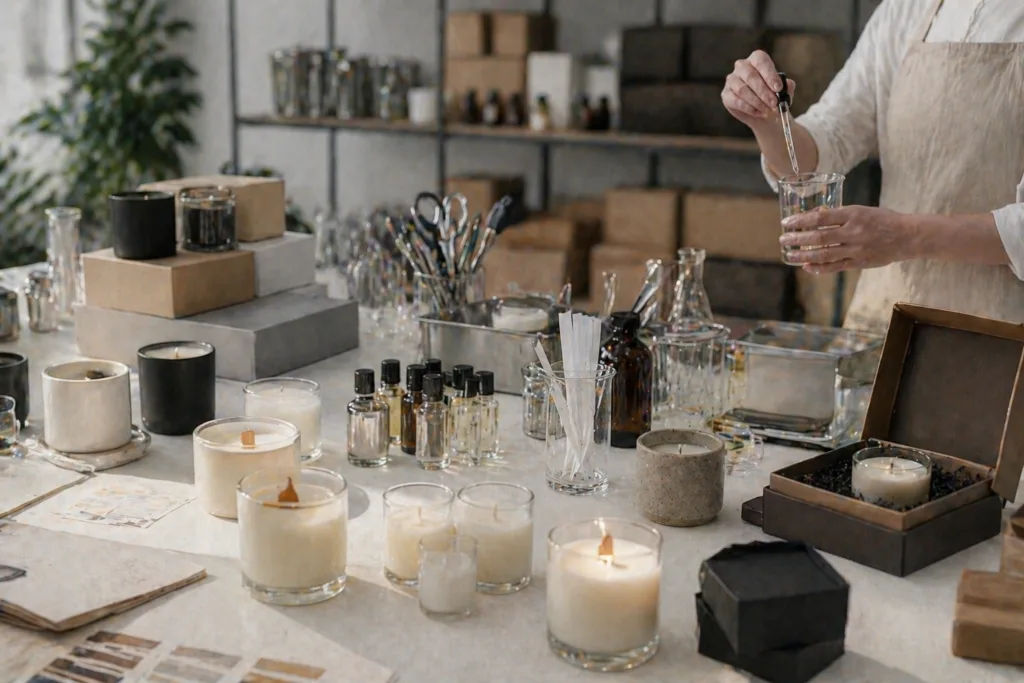
Now let’s connect materials to real buying situations.
Scenario 1: Boutique Brand Launching Its First Candle Line
Buyer profile:
A small to mid-sized brand wants to launch candles under its own label. It may have a strong visual identity but limited production experience.
Recommended material strategy:
- Standard glass vessel
- Soy wax or soy blend
- Cotton wick
- 2–4 fragrance options
- Sticker label or simple printing
- Folding carton or simple rigid box
- Moderate fragrance load
- Standard shipping carton
Why this works:
This path keeps development realistic. The buyer can create a polished product without forcing high custom vessel MOQ. It also allows testing multiple scents before scaling.
Order path:
- Choose existing vessel size.
- Select 2–4 fragrances from a fragrance library.
- Confirm label and packaging direction.
- Produce samples.
- Test burn, scent throw, and appearance.
- Confirm first production order.
- Scale successful scents into larger packaging or gift sets.
Scenario 2: Luxury Candle Brand Building a Premium Collection
Buyer profile:
A brand wants candles that feel expensive, giftable, and design-led. Retail price is higher, and packaging matters.
Recommended material strategy:
- Coconut-soy blend or premium wax blend
- Refined fragrance oil or custom scent
- Glass or ceramic vessel
- Cotton or wood wick depending on concept
- Rigid gift box
- Foam or pearl cotton insert
- Foil logo or premium printing
- Coordinated color palette
Why this works:
Luxury candles need more than wax. The fragrance, vessel weight, surface finish, packaging, and unboxing must work together. A cheap box will weaken a premium scent. A generic vessel will weaken a luxury story.
Order path:
- Define price point and retail channel.
- Select premium vessel direction.
- Build fragrance concept around brand positioning.
- Develop packaging structure.
- Sample wax, scent, wick, vessel, and box together.
- Approve burn performance and packaging protection.
- Move into production with stable MOQ planning.
Scenario 3: Hotel, Spa, or Hospitality Candle Program
Buyer profile:
A hotel, spa, or hospitality group wants candles for rooms, retail corners, guest gifts, or branded amenities.
Recommended material strategy:
- Soy blend or clean-burning wax blend
- Subtle fragrance profile
- Standard or frosted glass
- Cotton wick
- Minimalist label
- Secure packaging
- Strong safety labeling
- Repeatable formula
Why this works:
Hospitality candles should not be too overpowering. The scent should match the space and be pleasant to many guests. Safety, consistency, and reorder stability are more important than extreme customization.
Order path:
- Define usage: room, retail, spa, or gift.
- Choose fragrance intensity level.
- Select vessel size and burn time.
- Confirm safety label and packaging.
- Sample and test in the actual environment if possible.
- Place bulk order based on property usage and reorder cycle.
Scenario 4: Amazon FBA Private Label Candle
Buyer profile:
An online seller needs a candle that can survive shipping, meet labeling requirements, control cost, and generate good reviews.
Recommended material strategy:
- Standard glass or tin vessel
- Soy blend or paraffin blend depending on positioning
- Cotton wick
- Clear fragrance name and stable formula
- Folding carton or protective box
- Barcode and FBA label support
- Strong outer carton
- Weight-controlled design
Why this works:
Amazon candles need operational discipline. A beautiful but heavy candle may destroy margins. A fragile vessel may create returns. A vague scent description may lead to bad reviews.
Order path:
- Set target landed cost.
- Choose vessel based on weight and breakage risk.
- Select 1–3 proven scents.
- Confirm packaging and barcode needs.
- Test carton strength and product protection.
- Prepare FBA labeling and shipment plan.
Scenario 5: Retailer Developing a Seasonal Gift Set
Buyer profile:
A retailer, wholesaler, or importer wants a candle gift set for Christmas, Valentine’s Day, Mother’s Day, or corporate gifting.
Recommended material strategy:
- Blended wax for reliable scent performance
- Strong cold throw
- Coordinated fragrance family
- Rigid gift box
- Protective insert
- Premium logo finish
- Seasonal color palette
- Clear production timeline
Why this works:
Gift sets sell through appearance and emotion. The customer may buy before burning the candle, so cold throw, box design, and unboxing matter heavily.
Order path:
- Confirm seasonal launch date.
- Work backward from delivery deadline.
- Select vessel and gift box size.
- Choose fragrance set structure.
- Approve box artwork early.
- Sample complete set.
- Start bulk production with enough time for sea or air shipping.
Scenario 6: Established Brand Scaling from 500 to 5,000+ Units
Buyer profile:
A brand has validated demand and now wants better unit cost, more customization, and stronger supply chain support.
Recommended material strategy:
- Optimized wax blend
- Custom fragrance refinement
- Direct printing or higher-end decoration
- Larger packaging MOQ
- Possible custom vessel or custom color
- Better carton optimization
- DDP logistics planning
Why this works:
Once order volume grows, the buyer can justify better packaging, more stable material sourcing, and more customized production. At this stage, the goal is not only to make a beautiful candle but to build a repeatable supply chain.
Order path:
- Review sales data from first order.
- Identify best-selling scents and weak SKUs.
- Reduce unnecessary variation.
- Improve packaging and decoration.
- Lock material specs.
- Negotiate production and shipping plan.
- Build reorder calendar.
9. MOQ Logic: Why Material Choices Change Minimum Order Quantity
MOQ is not random. It comes from material setup, factory scheduling, packaging printing, mold development, decoration process, and supplier sourcing.
Low MOQ is possible when materials are standard.
High MOQ appears when materials are custom.
Lower-MOQ Friendly Choices
- Existing glass jars
- Existing tin containers
- Standard wax blends
- Existing fragrance library
- Sticker labels
- Simple packaging
- Standard carton sizes
These choices work well for 100–500 piece tests, depending on the product and supplier capacity.
Higher-MOQ Choices
- Custom ceramic molds
- Custom glass molds
- Custom vessel colors
- Direct printing on multiple SKUs
- Rigid boxes with multiple artwork versions
- Special lids or accessories
- Unique shaped candles
- Multi-scent gift sets with complex packaging
These choices often need 500, 1,000, 3,000, 5,000, or even higher quantities depending on the material and process.
Practical Rule for Buyers
If your order quantity is small, customize the flexible parts:
- Fragrance
- Label
- Dust cover
- Simple box sleeve
- Existing vessel selection
If your order quantity is large, customize the structural parts:
- Vessel mold
- Ceramic shape
- Glass color
- Rigid box
- Foil stamping
- Custom insert
- Full product line architecture
This is how mature buyers control risk.
10. Cost Logic: Which Materials Increase Unit Price Most?
Not all material upgrades affect cost equally. Some upgrades create strong perceived value with reasonable cost. Others add complexity without improving sales.
Materials That Often Increase Cost Significantly
- Custom ceramic vessels
- Custom glass molds
- Heavy glass jars
- Coconut wax or premium wax blends
- High-end fragrance oils
- Rigid gift boxes
- Foam or pearl cotton inserts
- Foil stamping and embossing
- Multiple scent SKUs at low quantity
- Multiple packaging designs
- Air freight for heavy candles
Materials That Can Improve Value Efficiently
- Better fragrance selection
- Standard colored glass
- Well-designed label
- Coordinated box design
- Premium dust cover
- Simple but elegant lid
- Strong product photography
- Better scent naming
A candle does not need every expensive feature. It needs the right value signal for its channel.
For example, a boutique candle in a standard amber glass jar with a strong fragrance, elegant label, and clean box may sell better than an overcomplicated custom vessel with weak scent performance.
11. Compliance and Safety Materials Buyers Should Not Ignore
Private label buyers sometimes focus on aesthetics and forget safety documentation. This is risky, especially for North America, Europe, the UK, and Australia.
Important areas include:
- Candle warning labels
- Glass container suitability
- Burn testing
- Fragrance documentation
- SDS/MSDS
- Allergen or regulatory declarations where required
- Packaging claims
- Shipping documentation
A professional candle supplier should support reasonable compliance documentation and help buyers avoid unsafe or misleading claims.
Key safety considerations:
- The vessel must tolerate candle heat.
- The wick must not create excessive flame height.
- The candle should not produce abnormal soot or smoke.
- The label should include proper candle-use warnings.
- The packaging should protect the product during transport.
- Fragrance usage should respect applicable safety guidelines.
For mature buyers, compliance is not a formality. It is part of brand protection.
12. How to Choose the Best Candle Materials for Your Private Label Project
Here is a practical decision framework.
Step 1: Define the Sales Channel
Ask:
- Is this for retail stores?
- Online sales?
- Amazon FBA?
- Hotel or spa use?
- Corporate gifting?
- Luxury boutique distribution?
Different channels need different material priorities.
Step 2: Define the Target Price Point
A $12 candle, a $28 candle, and a $65 candle cannot use the same material structure.
Ask:
- What is the target retail price?
- What is the expected wholesale price?
- What is the acceptable landed cost?
- Does the packaging support the price point?
Step 3: Choose the Vessel First
The vessel affects:
- Wax weight
- Wick size
- Burn time
- Shipping weight
- Packaging structure
- MOQ
- Perceived value
For first orders, standard vessels are usually the safest path.
Step 4: Choose Wax Based on Performance, Not Only Marketing
Do not choose wax only because it sounds popular. Match wax to your target performance:
- Strong scent throw: paraffin blend or optimized wax blend
- Plant-based story: soy or coconut-soy blend
- Luxury texture: coconut blend
- Natural traditional positioning: beeswax
- Cost control: paraffin or practical blend
Step 5: Choose Fragrance by Brand Positioning
Do not pick scents randomly. Build a fragrance architecture.
Example structures:
- Fresh / Floral / Woody / Gourmand
- Day / Evening / Seasonal
- Spa / Home / Gift
- Hero scent / Supporting scents / Limited edition
Step 6: Confirm Packaging Level
Choose packaging based on the order stage:
- Test order: label + simple box
- Retail order: printed carton
- Premium launch: rigid gift box
- Gift set: rigid box + insert
- Large retail program: optimized packaging + carton testing
Step 7: Sample the Complete Product
A candle sample should not be judged only by appearance. Test:
- Cold throw
- Hot throw
- Burn pool
- Flame height
- Wick performance
- Surface finish
- Container heat
- Packaging fit
- Label adhesion
- Overall unboxing
Step 8: Lock Specifications Before Bulk Production
Before placing a large order, confirm:
- Wax formula
- Fragrance percentage
- Wick model
- Vessel size
- Fill weight
- Label artwork
- Box artwork
- Insert structure
- Warning label
- Carton packing
- Shipping method
This prevents costly changes later.
13. Recommended Material Combinations by Order Size
100–300 Pieces: Market Test
Recommended:
- Standard glass jar
- Soy blend or existing wax formula
- Existing fragrance library
- Sticker label
- Simple box or no retail box
- Cotton wick
Avoid:
- Custom ceramic vessels
- Custom glass molds
- Multiple custom boxes
- Too many scents
- Complex accessories
Best goal:
Validate scent direction, branding, and buyer response.
500–1,000 Pieces: Serious First Production
Recommended:
- Standard or premium existing vessel
- Soy, coconut-soy, or blended wax
- 2–4 scents
- Printed label or simple direct printing
- Folding carton or entry-level rigid box
- Basic compliance documentation
Avoid:
- Too many packaging versions
- Overly complex gift sets
- Unstable custom finishes
Best goal:
Create a retail-ready private label candle with manageable cost.
2,000–5,000+ Pieces: Scalable Retail Program
Recommended:
- Optimized wax formula
- Custom fragrance refinement
- Direct decoration
- Premium packaging
- Better carton optimization
- Possible custom color vessel
- Stronger production planning
Avoid:
- Changing specs too late
- Launching too many untested SKUs
- Ignoring shipping weight
Best goal:
Build a repeatable, profitable candle supply chain.
10,000+ Pieces: Custom Development
Recommended:
- Custom mold evaluation
- Exclusive fragrance development
- Custom packaging structure
- Production line planning
- Long-term material sourcing
- Forecast-based pricing
Avoid:
- Starting without clear demand forecast
- Developing custom molds before finalizing product strategy
Best goal:
Create a signature product with stronger brand ownership and better long-term margin.
14. Common Mistakes in Candle Material Selection
Mistake 1: Asking for Full Customization at Very Low MOQ
A 100-piece order can be possible if materials are standard. But 100 pieces with custom ceramic vessels, custom gift boxes, custom fragrance, foil stamping, and multiple scent versions is usually not commercially realistic.
Better approach:
Start with standard structures, validate the market, then upgrade customization at higher volume.
Mistake 2: Choosing Wax Only for Marketing Words
“Soy,” “coconut,” or “beeswax” may sound attractive, but the final candle must still burn well and smell good.
Better approach:
Choose wax based on brand story plus tested performance.
Mistake 3: Overloading Fragrance
More fragrance does not always mean better scent. Overloading can create sweating, poor combustion, smoke, and instability.
Better approach:
Use the recommended fragrance load for the wax and test hot throw properly.
Mistake 4: Ignoring Packaging MOQ
Many buyers think the candle MOQ is the only MOQ. In reality, the box, insert, lid, label, and decoration may each have separate setup requirements.
Better approach:
Check MOQ by component before finalizing the design.
Mistake 5: Selecting Heavy Materials Without Freight Planning
Glass and ceramic candles are heavy. A beautiful candle can become unprofitable if freight is not considered early.
Better approach:
Estimate product weight, carton weight, and DDP shipping cost before confirming the final structure.
Mistake 6: Approving Samples Without Burn Testing
A candle that looks good on a desk may fail after burning.
Better approach:
Burn test the final wax, wick, fragrance, and vessel combination before bulk production.
15. Working With a Candle Manufacturer: From Material Idea to Bulk Order
A strong manufacturer should not only ask, “What candle do you want?”
A strong manufacturer should help you structure the project.
The ideal development conversation should include:
- Target market
- Retail price point
- Order quantity
- Vessel preference
- Wax positioning
- Fragrance direction
- Packaging level
- Compliance needs
- Shipping destination
- Timeline
At Circe Home, a practical private label candle development path usually follows this structure:
Step 1: Product Direction
We clarify your target buyer, sales channel, candle size, scent direction, and packaging expectation.
Step 2: Material Recommendation
We recommend wax, vessel, wick, fragrance, and packaging options based on your MOQ and price target.
Step 3: Fragrance Selection or Custom Scent Development
You can choose from our fragrance library, develop a custom scent, or provide a reference scent for duplication and adjustment.
Step 4: Packaging and Branding Structure
We help match your candle with suitable labels, boxes, inserts, lids, and gift packaging based on your order quantity.
Step 5: Sampling
We produce samples for appearance, scent, burn, and packaging review.
Step 6: Bulk Production
Once the sample is approved, we lock the specifications and move into production.
Step 7: Export and Shipping Support
We support international buyers with packaging, documentation, and logistics planning, including DDP options when applicable.
16. Final Recommendation: The Best Candle Material Is the One That Fits the Business Model
There is no single best candle material for every private label brand.
The best material choice depends on your scenario:
- For low MOQ testing, use standard glass, existing fragrance, soy blend, cotton wick, and simple labeling.
- For boutique retail, use soy or coconut-soy blend, refined fragrance, premium label, and retail-ready packaging.
- For luxury gift sets, use premium wax blend, layered fragrance, rigid box, insert, and high-end decoration.
- For hotels and spas, use stable wax, subtle fragrance, safe vessel, and repeatable formula.
- For Amazon FBA, control weight, packaging strength, labeling, and landed cost.
- For large-scale retail, optimize the full material system for cost, consistency, and repeat production.
Mature buyers do not simply ask for “the best wax.” They ask for the best material structure for their market, price point, MOQ, and growth plan.
That is the difference between a candle idea and a candle product that can actually sell.
If you are developing a private label candle line, start with the business scenario. Then build the material system around it.
That is how you create candles that look good, smell right, burn properly, ship safely, and support real repeat orders.
FAQ
1. What is the best wax for private label candles?
There is no single best wax for every project. Soy wax is popular for plant-based positioning, paraffin offers strong scent throw and cost efficiency, coconut blends feel more premium, and blended wax often gives the best balance of performance and stability. The best choice depends on your target market, price point, fragrance requirement, vessel, and MOQ.
2. Can I make private label candles with low MOQ?
Yes, but low MOQ works best when you use standard materials such as existing glass jars, existing wax formulas, fragrance library options, sticker labels, and simple packaging. If you need custom ceramic vessels, custom glass molds, rigid gift boxes, or multiple custom designs, the MOQ will usually be higher.
3. What materials make a candle feel more premium?
Premium candles usually combine a refined wax blend, strong fragrance design, quality glass or ceramic vessels, accurate wick testing, elegant decoration, and gift-ready packaging. A rigid box, protective insert, foil logo, premium lid, and well-developed scent can significantly increase perceived value when used correctly.