
Shaped candles are one of the most visually attractive categories in the candle business. They look artistic, highly giftable, easy to photograph, and easy to romanticize. For small brands, lifestyle stores, concept shops, and even first-time founders testing a personal brand, shaped candles often feel like an accessible entry point. The product is small, the visual impact is strong, and the retail markup can look promising on paper.
That is exactly why so many buyers walk into this category with the wrong expectations.
They think the cost is mainly about wax.
Or labor.
Or fragrance.
Or packaging.
But in real production, the real issue usually starts much earlier.
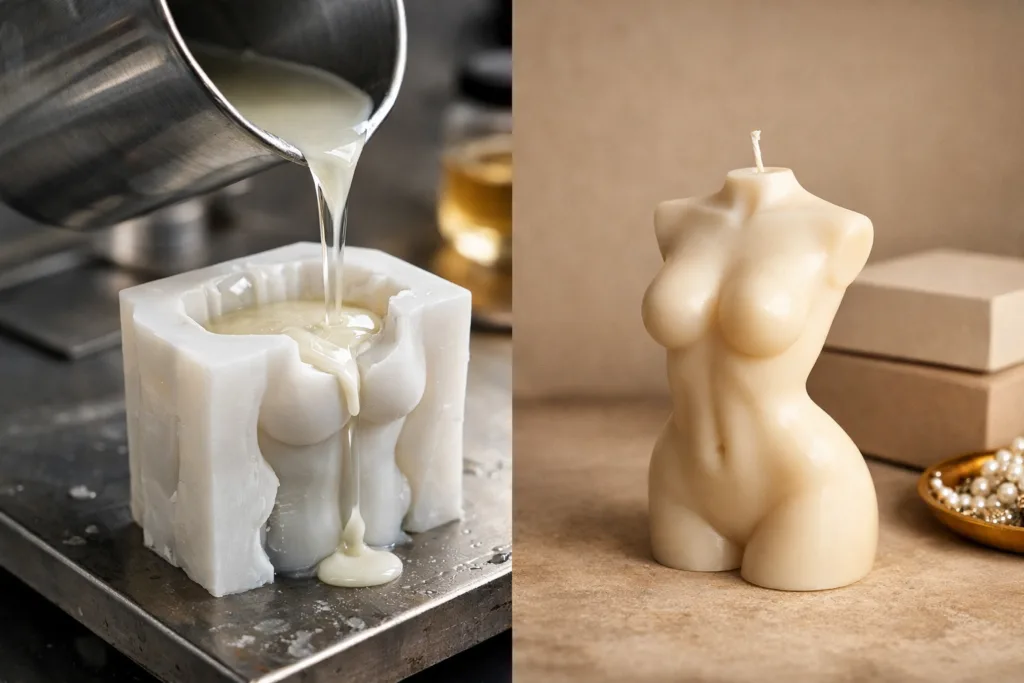
The real cost center of a shaped candle is not the wax body you see at the end. It is the mold development behind it.
That is the part many buyers do not see, and that is also the part many suppliers fail to explain clearly. A shaped candle is not just a candle in a different silhouette. It is a product that depends on whether a factory can convert a design into a repeatable physical form, demold it without damaging it, pour wax into it efficiently, and keep defect rates under control across multiple production cycles.
That ability does not come from cheap raw materials. It comes from tooling, development experience, and trial-and-error cost.
If you misunderstand mold development, you will misunderstand shaped candle pricing, MOQ, production lead time, and sometimes even whether your idea is commercially feasible.
This is where many first conversations between buyers and factories go wrong. A buyer sends a reference photo, asks for a quotation, and compares the number to a standard glass jar candle. When the quote comes back higher than expected, the buyer assumes the supplier is overcharging. In many cases, the supplier is not overcharging at all. The project simply has a tooling structure that the buyer has not accounted for.
At Circe Home, we work with dedicated mold suppliers and candle production partners, so we see this pattern repeatedly. The silicone itself is not expensive. The hidden cost is the development process: 3D modeling, prototype output, mold structure planning, production testing, replacement molds, and the inevitable loss that happens when a shaped design leaves the screen and enters the real world.
This article breaks that down in practical terms. If you are planning to develop custom shaped candles, or you are considering shaped candles as a niche product line or side business, understanding mold cost is the first step to budgeting correctly and avoiding the wrong expectations.
What Makes Shaped Candles Different From Standard Candle Products
A standard jar candle and a shaped candle may both be made of wax, but they belong to two very different production logics.
A jar candle is a container-based product. The vessel already exists. The factory selects a ready glass or ceramic jar, fills it, cures it, packs it, and ships it. The major cost variables are often container choice, fragrance load, wick testing, label, lid, and packaging. There is technical work involved, but the outer form of the product is already solved.
Its outer form is the project.
That means every production decision starts with shape feasibility. The candle is not being poured into a generic retail vessel. It is being formed by a mold that needs to be developed specifically for the design. Even when the design looks simple from the outside, the internal production logic may not be simple at all.
A shape with narrow legs, deep curves, hollow sections, thin protrusions, sharp edges, or layered details may look elegant in a sketch or an AI image, but once the project enters production, those details affect:
Demolding difficulty
If the shape cannot be released from the mold cleanly, the candle will tear, chip, bend, or break.
Cooling stability
Not every part of the candle cools at the same speed. Uneven cooling can create surface defects, shrinkage marks, deformation, or internal weakness.
Production efficiency
Some shapes take much longer to pour, wait, demold, trim, and inspect than buyers expect.
Defect rate
The more complex the shape, the more likely it is that a percentage of pieces will fail in production.
This is why shaped candles are often a tooling-driven category rather than a raw-material-driven category. The wax matters, but it is not the main thing controlling risk.
The Real Cost Structure of a Custom Shaped Candle
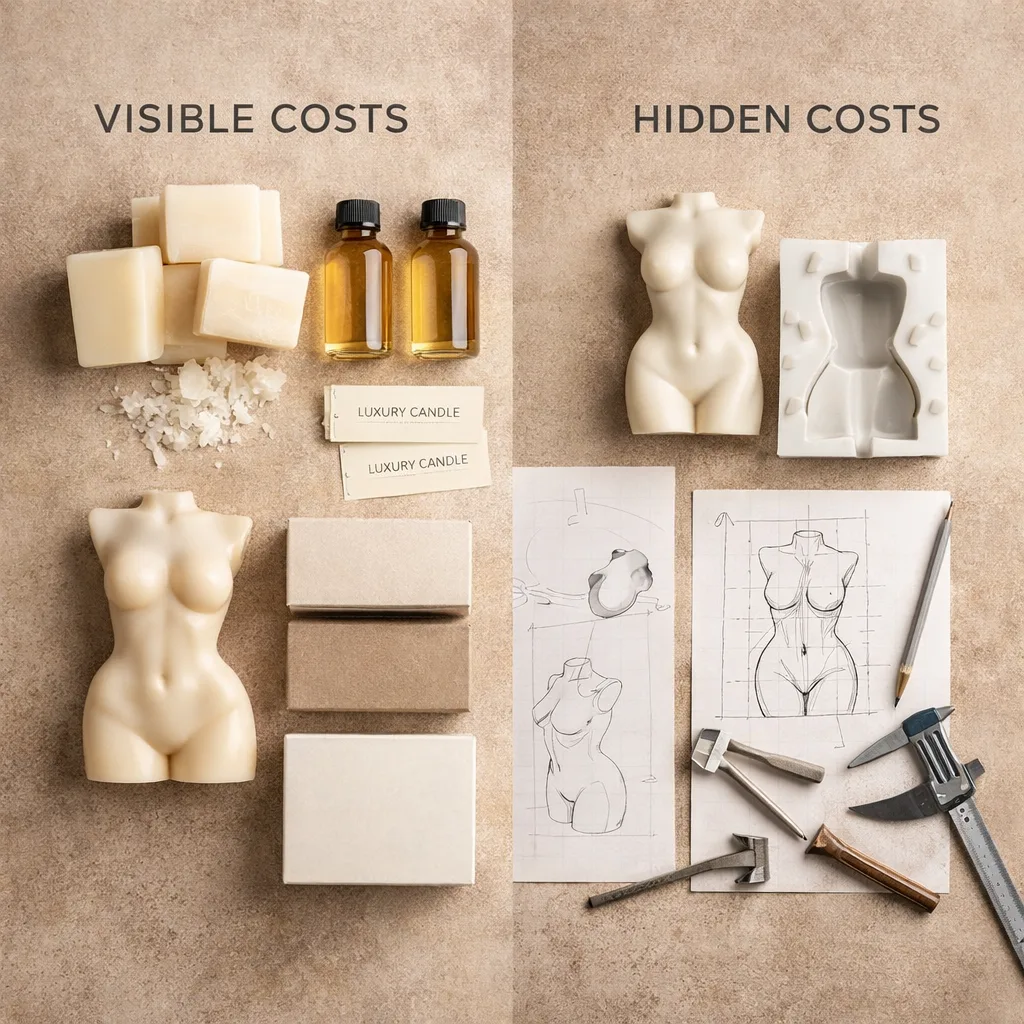
When buyers ask why shaped candles cost more, the question is usually framed the wrong way. They compare the finished object to another candle of similar size and assume cost should be similar because the wax weight looks similar.
That is not how factories calculate risk.
The more practical way to understand shaped candle pricing is to separate the cost structure into visible cost and invisible cost.
Visible cost
This includes the parts buyers usually notice immediately:
- Wax
- Fragrance, if scented
- Wick
- Color dye
- Label or basic branding
- Packaging
- Freight
These are tangible and easy to discuss.
Invisible cost
This is where shaped candle production becomes expensive:
- 3D file creation or refinement
- Prototype development
- Mold structure planning
- Mold making
- Test pours
- Mold replacement during production
- Labor loss caused by failed demolding
- Yield loss caused by imperfect structure
For many shaped candle projects, the invisible side matters more than the visible one.
That is the part that can make a simple-looking product commercially unworkable at low quantity.
Why Mold Development Is the Real Cost Driver
Many people hear the word mold and picture a simple silicone shell. They assume the mold itself must be cheap because silicone is not a luxury material.
That assumption misses the point.
The cost problem is not the raw silicone. The cost problem is developing a mold that actually works.
A mold is only valuable if it can produce a stable candle repeatedly.
A failed mold is not cheap, even if the silicone itself was cheap.
In practice, mold development cost comes from expertise, trial, and correction. A supplier must translate the design into something physically producible. That often means the supplier or mold partner has to think like a technician, not just like a manufacturer.
They have to ask:
- Where is the stress point during demolding?
- Does the candle need a split mold?
- Will certain details trap the candle inside?
- Will the design tear the mold after repeated use?
- Can the top opening allow smooth wax filling?
- Will the candle stand correctly after unmolding?
- Is the base stable enough for retail use?
Those are development questions, and development is where cost starts accumulating.
From Design to Mold: What Factories Actually Have to Do
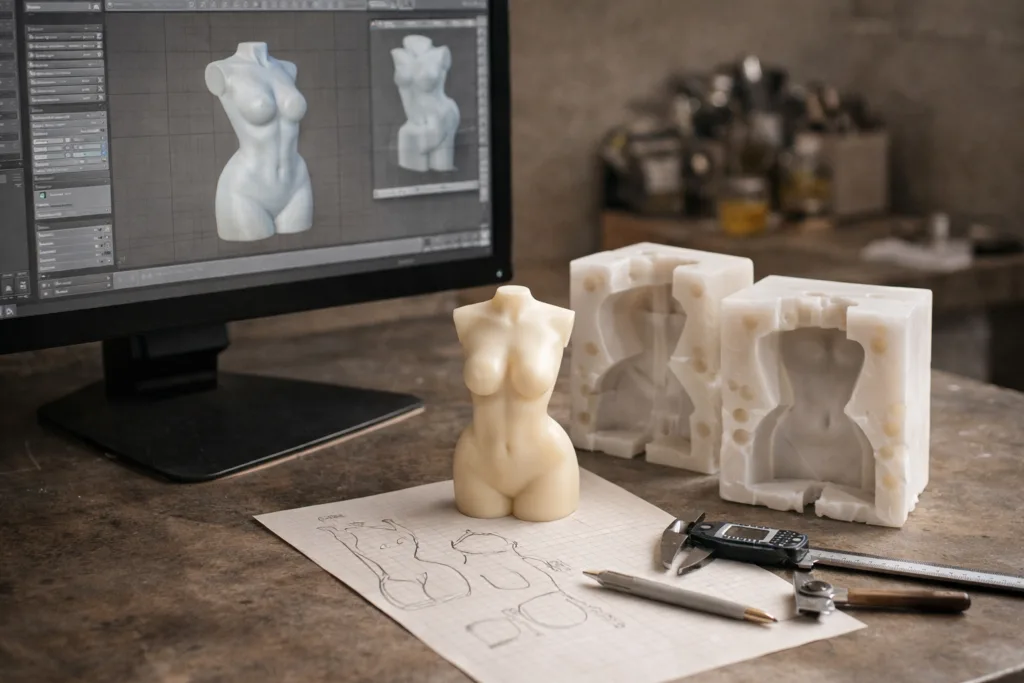
A shaped candle does not start with pouring wax. It starts with interpretation.
Even if the buyer provides a clean reference image, the factory still needs to convert that concept into a development path. That process often involves multiple stages.
3D modeling comes first
For a custom design, the shape usually needs to be built or refined as a 3D model. This is not only for visual confirmation. It is used to understand dimensions, symmetry, balance, and structural practicality.
A nice front-view image is not enough for production. Factories need depth, angle, curvature, and volume logic. If a design only exists as a flat picture, someone still has to create the missing information.
That work costs time and skill.
In many shaped candle projects, this is the first hidden expense buyers do not anticipate.
Then comes the prototype stage
After the 3D file is ready, the next step is often a 3D-printed prototype. This prototype is used to check shape fidelity and prepare the mold-making process.
This stage matters more than people think.
If the prototype has flaws, those flaws can transfer into the mold. If the dimensions are wrong, the mold needs correction. If the structure looks beautiful on the screen but awkward in hand, the project may need redesign before the first production mold is even made.
The mold is then built from the prototype
For many shaped candles, silicone is used because it is flexible and suitable for complex wax forms. But “using silicone” does not mean production is simple.
The mold still needs to be designed correctly.
A candle with curves, shoulders, thin limbs, or narrow openings may require a split mold or a carefully planned parting line. If the parting line is wrong, demolding becomes difficult and the surface finish may suffer.
In other words, the mold is not only a material object. It is an engineering decision.
Why One Mold Is Usually Not Enough
Another common misunderstanding is that a supplier can make one mold and use it for the whole order.
Technically, a single mold can be used repeatedly, but that does not mean it is enough for commercial production.
In real factory work, molds face wear and loss.
When wax is poured, cooled, released, trimmed, and handled over repeated cycles, the mold surface gradually changes. Fine details soften. Edges lose crispness. Tension points weaken. The mold may stretch, tear, or become less reliable.
This matters even more for intricate shaped candles.
If the product relies on clear facial detail, floral texture, body contour, sculptural folds, or other decorative features, mold wear becomes visible much faster. Once the mold quality drops, the candle quality follows.
That is why factories usually need more than one mold.
Multiple molds are required for two reasons.
Production capacity
One mold can only make so many units in a given time. Wax needs cooling time. If a buyer has a real bulk order, relying on one mold would make production inefficient.
Quality stability
Backup molds reduce the risk of production interruption and help maintain consistency when one mold begins to degrade.
So even when the unit looks small, the project may still require several molds to support bulk production. That increases upfront development cost in a way many buyers never include in their initial calculation.
Why Silicone Is Not Expensive, but Mold Development Still Is
This point is worth stating very clearly because it is often misunderstood.
The mold material itself is usually not the expensive part.
Silicone, as a material, is relatively accessible.
What makes the project expensive is everything around the silicone:
- turning the design into a 3D file
- printing or preparing the master model
- deciding how the mold should open
- testing whether the candle can be released cleanly
- correcting weak points
- making additional molds for production wear
- absorbing failed attempts
This is why it is misleading to ask only, “How much is the mold?”
A better question is, “How much development is required to make this design producible?”
That is where real quotation logic begins.
Why Complex Shapes Can Multiply Cost Fast
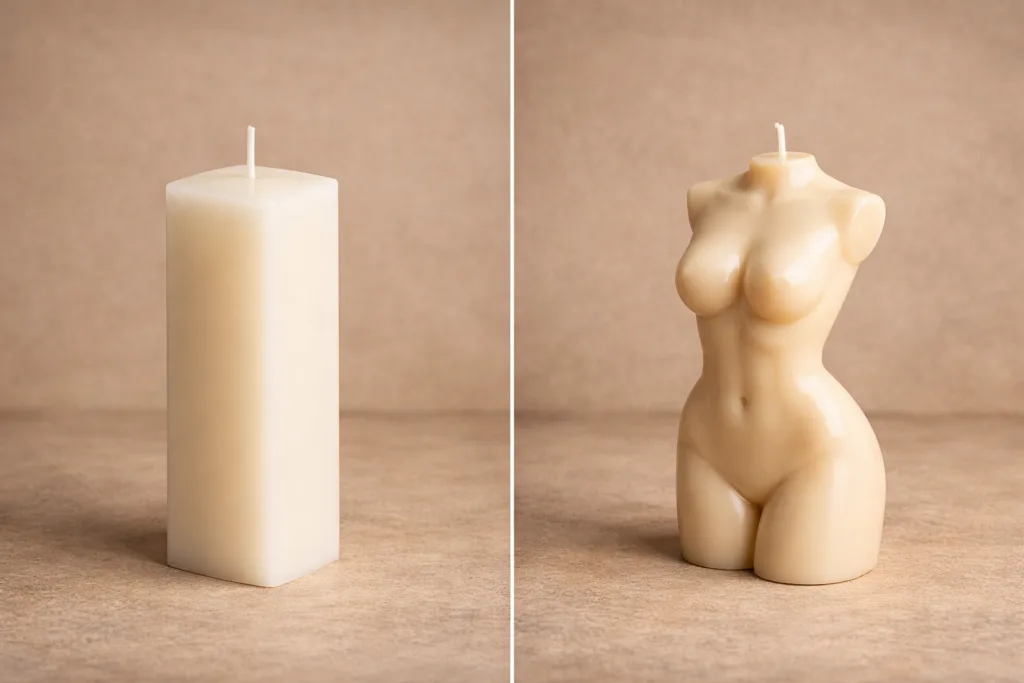
Not every shaped candle is equally difficult. A simple geometric pillar with minor relief detail is completely different from a human torso, an abstract statue, a fruit cluster, or an animal figure with extended limbs.
The more decorative the form, the more likely it is that the project will require additional technical attention.
Thin or protruding parts are risky
Arms, ears, petals, branches, bows, and other raised details can break during demolding or later during packing.
Deep undercuts complicate mold release
If part of the shape curves inward or locks into the mold structure, the candle may not release cleanly.
Highly detailed surfaces increase defect visibility
Texture is attractive, but it also means every small surface flaw becomes more obvious.
Unstable bases create practical retail problems
Even if the candle looks good in photos, an unstable base creates issues for display, packaging, and user experience.
This is why some of the most beautiful design concepts are not the best production candidates.
A factory with real experience will not only tell you whether a design looks good. It will tell you whether it works as a repeatable product.
The Relationship Between Mold Cost and MOQ
MOQ is one of the most sensitive topics in custom candle manufacturing because buyers and factories often look at it from completely different perspectives.
A buyer may think, “I only want to test the market, so I should be able to start with a very small quantity.”
A factory may think, “This project needs custom development, and the quantity is too low to spread the cost.”
Both sides are being logical from their own position.
The gap is mold amortization.
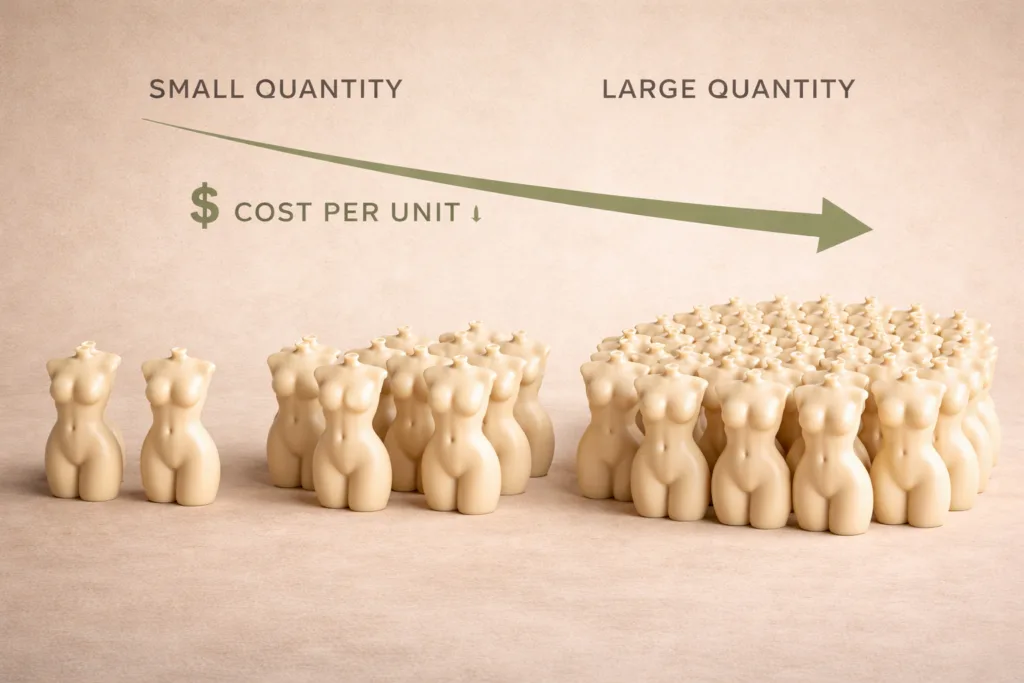
If a shaped candle requires development cost upfront, that cost has to be distributed somewhere. In practice, it is distributed across the order quantity.
Let’s say a project requires a few hundred dollars in mold development and multiple silicone molds for production support. At 100 pieces, the per-unit impact is heavy. At 500 pieces, it becomes more manageable. At 1000 pieces or above, it starts to look commercially healthier.
That is why shaped candles usually do not behave like standard ready-made products.
MOQ is not only a factory preference. It is a cost structure consequence.
If a factory accepts a very low quantity on a complex shaped candle, it often means one of three things:
- the design is based on an existing mold
- the supplier is underquoting and may recover cost elsewhere
- the project is too small to receive proper testing and development attention
That is why low MOQ is not always an advantage.
Sometimes it simply means the technical work is being cut too aggressively.
Why Factories Sometimes Reject Small Shaped Candle Orders
Buyers often take rejection personally. They assume the factory is inflexible or uninterested.
In many cases, the actual reason is much more basic.
The factory cannot justify the engineering effort for the proposed volume.
A shaped candle project can require back-and-forth design interpretation, prototype confirmation, mold discussion, testing time, repeated pouring, and troubleshooting. If the order quantity is too low, the margin does not support that workload.
This is especially true for suppliers who already have stable business from standardized product lines. They may simply prefer to allocate capacity to projects with clearer returns.
That does not mean the buyer’s idea is bad. It means the development burden is too high for the order size.
This is also why the right supplier matters. A supplier who understands both buyer logic and factory logic can often help reshape the project instead of rejecting it outright.
How Circe Home Helps Reduce Development Cost
At Circe Home, we work with specialized mold suppliers and candle production partners, which gives us more flexibility when evaluating custom shaped candle projects.
The goal is not to promise every design. The goal is to reduce unnecessary development cost before a client spends money in the wrong direction.
That usually starts with design evaluation.
If a concept is too fragile, too detailed, or too inefficient to produce well, we would rather say so early than let the client pay for avoidable mistakes later.
We also look for practical ways to reduce cost without stripping away the product identity.
That can include:
Simplifying non-essential details
A design may keep its overall look while removing certain fragile elements that make the mold much harder to develop.
Adjusting size or proportions
Sometimes small changes in thickness, curvature, or base width can improve stability and reduce defect risk.
Recommending a more production-friendly structure
A visually similar shape may have very different mold behavior depending on how it is built.
Exploring existing mold options where possible
If a client is still testing the market, using or adapting an existing mold can reduce initial investment significantly.
Because we work with dedicated mold suppliers, we are also able to help clients control development cost more carefully than they could by approaching random factories without technical screening.
The goal is simple: spend development money where it creates value, not where it disappears into preventable trial and error.
Why Shaped Candles Appeal to Small Brands and Side Businesses
From a business perspective, shaped candles are attractive for a reason.
They are visual products with strong social media appeal. They photograph well, they feel niche, and they can help a new brand create personality quickly. For buyers looking to test a broader home fragrance or gift concept, shaped candles can be a practical product to explore.
They also work well for personal-brand-style businesses because the product is emotionally expressive. A founder can launch a small sculptural candle line around mood, aesthetics, zodiac, body forms, flowers, fruit, holiday motifs, or interior styling trends. That makes shaped candles easier to position than completely generic candle lines.
In that sense, shaped candles can be a relatively approachable side business idea for people who want to test a design-led retail concept.
But the key word here is test smartly.
A shaped candle business is easier to start than a full-scale fragrance brand with dozens of SKUs, but it is not a free-entry category. The visual simplicity of the final product can hide real development cost at the factory level.
If buyers understand mold cost from the beginning, they can choose better designs, budget more realistically, and avoid turning a creative idea into an unnecessarily expensive small batch.
How to Control Shaped Candle Cost Without Ruining the Product
A shaped candle does not have to become a budget disaster. The cost issue becomes manageable when the project is developed with production logic in mind.
Start with feasibility, not just inspiration
Reference images are useful, but they are not enough. Before asking for a final quote, buyers should first ask whether the structure is mold-friendly.
Avoid details that do not add selling value
Many design details look impressive during concept stage but add little retail value while increasing technical risk.
Consider using existing molds for market testing
If the goal is to validate demand, an existing shape with custom color, finish, label, or packaging may be a better first step than a fully custom sculptural design.
Increase volume if the design must be custom
If the product truly depends on a proprietary shape, a more realistic quantity will make the per-unit cost healthier.
Balance shape complexity with packaging value
Sometimes a moderately distinctive candle paired with stronger packaging creates better overall margin than an extremely complex candle that drains budget into development.
This is a useful mindset shift for brand owners. Not all premium value has to come from shape alone.
Common Mistakes Buyers Make With Custom Shaped Candles
Many shaped candle problems are predictable.
The same misunderstandings tend to appear again and again.
Treating the candle like a simple wax item
When buyers only compare wax weight, they overlook the real development cost.
Sending only one reference image and expecting exact quoting
Without a proper 3D understanding, the supplier may not be able to judge complexity accurately.
Assuming one sample means mass production is solved
A single sample can prove visual possibility. It does not automatically prove production efficiency.
Underestimating mold wear
A design that works for a few pieces may still be inefficient or unstable in bulk.
Prioritizing uniqueness over manufacturability
The most unusual shape is not always the best business decision.
These mistakes are normal for first-time buyers. The problem is not lack of creativity. The problem is lack of factory-side visibility.
That visibility is exactly what good supplier guidance should provide.
Final Thoughts: For Shaped Candles, the Mold Comes Before the Wax
If there is one takeaway buyers should remember, it is this: a shaped candle is not expensive because wax is expensive. It becomes expensive because form has to be engineered, tested, and repeated.
The candle you see on the shelf is the visible result. The real cost started much earlier, when someone had to turn an idea into a workable mold system.
That is why shaped candle pricing cannot be judged by appearance alone.
It is also why the right supplier matters. A supplier who only says yes may not actually save you money. A supplier who understands mold development, yield risk, and structure optimization can often protect your budget better, even if the initial conversation sounds more technical.
At Circe Home, we help clients evaluate shaped candle projects from a production reality perspective. Because we work with specialized mold suppliers, we can help reduce avoidable development cost, screen out risky structures early, and guide buyers toward options that make more commercial sense.
If you are planning a custom shaped candle project, start by asking the right question.
Not “How much is the wax?”
Ask instead: “What does it take to develop this shape properly?”
That is where better budgeting begins, better communication begins, and better candle projects begin.
FAQ
Why are shaped candles more expensive than standard jar candles?
Shaped candles usually require custom mold development, while jar candles rely on ready-made containers. That means shaped candles carry upfront tooling, testing, and yield risk that jar candles do not.
Is silicone mold material itself expensive?
Usually no. Silicone as a material is not the main issue. The higher cost comes from 3D modeling, prototype preparation, mold structure design, testing, replacement molds, and development loss during production.
Can I launch a shaped candle business with a low MOQ?
You can, but it depends on whether you use an existing mold or develop a custom one. For a fully custom shape, low MOQ often leads to poor cost efficiency because the mold development cost has too few units to absorb it.