
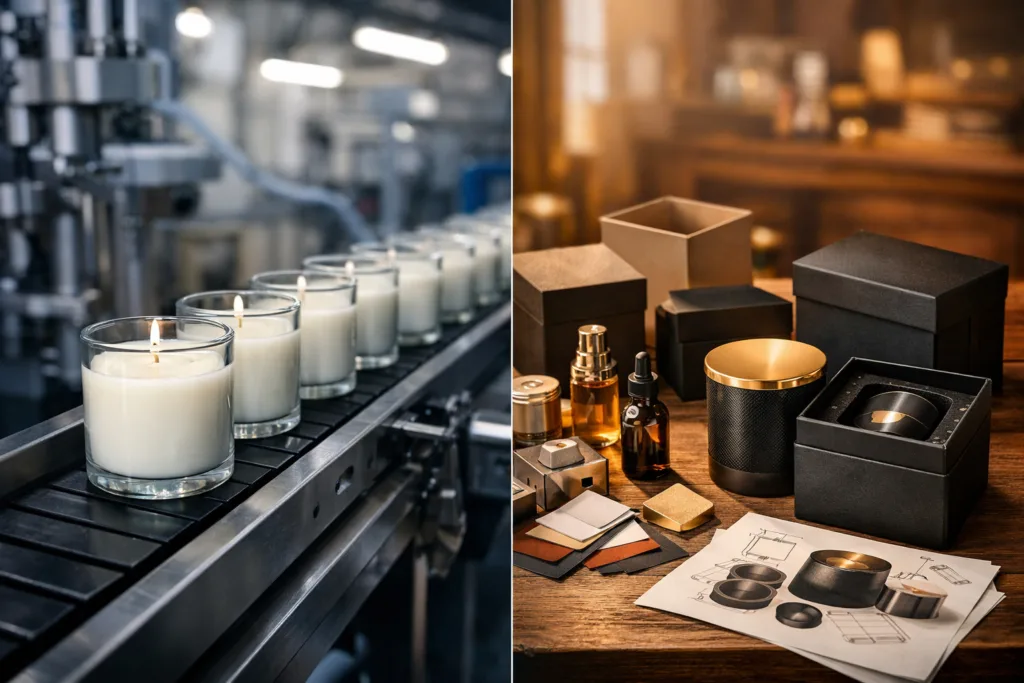
 For many candle buyers, one of the most frustrating moments in product development happens after the first exciting design conversation.
The mood is usually optimistic. A brand has a clear vision. They want a custom candle vessel, a signature color, a premium rigid gift box, foil details, and a presentation that looks expensive enough to compete on a boutique shelf or in a luxury gift set. Then the factory comes back with a minimum order quantity that feels far higher than expected.
The buyer asks a reasonable question: if a standard candle can be produced at 500 units, why does a customized version suddenly require 5,000 to 10,000 units?
The short answer is simple: high customization drives high MOQ because customization changes the economics of manufacturing. In candle production, the two biggest MOQ drivers are usually not the wax itself. They are the candle vessel and the packaging box.
That is the part many first-time buyers underestimate.
A standard candle can often be produced in smaller quantities because the factory is using existing jars, proven components, standard packing, and a streamlined production workflow. A highly customized candle is different. The moment you introduce a new vessel shape, a custom finish, a branded rigid box, or other made-to-order components, the project moves from simple production into custom development. At that point, MOQ is no longer just a factory preference. It becomes a supply chain requirement.
This article explains exactly why that happens, why custom candle vessels and boxes are usually the real limiting factors, and how brands can make smarter decisions before committing to a premium custom candle project.
Why a Standard Candle Can Start at 500 Units but a Custom Candle May Require 5,000 to 10,000
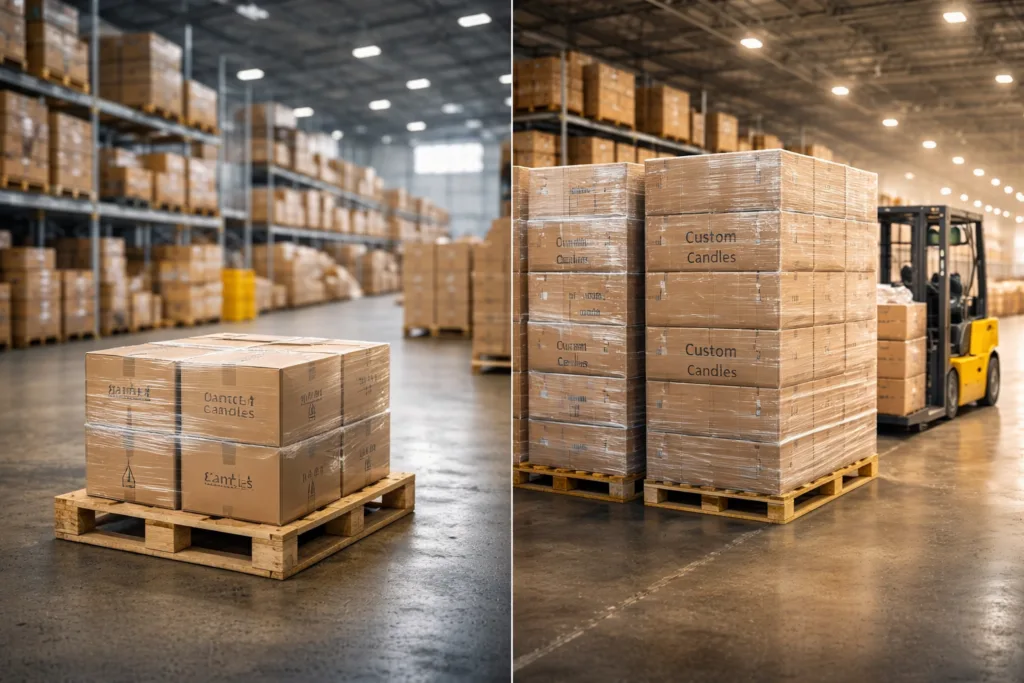 At first glance, the product may look similar.
Both versions are candles. Both may use similar wax. Both may even have a similar fill weight. From a buyer’s perspective, it can feel strange that one project can start at 500 pieces while another jumps to 5,000 or even 10,000 pieces.
The reason is that standard production and custom production operate on two completely different manufacturing models.
Standard candles use an existing production ecosystem
When a factory offers a standard candle at a relatively low MOQ, it is usually relying on components and processes that already exist, such as:
- existing glass jars or stock vessels
- standard lids already sourced in bulk
- existing fragrance options
- standard carton packaging
- routine filling line settings
- proven wick and wax combinations
- repeatable packing methods
Because these materials and processes are already in place, the factory does not need to build a new supply chain around the project. It can often combine production with other orders, pull from established suppliers, and keep the overall production cost manageable even at a lower quantity.
Customized candles require project-specific development
A customized candle typically introduces one or both of the following:
- A custom candle vessel
- A custom packaging box
Once those elements change, the project becomes more complex. The factory may need to:
- source a new jar or develop a new mold
- test coating, color, electroplating, spraying, frosting, or decal finishes
- confirm fit between vessel, lid, insert, and outer box
- create new packaging dielines
- buy custom paper, foam, ribbons, magnets, or specialty inserts
- run sampling rounds for approval
- reserve supplier capacity for non-standard components
This is why the MOQ gap becomes so dramatic. The wax may still be candle wax, but the product around the wax is no longer standard.
In Custom Candle Manufacturing, the Vessel and Packaging Box Usually Decide the MOQ
One of the most important truths in private label candle manufacturing is this:
The wax is rarely the main MOQ problem. The vessel and the box are.
Many buyers assume MOQ is mostly driven by the filling process. In reality, the candle filling stage is often one of the easier parts of production. The real pressure usually comes from upstream component suppliers.
If you choose a stock glass jar, a basic label, and a standard folding carton, the project can often remain flexible. But once you ask for a unique vessel and premium box structure, the minimum order quantity rises quickly because outside suppliers impose their own minimums.
This means a candle factory is not making MOQ rules in isolation. It is coordinating a chain of manufacturing partners, and the least flexible component often sets the floor for the whole order.
How Custom Candle Vessels Push MOQ Higher
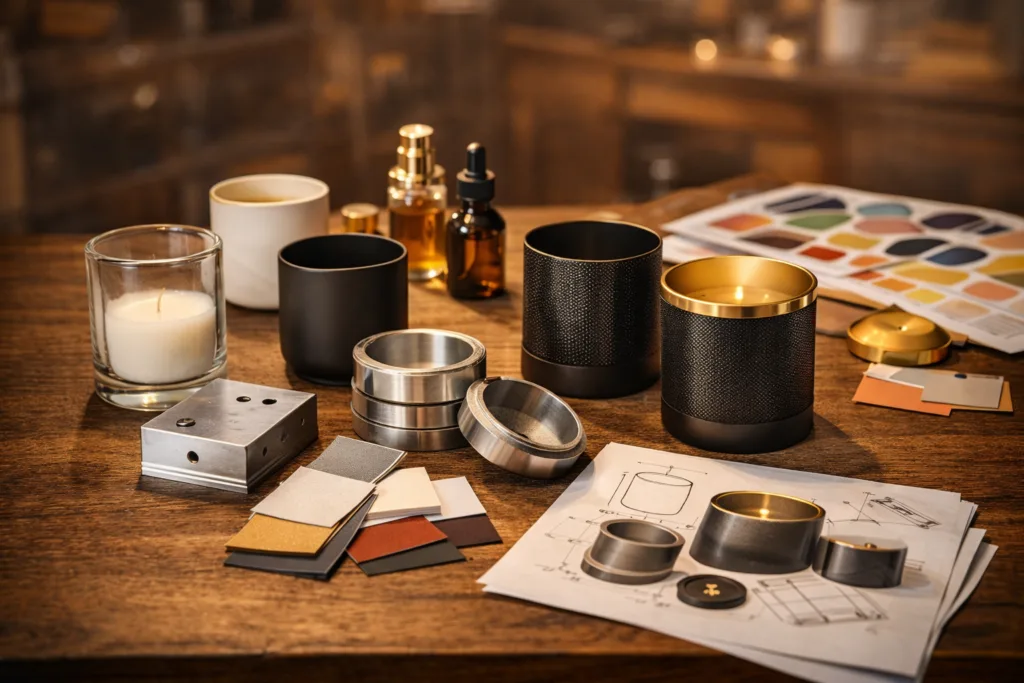 The vessel is often the first major reason a project moves from a 500-piece test order into a 5,000-piece or 10,000-piece custom program.
Custom vessel development is not the same as selecting a stock jar
A stock candle jar already exists. The dimensions are known. The wall thickness is controlled. The glass factory has already made it before. The candle manufacturer likely already knows which wick series and wax formula work inside it.
A custom vessel is different.
Depending on the design, it may require:
- a new mold
- a minimum production run at the glass or ceramic factory
- finish testing
- color matching
- logo decoration trials
- burn and compatibility testing
- packaging fit confirmation
If the vessel is ceramic, cement-based, metal, or a special decorative container, the MOQ may be even less flexible because handmade or semi-handmade processes also require stable volume planning.
Mold and setup costs must be absorbed somewhere
If a custom vessel needs a new mold, that immediately changes the economics of the order.
A factory cannot justify tooling, development work, and setup time for a very small run unless the buyer is willing to pay unusually high costs per unit. Most buyers do not want that. They expect a commercially reasonable landed cost.
That is why suppliers prefer to spread the development cost across more units.
For example, a vessel project that feels feasible at 10,000 pieces may become commercially inefficient at 500 pieces because each unit would carry an unreasonable share of setup cost.
Decorative finishes can carry their own supplier MOQs
Even when the vessel shape already exists, the finish may still trigger a high minimum.
Common examples include:
- custom spray color
- gradient coating
- soft-touch finish
- metallic plating
- embossed logo
- silk screen logo
- heat transfer decoration
- custom glaze for ceramics
Each of these may involve a separate process house or decoration vendor. That vendor may require its own minimum order quantity, especially when the finish is not part of its routine production.
So a buyer may think they are ordering a jar. In reality, they are ordering a jar plus a specialized finishing service plus possible rejection allowance plus protective packing adjustments.
That is one reason decorative custom vessels often jump to 5,000 units or more.
Vessel consistency matters more at premium positioning
The more premium the brand wants the product to feel, the more consistency matters.
Luxury-looking candle vessels need tighter control over:
- color consistency
- print placement
- lid fit
- opening diameter
- wall thickness
- surface quality
- finish durability
Better consistency usually requires more disciplined production planning. And disciplined production planning tends to favor higher volume, not lower volume.
Why Custom Packaging Boxes Are Often the Biggest MOQ Driver of All
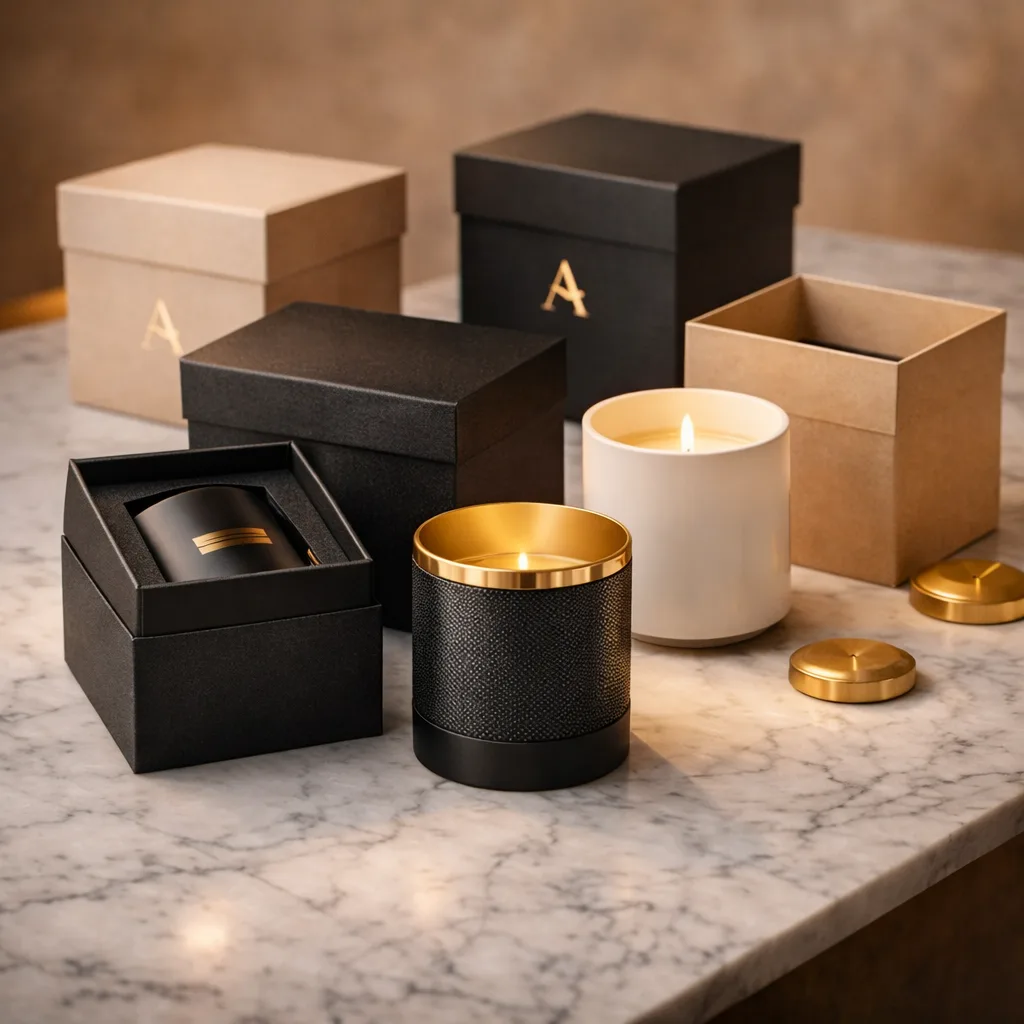 If the vessel is one half of the MOQ story, the packaging box is often the other half—and in many projects, the box is the stricter constraint.
This surprises many buyers because they assume packaging is just an accessory. In custom candle manufacturing, premium packaging can easily become the component that decides whether a project is viable at all.
Custom packaging has its own factory logic
A packaging supplier does not think like a candle buyer. It thinks in terms of paper sourcing, print setup, structure efficiency, machine calibration, and board utilization.
When you ask for a custom candle box, the packaging factory may need to manage:
- custom size
- custom print artwork
- foil stamping
- embossing or debossing
- magnetic closure
- rigid board structure
- EVA or foam insert
- flocked tray
- ribbon pull
- special paper wrap
- matte or soft-touch lamination
Every one of those details adds complexity. Every layer of complexity reduces flexibility.
Rigid boxes almost always require higher quantities than standard cartons
A simple folding carton is usually more MOQ-friendly because it is lighter, faster to produce, and easier to nest in efficient print runs.
A rigid box is different. It uses more material, more labor, more hand assembly, and more finishing steps. It also occupies more physical space during production and storage.
That is why a luxury rigid gift box often has a much higher MOQ than a standard mailer or folding carton.
If a brand wants a premium candle presentation box with foil logo, insert, and custom dimensions, 5,000 to 10,000 pieces is often much more realistic than 500.
Print efficiency and material waste affect MOQ
Packaging MOQ is not only about what the buyer wants. It is also about what the packaging line can produce efficiently.
For example, a packaging supplier may calculate:
- how many boxes fit per paper sheet
- how many sheets are needed for setup and spoilage
- how much waste is created by the box dimensions
- whether foil stamping dies need to be made
- whether the insert can be produced efficiently
A short run with a premium structure may be technically possible, but economically irrational.
That is why suppliers frequently set minimums that feel high to the buyer but are actually normal from the factory side.
Inserts and fitment details raise the threshold further
For candle gift packaging, the box is often not the only packaging component.
You may also need:
- inner tray
- die-cut card insert
- EVA insert
- molded pulp insert
- protective sleeve
- label or seal sticker
- instruction card
- barcode sticker
Each added packaging part can introduce its own MOQ or tooling requirement. The final result is that the packaging system, not the candle itself, becomes the real quantity driver.
The Supply Chain Behind a Custom Candle Is More Fragmented Than Buyers Expect
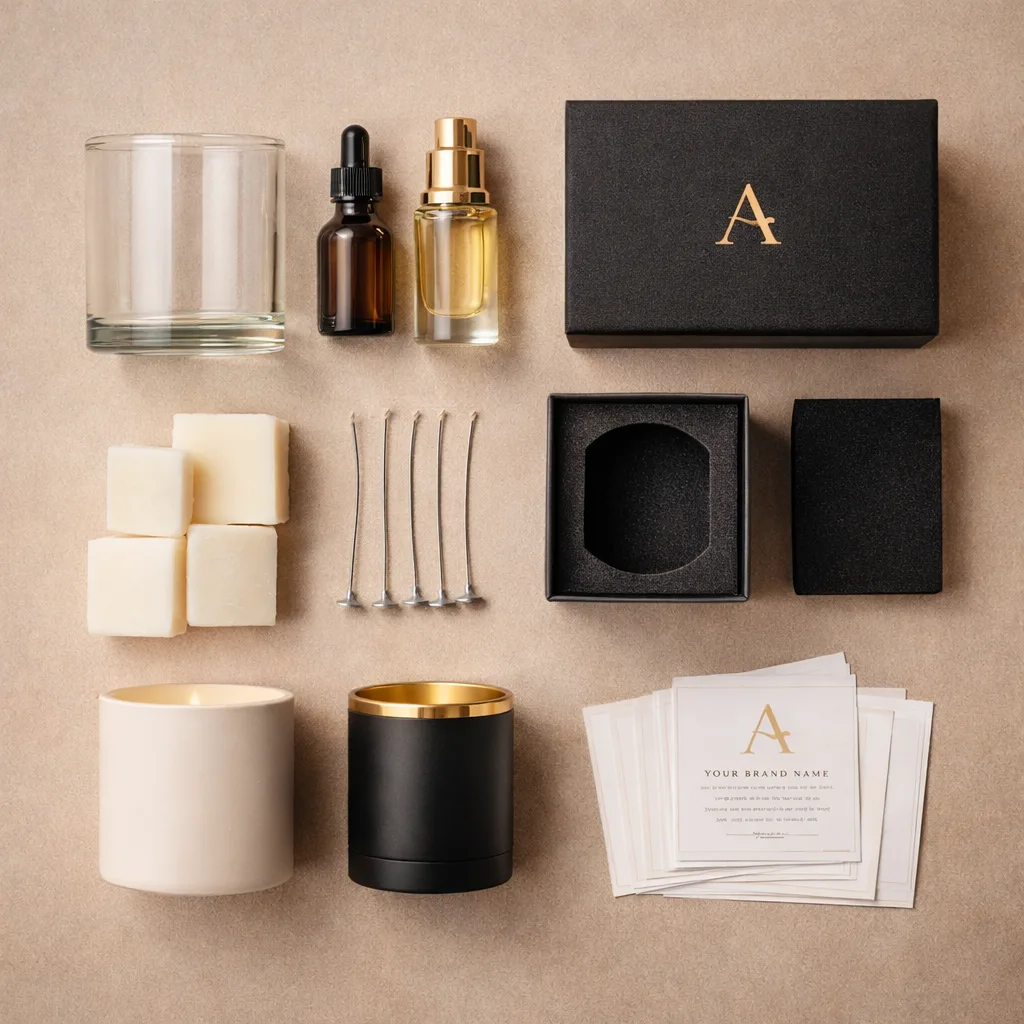 One reason MOQ discussions feel confusing is that many buyers picture a candle factory as a single integrated operation handling everything under one roof.
In reality, many candle projects rely on a network of suppliers.
A typical custom candle may involve:
- a vessel supplier
- a lid supplier
- a candle filling factory
- a label printer
- a packaging box factory
- an insert supplier
- a decoration or surface treatment vendor
That means the final MOQ is often the result of coordination, not a unilateral decision.
If the glass factory requires 5,000 units and the packaging factory requires 3,000 units, the project cannot realistically move at 500. The most restrictive supplier often determines the floor.
This is especially true for premium private label programs, where presentation quality matters and there is less room to substitute standard materials without changing the product positioning.
Why Factories Resist Small Orders on Highly Customized Candle Projects
From the buyer’s point of view, a 500-piece run may feel like a fair starting point for testing the market. From the factory’s point of view, it may look like a disproportionately demanding project with too little volume to support the complexity involved.
Small customized orders consume almost the same coordination effort
Even a small custom project still requires:
- quoting
- design review
- supplier communication
- sample development
- burn testing
- artwork approval
- production scheduling
- inspection planning
- export packing coordination
In other words, many of the administrative and technical steps are similar whether the order is 500 pieces or 5,000 pieces.
That is why factories are cautious about low-volume custom work. The overhead is real, and the margin often does not justify the effort.
Small runs carry higher risk of rework and waste
Custom projects are more sensitive to mistakes. If the vessel color is off, the insert does not fit, the logo placement looks weak, or the box structure fails transit testing, the supplier may have to remake or adjust components.
At low quantity, there is less room to absorb that risk.
For the factory, a small custom order can be operationally noisy but financially unattractive. That is another reason MOQ rises when customization rises.
Why the Wax Is Usually Not the Reason MOQ Jumps
This is worth stating clearly because it helps buyers focus on the right cost drivers.
In many candle projects, the wax itself does not create the biggest MOQ barrier.
Wax is often comparatively flexible because:
- it can be purchased in bulk and allocated across projects
- standard wax systems are already in use
- color variation can sometimes be controlled without reinventing the entire product
- the filling process is relatively scalable once the vessel is approved
Of course, highly unusual wax formulas or special performance requirements can add complexity. But in most custom candle programs, the jump from a low MOQ to a high MOQ is more directly tied to the vessel and packaging choices.
That is why brands should evaluate the entire product architecture, not just the fragrance and wax concept.
Typical Scenarios That Push Custom Candle MOQ to 5,000 to 10,000 Units
Not every candle project needs a very high MOQ. But certain features almost always push the quantity upward.
Scenario 1: Fully custom vessel + rigid gift box
This is one of the clearest high-MOQ combinations.
If a brand wants:
- a custom vessel shape
- a custom color or finish
- a custom lid
- a rigid gift box with insert
- foil or embossed branding
then a 5,000 to 10,000 MOQ is often far more realistic than a 500 MOQ.
Scenario 2: Existing vessel shape + fully custom finish + premium box
Even if the vessel mold already exists, the order can still move into a high-MOQ zone if the buyer wants a specific exterior finish, surface treatment, or highly branded premium packaging.
The project may avoid mold development, but it still carries decoration and packaging constraints.
Scenario 3: Multi-component gift set packaging
MOQ rises quickly when the product is not a single candle in a simple carton but part of a gift set, such as:
- candle + matches
- candle + room spray
- candle + towel
- candle + wax melts
- candle trio with fitted insert
Gift set packaging typically requires more structural engineering and more custom components, which means higher minimums.
How Buyers Can Lower MOQ Without Abandoning Brand Identity
The good news is that high customization does not always mean brands have no options. It simply means they need to customize strategically.
Use a stock vessel and customize around it
One of the smartest ways to lower MOQ is to use an existing jar or vessel already supported by the supplier.
Then customize through:
- label design
- outer carton print
- lid sticker
- fragrance naming
- brand story card
- color palette coordination
This can preserve a strong brand feel while keeping MOQ much more manageable.
Replace rigid boxes with premium folding cartons
If the box is the real MOQ driver, changing the packaging structure may solve the problem.
A well-designed folding carton can still look elevated if you use:
- strong artwork
- quality paper
- tasteful foil details
- insert simplification
- clean typography
For many emerging brands, this is a better commercial choice than insisting on a rigid box too early.
Limit custom work to one hero component
Instead of customizing everything at once, choose the element that matters most.
For example:
- stock jar + custom rigid box
- custom vessel + simple carton
- stock vessel + premium label + custom lid sticker
This approach reduces supply chain pressure and often leads to better launch economics.
Phase the development plan
A practical path for many brands is a two-stage strategy.
Stage one: launch with an MOQ-friendly version using stock vessels and simpler packaging.
Stage two: upgrade into a full custom vessel and premium box after market validation.
This is often a stronger business decision than forcing a luxury packaging concept before real demand is proven.
What Serious Buyers Should Ask Before Requesting a Fully Custom Candle
Brands can save time, money, and frustration by asking the right questions early.
Vessel questions
- Is the vessel stock or fully custom?
- Does it require a new mold?
- What finish options already exist?
- What is the MOQ for this vessel with logo decoration?
- Has this vessel already been used for candles before?
Packaging questions
- Is the box a folding carton or rigid box?
- What is the MOQ for this box structure?
- Does it require a custom insert?
- Is foil stamping or embossing affecting the minimum?
- Can the design be simplified without damaging brand perception?
Commercial questions
- What part of the project is setting the MOQ floor?
- Can the vessel and box MOQ be separated?
- Is there a stock-based alternative for launch?
- What would change if the order stayed below 1,000 units?
These questions move the conversation from vague frustration to practical decision-making.
The Real Business Lesson Behind High Custom Candle MOQ
High MOQ is not automatically a sign that a supplier is being difficult.
Often, it is simply the clearest reflection of how custom manufacturing works.
When a buyer wants a standard candle, the factory can use an existing supply chain. When a buyer wants a highly customized candle with a custom vessel and premium presentation box, the project requires a different level of commitment. More suppliers are involved. More setup is required. More materials become non-standard. More cost has to be spread across more units.
That is why a standard candle can sometimes start at 500 units, while a fully customized version may need 5,000 to 10,000.
The difference is not the wax alone. It is the structure of the product around the wax.
For buyers, this understanding is powerful. It leads to better budgeting, better supplier communication, and better launch planning.
For manufacturers, it creates more realistic conversations and fewer dead-end custom inquiries.
For brands building a serious candle line, the goal should not be to chase the lowest MOQ at any cost. The goal should be to align the level of customization with the stage of the business.
That is how smart product development works.
Conclusion
If you remember only one thing from this guide, remember this:
In candle manufacturing, high customization usually means high MOQ because the custom vessel and packaging box are what truly drive the minimum order quantity.
A standard candle can often be made at 500 units because it relies on existing components and efficient repeat production. A custom candle may require 5,000 to 10,000 units because the vessel and box introduce tooling, supplier minimums, special finishes, structural packaging, and project-specific coordination.
Once buyers understand that reality, MOQ stops feeling arbitrary.
It starts making business sense.
FAQ
1. Why can a standard candle be produced at 500 units, but a custom candle may require 5,000 to 10,000?
A standard candle usually uses stock jars, existing packaging, and routine production methods. A custom candle often involves custom vessels and premium packaging boxes, both of which come with higher supplier minimums and setup costs.
2. What is the biggest factor behind high custom candle MOQ?
In most cases, the biggest MOQ drivers are the candle vessel and the packaging box, not the wax itself. Custom molds, decorative finishes, rigid boxes, inserts, and premium print details all push minimum order quantities higher.
3. How can I reduce MOQ for a private label candle project?
The most practical ways are to use stock vessels, simplify packaging structure, avoid over-customizing every component, and launch in phases. This keeps the product branded while making the order quantity more commercially realistic.