
 If you run a candle brand — or are planning to start one — fragrance oil is not just another ingredient on your material list. It is the backbone of your product experience.
Yet, fragrance oil is also one of the most misunderstood parts of candle making. Many new brands confuse it with essential oils, assume stronger means better, or underestimate how much fragrance choice affects burn performance, safety, and brand perception.
This guide is written for candle brands, not hobbyists. It explains what fragrance oil actually is, how it works inside a candle, and what you need to understand before choosing or developing scents for commercial use.
What Is Fragrance Oil?
Fragrance oil is a professionally formulated aromatic blend designed to deliver consistent scent performance in a finished product.
Unlike essential oils, which are extracted directly from plants, fragrance oils are created by perfumers using a combination of:
- Aroma chemicals (synthetic or nature-identical molecules)
- Natural isolates (specific molecules derived from natural materials)
- Functional solvents or carriers
The goal is not to imitate nature perfectly, but to achieve stability, safety, repeatability, and performance — especially under heat.
For candles, fragrance oils are engineered to:
- Withstand high wax temperatures
- Bind properly with different wax systems
- Release scent evenly when heated
- Burn cleanly without producing excessive soot or smoke
This is why nearly all commercial candles — including luxury and designer brands — rely on fragrance oils rather than pure essential oils.
Fragrance Oil vs. Essential Oil: Why Candles Use Fragrance Oils
 Essential oils are often perceived as more “natural,” but natural does not automatically mean suitable.
In candles, essential oils present several challenges:
- Many evaporate or degrade when exposed to heat
- Scent profiles are often thin or unstable in wax
- Batch-to-batch variation is high
- Costs are significantly higher at scale
Fragrance oils, by contrast, are formulated specifically for performance. They allow brands to create complex, layered scents that remain recognizable from the first burn to the last.
For candle brands focused on consistency, compliance, and customer experience, fragrance oil is not a compromise — it is a requirement.
How Fragrance Oils Are Structured: Top, Middle, and Base Notes
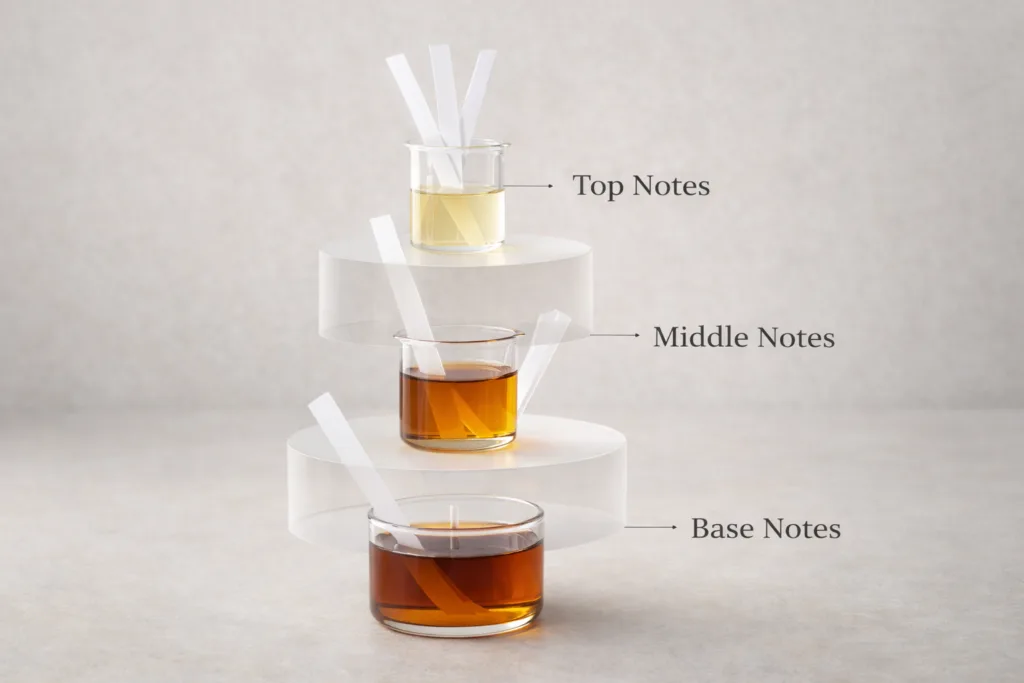 Fragrance oils are not single smells. They are structured compositions.
Just like fine perfume, a candle fragrance typically includes:
- Top notes: The first impression. Often citrus, herbs, or light aromatics that appear quickly after lighting.
- Middle notes: The core character of the scent. Florals, fruits, spices, or greens that define the candle’s personality.
- Base notes: The foundation. Woods, resins, musks, and ambers that give depth, warmth, and longevity.
In candles, base notes are especially important. They determine whether a scent feels refined or flat, memorable or forgettable.
A well-built fragrance oil balances volatility and longevity, ensuring the scent unfolds naturally rather than collapsing into a single, overpowering note.
Scent Throw: Why Performance Matters More Than Strength
Scent throw refers to how well a candle releases fragrance into a space. It includes:
- Cold throw: How the candle smells before lighting
- Hot throw: How it performs when burning
A common misconception is that higher fragrance load equals stronger scent. In reality, scent throw depends on:
- Fragrance structure
- Wax compatibility
- Wick selection
- Burn temperature and airflow
Adding more fragrance oil beyond an optimal range can cause problems such as oil seepage, unstable flames, or distorted scent profiles.
For most professional candles, a fragrance load between 6% and 10% delivers the best balance of performance and safety.
Fragrance Oil and Wax Compatibility
Not every fragrance oil works well with every wax.
Different waxes interact with fragrance in different ways:
- Soy wax absorbs fragrance well but requires higher-quality formulations
- Coconut-based blends offer smooth scent diffusion but are more sensitive to imbalance
- Paraffin provides strong throw but may not align with certain brand values
A fragrance oil that performs beautifully in one wax may fall flat in another. This is why professional testing is essential — and why off-the-shelf scents often disappoint when scaled.
Compliance and Safety: The Non-Negotiable Side of Fragrance Oil
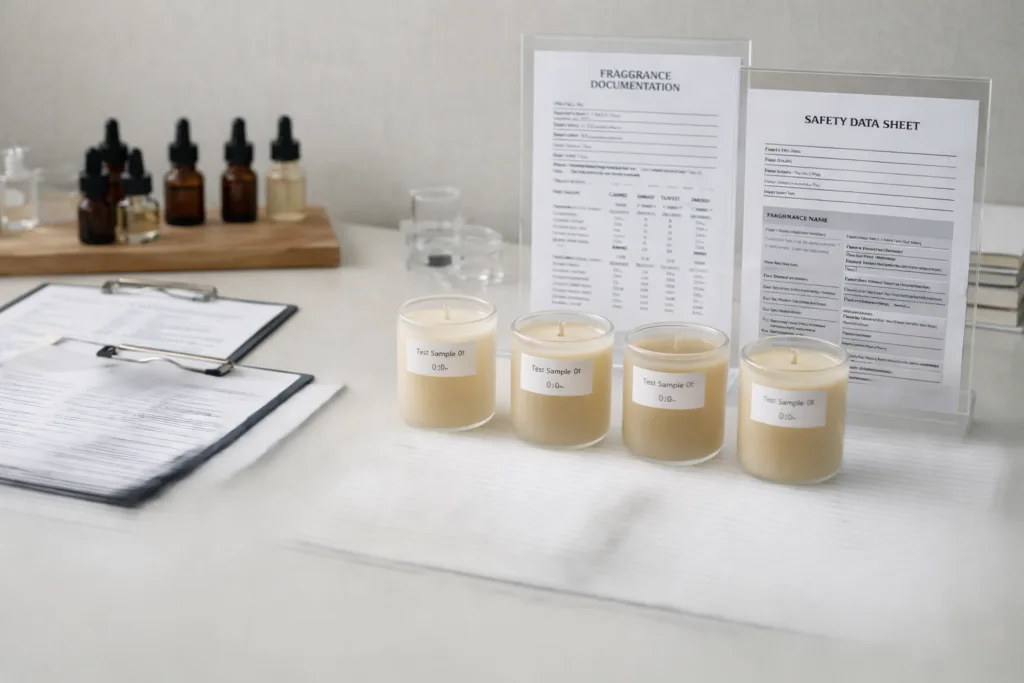 For candle brands selling internationally, fragrance oil must meet regulatory requirements.
Key frameworks include:
- IFRA standards, which restrict certain materials and usage levels
- SDS documentation for handling and transport
- CLP labeling requirements in the EU
- Allergen disclosure obligations
Compliance is not optional. It affects labeling, shipping, insurance, and long-term brand viability.
A well-formulated fragrance oil balances creativity with regulation, ensuring the product can be sold legally and safely across markets.
Why Many Brands Choose Bespoke Fragrance Oils
Catalog fragrances are convenient, but they are also widely shared.
As brands mature, many move toward bespoke fragrance development — scents created specifically for their identity, audience, and product line.
A bespoke fragrance oil allows a brand to:
- Create a recognizable scent signature
- Avoid direct duplication by competitors
- Control performance across product formats
- Build emotional connection through scent
In a crowded market, fragrance is one of the few elements customers remember instinctively.
Final Thoughts
Fragrance oil is not just about smelling good. It is about engineering a reliable, safe, and emotionally resonant experience.
For candle brands, understanding fragrance oil means making better decisions — from sourcing and testing to branding and storytelling.
When fragrance is treated as a core system rather than an afterthought, the result is not just a better candle, but a stronger brand.
Frequently Asked Questions (FAQ)
1. Is fragrance oil safe to use in candles?
Yes—when properly formulated and used within recommended limits. Professional fragrance oils for candles are developed to meet IFRA standards and undergo safety evaluations. Safety depends on correct fragrance load, proper wax compatibility, and compliant labeling rather than whether a scent is synthetic or natural.
2. Why don’t luxury candle brands use pure essential oils?
Because essential oils are unstable under heat and often perform poorly in wax. Luxury brands prioritize consistency, clean burn, and scent longevity, which professionally formulated fragrance oils are designed to deliver.
3. Does a higher fragrance load mean a stronger candle?
Not necessarily. Scent throw depends more on fragrance structure, wax type, and wick selection. Exceeding optimal fragrance load can cause oil seepage, poor burn performance, and distorted scent profiles.
4. What’s the difference between catalog fragrance oils and bespoke fragrances?
Catalog fragrances are pre-made and widely used. Bespoke fragrances are developed specifically for one brand, offering better alignment with brand identity, improved performance control, and reduced risk of duplication by competitors.