
Wholesale scented candles can be a strong product line for retailers, importers, hotels, spas, gift companies, and private label brands. Candles are no longer just small home décor items. They are part of self-care, home fragrance, hotel gifting, holiday collections, and lifestyle branding. The global candle market is expected to keep growing in the coming years, with market reports showing steady demand across retail, home fragrance, and gift channels.
But for B2B buyers, ordering scented candles in bulk is not just about choosing a nice scent and a pretty jar.

A candle may look beautiful in a photo but still fail in the real market. It may burn poorly. The wick may be wrong. The wax may sweat during shipping. The scent may be weak. The glass may crack. The label may not meet market requirements. The packaging may look premium but break during international transport.
For mature buyers, the real question is not “Which candle looks good?” The better question is:
What should we confirm before placing a bulk order, so we can reduce risk and protect our brand?
This guide explains the key points B2B buyers should check before ordering wholesale scented candles.
1. Define Your Sales Channel Before Choosing the Candle
Before you ask for a price, you need to know where the candles will be sold or used.
Different channels need different candle solutions.
A retail store may need beautiful shelf packaging, barcode labels, seasonal scents, and a clear price range. A hotel may need a more elegant scent, stable reorder supply, and safe packaging for guest rooms or gift sets. A spa may care more about mood, wellness, and soft fragrance. A wholesaler may focus on cost, MOQ, mixed scents, carton packing, and fast delivery.
This step matters because the same candle cannot fit every buyer.
For example, a 200g frosted glass candle with a rigid gift box may work well for a boutique retail line. But it may be too expensive for a mass wholesale order. A simple amber glass jar with a kraft box may be better for a natural lifestyle brand. A ceramic vessel may look more premium, but it needs better protection during shipping.
Before ordering, confirm these points:
- Who is the final customer?
- What is the retail price target?
- Is the product for daily retail, hotel use, holiday gifting, or private label launch?
- Does the buyer need custom packaging?
- Is the order for one-time promotion or long-term reorder?
A clear sales channel helps your supplier recommend the right wax, jar, scent, packaging, MOQ, and price level.
2. Choose the Right Wax for Your Market Position
Wax type affects cost, appearance, scent throw, burn quality, and brand story.
Many buyers ask for soy wax because it sounds natural and clean. Soy wax is popular for wellness, lifestyle, and eco-style candle brands. It gives a soft and natural product image. But pure soy wax can be sensitive to temperature. It may show frosting, rough surfaces, or small changes after shipping.
Soy blend wax is often a practical choice for wholesale scented candles. It can offer better stability, smoother surfaces, and more consistent burning. For many B2B orders, a good wax blend can give a better balance between cost and performance.
Beeswax blend can work for higher-end or natural-positioned products. It has a premium feel, but it is usually more expensive. It may also have its own natural smell, which can affect the final fragrance.
Paraffin or paraffin blends can give strong scent throw and good cost control. Some markets still accept them well, especially for price-sensitive wholesale orders. However, some buyers in North America and Europe prefer plant-based wax stories, so the final choice should match the target market.
The best wax is not always the most expensive one. The best wax is the one that matches your price, market, scent, container, and shipping condition.
Before bulk production, ask your supplier:
- What wax type is used?
- Is it pure wax or a blend?
- What is the melting point?
- Is it stable in warm-weather shipping?
- Does it work well with the selected fragrance load?
- Has it passed a burn test in the chosen jar?
Wax is not just a material. It is part of product performance.
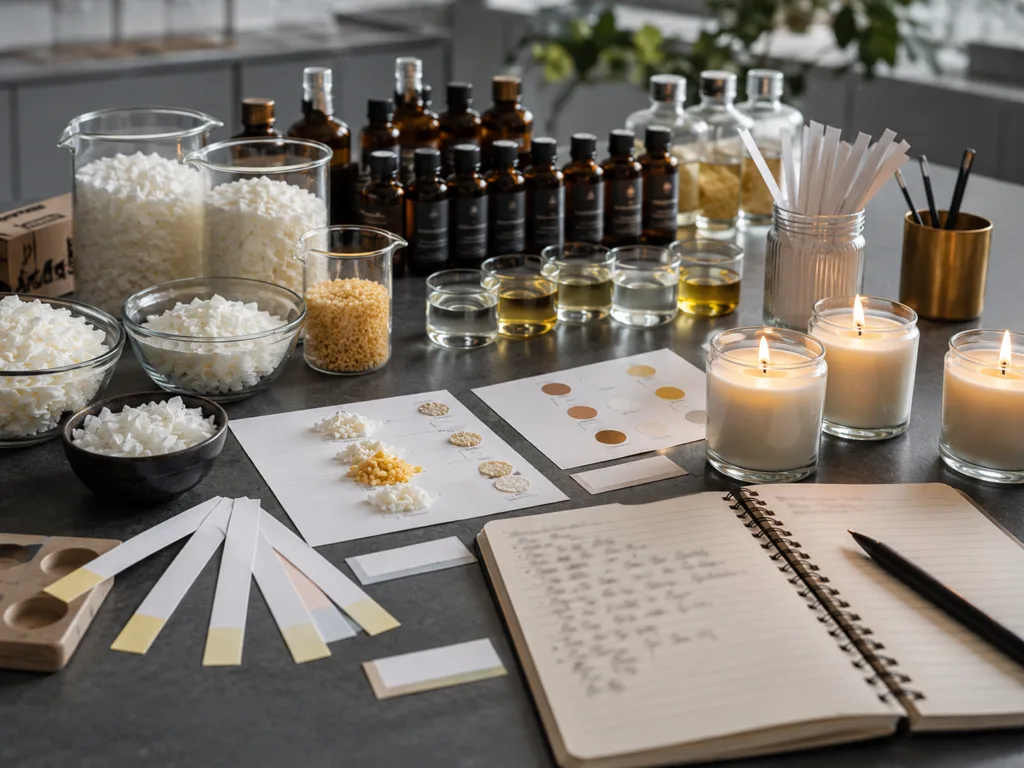
3. Check Cold Throw and Hot Throw, Not Just the Fragrance Name
Many buyers choose scents by name. Vanilla. Lavender. Sandalwood. Rose. Amber. Fig. White tea. Citrus. Sea salt.
These names are useful, but they are not enough.
For wholesale scented candles, you need to test both cold throw and hot throw.
Cold throw is the scent when the candle is not burning. It matters for retail stores because customers often smell the candle before buying. Hot throw is the scent when the candle is burning. It matters for real use, customer reviews, and repeat sales.
A candle can smell strong when cold but weak when burning. Another candle can smell soft when cold but perform well in a room after 30 minutes of burning.
B2B buyers should also think about fragrance style. Popular scents are safer for fast sales. Signature scents are better for brand difference.
For retailers and wholesalers, popular scents may include:
- Vanilla
- Lavender
- Sandalwood
- Amber
- Rose
- Citrus
- White tea
- Sea salt
- Fig
- Oud
For hotels, spas, and private label brands, a custom fragrance can be more valuable. A signature scent can help customers remember the brand. But custom fragrance development needs more time, sampling, and testing.
Before placing a bulk order, confirm:
- Fragrance load percentage
- Cold throw result
- Hot throw result
- Scent strength level
- Fragrance oil safety documents
- Whether the scent fits your target market
- Whether the fragrance can stay stable during production
For fragrance compliance, buyers often request documents such as IFRA certificates and SDS. IFRA standards are global fragrance industry guidelines for the safe use of fragrance ingredients, while buyers still need to follow local market rules.
4. Match the Wick to the Wax, Jar, and Fragrance
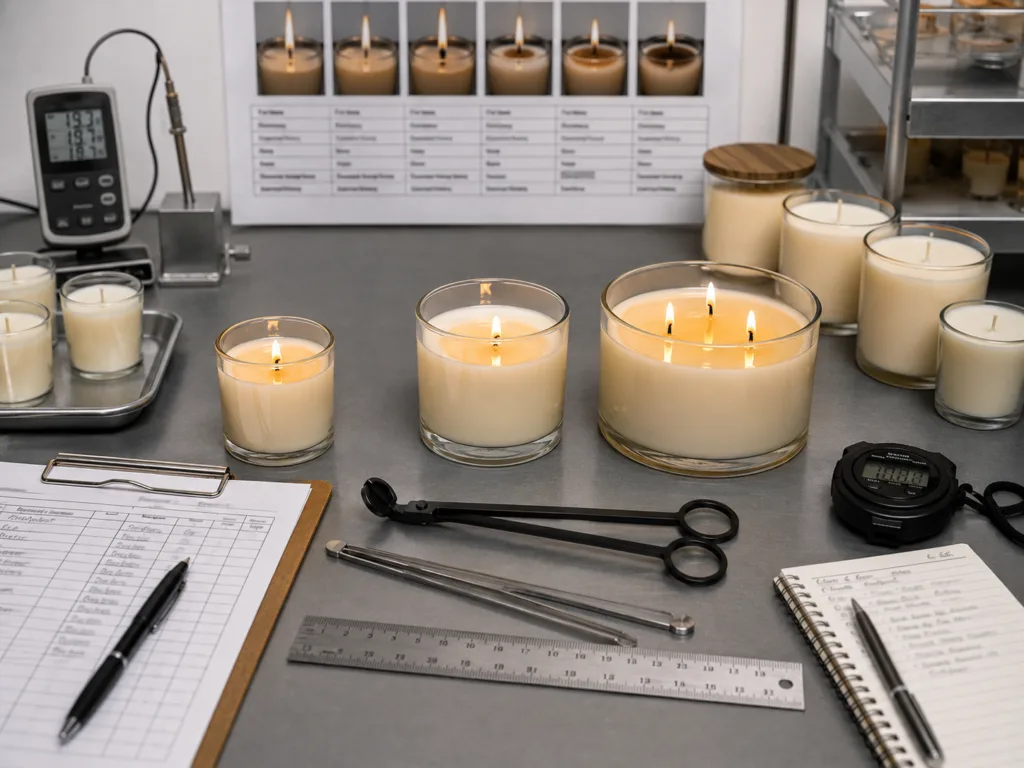
The wick is small, but it can decide whether a candle succeeds or fails.
A wrong wick can cause many problems:
- Tunneling
- Too much soot
- Weak scent throw
- High flame
- Jar overheating
- Uneven wax pool
- Poor burn time
- Mushrooming at the wick tip
For B2B buyers, wick testing is not optional. It is a key part of product development.
The wick must match the wax, fragrance load, jar diameter, and candle size. A wider jar usually needs a larger wick or even double wicks. A fragrance with heavy notes may burn differently from a light citrus scent. A ceramic vessel may hold heat differently from glass.
Do not approve a bulk order only from photos.
Ask for burn test details or sample testing. A good supplier should test the wick before mass production. The test should check flame height, wax pool, jar temperature, soot, burn time, and remaining wax.
For large orders, even a small wick mistake can create a serious problem. It can lead to customer complaints, returns, safety issues, and brand damage.
5. Select the Right Vessel for Cost, Branding, and Shipping
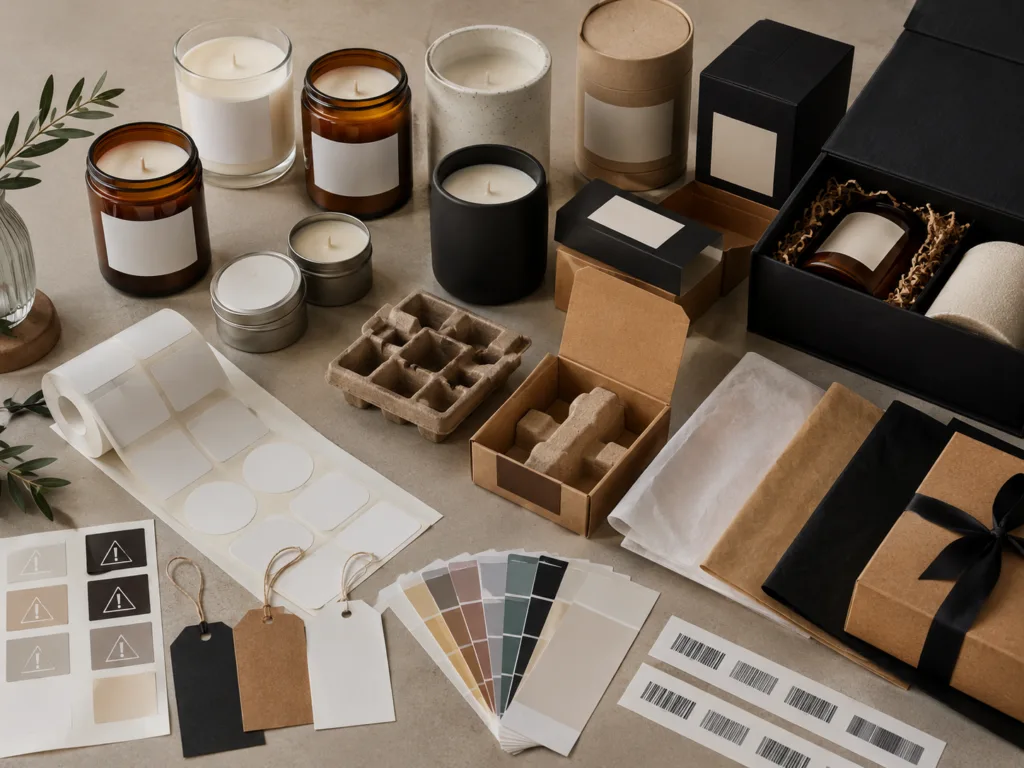
The candle vessel affects product value and shipping risk.
Common vessel options include:
- Clear glass jars
- Frosted glass jars
- Amber glass jars
- Black glass jars
- Ceramic vessels
- Concrete jars
- Travel tins
- Refillable candle jars
Glass jars are common and flexible. They work for many price levels. Frosted glass gives a soft premium look. Amber glass fits natural, apothecary, and wellness styles. Ceramic vessels feel more high-end and reusable, but they can cost more and need stronger packing.
Travel tins are light and useful for gift sets or lower-cost lines. Refillable jars can support a more sustainable brand story.
Before choosing a vessel, buyers should confirm:
- Jar size
- Wax fill weight
- Full product weight
- Heat resistance
- Inner diameter
- Surface finish
- Color consistency
- Defect rate
- Breakage risk
- Packaging protection
- MOQ for custom colors or molds
A beautiful vessel is not enough. It must survive filling, cooling, labeling, packing, shipping, warehousing, and final sale.
If you plan to create a custom mold, ask about mold cost, sample time, production MOQ, and lead time. Fully custom vessels are better for mature brands with long-term volume. For smaller test orders, using existing vessel styles with custom labels or packaging is usually safer.
6. Do Not Treat Packaging as Decoration Only
Packaging is both a branding tool and a protection system.
For wholesale scented candles, packaging must do three jobs:
First, it must present the product well. Second, it must protect the candle during shipping. Third, it must carry required product information.
Common packaging options include:
- Kraft box
- Rigid gift box
- Paper tube
- Window box
- Sleeve box
- Custom label
- Warning label
- Barcode label
- Hang tag
- Gift set packaging
- Carton dividers
- Protective inserts
Premium buyers often focus on outer packaging design. That is important, but export packing is just as important.
Candles are heavy and fragile. Glass jars can break. Wax can melt or sweat in high temperature. Boxes can be crushed. Labels can shift if the surface or adhesive is not right.
Before placing a bulk order, check:
- Does each candle need an inner box?
- Is there a divider inside the export carton?
- Is the gift box strong enough?
- Can the label stay flat on the jar?
- Is the barcode position correct?
- Are carton marks clear?
- Is the packing suitable for air or sea shipping?
- Has the supplier considered drop and pressure risk?
Good packaging reduces damage, complaints, and hidden costs.
7. Confirm MOQ, Customization Level, and Real Unit Cost
Many B2B buyers ask one question first: “What is your price?”
But the unit price depends on many details.
For wholesale scented candles, price is affected by:
- Candle size
- Wax type
- Fragrance quality
- Fragrance load
- Vessel material
- Lid type
- Label material
- Box structure
- Printing method
- Order quantity
- Number of scents
- Number of packaging designs
- Testing needs
- Shipping method
A low unit price may not include custom packaging, premium fragrance, strong carton packing, or compliance documents.
Buyers should also understand the difference between light customization and full customization.
Light customization may include existing jars, standard scents, logo labels, and standard boxes. This is faster and usually has a lower MOQ.
Private label customization may include custom fragrance, custom label, custom box, barcode label, warning label, and retail-ready packing. This is better for brands and retailers.
Full customization may include custom vessel mold, custom color, custom lid, custom fragrance, and custom gift packaging. This needs higher MOQ, longer lead time, and higher development cost.
Mature buyers should not only compare unit prices. They should compare total project cost and risk.
Ask your supplier:
- What is the MOQ per scent?
- What is the MOQ per jar style?
- What is the MOQ per packaging design?
- Are samples charged?
- Is the mold fee refundable after bulk order?
- What does the unit price include?
- What is not included?
- What is the estimated shipping cost?
- What is the lead time for each stage?
This helps avoid surprises after the project starts.
8. Review Safety, Labeling, and Compliance Documents Early
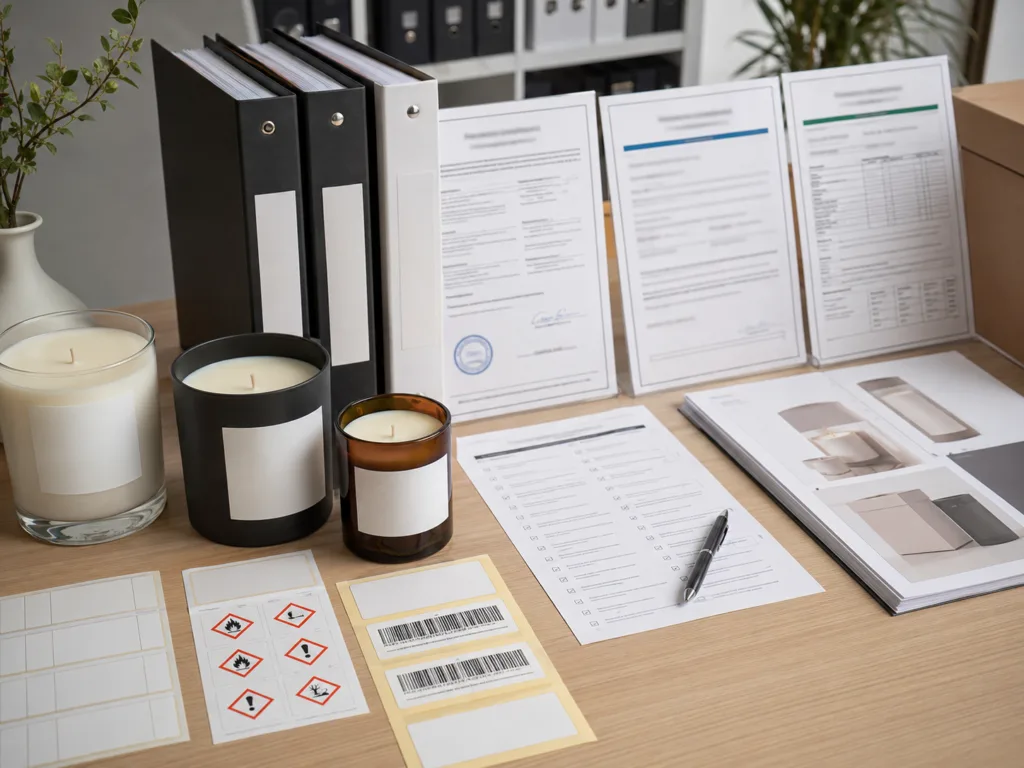
Candles are products with fire risk. For B2B buyers, safety and labeling cannot be left until the last minute.
Different markets have different rules and expectations. The European candle sector commonly refers to EN 15493 for fire safety, EN 15494 for product safety labels, and EN 15426 for sooting behavior. In the United States, candle safety discussions often refer to ASTM standards such as ASTM F2417 and F2058 for fire safety and candle holders.
B2B buyers should ask suppliers what documents they can support. Common documents may include:
- SDS
- IFRA certificate
- Fragrance allergen declaration
- Wax or fragrance MSDS if needed
- Candle warning label
- Product specification sheet
- Packing list
- Carton label
- Test report if required
For EU buyers, CLP labeling may also be important when fragrance allergens are involved. Buyers should confirm local requirements with their compliance team or importer before final artwork approval.
A reliable supplier should not guess your market rules. But they should understand basic export document support and warning label needs.
This is especially important for mature buyers selling through retail chains, online platforms, hotels, or distributors.
9. Always Approve Samples Before Bulk Production
Samples are not just for checking whether the candle looks pretty.
Samples help buyers check real product performance before money is locked into mass production.
A good sample review should include:
- Jar quality
- Wax surface
- Wick position
- Label position
- Box printing
- Scent strength
- Cold throw
- Hot throw
- Burn pool
- Flame height
- Soot level
- Burn time
- Packaging protection
- Product weight
- Color match
- Logo effect
If the order includes custom fragrance, custom vessel, or custom box, sampling is even more important.
For mature buyers, the sample approval process should be written and clear. Do not rely only on chat messages. Confirm the final sample version, scent name, wax type, packaging artwork, label content, carton packing, and production quantity.
A small mistake in sample approval can become a large mistake in bulk production.
10. Set a Realistic Production and Shipping Timeline
Wholesale scented candles need time.
The timeline may include:
- Product discussion
- Quotation
- Sample making
- Sample shipping
- Sample testing
- Artwork adjustment
- Packaging proofing
- Material purchasing
- Candle filling
- Cooling and curing
- Labeling
- Packing
- Quality inspection
- Export booking
- International shipping
For simple stock-style candles with light customization, the timeline can be shorter. For custom fragrance, custom packaging, or new vessel development, buyers need more time.
Seasonal orders need extra planning.
For example, Christmas, Black Friday, Valentine’s Day, Mother’s Day, wedding season, and hotel gift projects should be planned early. Waiting too long can lead to higher shipping costs, rushed production, and packaging mistakes.
Ask your supplier for a timeline by stage, not only one general delivery date.
You should know:
- Sample lead time
- Packaging lead time
- Bulk production time
- Inspection time
- Shipping time
- Peak season risk
- Latest order date for your launch
A mature buyer plans backward from the retail launch date.
11. Use a Quality Control Checklist Before Shipment
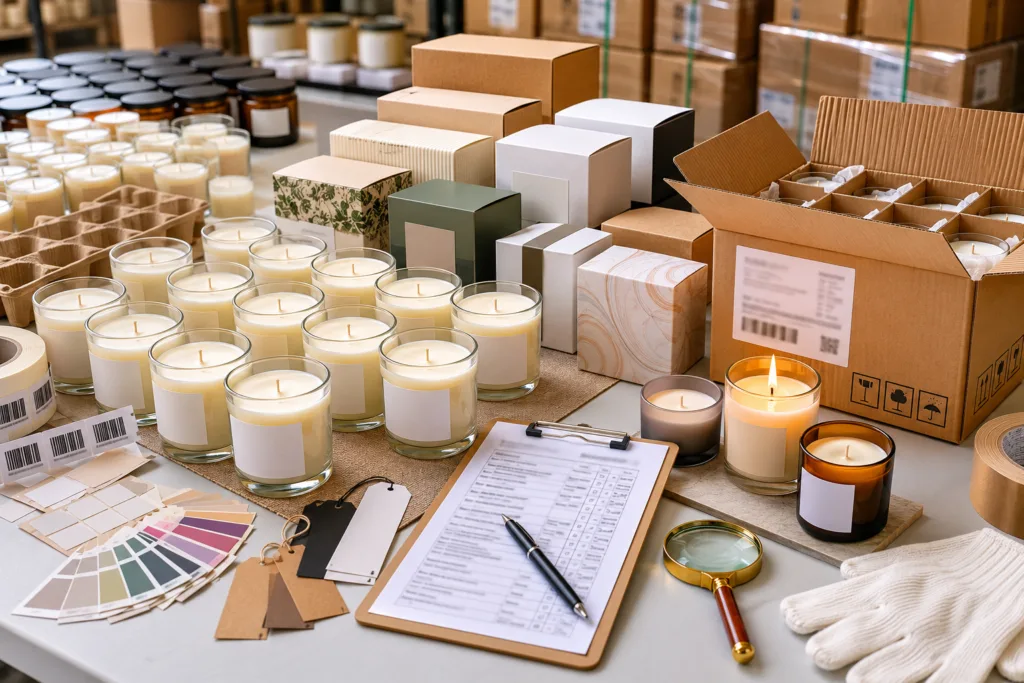
Quality control is where many candle orders are saved or lost.
Before shipment, buyers should ask what the supplier checks. For large orders, you may also arrange third-party inspection.
A wholesale scented candle QC checklist should include:
- Wax surface condition
- Wick centering
- Net weight
- Fragrance consistency
- Jar defects
- Color difference
- Label position
- Box printing quality
- Barcode readability
- Warning label accuracy
- Carton packing
- Carton weight
- Carton marks
- Random burn test
- Leakage or sweating
- Broken jar risk
- Gift box damage
- Quantity per carton
Do not only inspect the candle. Inspect the full retail unit and the export carton.
A candle can be well made but poorly packed. That still creates loss.
For importers, wholesalers, and retail buyers, strong QC helps protect margins. It also protects your relationship with your own customers.
12. Choose a Supplier That Understands B2B Risk
A good wholesale candle supplier should do more than make candles.
For mature B2B buyers, the right supplier should understand product development, packaging, compliance, shipping, and long-term reorder needs.
When choosing a supplier, check whether they can support:
- Existing candle styles for faster orders
- Custom fragrance development
- Private label packaging
- Glass, ceramic, tin, or gift set options
- Proper warning labels
- Export carton packing
- Sample approval process
- Stable bulk production
- Compliance document support
- Quality inspection before shipment
- Clear MOQ and lead time communication
The best supplier is not always the cheapest one. The best supplier is the one that helps reduce risk and supports your business model.
For a serious retail buyer, hotel group, importer, or brand owner, hidden costs are often more dangerous than a slightly higher unit price. Broken jars, weak scent, wrong labels, late delivery, and poor packaging can cost more than the product itself.
Final Thoughts: Order Wholesale Scented Candles With a Buyer’s Checklist
Wholesale scented candles can be a profitable product line, but only when the order is planned correctly.
Before placing a bulk order, B2B buyers should confirm the sales channel, wax type, scent performance, wick testing, vessel choice, packaging structure, MOQ, compliance needs, sample approval, lead time, and quality control process.
A professional candle order is not built from one nice photo. It is built from clear specifications, tested samples, strong packaging, and supplier support.
If you are sourcing wholesale scented candles for retail stores, hotels, spas, corporate gifts, import distribution, or private label projects, prepare your requirements before asking for a final quote. The more clearly you define your market, budget, quantity, packaging style, and compliance needs, the faster your supplier can recommend the right solution.
A well-planned candle order can help you reduce risk, protect your brand, and build a product line that customers want to buy again.
FAQ
1. What should B2B buyers check before ordering wholesale scented candles?
B2B buyers should check wax type, fragrance performance, wick testing, jar quality, packaging strength, MOQ, safety labels, compliance documents, sample quality, lead time, and pre-shipment inspection. These details help reduce risk before bulk production.
2. What is a good MOQ for wholesale scented candles?
MOQ depends on the customization level. Existing jars with standard scents and logo labels usually have a lower MOQ. Custom fragrance, custom packaging, custom vessel colors, or new molds need higher MOQ because they require extra material, testing, and production setup.
3. Are samples necessary before placing a bulk candle order?
Yes. Samples are important for checking scent, wax surface, wick position, burn quality, label effect, packaging, and shipping protection. For wholesale scented candles, sample approval helps buyers avoid costly mistakes in bulk production.