
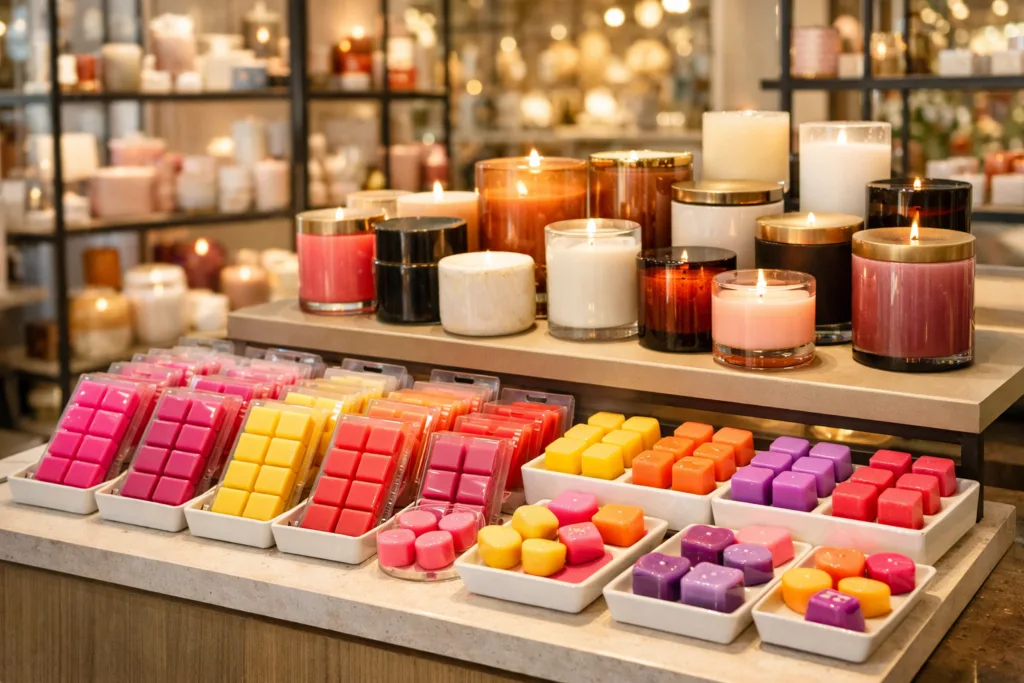
 Walk into any mature candle retail environment — whether an independent boutique, national retail chain, museum store, spa retail space, or lifestyle concept store — and a consistent merchandising pattern emerges. Candles are almost never presented alone. Wax melts are positioned alongside them, often within the same visual merchandising zone, fragrance grouping, or seasonal display.
This is not a coincidence. It is not a stylistic choice. It is a structural retail strategy.
For professional buyers, private label brands, and large‑scale retailers, selling candles and wax melts together serves multiple commercial objectives simultaneously. This pairing increases average order value, accelerates customer acquisition, improves inventory efficiency, and strengthens long‑term customer retention. More importantly, it creates a complete fragrance ecosystem that supports sustainable revenue growth.
Understanding why this strategy works — and how to implement it correctly — is essential for any serious candle program.
Candles Serve as the Anchor Product — Wax Melts Serve as the Volume Driver
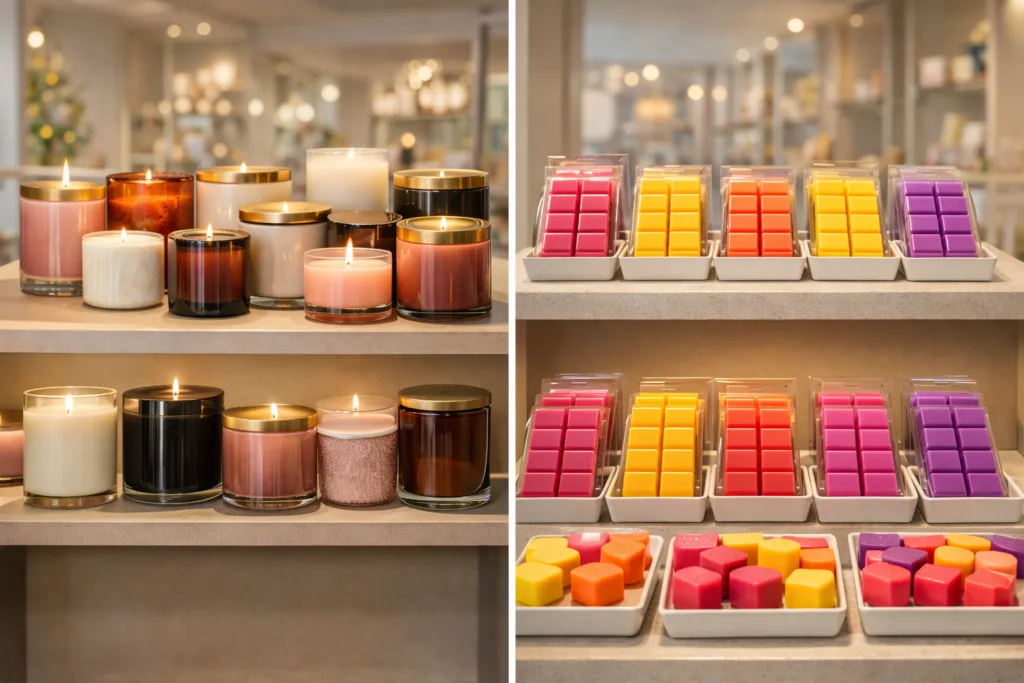 In mature fragrance retail programs, candles function as the anchor product. They define brand identity, establish price positioning, and provide visual authority on the shelf.
Candles carry several structural advantages in this role:
• They communicate brand value clearly
• They create a strong visual merchandising presence
• They justify premium pricing structures
• They function effectively as gift items
However, candles alone cannot optimize retail velocity.
Wax melts serve a different, equally important function. They operate as volume drivers — products designed to increase purchase frequency, lower entry barriers, and expand fragrance exploration without introducing excessive cost or risk for the customer.
Together, candles and wax melts create a balanced product architecture:
• Candles establish brand and margin structure
• Wax melts increase transaction frequency
• Candles support premium positioning
• Wax melts support repeat purchasing behavior
This dual‑product structure is one of the most efficient ways to stabilize and scale a fragrance retail program.
Wax Melts Lower Customer Entry Barriers Without Diluting Brand Positioning
Customer acquisition cost is one of the most important variables in retail profitability. Every retail buyer, whether operating physical stores or ecommerce platforms, must continuously balance customer acquisition with lifetime value.
Candles, particularly those positioned within the mid‑premium or premium segment, typically retail between $18 and $48 depending on vessel material, fragrance composition, and brand positioning.
For new customers unfamiliar with a brand, this price point represents a commitment.
Wax melts provide a structurally lower‑risk entry point.
Because wax melts do not require a permanent container, lid, or heavy packaging, their retail price can remain significantly lower while maintaining healthy margins. Customers can explore the fragrance profile, evaluate scent quality, and experience brand identity without committing to a full candle purchase.
This allows retailers to capture new customers who might otherwise hesitate.
Once trust is established through lower‑risk products, customers transition naturally toward higher‑value candle purchases.
This progression follows a predictable retail funnel structure:
Entry product: wax melts
Core product: candles
Premium product: gift sets and larger format candles
This funnel improves overall conversion efficiency while protecting brand positioning.
Wax Melts Increase Average Order Value Through Strategic Attachment
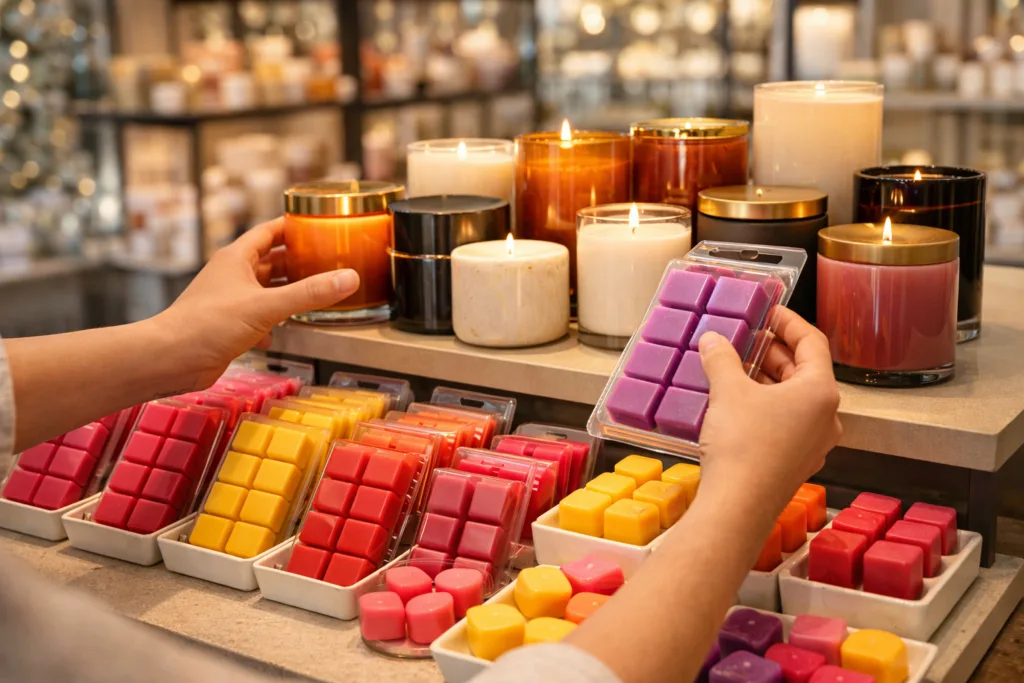 One of the most consistent performance metrics across mature candle retailers is the attachment rate of wax melts to candle purchases.
Wax melts function exceptionally well as attachment products due to several structural characteristics:
• Low incremental cost relative to candle price
• High sensory appeal
• Small physical footprint
• Strong impulse purchase behavior
Customers purchasing a candle are already engaged in fragrance selection. Introducing complementary wax melts in alternative scents encourages incremental purchasing without significant resistance.
A typical transaction pattern illustrates this clearly:
Initial purchase intent:
1 candle at $32
Final basket:
1 candle at $32
2 wax melts at $12 each
Total transaction value increases to $56.
This represents a 75 percent increase in revenue from the same customer interaction.
This type of attachment behavior significantly improves retail efficiency without increasing marketing costs or customer acquisition expense.
For high‑volume retail programs, the cumulative impact on annual revenue is substantial.
Wax Melts Accelerate Fragrance Discovery and Expand Future Candle Sales
 Fragrance selection inherently involves uncertainty. Customers cannot fully predict how a scent will perform within their home environment.
Candles represent a single fragrance commitment per unit. Purchasing multiple candles introduces cost, storage, and usage limitations.
Wax melts solve this limitation efficiently.
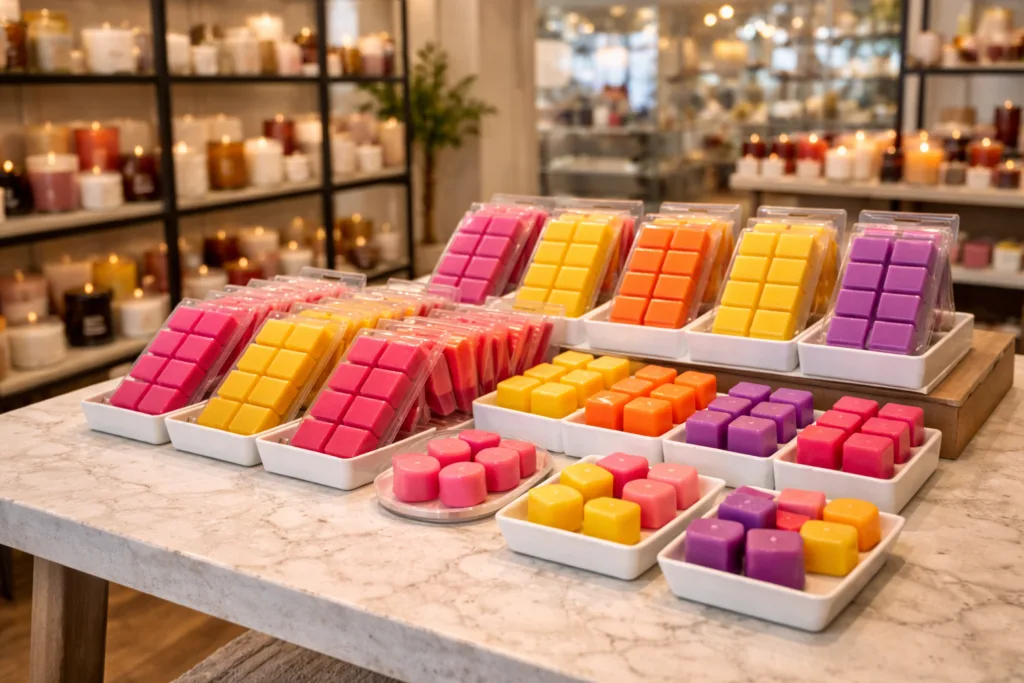
Because they are smaller and less expensive, customers can explore multiple fragrance profiles simultaneously. This accelerates fragrance discovery and reduces decision friction.
More importantly, wax melts function as a fragrance testing mechanism that supports future candle purchases.
Customers who discover preferred fragrances through wax melts frequently upgrade to candle formats once confidence in the scent is established.
This expands long‑term candle sales rather than replacing them.
In this structure, wax melts serve as conversion accelerators rather than substitutes.
Wax Melts Improve Inventory Efficiency and Reduce Operational Risk
From a supply chain perspective, wax melts offer several operational advantages compared to container candles.
They require:
• No fragile glass containers
• No ceramic vessels
• No lids or complex assembly
• Minimal packaging weight
This reduces multiple cost variables simultaneously:
• Lower inbound shipping cost
• Lower outbound shipping cost
• Lower breakage rates
• Lower storage cost per unit
Wax melts also allow retailers to expand fragrance variety without introducing the financial burden of additional container inventory.
This flexibility is particularly valuable for seasonal rotations, limited editions, and regional fragrance variations.
Retailers can test fragrance performance using wax melts before committing to larger candle production runs.
This reduces inventory risk and improves forecasting accuracy.
Wax Melts Increase Purchase Frequency and Customer Lifetime Value
Candles have relatively long usage cycles. A typical candle may last between 30 and 60 hours depending on size.
This means customers may only repurchase candles every one to three months.
Wax melts have shorter usage cycles, often lasting one to three weeks depending on usage frequency.
This shorter lifecycle increases customer return frequency.
More frequent purchasing creates several structural advantages:
• Higher annual revenue per customer
• Increased brand exposure
• Stronger customer retention
• Greater opportunity for cross‑selling
Retail programs that incorporate wax melts consistently demonstrate higher customer lifetime value compared to candle‑only programs.
Wax Melts Support More Efficient Merchandising and Display Density
Retail space is one of the most expensive assets in physical retail.
Wax melts allow retailers to increase product density without increasing display footprint.
Because wax melts are smaller, retailers can present a broader fragrance range within the same shelf space.
This improves visual variety and encourages exploration.
Increased fragrance variety increases engagement time, which correlates strongly with higher conversion rates.
Wax melts also support flexible merchandising strategies such as:
• Seasonal fragrance displays
• Limited edition collections
• Promotional bundles
• Discovery sets
This improves merchandising agility without introducing structural complexity.
Wax Melts Deliver Higher Margins Relative to Production Cost
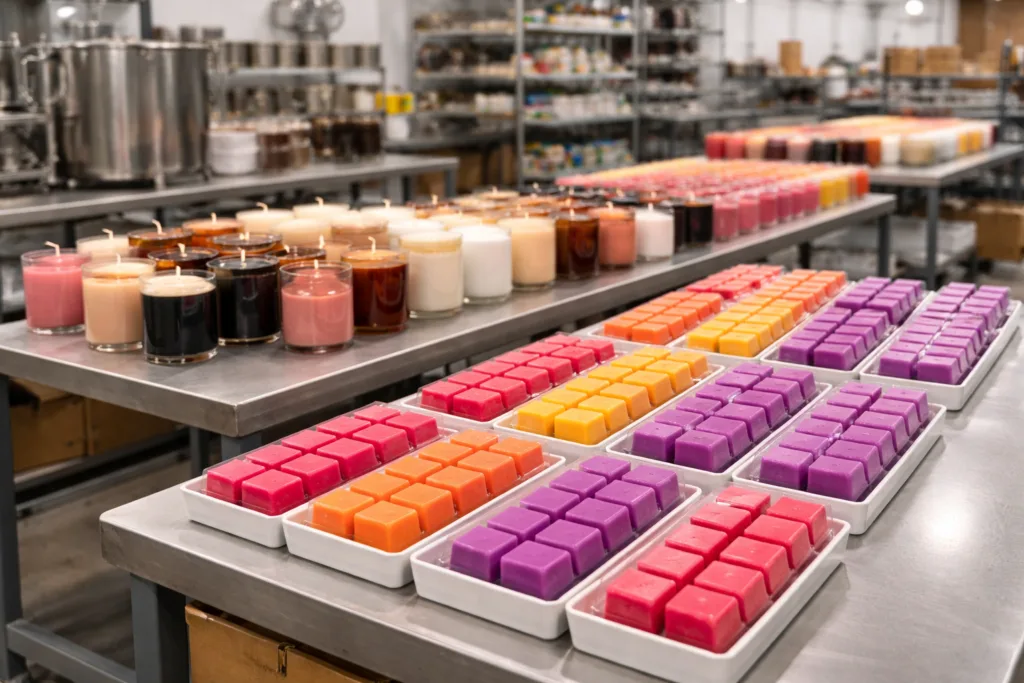 From a manufacturing perspective, wax melts eliminate several cost components associated with candles.
They do not require:
• Glass vessels
• Ceramic containers
• Lid components
• Complex assembly
Material cost per unit is lower, while retail pricing remains strong due to perceived fragrance value.
This often results in margin structures comparable to or exceeding candle margins on a percentage basis.
For private label buyers and retail chains operating at scale, wax melts provide an efficient mechanism to increase margin contribution without increasing operational overhead.
Wax Melts Strengthen Private Label Programs and Product Line Scalability
Private label candle programs benefit significantly from including wax melts.
Wax melts allow buyers to:
• Expand product assortment efficiently
• Introduce new fragrances with lower risk
• Increase SKU depth without large capital investment
• Improve supply chain flexibility
Wax melts also provide an effective entry point for new retail partners testing a fragrance program.
Once sales performance is validated, retailers can expand into larger candle formats with greater confidence.
This staged expansion model improves capital efficiency and reduces risk exposure.
Candles and Wax Melts Together Create a Complete Fragrance Ecosystem
The most successful fragrance retail programs are not built around a single product category. They are built around a complete fragrance ecosystem.
Candles provide identity, visual presence, and premium positioning.
Wax melts provide volume, flexibility, and repeat purchase frequency.
Together, they create a structurally balanced retail program capable of supporting both brand positioning and scalable revenue growth.
For professional buyers, incorporating both products is not optional. It is foundational.
Retailers operating at scale consistently adopt this dual‑product structure because it improves revenue stability, operational efficiency, and long‑term profitability.
Conclusion: Why Mature Retail Programs Always Include Both Products
Selling candles without wax melts limits retail efficiency.
Selling wax melts without candles limits brand positioning.
Selling both together creates a structurally optimized retail program that supports customer acquisition, retention, and revenue growth.
For mature retail buyers, private label brands, and fragrance programs operating at scale, the combination of candles and wax melts is not a trend. It is a proven commercial strategy.
FAQ
Do wax melts reduce candle sales?
No. Wax melts typically increase candle sales by allowing customers to explore fragrances at lower risk. Once customers identify preferred scents, they frequently upgrade to candle formats. Wax melts function as conversion accelerators rather than substitutes.
Are wax melts profitable for retailers?
Yes. Wax melts often deliver strong margins due to lower production and shipping costs while maintaining strong retail pricing. Their smaller size and lower cost also increase purchase frequency and attachment rates.
Should private label candle brands offer wax melts?
Yes. Including wax melts improves product line scalability, increases customer acquisition efficiency, and strengthens long‑term revenue potential. Most mature private label candle programs include both formats as part of a complete fragrance strategy.