
In candle product development, many brands spend most of their early attention on fragrance, wax type, vessel shape, and unit cost. Those details matter. A candle that burns poorly, smells weak, or arrives damaged will not survive in the market for long. But there is another element that often decides whether a buyer notices the product in the first place: the label.
A custom candle label is not just a sticker on a jar. It is a compressed branding system. It tells the buyer what kind of product they are looking at before they smell the fragrance, touch the glass, open the box, or read the ingredients. In a few square inches, the label communicates price level, design taste, product category, scent direction, emotional mood, and brand credibility.
For mature candle buyers, especially retailers, wholesalers, boutique owners, hotel groups, spa brands, gift companies, and private label brands, the label is not a decorative afterthought. It is a commercial tool. It affects shelf appeal, perceived value, retail readiness, compliance communication, product-line consistency, and consumer confidence.
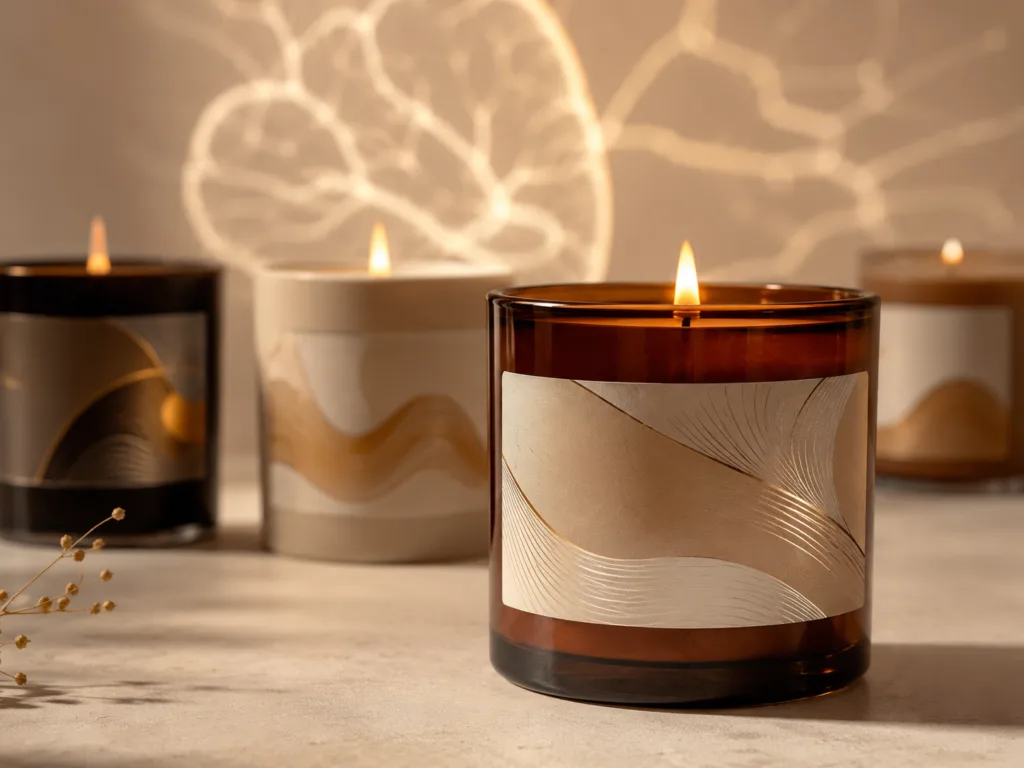
This is why custom candle labels deserve a serious place in the product development process. A good label helps a simple candle look like a real brand. A weak label can make an expensive candle look unfinished.
From a neuromarketing perspective, the label works before rational evaluation begins. The consumer does not first calculate wax weight, fragrance load, glass thickness, or production MOQ. The consumer first reacts to visual cues: contrast, color, typography, spacing, texture, symmetry, hierarchy, and material finish. These cues create an immediate impression of quality or cheapness, calm or clutter, luxury or mass market, trust or uncertainty.
For B2B buyers working with limited development budgets, this is extremely important. You may not always be able to create a custom ceramic vessel, a complex rigid box, or a fully bespoke fragrance from the first order. But you can often create strong marketing value through label design, label material, packaging hierarchy, and visual consistency. In other words, custom candle labels can be one of the most cost-effective ways to improve perceived value without completely changing the product formula.
This article explains how custom candle labels influence candle branding, buyer perception, retail presentation, and private label product development. It also shows how candle brands can use label design strategically to create stronger visual communication and better commercial results within a realistic budget.
1. Why Custom Candle Labels Matter More Than Many Brands Think
A candle label does several jobs at once. It identifies the product, introduces the brand, communicates the scent, supports compliance, and creates a visual promise. For a consumer, the label answers silent questions within seconds:
Is this candle premium or basic?
Is it natural, romantic, minimalist, bold, masculine, seasonal, wellness-focused, or gift-oriented?
Does this brand look professional?
Would this product look good on a shelf, bedside table, bathroom counter, hotel room, spa reception desk, or gift display?
Would I feel comfortable giving this candle as a gift?
These questions are not always processed consciously. This is where neuromarketing becomes useful. Human decision-making often starts with fast visual interpretation before slower rational comparison. Consumers may later justify a purchase by saying they liked the scent, price, or ingredients, but the initial attraction often begins with design.
A label is one of the first design signals. Even if the vessel and fragrance are strong, poor labeling can damage the product’s perceived value. A blurry logo, crowded text, wrong font, cheap material, weak alignment, or mismatched color palette can make the candle look amateur. On the other hand, a well-designed label can make a standard glass candle feel boutique, giftable, and retail-ready.
For retailers and wholesalers, this matters even more. They are not only buying a candle; they are buying something that must perform in a sales environment. A product with stronger shelf presence is easier to display, easier to explain, and easier to sell. A product that already looks like a finished brand reduces the buyer’s risk.
This is why custom candle labels have a direct impact on B2B purchase confidence. Mature buyers do not only ask, “Can you make candles?” They ask, “Can this product compete in my market?”
A strong label helps answer yes.
2. The Neuromarketing Logic Behind Candle Label Design
Neuromarketing does not mean manipulating customers with tricks. For product design, it means understanding how people respond to visual and sensory signals. Candles are emotional products. They are linked with comfort, home, memory, atmosphere, self-care, romance, gifting, hospitality, and identity. The label must communicate that emotional value quickly.
A candle is rarely purchased only as wax in a container. It is purchased as a mood. The label is part of that mood.
Visual Processing Happens Fast
Consumers make visual judgments very quickly. Before they read the scent description, they notice the overall look. Is the design clean or messy? Does it feel balanced? Does it look expensive? Does it fit their personal taste? Is it something they would place in their home?
This is why layout and hierarchy matter. A candle label needs to guide the eye naturally. The buyer should be able to recognize the brand, understand the scent, and feel the product’s positioning without effort.
A common mistake is trying to say everything on the front label. Many new brands place the logo, scent name, wax type, long fragrance description, net weight, origin, warning message, slogan, website, and decorative graphics all on the same small surface. The result is visual overload.
When the brain sees too much information at once, it does not feel premium. It feels noisy.
Texture Creates Quality Expectations
Touch and visual texture affect perceived value. A matte textured paper label feels different from a glossy plastic label. A foil-stamped logo reflects light and can signal gifting or luxury. A transparent label can make a candle look clean and modern. A thick paper label can support a natural or handmade identity.
The material does not need to be expensive in every case. It needs to be consistent with the brand promise. A wellness candle may benefit from soft matte paper and calm typography. A luxury holiday candle may benefit from gold foil and deep color. A masculine hotel candle may benefit from black labels, restrained typography, and minimal copy.
The label finish gives the buyer a sensory expectation before the candle is used.
Color Influences Category Recognition
Color helps consumers categorize products. Soft beige, sage green, warm white, and kraft tones often suggest natural, organic, wellness, or home comfort. Black, charcoal, navy, burgundy, and deep green can suggest premium, masculine, formal, or hotel-style candles. Pastel tones may support spring, bridal, or lifestyle gifting. Metallic accents often increase perceived gift value.
Color should not be chosen only because it is beautiful. It should help the buyer understand the product’s category and intended use.
For example, a lavender spa candle with neon red typography creates confusion. A Christmas candle with pale beige minimalist labeling may look elegant, but it may not create enough seasonal impact for gift retail. A masculine amber candle with a floral watercolor label may attract the wrong audience.
Good candle label design creates visual alignment between scent, vessel, packaging, and target customer.
Simplicity Reduces Cognitive Friction
In many product categories, premium design is not about adding more. It is about removing what does not help the buyer decide. A clean label with good spacing can feel more expensive than a label filled with decorative elements.
For candles, simplicity is especially powerful because the product itself is already associated with calm, atmosphere, and sensory pleasure. When the label is too crowded, it works against the emotional reason people buy candles.
This does not mean every candle label must be minimalist. A vintage, botanical, holiday, or illustrated label can be rich and expressive. But even expressive design needs hierarchy. The buyer must still understand the brand, scent, and product mood quickly.
3. Custom Candle Labels and Perceived Value
Perceived value is not the same as production cost. A candle can have a high-cost formula and still look cheap if the visual presentation is weak. Another candle can use a standard vessel and become more attractive through thoughtful label design and packaging coordination.
This is why labels are powerful for brands with limited budgets. They can increase perceived value without requiring a completely custom mold or complex packaging structure.
Consider the same 220g soy candle in a standard amber glass jar. If it uses a thin white sticker with crowded text and weak alignment, it may look like a basic handmade product. If it uses a textured cream label, restrained typography, a balanced scent name, and a matching box, it can feel like a boutique product. If it uses a black matte label with foil details and a rigid gift box, it can enter a more premium gifting position.
The wax did not change. The jar may not have changed. But the market perception changed.
For B2B buyers, this is a practical lesson. If the goal is to test a product line without over-investing, label design may be the first place to create brand differentiation. Instead of spending the entire budget on a custom vessel too early, a brand can begin with stock glass, strong label design, carefully selected fragrance, and coordinated packaging.
A custom label can help a standard candle feel less generic.
The Label Defines Price Expectation
Consumers often use packaging cues to estimate what a product should cost. A candle with poor label material and weak print quality may feel difficult to sell at a premium price. A candle with elegant typography, proper spacing, and a refined finish may support a higher retail price even before the customer burns it.
This matters for gift shops, boutique retailers, hotels, spas, and lifestyle brands. Their customers are not only buying function. They are buying emotion, identity, and presentation. The label must support that price psychology.
The Label Makes the Product Giftable
Giftability is a major commercial factor in candles. Many candles are bought for birthdays, holidays, weddings, corporate gifting, hospitality welcome sets, real estate closing gifts, and seasonal promotions. In these cases, the product must look complete.
A candle without a strong label may look like a sample or a commodity. A candle with a well-designed label looks intentional. When matched with a gift box, insert, ribbon, sleeve, or outer carton, the label becomes part of the total gifting experience.
If the label looks premium, the buyer is more likely to believe the candle is suitable as a gift.
The Label Helps Build Trust
Trust is visual. A clean, professional label suggests that the brand pays attention to details. If the label is misaligned, poorly printed, or inconsistent across scents, buyers may worry about quality control in other areas too.
This is especially relevant for private label candle manufacturing. A brand may be sourcing from overseas and cannot inspect every production step in person. The final label quality becomes one of the visible signs of manufacturing discipline.
For bulk orders, consistency matters. Label placement, color accuracy, adhesive performance, batch information, and packaging alignment all affect whether the product looks professionally produced.
4. Custom Candle Labels as a Brand System, Not a Single Sticker
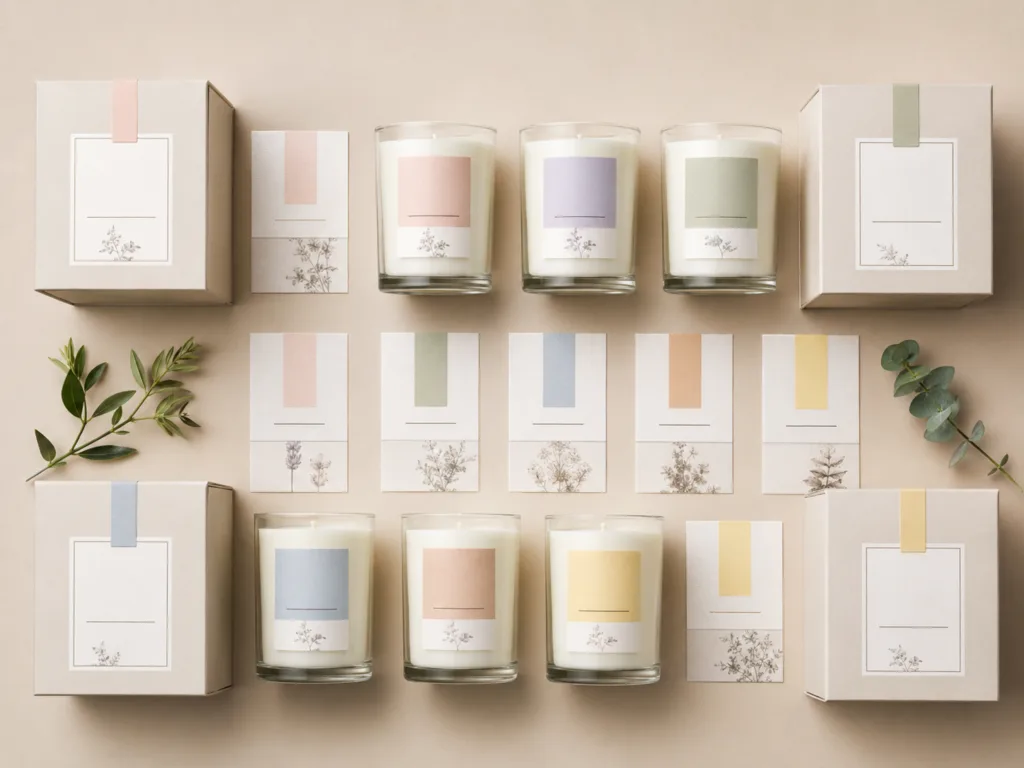
One of the biggest differences between amateur product development and mature brand development is system thinking.
A new candle brand may design one label for one scent. A mature brand designs a label system that can support multiple scents, seasonal collections, gift sets, refill formats, wax melts, reed diffusers, room sprays, and future line extensions.
A label system includes:
Brand logo placement
Font hierarchy
Color palette
Label size standards
Scent naming structure
Collection naming structure
Front label information rules
Back label or bottom label information rules
Barcode and compliance information placement
Material and finish guidelines
Packaging coordination rules
This system allows the brand to grow without looking inconsistent.
For example, if a brand launches six candles, each scent can have a different color or small graphic element, but the main structure should remain consistent. The logo should appear in the same position. The scent name should follow the same hierarchy. The label size should feel proportional across different vessels. The collection should look like one family.
This is important for retail display. A collection with visual consistency looks stronger on a shelf. It also helps consumers remember the brand. If every scent looks like a different company, the brand loses recognition.
Product Line Expansion Starts with Label Discipline
Many candle brands begin with one jar candle and later expand into wax melts, reed diffusers, room sprays, ceramic candles, travel tins, and gift boxes. If the original label system is poorly designed, expansion becomes messy.
A strong custom candle label should be flexible enough to work across future formats. The visual identity should not depend on only one vessel size. The logo, typography, and color system should be adaptable.
For buyers planning long-term private label development, this is where early design decisions have future value. A good label system saves time, reduces redesign costs, and keeps the brand recognizable as the product line grows.
5. Choosing the Right Label Material for Your Candle Brand
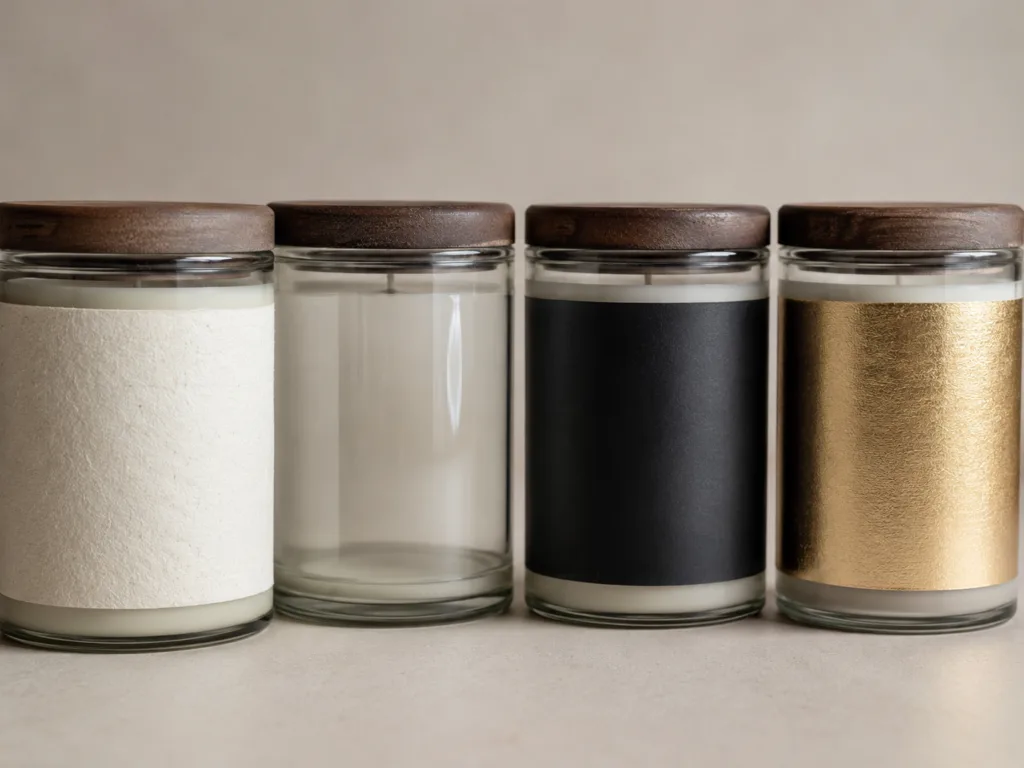
Label material affects both appearance and performance. The best material depends on the candle vessel, brand positioning, packaging style, budget, order quantity, and sales channel.
There is no single best candle label material for every brand. The right choice is the one that supports the product’s market position and survives the real supply chain.
Paper Labels
Paper labels are common for boutique, handmade, natural, and lifestyle candle brands. They can feel soft, warm, and approachable. Textured paper can add a tactile quality that works well with soy wax candles, wellness candles, botanical collections, and eco-inspired branding.
Paper labels are often more cost-friendly than complex specialty labels, but brands should still consider durability. Candles may move through production, packing, international shipping, warehouse storage, retail handling, and customer use. If the paper is too delicate or the adhesive is weak, the label may wrinkle, lift, stain, or tear.
Paper labels work best when the brand wants a natural, artisanal, calm, or premium handmade impression.
Transparent Labels
Transparent labels are often used on glass vessels when brands want a clean, modern look. They allow the color of the glass and wax to remain visible, which can create a lighter visual presence.
Transparent labels can work well for minimalist candles, amber glass jars, clear glass vessels, spa products, and modern home fragrance lines. However, they require good printing and careful application. Air bubbles, dust, poor edge cutting, or low-quality adhesive can be more visible on transparent material.
Transparent labels are not automatically premium. They look premium only when applied cleanly and matched with the right vessel.
Matte Labels
Matte labels are popular in premium candle branding because they reduce glare and create a softer, more refined look. They photograph well, which matters for e-commerce, Amazon listings, Pinterest, social media, and brand websites.
A matte white label can feel clean and modern. A matte black label can feel bold, masculine, or luxury. A matte beige label can feel warm and natural. Matte labels are versatile and often a good choice for brands that want a quiet premium feeling without excessive decoration.
Glossy Labels
Glossy labels can be useful for certain bright, colorful, playful, or mass-market candle lines. They can make colors appear more vivid and are sometimes easier to wipe clean depending on the material.
However, glossy labels can also look less premium if used without intention. For luxury candle brands, glossy surfaces may conflict with a softer, more refined visual direction unless the whole packaging system is designed around shine, contrast, and color impact.
Foil Labels
Foil labels, including gold foil, silver foil, rose gold foil, copper foil, and holographic foil, can increase perceived value and gift appeal. They are especially useful for holiday candles, wedding candles, luxury candle collections, hotel amenities, and premium gift sets.
Foil should be used carefully. Too much foil can look cheap or overly decorative. A small foil logo, scent name, line border, or accent can create a stronger effect than covering the entire label with metallic elements.
Foil also has production implications. It may require higher MOQ, additional setup cost, longer sampling time, and more precise artwork. Buyers should plan foil labels earlier in the development process rather than treating them as a last-minute upgrade.
Waterproof or Oil-Resistant Labels
For candles that will go through long-distance shipping, warehouse storage, or humid environments, durability matters. Labels should resist lifting, smudging, oil exposure, friction, and temperature changes as much as possible.
This is especially relevant for brands shipping by sea, using DDP logistics, storing inventory in overseas warehouses, or selling through retail channels where products are handled repeatedly.
A beautiful label that fails during transport is not a good label. Mature buyers should evaluate both visual quality and practical performance.
6. Label Size, Shape, and Placement: Small Details That Change Everything
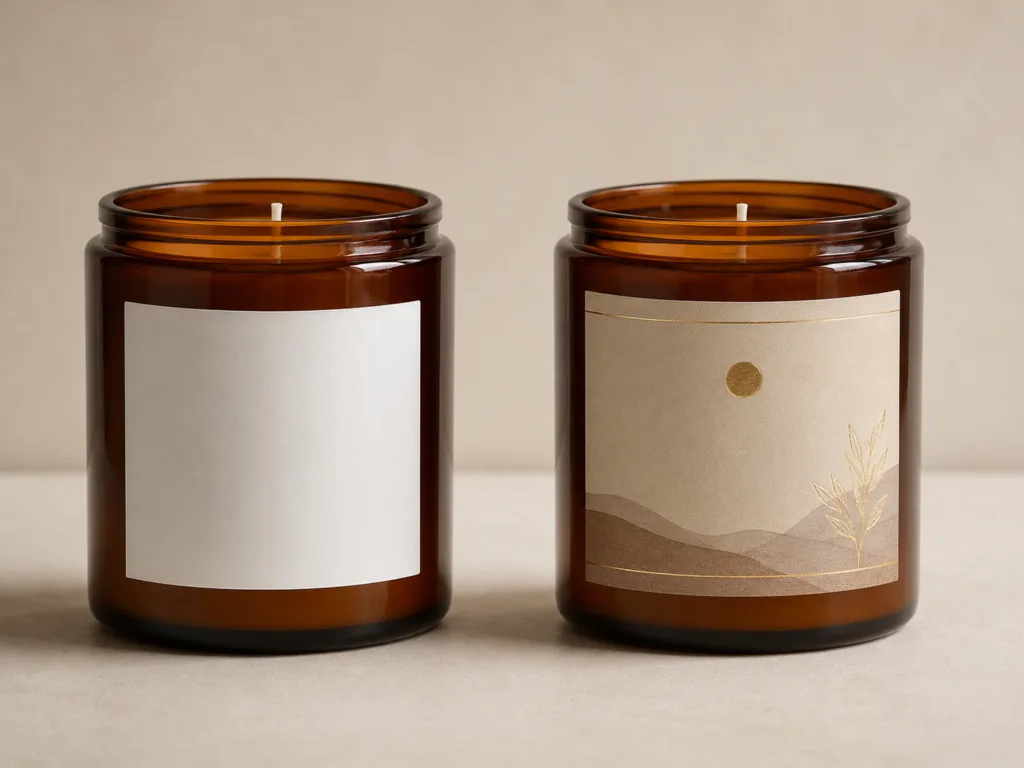
Candle label design is not only about artwork. Size and placement can make the difference between premium and awkward.
A label must fit the vessel. A tall narrow vessel needs different proportions from a short wide vessel. A curved glass jar needs a label that wraps smoothly. A square vessel needs proper alignment with edges. A ceramic vessel may require a different adhesive or smaller label depending on texture.
Label Size Controls Visual Balance
If the label is too large, it may cover too much of the vessel and make the candle look heavy. If it is too small, the brand may disappear and the product may look unfinished. The right label size depends on the diameter, height, taper, color, and material of the vessel.
For premium candles, empty space is valuable. A label does not need to cover the entire front surface. Controlled negative space can make the product feel more refined.
Label Placement Signals Quality Control
A crooked label can ruin the appearance of an otherwise good candle. In bulk production, label placement must be consistent across units. This is not only a design issue but also a manufacturing quality-control issue.
For B2B buyers, label alignment should be checked during sampling. The sample should not only be evaluated for scent and wax appearance. The buyer should also check label position, edge adhesion, print clarity, and how the product looks from different angles.
Vessel Shape Affects Label Strategy
A straight-sided glass jar is usually easier to label. A tapered vessel may require adjusted label dimensions. A ribbed glass vessel may not be suitable for large flat labels. A ceramic vessel with a rough surface may need special adhesive or alternative branding methods such as hang tags, sleeves, screen printing, or packaging-based branding.
This is why label planning should happen together with vessel selection. If the vessel is chosen first without thinking about label placement, the brand may later discover that its preferred label style does not work well.
7. What Information Should Be Included on a Candle Label?
A candle label must balance beauty and information. Too little information can create confusion. Too much information can damage the design. The key is to separate the role of the front label, back label, bottom label, and outer packaging.
Front Label
The front label should usually focus on the elements that attract and identify:
Brand name
Scent name
Collection name
Short scent direction or fragrance notes
Wax type if relevant
Net weight if required or preferred
Simple visual identity element
The front label should not carry every technical detail. Its job is to communicate the product’s mood and brand position quickly.
Back Label or Bottom Label
The back or bottom label can carry functional and compliance-related information:
Burning instructions
Safety warnings
Manufacturer or distributor information
Country of origin
Batch code
Barcode
Website
QR code
Ingredient or wax information if needed
For candles, warning information is important. Safety labels may include instructions such as trimming the wick, burning within sight, keeping away from flammable objects, keeping away from children and pets, avoiding drafts, and stopping use when a certain amount of wax remains.
The exact information needed may vary by market, sales channel, retailer requirements, and product type. Mature buyers should discuss label content early, especially if the candles will be sold in the United States, European Union, United Kingdom, or other regulated markets.
Outer Packaging
If the candle has a box, sleeve, tube, or gift set packaging, the outer packaging can carry additional storytelling and product information. This allows the front jar label to remain clean while the box communicates more details.
For premium products, the label and box should not compete. They should work together. The jar label may be minimal, while the box carries fragrance notes, brand story, barcode, and retail information.
8. Custom Candle Labels and Retail Shelf Appeal
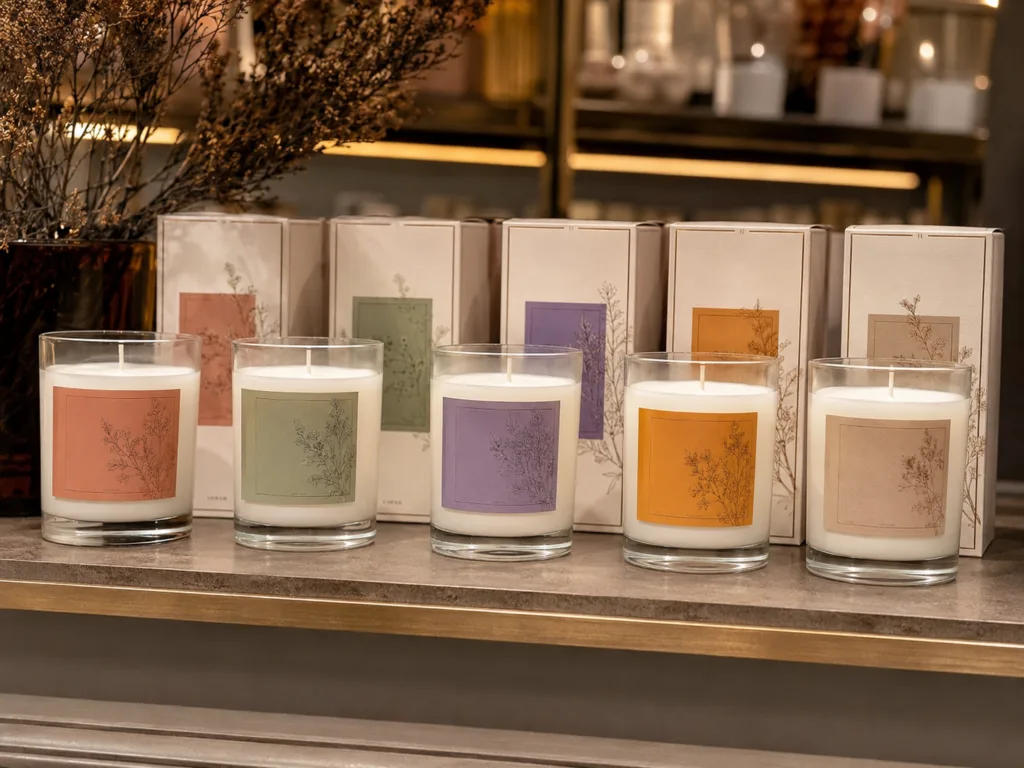
Retail shelf appeal is not about making the loudest design. It is about making the right customer notice the product and understand it quickly.
In a store, consumers are surrounded by visual choices. They may not stop to read every detail. The candle label has to create enough attraction from a distance and enough confidence up close.
From a shelf perspective, a strong candle label should communicate:
The product category
The fragrance mood
The brand identity
The price level
The intended use
The collection relationship
A label that looks beautiful in isolation may not always work on a shelf. It must also work next to other products. Boutique retailers often choose products that contribute to the overall look of their store. A candle that photographs well and displays well is easier for them to buy.
For Gift Shops
Gift shops need candles that look ready to give. Labels should feel polished, emotionally clear, and easy to understand. Seasonal colors, foil accents, elegant scent names, and matching boxes can increase gift appeal.
For Spas and Wellness Brands
Spa candles need calm, clean, sensory design. Soft colors, matte finishes, natural textures, and minimal typography often work well. The label should not feel aggressive or cluttered.
For Hotels and Hospitality
Hotel candles often require a refined, understated look. Labels may need to match interior design, brand guidelines, or room amenities. Durability and consistency are important because the product may represent the hotel’s image.
For Boutiques and Lifestyle Retailers
Boutique candles need a strong brand point of view. The label should feel distinct but not chaotic. It should help the retailer tell a story around the product.
For E-Commerce and Amazon
Online, the label must be readable in photos. Small text, low contrast, reflective material, and confusing design can reduce performance. Since customers cannot smell the product online, visual branding becomes even more important.
A candle label for e-commerce should photograph clearly, show the scent name, support lifestyle imagery, and communicate value without relying on physical touch.
9. How Custom Labels Help Buyers Maximize Marketing Value on a Limited Budget
Not every brand can afford full custom tooling from the first production run. Mature product development means knowing where to spend money first.
Custom candle labels are often one of the smartest early investments because they create visible differentiation at a manageable cost. A buyer can use a standard vessel, existing wax formula, and available fragrance library while still creating a strong branded product through labels and packaging coordination.
Start with Stock Glass and Strong Label Design
For smaller test orders or early brand launches, stock glass vessels can be a practical choice. Instead of investing in a custom mold, the buyer can choose a good existing vessel and focus on label material, design quality, scent selection, and packaging presentation.
This approach keeps development flexible while still producing a retail-ready product.
Use Label Design to Create Product Tiers
A brand can use labels to separate different price levels:
A simple paper label for core everyday candles
A textured matte label for premium wellness candles
A foil label for holiday or gift collections
A black label for hotel or masculine collections
A transparent label for minimalist modern candles
This allows the same manufacturing base to support multiple marketing positions.
Coordinate Labels with Boxes Instead of Over-Customizing the Vessel
A custom vessel can be expensive and MOQ-heavy. In many cases, a strong label plus a well-designed gift box can create enough premium value for retail testing.
For example, a standard amber glass candle with a refined label and a rigid box can look more complete than a custom vessel with weak packaging. Buyers should evaluate the total product impression rather than only one component.
Build a Scalable Label Template
A scalable label template saves cost over time. Once the brand confirms the main structure, new scents can be developed faster. The designer only needs to adjust scent names, colors, notes, or small visual elements.
This is useful for seasonal launches, limited editions, and fast product expansion.
Avoid Redesigning Too Often
Frequent redesign can confuse consumers and waste money. A good label system should last long enough to build recognition. Mature brands update carefully rather than changing the entire look every season.
10. Common Mistakes Brands Make with Custom Candle Labels
Many candle label problems do not come from lack of budget. They come from lack of planning.
Mistake 1: Treating the Label as the Last Step
Some buyers finish fragrance, vessel, wax, and box decisions first, then ask for a label at the end. This often creates problems. The label may not fit the vessel. The color may not match the box. The material may not suit the surface. The required warning information may not have enough space.
Label planning should begin early.
Mistake 2: Putting Too Much Text on the Front
A front label is not a brochure. If the customer needs to work hard to understand it, the design has failed. Long descriptions, multiple fonts, excessive icons, and too many claims can reduce perceived value.
The front should attract. The back or box can explain.
Mistake 3: Choosing Fonts That Look Pretty but Read Poorly
Typography is a major part of candle branding. Thin script fonts may look elegant on a large screen but become unreadable on a small label. Decorative fonts can also create production issues if the strokes are too fine for foil stamping or small-format printing.
A good label font must be beautiful, readable, and printable.
Mistake 4: Ignoring the Vessel Color
The same label may look different on clear glass, amber glass, frosted glass, black glass, ceramic, or metal tins. Label color and contrast should be tested on the actual vessel.
A beige label on clear glass may feel soft. The same beige label on amber glass may look warmer. A transparent label on frosted glass may lose clarity. A black label on black glass may look premium or disappear depending on contrast.
Mistake 5: Using Cheap Label Material for a Premium Product
If the candle uses a luxury scent, heavy glass, and a rigid gift box, a cheap-looking label can weaken the entire product. The label does not need to be the most expensive option, but it must match the product’s positioning.
Mistake 6: Forgetting Compliance and Safety Information
A beautiful candle label still needs practical information. Retailers may require safety warnings, net weight, barcode, country of origin, distributor information, or batch tracking. If these are not planned early, the design may need to be changed later.
Mistake 7: Creating Inconsistent Labels Across Scents
A candle collection should look like a collection. If each scent has a completely different visual style, the brand becomes harder to remember and harder to merchandise.
Mistake 8: Ignoring Photography
Labels must work in product photos. Reflective foil, low contrast, tiny text, or curved surfaces can create problems in e-commerce images. Buyers should consider how the candle will look on websites, Amazon listings, Instagram, Pinterest, LinkedIn, catalogs, and wholesale line sheets.
11. MOQ and Cost Considerations for Custom Candle Labels
Custom candle labels can be cost-effective, but buyers still need realistic expectations. The cost depends on material, size, printing method, finish, quantity, artwork complexity, application method, and quality requirements.
Simple Labels
Simple printed labels are usually the most flexible option. They are suitable for small-batch testing, early private label projects, and standard glass candles. For brands starting with a limited budget, this is often the most practical route.
Specialty Labels
Textured paper, metallic foil, embossing, debossing, special die-cut shapes, waterproof materials, and premium finishes may increase cost and MOQ. They may also require longer sampling time and more precise artwork.
Label MOQ vs Candle MOQ
Buyers should understand that label MOQ and candle MOQ may not always be the same. A candle supplier may be able to produce a certain number of candles, but label printing suppliers may have their own minimum quantity, especially for special finishes.
This is one reason experienced manufacturers guide buyers toward realistic combinations. For small test orders, simple labels may be better. For larger retail orders, more advanced label finishing becomes more economical.
Application Cost
Labels also require application. In bulk candle production, label placement must be consistent. Manual labeling may work for smaller quantities, but it still requires labor and QC. For large orders, application efficiency and consistency become more important.
Sampling Cost
A label sample may look different from the digital mockup. Colors, foil reflection, paper texture, and label size should be tested physically. Buyers should budget time and money for label proofing, especially before large production.
The Best Budget Strategy
For buyers with limited budgets, the best approach is not to choose the cheapest label. It is to choose the label that creates the strongest market impression for the product’s target price.
A low-cost label that makes the product look cheap is not saving money. A slightly better label that helps the candle sell at a higher price may create better commercial value.
12. Label Design for Different Candle Brand Positions
Different candle markets need different label strategies. A good private label candle manufacturer should not recommend the same visual direction for every buyer.
Luxury Candle Brands
Luxury candle labels should usually be restrained, balanced, and material-driven. Too many decorative elements can reduce the sense of luxury. Matte paper, foil details, embossing, deep colors, and elegant typography often work well.
The label should create confidence, not noise.
Natural and Eco-Friendly Candle Brands
Natural candle labels often use paper textures, earthy colors, botanical elements, simple typography, and clear ingredient communication. However, eco-friendly design should not look careless. Natural does not mean unfinished.
Buyers should also be careful with sustainability claims. Any claim related to eco materials, natural wax, recyclable packaging, or clean fragrance should be accurate and supportable.
Wellness and Spa Candle Brands
Wellness labels should reduce visual stress. Soft colors, calm spacing, minimal copy, and sensory scent descriptions can work well. The label should feel like part of a relaxing ritual.
Holiday Candle Collections
Holiday candles can use richer color and more decorative cues. Foil, deep red, forest green, gold, silver, ribbon-style graphics, or festive illustrations can increase gift appeal. However, the design should still remain aligned with the brand identity.
A holiday candle should feel seasonal without becoming disposable.
Masculine Candle Lines
Masculine candle labels often use darker colors, strong typography, leather, tobacco, oud, cedarwood, amber, smoke, whiskey, or forest-inspired naming. Matte black, charcoal, kraft, metallic copper, or deep green can work well depending on the market.
The key is not to rely on clichés. The label should feel confident and refined.
Boutique and Lifestyle Candle Brands
Boutique candle labels can be more expressive. They may use illustration, art direction, poetic scent names, or local storytelling. But the design still needs discipline. The label should help the product stand out while remaining easy to understand.
13. Custom Candle Labels and Packaging Integration
A candle label should never be designed in isolation. It should match the vessel, wax color, lid, dust cover, gift box, insert, shipping carton, and retail display.
For example, if the candle uses amber glass, a warm cream or textured label may create a natural boutique feeling. If it uses matte black glass, a black-on-black label with foil detail may create a luxury effect. If it uses ceramic, the label may need to be smaller or replaced with a hang tag, box branding, or direct print.
Packaging integration includes:
Label and vessel color harmony
Label and box material matching
Logo consistency across jar and box
Scent name consistency across all packaging
Safety label placement
Barcode placement
Insert and gift set presentation
Outer carton labeling for logistics
For bulk buyers, packaging integration reduces confusion and improves operational efficiency. A complete packaging system also helps the product move more easily through retail, warehousing, and e-commerce channels.
14. Working with a Private Label Candle Manufacturer on Label Development
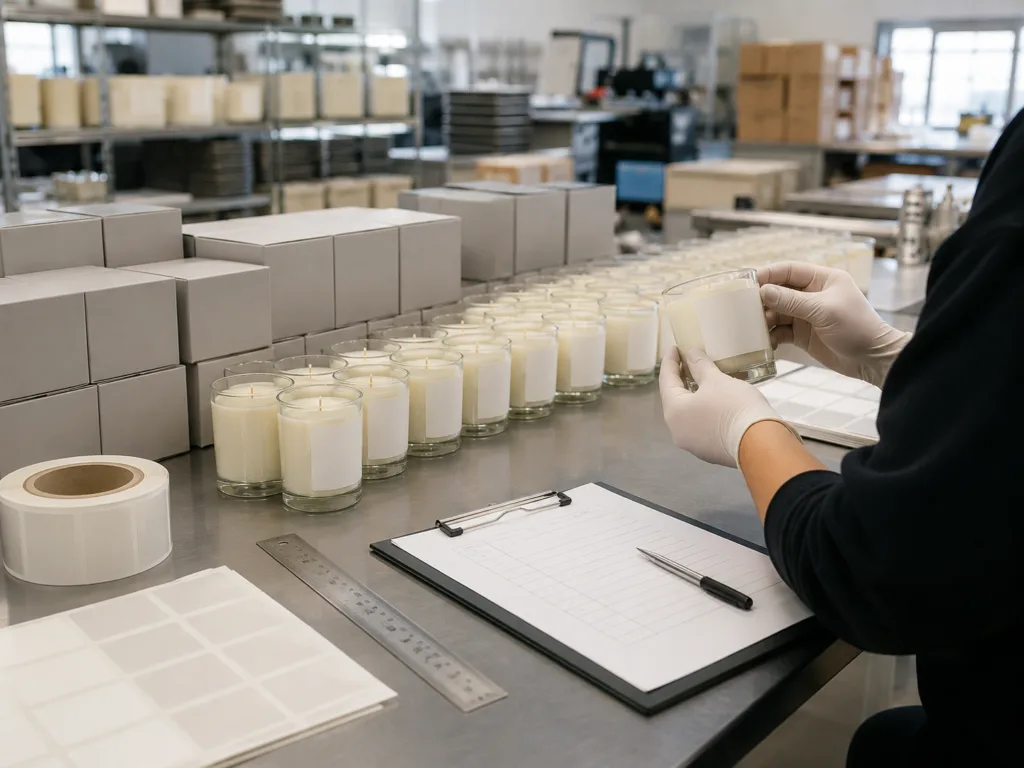
A professional candle supplier should do more than make the wax and vessel. For private label buyers, the supplier should help coordinate the practical side of label development.
Before production, buyers and manufacturers should confirm:
Vessel size and shape
Label dimensions
Label material
Printing method
Finish options
Artwork format
Logo file quality
Pantone or CMYK color requirements
Scent name and collection structure
Net weight and required information
Safety warning label
Barcode requirements
Application position
Sample approval process
Bulk production tolerance
Packaging match
Shipping and storage conditions
This level of detail is especially important for large orders. A label mistake on 50 samples is manageable. A label mistake on 5,000 units is expensive.
For mature buyers, the goal is not just to find the lowest unit price. The goal is to reduce development risk and create a product that can be sold confidently.
At Circe Home, we support private label candle brands with product development, fragrance selection, custom candle labels, packaging coordination, sampling, bulk production, quality control, and DDP logistics. For buyers building retail, gift, hotel, spa, or boutique candle lines, this integrated approach helps connect design decisions with real manufacturing feasibility.
15. How to Brief Your Supplier for Custom Candle Labels
A clear brief saves time and prevents misunderstandings. Before asking for a quotation, buyers should prepare as much information as possible.
A good custom candle label brief may include:
Target market: United States, Canada, United Kingdom, European Union, Australia, etc.
Sales channel: boutique retail, Amazon, hotel, spa, gift shop, wholesale, corporate gifting
Brand positioning: luxury, natural, wellness, playful, masculine, seasonal, minimalist
Target retail price
Candle size and wax weight
Vessel material and dimensions
Preferred label style
Reference images
Logo files
Color palette
Required label information
Expected order quantity
Packaging requirements
Shipping destination
Timeline
If the buyer does not have final artwork, the supplier can still help evaluate label size, material options, and production feasibility. But the more clearly the buyer defines the brand direction, the easier it is to create a commercially useful product.
16. Practical Label Strategy for Different Order Sizes
Label strategy should match order size and business stage.
Small Test Orders
For small test orders, use standard vessels and simple custom labels. Focus on clean branding, readable scent names, and good product photography. Avoid expensive foil, special die-cut shapes, or complex packaging unless the budget allows.
The goal is to test market response without overloading the project.
Medium Private Label Orders
For medium orders, buyers can improve label material, introduce better finishes, coordinate the label with a gift box, and create a more complete product line. This is a good stage to build a consistent visual system across several scents.
Larger Retail or Wholesale Orders
For larger orders, buyers can consider foil stamping, textured paper, custom rigid boxes, inserts, seasonal collections, and more advanced packaging coordination. At this stage, the unit cost of better finishing may become more reasonable, and the brand can invest in stronger retail presentation.
Long-Term Brand Programs
For long-term private label programs, buyers should build a full packaging guideline. This includes label templates, artwork rules, compliance placement, color standards, photography direction, and packaging specifications. This makes future product launches faster and more consistent.
17. Final Thoughts: A Small Label Can Carry a Big Brand Message
A custom candle label may be small, but its commercial impact is large. It shapes first impressions, communicates brand identity, supports price positioning, improves shelf appeal, helps organize product lines, and gives buyers confidence that the candle is retail-ready.
For candle brands working with limited budgets, labels are one of the most efficient tools for creating marketing value. You may not need to start with a fully custom vessel or the most expensive packaging structure. A standard glass jar with a strong label, well-chosen fragrance, clean box, and consistent branding can already create a professional product.
The key is to treat label design as part of the whole product strategy, not as a final decoration.
Good candle branding is not only about being beautiful. It is about making the right customer understand the product quickly, feel the value immediately, and trust the brand enough to buy.
In private label candle development, the strongest products are not always the most complicated. They are the ones where every visible detail works together: vessel, wax, fragrance, label, box, insert, safety information, and shipping presentation.
A candle label does not only tell people what the scent is.
It tells them what the brand is worth.
Call to Action
If you are developing a private label candle collection, Circe Home can help you create custom candle labels, coordinated packaging, fragrance options, bulk candle production, and DDP delivery solutions for retail, gift, hotel, spa, and boutique markets.
Whether you are testing a small branded candle line or preparing a larger wholesale collection, we can help you turn design decisions into manufacturable, retail-ready products.
FAQ
1. What are custom candle labels?
Custom candle labels are branded labels designed specifically for candle products. They usually include the brand name, scent name, collection details, net weight, fragrance description, safety information, barcode, or other product details. They help turn a basic candle into a recognizable branded product.
2. What is the best material for custom candle labels?
The best material depends on the candle’s brand positioning, vessel type, budget, and sales channel. Paper labels work well for natural and boutique candles, matte labels suit premium and wellness products, transparent labels create a clean modern look, and foil labels are often used for luxury or gift collections.
3. Can custom candle labels increase the perceived value of a candle?
Yes. A well-designed label can make a standard candle look more professional, giftable, and retail-ready. Good label design improves first impressions, supports higher price positioning, and helps buyers understand the brand’s style and product value more quickly.