
What Actually Determines MOQ in Candle Manufacturing?

MOQ, or Minimum Order Quantity, sets the baseline for feasible production runs. In candle factories, MOQ isn’t a random figure—it derives from three complex drivers:
- Equipment Startup Cost: Every machine in a candle factory—from large batch melters to precision pouring lines—must hit a minimum output to justify the energy, prep, and calibration work required each time it’s fired up.
- Labor Scheduling: High-touch processes demand skilled technicians and QC staff. Production runs require full teams, so MOQ covers a minimum threshold of labor hours—even if the project itself is boutique-sized.
- Material Procurement MOQ: Suppliers of specialty waxes (soy, coconut, rapeseed), fragrance oils, custom vessels, and packaging impose their own purchase minimums on manufacturers. These upstream MOQs dovetail into the factory’s own total production math.
The Inner Workings of a Candle Factory: Blends, Machines, and Batches
Candle manufacturing at scale is as much an orchestration as it is craft. Circe Home, for instance, runs advanced batch systems, blending ingredient chemistry and operational logistics. The cost of switching wax blends (soy, coconut, beeswax, paraffin) or integrating new fragrance oils translates directly into MOQs that maintain product integrity and cost viability.
Wax Blend Selection & MOQ Impact
Switching wax types or adding exotic blends bumps up the base cost unless batch volumes stay high. Small orders force factories to run sub-optimal, costlier cycles.
Fragrance Development & Curing Constraints
Creating custom scents—Circe Home specializes in fragrance development—means sourcing niche raw materials in bulk. High fragrance load blends often require longer curing times and strict quality testing, further impacting labor and scheduling.
Equipment Startup Cost: The Real Foundation of MOQ
Candle factories maximize efficiency by running large melters, automatic pouring lines, and curing chambers in optimal cycles. Each activation comes with a physical, chemical, and human cost:
- Pre-run cleaning and calibration
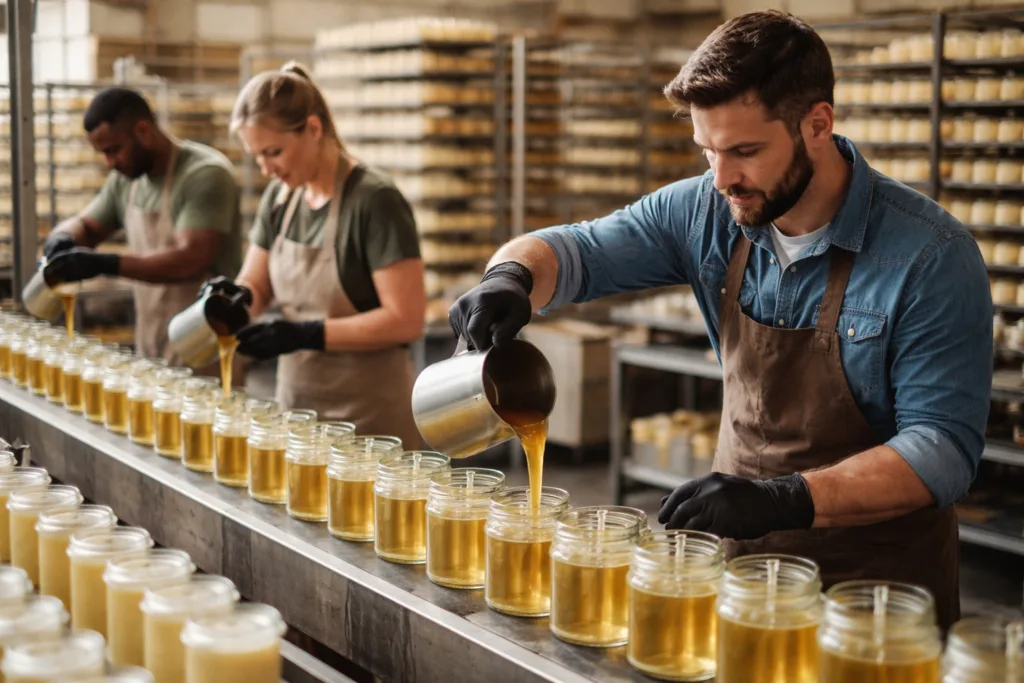
- Batch wax melting—often hundreds of kilograms per run
- Fragrance blending, vessel warming, wick prepping
Even the most refined luxury wax formula needs enough volume to balance out initial energy use and labor overhead. Below MOQ, the per-unit cost climbs sharply—affecting both pricing and quality.
Labor Scheduling: Why Human Skill Drives MOQ Up
Not all steps can be automated. From precise wick centering to real-time QC checks, trained staff orchestrate:
- Wax pouring, topping, and surface smoothing
- Scent dispersion and curing validation
- Burn profile and soot index testing
- Safe boxing and label compliance
Full production teams must be scheduled for a shift, regardless if only a small batch is run. MOQ ensures a balance—protecting skilled labor jobs, smooth workflow, and manufacturing consistency.
Material Procurement MOQ: Upstream Constraints on Candle Batches
Factories order waxes, oils, wicks, glass jars, and packaging in minimum lots. Suppliers of premium wax (like Circe Home’s blend partners) enforce their own MOQs, which cascade downstream. For example, European glass vessels may require 2,000-unit orders; fragrance suppliers have barrel-size minimums. The result? Candle MOQs reflect not just factory realities, but the entire value chain’s economics.
Comparative Table: MOQ Variables by Wax Blend
The following table highlights core production impacts by wax blend, demonstrating how formulation choices drive MOQ enforcement:
| Wax Blend | Scent Throw | Burn Time | Supplier MOQ |
|---|---|---|---|
| Soy Wax | Strong (up to 10% fragrance load) | 35–45 hrs / 200g | 200 kg / batch |
| Coconut Wax | Very strong, deep hot throw | 38–48 hrs / 200g | 150 kg / batch |
| Beeswax Blend | Refined, subtle cold throw | 55–60 hrs / 200g | 100 kg / batch |
| Custom Blend (Soy+Coco) | Balanced, customizable | 40–50 hrs / 200g | 250 kg / batch |
Circe Home Lab Insight: Achieving optimal scent throw in soy or coconut blends requires not only high-quality fragrance materials, but careful batching—MOQ ensures enough volume for stable curing and scent diffusion.
Fragrance Systems: Cold Throw, Hot Throw, and Compatibility
Fragrance compatibility with wax blend is critical. Factories must purchase oils and extracts above certain volumes, especially for custom scents and high fragrance load blends. Essential oil-based formulas typically require larger batch minimums due to volatility and lower scent retention. Testing for IFRA compliance, allergen declarations, and clean burn is mandatory—each step raising the base MOQ.
Fragrance Curing Time
Candles cured for 5–14 days reach optimal cold and hot throw. Under-sized batches are harder to QC, raising risk of scent inconsistency.
Wicks, Containers, and The Role of Customization
Wick sizing, container selection, and packaging aesthetics impact MOQ. Factories custom-fit cotton, wood, or paper-core wicks to match each vessel and wax blend—a process that only streamlines above certain batch sizes. Custom vessels (glass, ceramic, concrete) and luxury packaging (embossed labels, foil caps, FSC cartons) often have minimum purchase requirements that manufacturers must pass on to clients.
Container Order Constraints
European and Asian suppliers require commitment to full production lines—low unit orders incur surcharges, slow factory turnaround, and threaten quality control.
Production Process: Every Step Under MOQ Scrutiny
From raw material receiving to boxing:
- Melting and blending wax to precise temperature and ratio
- Pouring into prepped vessels, wick centering, topping
- Cooling, curing, surface finishing
- Final QC: burn profile, cold/hot throw, soot testing
- CLP/IFRA label application and safe packaging
Every stage involves costs best spread across larger batches. Below MOQ, factories risk higher defect rates, cost float, and less consistent product.
MOQ vs. Customization: Finding the Sweet Spot for Brands
Luxury candle brands aspire to exclusive scents and boldly distinct packaging. Yet every customization request—from wax blend tweaks to vessel embossing—signals a deeper MOQ threshold. Circe Home, renowned for its refined scent experience and elegant packaging options, works with brands to optimize runs: balancing creative freedom and responsible, sustainable production.
How to Reduce MOQ Through Smart Choices
- Choose commonly available wax blends and vessels
- Group scent launches to streamline fragrance ordering
- Skip ultra-specific packaging styles for first runs
- Leverage refillable or FSC-packaged options for easier sourcing
Inside a Candle Factory: Why MOQ Is Not Just a Number
Bringing it full circle, MOQ in a candle factory is a composite equation—not a simple numeric hurdle. Manufacturers like Circe Home set MOQs driven by the realities of batch chemistry, equipment economics, supplier contracts, and quality assurance. Every minimum order quantity is a guardrail for sustainable, premium production—not an obstacle to creativity, but its enabler. When brands collaborate closely with their manufacturer, they unlock deeper insight into why MOQs matter, and how each choice—from wax blend to vessel—impacts their bottom line and market success.
Applications and Compliance: MOQ in Real Market Scenarios

Whether crafting private-label wellness blends, luxury gifting candles, or minimalist aroma lines, factories must balance dream designs with real-world production thresholds. Modern compliance—from IFRA’s 51st amendment to CLP labeling for EU sellers—adds new regulatory material needs, which further impact MOQ.
Sustainable MOQ Practices
Eco-packaging initiatives (soy ink labels, compostable wraps, FSC cartons) are gaining traction, yet often come with supplier-imposed minimums. Some factories are trialing refill programs for hotel/spa brands—innovations that still intersect with batch-sized economic realities.
Frequently Asked Questions
Why is MOQ higher for custom candle designs?
Custom wax blends, fragrances, or packaging require special sourcing and setup, increasing minimum order needs to ensure cost-effectiveness and manufacturing consistency.
Can MOQ be negotiated with a candle factory?
In some cases, factories can adjust MOQ by using standard raw materials and packaging, but deep customizations or premium components often lock in supplier-driven minimums.
What happens if my candle order falls below MOQ?
Orders under factory MOQ usually incur higher unit costs or delays, as batching, labor scheduling, and material procurement become inefficient and risk quality issues.
How does wax type affect MOQ?
Rare or specialty waxes like coconut or beeswax have higher supplier MOQs; common blends like soy are more flexible. Custom blending also increases batch minimums.
Why do fragrance oils require minimum volume orders?
Fragrance suppliers produce and ship oils in bulk to guarantee scent consistency, safety, and compliance; factories must order a fixed minimum per batch.
Is eco-friendly packaging available at lower MOQs?
Typically, eco-packaging suppliers set their own MOQs, but some factories offer group sourcing or refill programs to help reduce minimums for small brands.