
If you are developing a custom scented candle line, wax melts collection, reed diffuser range, or a broader home fragrance brand, one question tends to come up very early:
“Do you have your own factory?”
On the surface, it seems like the most important sourcing question a buyer can ask.
People naturally assume that working directly with a factory means lower prices, better control, faster lead times, and a more straightforward process. In theory, that sounds efficient. In practice, however, the reality is often much more complicated.
For many retailers, boutique brands, importers, and private label buyers, the real challenge is not simply finding a factory. The challenge is finding the right production solution among a huge number of suppliers, each with different strengths, limitations, pricing structures, communication styles, and quality levels.
That is exactly where Circe Home creates value.
Circe Home was not built around the narrow idea that one single factory should do everything. Instead, it was built around a more useful question:
How do we create the best supply chain structure for each client’s product, price point, packaging needs, and retail positioning?
Behind this approach is founder Charlotte’s belief that being a reliable back-end partner for retailers requires much more than just offering a low quote. A strong supply chain must also deliver service, comparison, stability, flexibility, communication, and long-term execution reliability.
In other words, Charlotte has already done a first round of screening for buyers. Rather than forcing customers to navigate countless Chinese candle and home fragrance suppliers alone, Circe Home helps narrow the field, integrate the right resources, and recommend the most workable route.
That is why many brands choose Circe Home not because they want “just a factory,” but because they want something more comprehensive, more strategic, and often more efficient than dealing with factories one by one.
Why “Working Directly With a Factory” Is Not Always the Best Move
There is a common misconception in sourcing: factory-direct is always best.
But the truth is that factories are typically built to optimize their own production lines, not necessarily to optimize your full project outcome.
A factory may be very good at making one specific type of glass jar candle, one standard fragrance filling format, or one packaging process. That does not automatically mean it is the best partner for your brand launch.
When buyers work directly with factories, they often run into challenges such as:
- high MOQ requirements for custom components
- limited willingness to adjust packaging or structure
- weak support on fragrance development or retail positioning
- inconsistent communication during product development
- pricing that looks low at first, but becomes inefficient once tooling, packaging, testing, and changes are included
- limited understanding of what actually matters to retailers and end consumers
This is especially true for emerging brands, mid-sized retailers, and buyers launching new collections. Many of them do not have a full internal R&D team, packaging development department, or sourcing office in China. They need more than a production line. They need a capable partner that helps them make the right decisions from the beginning.
That is where the Circe Home model becomes much more practical.
What Circe Home Actually Offers
Circe Home operates as a product development partner and supply chain integrator for custom scented candles and home fragrance products.
That means we do not simply ask, “Which factory can make this?”
We ask a much more important set of questions:
- What is the brand positioning?
- What material combination makes the most sense?
- What is the target retail channel?
- Does the customer need glass, ceramic, tin, or mixed packaging formats?
- Is the project early-stage and sensitive to MOQ?
- Does the packaging need to feel more premium, or more cost-efficient?
- What is the right balance between aesthetics, margin, and production feasibility?
Once those questions are clear, we build the most suitable route.
Instead of relying on one factory for everything, Circe Home can integrate specialized resources where needed. One supplier may be stronger in glass vessels. Another may be better at ceramic craftsmanship. Another may offer stronger fragrance blending support. Another may be more suitable for rigid gift boxes, inserts, or luxury packaging details.
The result is a more tailored and more commercially intelligent supply chain.
The Founder’s Philosophy: Charlotte’s Role in Making Sourcing Easier
One of the reasons Circe Home stands out is that the company was built around real sourcing logic rather than a simple factory identity.
Charlotte understands a reality that many overseas buyers only discover after months of frustration: no single factory excels at everything.
Some factories are strong in standard production but weak in development. Some offer attractive unit pricing but become rigid once custom requests are introduced. Some can make attractive vessels but struggle with packaging coordination. Others can quote quickly but fail when it comes to stability, flexibility, or solving problems under pressure.
Rather than presenting clients with chaos, Charlotte’s approach is to filter it first.
She evaluates supplier strengths, compares options, weighs risks, and structures recommendations before buyers even need to face that complexity themselves. This saves time, reduces confusion, and lowers the risk of choosing the wrong partner too early.
For buyers facing a crowded Chinese supplier landscape, that first layer of screening is not a minor advantage. It can completely change the quality of the sourcing process.
Instead of guessing, buyers receive guidance.
Instead of comparing endless unknown factories, they work within a more curated and tested framework.
Instead of being left alone to decode different prices and inconsistent claims, they get practical recommendations shaped by real execution experience.
Top 9 Reasons Brands Choose Circe Home Over Direct Factories
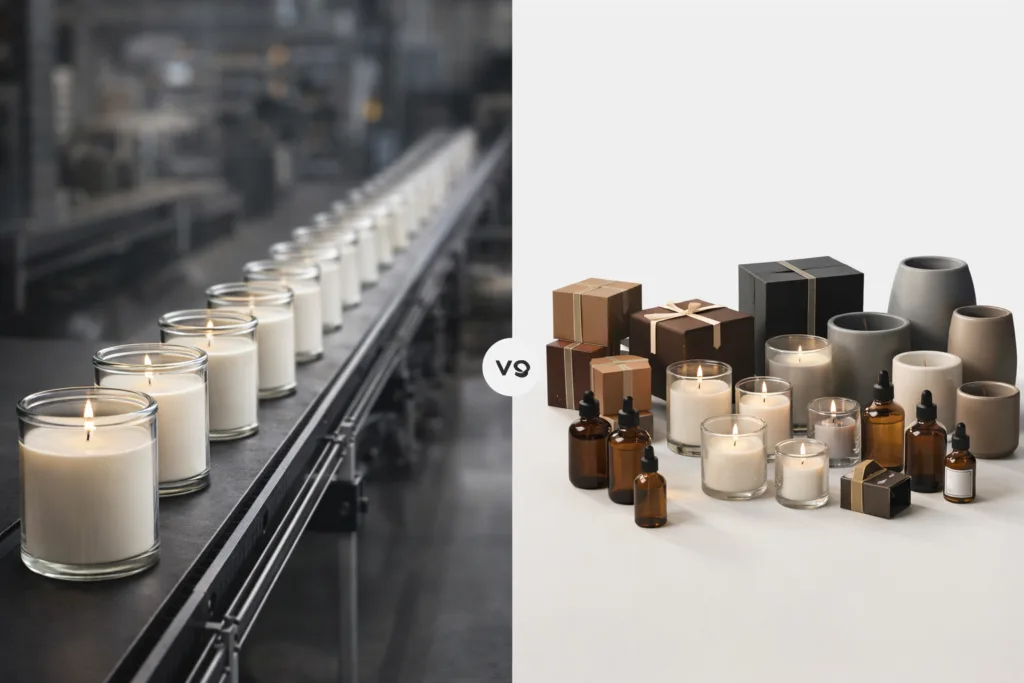
1. Circe Home helps buyers cut through supplier overload
China offers a huge number of candle and home fragrance suppliers. That can be an advantage, but it can also become a major burden.
Many buyers do not know where to start. They compare quotation sheets that are not structured the same way. They receive inconsistent answers about MOQ, vessel options, fragrance formats, packaging costs, and lead times. The more they search, the less clear the decision becomes.
Circe Home reduces that noise.
Because the first layer of supplier filtering has already been done, buyers do not need to start from zero. This makes sourcing dramatically easier, especially for retailers and private label brands that want clarity rather than a chaotic vendor hunt.
2. Circe Home optimizes across multiple dimensions, not just price
A good supply chain is not defined by low price alone.
A supplier can be cheap and still cost you more overall if communication is poor, if defects are higher, if development takes too long, or if packaging coordination repeatedly fails.
Circe Home evaluates sourcing through multiple dimensions, including:
- service quality
- comparison logic
- stability
- flexibility
- communication efficiency
- product consistency
- cost structure
- launch feasibility
This broader view is especially important in private label candle manufacturing, where success depends on more than just what appears on an initial quote.
3. Charlotte has already done a first round of screening for buyers

This point is one of the strongest parts of the Circe Home value proposition.
Many buyers underestimate how much energy is lost in the early screening stage. They spend weeks contacting suppliers, reviewing samples, comparing promises, and trying to figure out who is actually capable.
Charlotte has already done much of that legwork.
That means the buyer is not entering the market blind. They are working with a partner that already understands which production routes are realistic, which supplier types are suitable for which projects, and where the hidden risks tend to appear.
This shortens the learning curve and helps buyers move faster with fewer mistakes.
4. Circe Home is built for product development, not just production
Factories are usually designed to produce what is already defined.
Circe Home supports what many brands actually need: help defining the product in the first place.
That may include:
- fragrance direction and scent concept alignment
- vessel selection based on positioning and budget
- packaging system planning
- gift set structure development
- balancing premium look with realistic cost control
- choosing between standard and custom routes
For buyers launching a new custom candle line or home fragrance collection, this kind of support can be more valuable than factory ownership itself.
5. Circe Home can integrate specialized strengths from different suppliers
This is one of the biggest structural advantages.
If you work with only one factory, you are limited by what that factory does best. If they are weak in packaging, you feel it. If their ceramic is inconsistent, you inherit that limitation. If their fragrance development is basic, your product direction suffers.
Circe Home does not force projects into a single production line when that is not the smartest route.
Instead, we can integrate the best available strengths for the actual project. That creates more freedom, better matching, and often a stronger final retail product.
6. Circe Home helps manage MOQ pressure more strategically
MOQ is where many private label projects start to break down.
Factories often set MOQs according to what suits their own production systems. That is understandable from their side, but it does not always align with the buyer’s launch reality.
Circe Home looks at MOQ as part of a broader strategy.
Rather than just saying yes or no, we evaluate whether standard vessels, adjusted packaging formats, phased launches, or smarter material choices can help the buyer move forward with less risk.
This makes the sourcing process more commercially realistic, particularly for early-stage brands and retailers testing new categories.
7. Pricing through Circe Home can be more efficient than factory pricing alone
Some buyers assume that any intermediary must automatically make the price worse.
That assumption ignores how real sourcing works.
When a project is poorly structured, even a direct factory price can become inefficient. Hidden development costs, expensive packaging mismatches, tooling decisions, repeated changes, and poorly matched materials can all raise the total project cost.
Circe Home focuses on total solution efficiency, not just isolated unit price.
In many cases, that means the final outcome is equal to or better than what a buyer would achieve alone by approaching factories directly, especially once time, revisions, and project risk are considered.
8. Communication and coordination are more professional and buyer-oriented
Many sourcing delays are not caused by manufacturing itself. They are caused by poor coordination.
Buyers often lose time because they must explain the same thing repeatedly to different parties, reconcile conflicting answers, or wait for suppliers to react rather than proactively solve issues.
Circe Home is designed to be easier to work with from the buyer’s perspective.
We help translate creative ideas into workable production language, compare routes, coordinate across suppliers when needed, and keep the project aligned with the end goal. That reduces friction and gives buyers a more professional experience overall.
9. Circe Home is built to be the retailer’s back-end support system
This may be the most important point of all.
Circe Home is not trying to be “just another supplier.”
The goal is to become a stronger and more dependable back-end partner for retailers, importers, and private label brands. That means helping clients build products that are not only manufacturable, but also commercially sensible.
Being a strong back-end partner means thinking beyond the quote sheet. It means considering how decisions around vessel choice, fragrance direction, packaging level, MOQ, and supplier coordination affect the buyer’s retail reality.
That is why Circe Home’s value is not limited to production. It lies in helping buyers make better sourcing decisions with more confidence.
Why This Matters in Custom Scented Candles and Home Fragrance
The home fragrance category is unusually layered.
A finished product may involve multiple decision points at once:
- wax type
- fragrance profile
- wick selection
- jar or vessel material
- printing or labeling method
- lid style
- gift box structure
- inserts and protective packaging
- testing requirements
- retail price target
- shipping practicality
A buyer can easily choose the wrong combination even when each individual component looks acceptable on its own.
That is why sourcing custom scented candles is not just about making a candle. It is about assembling a coherent product system.
Circe Home helps make that system more intentional.
Whether the client is creating a luxury candle brand, a boutique gift set program, a seasonal retail collection, a spa fragrance line, or a broader private label home fragrance offering, the decisions need to work together.
That is where integrated thinking matters more than a factory label.
Factory Ownership Is Not the Only Signal of Capability
Many buyers ask about factory ownership because they are trying to measure seriousness, legitimacy, and control.
That concern is understandable.
But in today’s sourcing environment, factory ownership alone is not the most meaningful signal.
A better question is this:
Who can actually deliver the right product, through the right structure, with the right balance of price, service, flexibility, and execution reliability?
That is the question that affects business results.
If a company can offer smarter comparison, better development support, stronger coordination, and a more suitable supplier network, then that may be more valuable than simply claiming a single factory identity.
In fact, for many projects, it is exactly what the buyer needs.
Circe Home as a Smarter Alternative to the “Factory-Only” Mindset
As global retail becomes more competitive, brands need sourcing partners who understand more than production.
They need partners who understand:
- how products should be positioned
- how launch risk should be reduced
- how supply chains should be structured for stability
- how to compare options without overwhelming the buyer
- how to align material choices with margin and retail value perception
This is why the sourcing conversation is changing.
More brands are no longer looking only for factories. They are looking for partners that can help them move from idea to execution with more confidence.
Circe Home fits that role.
For many clients, the real advantage is not that we replace factories. It is that we organize factory strengths in a way that is more useful to the client.
That difference matters.
Final Thoughts
If you are still asking whether Circe Home is “just a factory,” you may be asking the wrong question.
The stronger question is whether your sourcing partner can make the process more efficient, more stable, more flexible, and more commercially intelligent.
At Circe Home, founder Charlotte built the company around a clear belief: being a strong back-end partner for retailers requires more than friendly pricing. It requires thoughtful comparison, structured recommendations, reliable communication, flexible coordination, and a supply chain that is designed around the client rather than around a single production line.
That is why many buyers choose Circe Home.
Not because they need another factory.
But because they need a more complete solution.
If you are developing custom scented candles, private label wax melts, reed diffusers, or other home fragrance products, Circe Home can help you move from idea to workable execution with more clarity and less noise.
FAQ
1. Why choose Circe Home instead of working directly with a candle factory?
Circe Home offers more than basic production. We help buyers compare options, structure projects more intelligently, reduce sourcing confusion, and combine the strengths of multiple specialized suppliers when needed. For many brands, this creates a more efficient and lower-risk outcome than dealing with factories alone.
2. Does Circe Home have its own factory?
Circe Home is built around a curated supply chain model rather than a simplistic one-factory approach. The focus is on selecting the most suitable production route for each client’s project, based on category, packaging, material requirements, and commercial goals.
3. Can Circe Home help with private label scented candles?
Yes. Circe Home supports private label scented candles, wax melts, gift sets, and other home fragrance products. Services may include product development support, vessel selection, packaging coordination, fragrance planning, and production recommendations.
4. Is Circe Home suitable for new candle brands?
Yes. Early-stage brands often need support beyond simple manufacturing. Circe Home is especially useful for brands that need help with MOQ strategy, packaging planning, supplier comparison, and turning an initial concept into a more workable product plan.
5. Can Circe Home offer better pricing than direct factories?
In many cases, yes. While factory-direct pricing may seem lower at first glance, total project efficiency depends on more than unit cost. Better supply chain matching, fewer mistakes, smarter material choices, and stronger coordination can result in better overall value.
6. What kinds of products can Circe Home help develop?
Circe Home can support a range of custom home fragrance products, including scented candles, wax melts, reed diffusers, candle gift sets, and related retail packaging systems.
7. Why is supplier comparison so important in home fragrance sourcing?
Because different suppliers are strong in different areas. Some are better in glass, some in ceramics, some in fragrance blending, and some in packaging. Choosing the wrong structure can increase cost and reduce product quality. Comparison helps create a better overall solution.
8. How does Circe Home reduce sourcing risk for buyers?
Circe Home reduces risk by pre-screening options, recommending more suitable production routes, helping buyers avoid poor supplier matches, and building a clearer path from concept to production.
9. Is Circe Home only for large retailers?
No. Circe Home can also be valuable for boutique brands, growing retailers, importers, and private label startups that want a more guided and strategic sourcing process.
10. What makes Circe Home different from a normal supplier?
A normal supplier may only quote what they can make. Circe Home helps evaluate what should be made, how it should be structured, and which sourcing route makes the most sense for the client’s product and retail goals.
Suggested CTA
Tell us what you are building. Even if your concept is still early, Circe Home can help you turn it into a clearer, more workable custom candle or home fragrance product plan.