
In the fragrance industry, a candle is never just wax in a vessel.
For a brand owner, buyer, retailer, hotel group, gift company, event planner, or product developer, a candle carries far more than fragrance. It carries brand positioning, customer experience, retail margin, packaging expectations, logistics pressure, and sometimes the very first physical impression a customer has of a new collection.
That is why, at Circe Home, we do not see ourselves as a supplier who simply waits for a specification sheet and sends back a price. We work best when we are allowed to understand the project behind the product: what the candle is for, who will buy it, how it will be displayed, what the buyer’s budget is, which details are fixed, and where there is still room for adjustment.
The global candle and home fragrance market continues to grow because candles have become part of modern lifestyle rituals: home décor, self-care, gifting, hospitality, wellness, seasonal promotions, religious use, and brand storytelling. In the U.S. alone, candle consumption remains significant, with large seasonal demand during the Christmas and holiday period, while everyday home fragrance continues to support year-round sales. For fragrance brands, this creates opportunity—but also pressure. A beautiful idea must become a commercially workable product.
That is where a practical manufacturing partner matters.
The Circe Home way is simple: we listen carefully, give realistic suggestions, respect small testing projects when they make sense, and build cooperation with a long-term view. We care about long-term cooperation more than pushing a quick order.
1. We Start by Understanding the Real Purpose of the Project
Before quoting a candle, we try to understand what the customer is actually building.
A candle for a luxury gift box is different from a candle for a hotel amenity program. A candle for a seasonal retail launch is different from a candle for a religious ritual. A candle for a first-time brand test is different from a replenishment order for an existing bestseller. Even if the size looks similar, the business logic may be completely different.
When a customer contacts us, we usually want to know several things:
- Is this a new brand, an existing collection, or a one-time promotional project?
- Is the product intended for retail, wholesale, gifting, hospitality, events, subscription boxes, or online sales?
- Does the customer already have a vessel, fragrance direction, logo, label design, and packaging concept?
- Is the priority luxury presentation, cost control, fast shipment, natural materials, low MOQ, or full customization?
- Does the customer need finished scented candles, empty vessels, wax melts, tea lights, taper candles, gift sets, or packaging support?
- Is the project in the sampling stage, small batch testing stage, or ready for mass production?
These questions are not meant to slow down the process. They prevent wrong assumptions.
A customer may ask for “the cheapest custom candle,” but after discussion, the real need may be a low-MOQ private label solution using an existing vessel and customized label. Another customer may ask for a fully custom ceramic jar, but the order quantity may not support mold development. A buyer may request natural honey scent, but the project may require a clear explanation of essential oils, fragrance accords, MSDS documentation, and realistic marketing claims.
Good B2B cooperation begins with understanding—not rushing.
2. We Give Realistic Suggestions Instead of Over-Promising
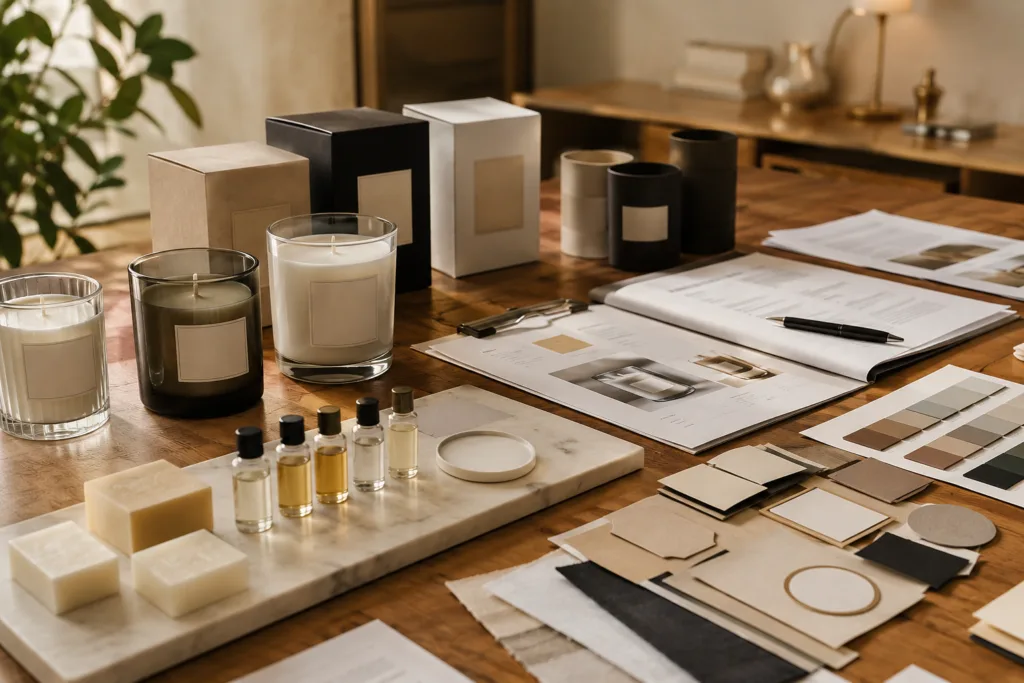
In candle manufacturing, not every beautiful idea is commercially practical at every quantity.
This is especially true for fragrance brands that are still testing the market. Many customers come to us with strong creative ideas: custom vessel shapes, special wax formulas, unique fragrance blends, premium boxes, gold foil logos, custom colors, gift packaging, or small trial quantities with many variations.
We respect creative ambition. But we also believe a supplier should explain the production reality clearly.
For example, full custom vessel development usually requires higher MOQ, longer lead time, mold cost, sample adjustment, and packaging testing. Custom ceramic or concrete vessels may be beautiful, but they are not always suitable for a very small first trial order. A special color towel, a custom glass vessel, or a fragrance set with many scent variations may require new material sourcing and separate production planning. Some shipping destinations cannot support DDP door-to-door service. Some addresses, such as PO Box addresses, cannot be used for international sample delivery.
Instead of saying yes to everything and creating disappointment later, we prefer to explain what can be done, what should be adjusted, and what may not be feasible at the current quantity.
This is part of our professional responsibility.
A good candle supplier should not only execute instructions. A good supplier should protect the project from avoidable mistakes.
3. We Respect Small-Budget Projects, but We Set Clear Boundaries
Many fragrance brands begin with small quantities. We understand this very well.
A new brand may not want to order thousands of units before testing scent preference, customer response, packaging style, and retail price. A boutique retailer may only need a small seasonal batch. A gift company may want samples before presenting options to its own client. A designer may need physical products for photography, market testing, or investor presentation.
At Circe Home, we do not look down on small projects simply because they are small.
Small does not mean unserious. Many strong brands begin with controlled testing. In fact, testing small before scaling is often the healthier way to build a product line.
However, small-budget projects need smart structure.
For low-MOQ projects, we may suggest using existing glass vessels, standard lids, available wax formulas, stock packaging structures, standard fragrance options, or light customization such as logo labels, hang tags, paper sleeves, or simple gift boxes. This helps the customer test the market without paying unnecessary mold fees or taking excessive inventory risk.
For example, instead of developing a completely new vessel for a first trial order, a customer may choose from existing vessel styles and invest more budget in fragrance selection, label design, or packaging presentation. Instead of making ten custom scents at a very low quantity, a brand may begin with two or three stronger fragrance directions and expand later based on sales feedback. Instead of requesting complex retail packaging immediately, a buyer may start with clean private label packaging that can still look professional and ship safely.
This is not lowering the standard. It is matching ambition with the right stage of business.
We believe small projects deserve respect, but they also require honest boundaries. If a request is not feasible at a certain quantity, we will say so. If there is a more practical alternative, we will propose it.
4. We Treat Sampling as Product Development, Not a Formality
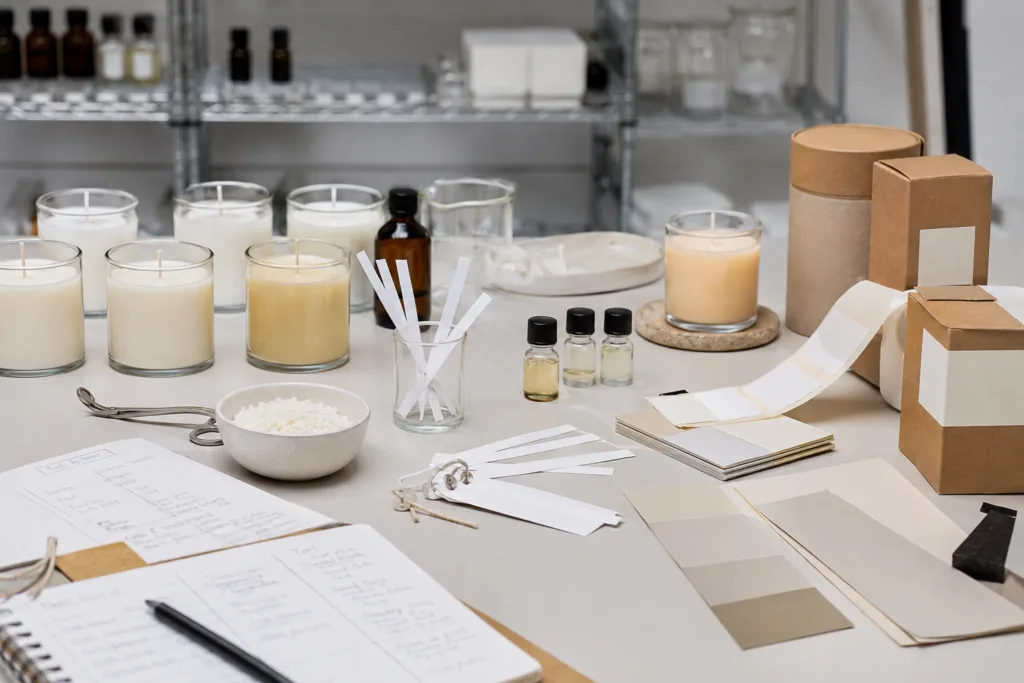
A candle sample is not just a preview. It is a test.
It tests scent impression, wax appearance, vessel compatibility, wick behavior, burn performance, label placement, packaging protection, and shipping safety. For fragrance brands, this stage can reveal issues that are difficult to see on a quotation sheet.
During sampling, customers often evaluate questions such as:
- Does the fragrance match the brand mood?
- Is the cold throw attractive before burning?
- Is the hot throw strong enough after burning?
- Does the wax surface look clean and stable?
- Does the wick size suit the vessel diameter?
- Does the vessel feel premium enough for the retail price?
- Does the label look balanced on the jar?
- Does the packaging protect the candle during transit?
- Does the full product feel giftable?
This is why we take sampling seriously.
For private label candles and custom scented candles, the sample stage is where the creative concept meets manufacturing reality. Sometimes the first version works well. Sometimes the wax formula needs adjustment. Sometimes the fragrance load needs to be reconsidered. Sometimes the customer realizes that the vessel is too small, the packaging is too expensive, or the original design direction is not aligned with their target market.
That is normal.
Good sampling is not about pretending everything is perfect. It is about identifying what needs to be improved before mass production.
For us, the value of a sample is not only whether the customer places an order immediately. The value is whether the project becomes clearer.
5. We Help Customers Balance Customization, Cost, and MOQ
In B2B candle manufacturing, customization always has a cost structure.
A fully custom candle may include custom vessel development, custom wax color, custom fragrance, logo printing, labels, box design, inserts, carton protection, and freight planning. Each layer adds value, but each layer also affects price, MOQ, lead time, and operational complexity.
Many buyers only see the final unit price, but a professional fragrance brand needs to understand the whole cost picture:
- Product cost
- Vessel cost
- Wax and fragrance cost
- Label or printing cost
- Packaging cost
- Sample cost
- Mold cost, if applicable
- Inner carton and export carton cost
- Freight cost
- Import duty or local taxes
- Warehousing or fulfillment cost
- Potential damage rate during shipping
A lower unit price is not always the better choice if it creates poor packaging, weak scent performance, fragile shipping, or unstable production quality. At the same time, a beautiful but over-complicated product may be too expensive for the brand’s current retail channel.
This is why we often help customers compare different levels of solutions.
For example:
Option 1: Stock Vessel + Custom Label
A practical choice for small-batch testing, lower MOQ, faster sampling, and lower development cost.
Option 2: Stock Vessel + Custom Fragrance + Retail Box
A stronger private label option for brands that need a more complete retail product but still want to control risk.
Option 3: Full Custom Vessel + Custom Packaging + Signature Fragrance
A better fit for mature brands with clearer positioning, higher order quantity, and a stronger launch plan.
This kind of comparison helps customers make decisions based on business reality, not emotion alone.
We do not believe B2B cooperation should be a guessing game. Negotiation is not fighting over price. Good negotiation is the process of finding the most workable solution for both sides.
6. We Support Fragrance Brands Beyond Candle Production
Circe Home is not only a candle factory contact. We see ourselves as a product development partner for fragrance brands.
That means we may support customers across several parts of the project:
Fragrance Direction
We can discuss scent families, seasonal fragrance ideas, market positioning, and whether a scent direction is more suitable for wellness, gifting, home décor, hotel use, or holiday retail.
For example, lavender, vanilla, sandalwood, amber, fig, citrus, rose, jasmine, honey, neroli, and woody blends can each create very different brand signals. Some scents feel clean and spa-like. Some feel warm and giftable. Some feel more premium, religious, nostalgic, romantic, or seasonal.
Wax and Material Suggestions
Different projects may use soy wax, soy blend wax, beeswax, paraffin blend, gel wax, wax melts, pillar wax, or other formulas depending on form, burning needs, appearance, cost, and market preference.
Many customers ask for clean burn, natural positioning, strong scent throw, low cost, and perfect appearance at the same time. These goals may need balance. A professional supplier should explain the trade-offs instead of using empty marketing language.
Vessel and Format Selection
Glass jar candles, tin candles, concrete jar candles, ceramic vessels, tea lights, taper candles, wax melts, gel candles, floating candles, and gift sets all serve different use cases.
The right format depends on the brand’s sales channel, target price, shipping method, and customer experience.
Packaging Development
Packaging is not an afterthought. For fragrance brands, packaging affects perceived value, gifting potential, retail shelf appeal, shipping safety, and profit margin.
We can support options such as logo labels, paper sleeves, individual boxes, kraft boxes, rigid gift boxes, inserts, carton dividers, protective packaging, hang tags, and export cartons.
Documentation and Compliance Support
Depending on the project, customers may need MSDS/SDS, IFRA-related documents, fragrance allergen information, wax information, or other supporting documents. We help provide available documentation where applicable and clarify what can be claimed realistically.
This matters because fragrance brands must protect both customer trust and regulatory safety.
7. We Believe Long-Term Cooperation Is Better Than a Quick Order
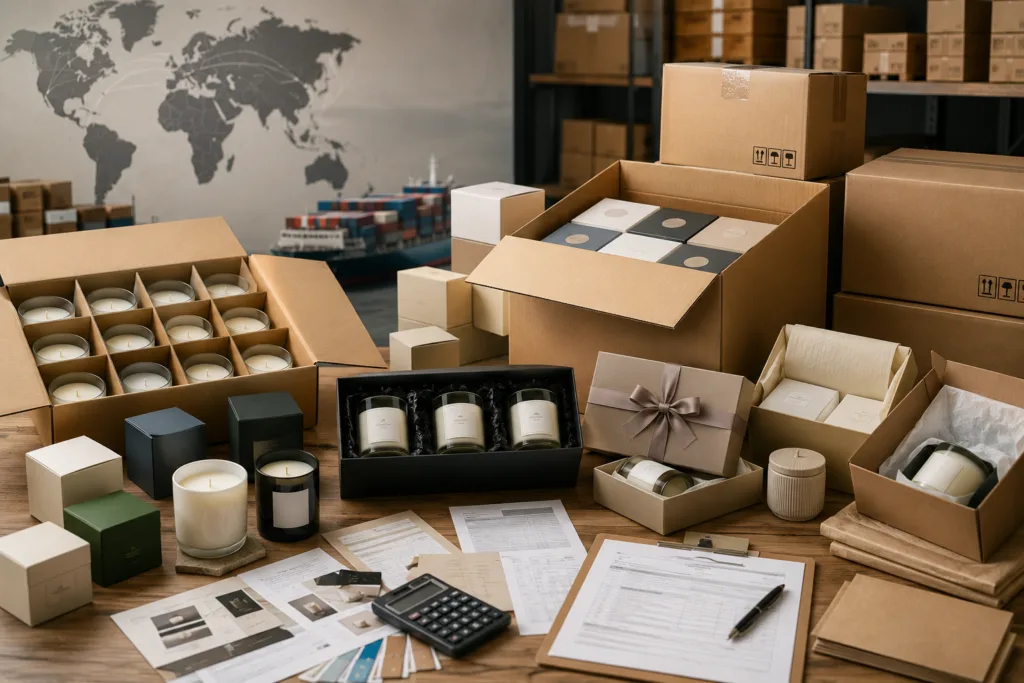
Some suppliers push for fast payment. Some customers push for the lowest price. But serious B2B business cannot be built only on urgency.
A candle brand does not grow from one rushed sample. A supplier relationship does not become reliable from one quotation. Trust is built through clear communication, practical problem-solving, honest boundaries, and consistent execution.
At Circe Home, we would rather spend more time understanding a project than push a customer into the wrong order.
If a customer’s quantity is not suitable for full customization, we may suggest a lighter solution. If the shipping method is not workable, we will explain the limitation. If the budget is tight, we may propose a simpler structure. If the product idea has risk, we will point it out. If the customer is not ready for mass production, we may recommend sampling and testing first.
This is not a lack of ambition. It is a long-term way of doing business.
We believe a good supplier should be useful before the order is placed, not only after the invoice is paid.
The best B2B cooperation is not one side obeying the other. It is negotiation: two sides bringing their goals, limitations, resources, and experience to the table, then shaping a solution that can actually work.
For fragrance brands, this kind of cooperation matters because every candle is a combination of emotion and execution. The scent must feel right. The vessel must fit the brand. The packaging must protect the product. The price must support the business model. The MOQ must match the stage of growth. The logistics must be realistic. The supplier must be willing to think.
This is the Circe Home way.
What Kind of Customers Do We Work Best With?
We work best with customers who value communication, clarity, and practical development.
They do not need to have every technical detail ready. Many customers come to us with only a rough idea, a mood board, a target market, or a reference image. That is fine. We can help organize the project step by step.
But successful cooperation usually requires several things:
- A real product goal
- Clear communication
- Willingness to discuss budget and quantity honestly
- Respect for production limitations
- Openness to alternative solutions
- Patience during sampling and adjustment
- Long-term thinking beyond one transaction
We do not expect every customer to be a candle expert. But we do appreciate customers who are willing to build the project with us.
How a Typical Project Begins
A typical Circe Home project may begin with a simple inquiry:
“I want to make private label scented candles for my brand.”
“We need a candle gift set for the holiday season.”
“Can you make wax melts with our logo?”
“We are looking for a custom vessel candle with clean white wax.”
“We need samples for a small test launch.”
From there, we usually help clarify the product direction:
- Product type: jar candle, wax melt, tea light, taper candle, gift set, vessel only, or other format.
- Size and material: vessel dimensions, wax weight, lid requirement, packaging structure.
- Fragrance: existing scent options, custom fragrance direction, scent intensity, documentation needs.
- Branding: label, logo, box, color, printing method, private label requirements.
- Quantity: sample quantity, trial order quantity, mass production plan.
- Shipping: destination country, delivery address, DDP availability, freight estimate, customs considerations.
- Budget: what level of customization is realistic for the current stage.
Once these details become clearer, the quotation becomes more meaningful.
A price without context is only a number. A price connected to product strategy is a decision tool.
Why This Matters for Fragrance Brands
The fragrance market is crowded. Consumers have many choices. Retailers are selective. Online customers judge quickly. A candle brand must compete not only on scent, but also on presentation, story, consistency, and perceived value.
For fragrance brands, the wrong production decision can be expensive. A vessel that looks good but ships poorly can create damage claims. A fragrance that smells good in a bottle may behave differently in wax. A low-cost box may weaken the retail impression. A high MOQ may create inventory pressure. A rushed sample may lead to changes after mass production, which is always more costly.
This is why we believe the supplier’s role should be broader than production.
We help customers think through the product before committing too much budget. We help identify where customization is worth paying for and where a standard option may be smarter. We help connect creative ideas with manufacturing steps. We help customers avoid preventable mistakes.
In other words, we do not only make candles. We help fragrance brands make better candle decisions.
The Circe Home Promise
Our promise is not that every project will be the cheapest, fastest, or easiest.
Our promise is that we will treat the project seriously.
We will listen before quoting. We will explain before promising. We will suggest alternatives when the original idea is too costly or unrealistic. We will respect small testing orders when they are structured properly. We will care about scent, packaging, cost, shipping, and long-term cooperation together.
We are here for fragrance brands that want more than a product list.
We are here for buyers who want a supplier who can think with them.
We are here for brands that understand good products are developed through communication, negotiation, testing, and refinement.
At Circe Home, we care about long-term cooperation more than pushing a quick order.
That is not just a sentence for us. It is how we prefer to build every serious B2B relationship: with patience, clarity, professionalism, and respect for the brand behind the candle.
FAQ
1. Can Circe Home support small fragrance brands with low-MOQ candle projects?
Yes. Circe Home can support small fragrance brands and trial projects when the customization level matches the order quantity. For lower MOQ projects, we usually recommend existing vessels, standard packaging structures, stock fragrance options, custom labels, or light private label solutions to help customers test the market with lower risk.
2. What information should I prepare before requesting a custom candle quotation?
It is helpful to prepare the product type, vessel size, wax preference, fragrance direction, logo or label requirements, packaging idea, estimated quantity, destination country, and budget range. If you do not have all details ready, Circe Home can help clarify the project step by step.
3. Can Circe Home help with candle packaging and private label branding?
Yes. Circe Home can support private label candle packaging, including logo labels, paper sleeves, individual boxes, gift boxes, inserts, carton dividers, hang tags, and export packaging. Packaging suggestions depend on the customer’s budget, order quantity, retail positioning, and shipping needs.
4. Why does Circe Home sometimes suggest a simpler solution instead of full customization?
Full customization often requires higher MOQ, longer lead time, mold fees, and more development cost. For new or small-batch fragrance brands, a simpler solution may be more practical for market testing. Circe Home suggests alternatives to help customers control risk while still building a professional product.