
For boutique brands, the candle versus diffuser decision is rarely about fragrance alone.
It is a margin decision. A cash-flow decision. A packaging decision. A compliance decision. And in many cases, it is a channel decision.
That is why the question “Candle vs Diffuser: Which One Is More Profitable for Boutique Brands?” deserves a more serious answer than the usual lifestyle blog comparison.

From the outside, the math looks simple. Candles sell well, are giftable, and feel emotionally rich. Reed diffusers look refined, have a longer use cycle, and often carry a higher retail price. So many new brands assume diffusers must be more profitable.
In practice, the answer is more complicated.
A product can have a higher retail price and still be the worse commercial choice. A product can look more premium and still create slower sell-through, more shipping friction, more damaged inventory, or a harder first production run. On the other hand, a product with a slightly lower ticket can outperform because it turns faster, offers better bundling opportunities, and is easier to standardize at scale.
That is exactly how experienced buyers think.
Mature boutique brands do not ask only, “What can I sell for more?” They ask:
- What gives me healthy gross margin after packaging and freight?
- What is the safer category for first launch or line expansion?
- Which product is easier to reorder consistently?
- Which one fits my retail channel, compliance burden, and warehouse reality?
- Which format helps me scale into larger purchase volumes without eroding brand positioning?
This article is written from that B2B angle.
It is not a trend piece. It is a procurement-minded breakdown based on how real home fragrance projects are developed: vessel selection, fragrance format, packaging architecture, MOQ pressure, freight classification, certification expectations, and channel fit.
If you are building a boutique home fragrance line for retail, hospitality, gifting, or private label distribution, this is the question that matters:
Which category gives you the stronger business model, not just the prettier shelf display?
The short answer is this:
Candles are usually the better choice for faster market entry, easier assortment testing, and stronger short-term cash flow. Reed diffusers often support higher positioning and stronger long-tail brand value, but they can bring more formulation, shipping, and inventory complexity.
The long answer is below.
Why This Question Matters More in 2026 Than It Did a Few Years Ago
The home fragrance category is no longer a soft “gift and décor” segment. It has become a more structured purchase category shaped by wellness, gifting, hospitality styling, private label expansion, and premium home rituals.
That creates opportunity, but it also creates noise.
More SKUs are entering the market. More buyers are sourcing globally. More boutique brands are trying to look premium without fully understanding what actually drives profitability underneath the product.
In other words, presentation got better, but unit economics did not always improve.
That is why the candle versus diffuser debate should be handled at the supply-chain level.
A well-positioned boutique brand may sell both. In fact, many of the strongest brands do. But they usually do not scale both categories in the same way, at the same time, or for the same commercial reason.
A candle may be the hero SKU that drives discovery, gifting, and repeat impulse purchases. A diffuser may be the prestige add-on that raises AOV, extends scent presence in the room, and improves the perception of a complete home fragrance collection.
That means the most profitable answer is often not “candles only” or “diffusers only.”
It is knowing which category should lead, which should follow, and when.
Candle vs Diffuser: The Profitability Question Buyers Actually Mean
When buyers ask which one is more profitable, they usually mean one of five things:
- Which one has better gross margin on paper?
- Which one is easier to launch without overcommitting on MOQ?
- Which one has fewer operational headaches?
- Which one performs better in my channel?
- Which one helps me scale into larger, more stable reorder volumes?
Those are different questions, and they do not always point to the same answer.
A candle may win on reorder rhythm and launch simplicity. A diffuser may win on price perception and premium merchandising. A candle may be easier to standardize with stock vessels. A diffuser may face more transport or formulation scrutiny depending on the base and the destination market.
So instead of asking which category is “better,” it is smarter to compare them across six commercial layers:
- retail price architecture
- component cost structure
- packaging dependence
- MOQ pressure
- logistics and compliance
- sell-through behavior by channel
Once you look at the business that way, the answer becomes much clearer.
The Real Cost Structure: Candles vs Reed Diffusers

Let us start where mature buyers start: what really makes the cost.
Candle Cost Structure
A candle is usually built from the following cost layers:
- wax
- fragrance oil
- wick
- vessel
- decoration method
- box or outer packaging
- inserts or protective structure
- labor and assembly
On simple projects, buyers tend to underestimate packaging and over-focus on wax.
That is backwards.
Wax matters, but packaging often decides margin more than wax does.
A clean private label candle in a standard glass jar with a label and folding carton can be commercially efficient. The same candle in a heavy custom vessel with metallic decoration, rigid box, fitted insert, belly band, and premium lid can look dramatically stronger on shelf, but it can also change the landed economics very quickly.
This is one of the most common mistakes new boutique brands make. They believe the premium feeling comes mainly from fragrance or vessel size. In reality, the biggest cost jump often comes from presentation architecture.
For candles, the biggest cost levers are usually:
- vessel type: standard glass versus custom ceramic or specialty glass
- fragrance loading and oil grade
- print/decor method: sticker, screen print, spray, decal, engraving, foil
- packaging style: folding carton versus rigid box
- protective insert type
In B2B sourcing, candles are often easier to engineer profitably because there are more standard component options available. You can begin with an existing jar, use a tested wax system, select from an established fragrance library, and control cost by simplifying packaging.
That flexibility matters.
It gives boutique brands a practical way to launch or test without paying the full price of custom development on every layer.
Reed Diffuser Cost Structure
A reed diffuser usually includes:
- fragrance base or carrier base
- fragrance oil
- bottle
- cap or collar
- reeds
- shrink or seal protection if required
- label or decoration
- packaging box
- assembly and filling
At first glance, diffusers can look simpler. No wick. No burn test in the same way a candle requires. No melt pool behavior to manage.
But commercial simplicity and sourcing simplicity are not the same thing.
The diffuser cost structure is often more sensitive in these areas:
- base compatibility with the fragrance
- evaporation performance
- bottle-neck design and leakage control
- shipping treatment for liquid fragrance products
- performance consistency across climates
This is especially important for premium boutique brands, because a diffuser that looks beautiful but throws weakly, evaporates too fast, leaks in transit, or discolors the reeds is not a premium product.
It is a returns problem.
That is why strong diffuser supply chains are not just bottle suppliers. They need formulation discipline, filling stability, packaging protection, and export handling experience.
Which One Has Better Gross Margin on Paper?
If you look only at retail price, diffusers often appear more attractive.
They typically support a higher ticket than a comparable mid-sized candle. In premium retail, the diffuser often reads as “longer-lasting,” “more elevated,” and “more interior-design friendly.” For that reason, boutique brands can often price a diffuser above a candle of similar visual tier.
That is the surface answer.
The deeper answer is that paper margin and working margin are not the same thing.
A diffuser may sell at a higher retail price, but the path to that margin depends on:
- whether the formula travels well
- whether the packaging survives shipping
- whether the product turns fast enough
- whether leakage or handling losses reduce usable stock
- whether the channel can educate the consumer well enough
Candles tend to have more familiar purchase behavior. The consumer already understands what they are buying. Gift buyers understand candles. Boutique retailers understand candles. Seasonal programs understand candles. Discovery sets and gift sets work well with candles.
This makes candle sell-through easier in many cases, even when the ticket is lower.
A diffuser may deliver a stronger price point, but if it sits longer, requires more explanation, or underperforms on fragrance diffusion, then the gross margin advantage can narrow fast.
From a wholesale and procurement perspective, the better question is:
Which category protects margin after packaging, freight, damage risk, and sell-through pace are considered together?
For many boutique brands, especially earlier-stage or retail-led brands, the answer is still candles.
Why Candles Often Win on Short-Term Profitability
Candles often outperform diffusers commercially in the early and middle stages of a boutique brand for six reasons.
1. Faster Consumer Recognition
Candles are easy to understand and easy to gift.
That matters more than many suppliers admit.
A customer walking into a boutique shop, museum store, concept store, florist, salon, or design-led gift shop needs very little education to buy a candle. The product has emotional familiarity. It is suitable for gifting, self-purchase, and seasonal merchandising.
That gives candles strong first-purchase momentum.
2. Better Assortment Testing With Standard Components
From a sourcing angle, candles are usually easier to test using standard jars, standard cartons, and a controlled fragrance library.
That lowers the cost of learning.
Instead of locking into a highly customized bottle program, boutique brands can validate scent direction, packaging style, and price tolerance faster.
Mature buyers understand the value of that. They do not want expensive confusion. They want efficient proof.
3. Stronger Giftability
Giftability is not just a branding term. It is a margin tool.
Categories that gift well can tolerate better packaging, higher markups, and more seasonal rotation. Candles benefit heavily from this, especially in Q4, holiday capsule programs, event gifting, and branded sets.
That means the candle category often supports broader retail applications sooner.
4. Easier Bundling Strategy
Candles fit naturally into 1-piece, 2-piece, or 3-piece bundles, holiday gift boxes, and scent discovery assortments.
They also cross-sell well with accessories such as wick trimmers, trays, matches, and packaging upgrades.
This creates practical AOV opportunities without changing the core formula.
5. Fewer Liquid-Handling Concerns
While candles absolutely require safety discipline, they do not bring the same type of liquid-transport concerns as many diffuser formats.
That does not mean candles are simple. It means their operational challenges are different and often easier for boutique brands to control in launch-stage production.
6. Reorder Behavior Can Be More Predictable
Many consumers burn through candles faster than they finish a diffuser.
That matters because profitability is not only about the first sale. It is about reorder rhythm. A product that replenishes naturally can support more stable production planning and more reliable reorder cycles for retailers.
For boutique brands trying to build recurring purchasing behavior, this gives candles a meaningful advantage.
Why Diffusers Can Still Be the Better Strategic Product
All of that said, diffusers should not be underestimated.
In some channels, they are commercially excellent.
They are especially strong when a brand needs:
- a more “always-on” room fragrance format
- a no-flame product for certain environments
- a visually elegant object for shelf or interior styling
- a higher perceived-value SKU that lifts the collection
- a category extension that signals maturity beyond candles alone
Diffusers Often Feel More Premium in Quiet Retail Environments
In boutiques, hotels, spas, design stores, and lifestyle shops, diffusers often communicate permanence and polish.
A candle is experiential. A diffuser is atmospheric.
That difference matters in merchandising.
A diffuser does not need to be lit. It reads as décor and scent object at the same time. For buyers building a refined shelf story, that can be extremely valuable.
Diffusers Can Raise Price Perception Across the Whole Collection
Even when candles drive more unit volume, diffusers often help the brand look more complete and more elevated.
That halo effect is real.
A collection with both candles and diffusers usually feels more intentional than a candle-only brand, especially in upscale retail. It signals that the brand understands home fragrance as a category, not just as a single product type.
This is why many mature buyers do not choose between them in the long run. They use candles to open the door and diffusers to upgrade the room story.
Better Fit for Hospitality and Some Commercial Spaces
Hotels, spas, wellness spaces, and some commercial interiors often prefer scent solutions that do not rely on an open flame.
That does not automatically mean reed diffusers are the answer for every project, but it does mean diffusers can be easier to adopt in environments where candles may be operationally restricted, supervised, or limited to certain use cases.
In those channels, diffusers can be more than a product. They become part of spatial branding.
MOQ Reality: Which One Is Easier to Start Correctly?
This is where many supplier comparisons become unrealistic.
Profitability depends heavily on whether the MOQ matches the buyer’s stage and plan.
Candle MOQ Dynamics
Candles can be relatively flexible if the brand is willing to use standard vessels and practical decoration methods.
For example, a brand can often start with:
- standard glass instead of custom-mold ceramic
- existing lids instead of new tooling
- label application instead of specialized direct print
- folding cartons instead of rigid gift boxes
That is why candles are often the better first commercial step.
You can build a premium look without customizing every layer from day one.
Once volume is proven, the brand can move into:
- custom vessel development
- proprietary gift box structure
- special coatings, embossing, foil, or inserts
- higher fragrance complexity or custom scent matching
In other words, candles usually allow a staged investment path.
Diffuser MOQ Dynamics
Diffusers can also look simple on paper but become less flexible once quality expectations rise.
The bottle, cap fit, reeds, fill weight, liquid behavior, and packaging protection all have to work together. If the buyer wants a custom bottle, a specific neck finish, or a very particular visual effect, MOQ can climb quickly.
Even when the bottle is standard, there is still more performance sensitivity in the liquid system itself.
That means a diffuser launch may require more careful early-stage validation.
For a mature buyer with a clear positioning plan, that is manageable.
For a small brand trying to test too many ideas at once, it can become an expensive distraction.
Packaging: The Silent Profit Driver in Both Categories
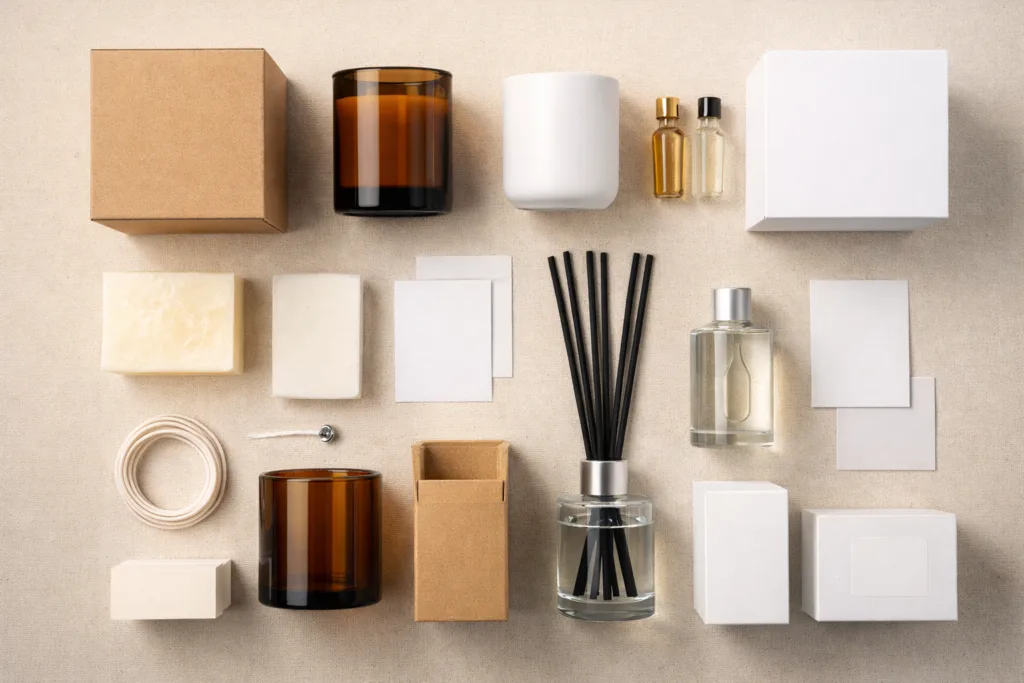
Ask experienced buyers what destroys margin in home fragrance, and many will not say wax or fragrance first.
They will say packaging.
That is because packaging controls three things at once:
- perceived value
- freight efficiency
- damage protection
Candle Packaging Logic
In candles, packaging can radically change the business model.
A simple folding carton can keep the line commercially viable for wholesale. A rigid lid-and-base gift box with insert can help a boutique brand move upmarket and support a stronger retail price, but it also increases:
- unit cost
- carton volume
- shipping cost
- damage sensitivity if poorly designed
The right answer depends on channel.
If the brand sells through independent boutiques or online DTC with a premium gift angle, rigid packaging may be justified. If the brand is trying to secure broader wholesale volume, a more disciplined carton strategy may protect margin better.
Diffuser Packaging Logic
For diffusers, packaging is not only about presentation. It is also about liquid protection.
The package has to support the bottle, reduce breakage risk, help leakage control, and arrive looking clean. A premium diffuser with weak transit protection is one of the fastest ways to damage retailer trust.
This is why diffuser packaging must be treated as a structural decision, not just a graphic design decision.
Logistics and Compliance: Where the Real B2B Gap Appears
This section is often what separates an experienced fragrance supply chain from a general giftware supplier.
Candle Logistics
Candles bring familiar challenges:
- glass breakage risk
- heat sensitivity in some climates
- label adhesion and surface finish consistency
- outer carton compression and pallet stability
These are real issues, but they are operational issues that experienced candle suppliers usually know how to manage.
Diffuser Logistics
Diffusers add a different type of risk.
Because they are fragrance liquids, buyers must pay close attention to:
- formula classification
- documentation requirements
- leakage prevention
- destination-specific shipping treatment
- compatibility between fragrance oil, base, bottle, and closure
This is one reason boutique brands should not source diffusers casually.
A good-looking bottle is not enough.
The supplier needs to understand how the product behaves in transport, in storage, and after opening. That includes the fragrance system, not only the glass.
Compliance Expectations Are Also Different
For candles, buyers usually focus on vessel safety, burn behavior, warning language, labeling, and packaging consistency.
For diffusers, buyers often need more active support on fragrance documentation and intended-use alignment, especially when selling into regulated or quality-conscious markets.
If your supplier can discuss IFRA categories intelligently, explain intended use, provide documentation pathways, and help you align candle and diffuser fragrance development under the right usage logic, that is a strong sign of a serious fragrance supply chain.
If they can only quote bottle size and box price, that is not enough.
Sell-Through by Channel: The Part Many Margin Calculations Ignore
A profitable SKU is not just a well-costed SKU. It is one that moves in the right channel.
Independent Boutiques and Concept Stores
Candles usually move faster in mixed retail because they are familiar, giftable, and easy to merchandise. They fit seasonal drops, holiday tables, and sensory retail storytelling.
Diffusers can perform well too, especially in design-led stores, but they often benefit from stronger visual merchandising and clearer brand positioning.
Hotels, Spas, and Wellness Retail
Diffusers often become more attractive here because they align with ambient scenting and no-flame positioning in more settings.
Candles still work in guest gifting, suites, or retail take-home programs, but the diffuser may feel more operationally suitable for certain spaces.
E-commerce Launches
For online-first boutique brands, candles often perform better early because consumers understand them immediately and the gifting language is already well-established.
Diffusers can sell well online too, but they depend more heavily on precise education: scent throw, longevity, refillability, room size expectations, and design cues.
Corporate Gifting and Event Programs
Candles often win on emotional impact and presentation. They are easier to theme seasonally and easier to brand visually.
Diffusers can work beautifully in premium gifting, but the program must be operationally tight.
So, Which One Is More Profitable?
Here is the practical answer.
Candles are usually more profitable when:
- the brand is in launch or early growth stage
- the buyer needs easier assortment testing
- the product is aimed at gift retail or broad boutique distribution
- the brand wants faster reorder rhythm
- standard vessels can be used to control cost
- the business needs lower complexity in the first production cycles
Diffusers are often more profitable when:
- the brand already has a stable identity and retail story
- the target channel values refined ambient scenting
- the business can support more careful product education
- the buyer wants to lift perceived value across the collection
- hospitality, spa, design retail, or premium interior channels are important
- the supply chain can properly manage liquid fragrance product development and export handling
The Most Commercially Sound Strategy for Many Boutique Brands
For many serious boutique brands, the best answer is not choosing one forever.
It is this sequence:
Start with candles to validate scent direction, packaging language, and price acceptance. Then introduce diffusers as a category expansion once the brand position and reorder behavior are clearer.
That sequence protects cash flow while still building a premium brand architecture.
It also mirrors how many successful fragrance collections scale in practice.
What Mature Buyers Should Ask Before Placing a Large Order
If you are sourcing for serious volume, these are the questions worth asking your supplier.
- Can you support both candles and reed diffusers through a stable, experienced fragrance supply chain rather than one single factory line?
- Can you explain the MOQ impact of vessel choice, print method, and packaging structure clearly?
- Can you offer standard component routes for first production and upgrade routes for later scaling?
- Can you support fragrance customization, stock library selection, and scent matching where commercially viable?
- Can you discuss documentation and intended-use logic for both candle and diffuser projects with confidence?
- Can you quote with real packaging logic, not just a naked product price?
- Can you advise which category should lead based on the buyer’s channel and order strategy?
These questions matter because large orders are rarely won by the cheapest quote.
They are won by the supplier that can reduce commercial mistakes.
Our View as a Home Fragrance Supply Chain Partner
After years working across scented candles and reed diffusers, one lesson stays consistent:
The most profitable product is not the one with the highest theoretical markup. It is the one that fits the buyer’s stage, channel, packaging budget, compliance burden, and reorder pattern.
That is why strong boutique brands should not source candles and diffusers as isolated objects.
They should source them as part of a category strategy.
A well-built candle line can generate faster traction, easier gifting appeal, and smoother early production. A well-built diffuser line can elevate the brand, support hospitality and premium retail channels, and increase collection value.
Both can be powerful.
But both need the right supply-chain structure behind them.
That means:
- strong component sourcing
- tested fragrance development
- practical MOQ planning
- packaging that matches the target margin
- documentation support
- export experience
- the discipline to recommend the commercially sensible route, not just the most decorative one
For mature buyers, that is the difference between buying a product and building a sustainable fragrance business.

Final Verdict
If your goal is faster launch, easier testing, broader giftability, and stronger short-term cash flow, candles are usually the more profitable starting point.
If your goal is higher price perception, stronger spatial branding, and a more elevated home fragrance collection, diffusers can become the more strategic profit driver once the brand is ready.
For most boutique brands, the smartest route is not candle versus diffuser as a binary decision.
It is:
Candles first for traction. Diffusers next for expansion. Both supported by a supply chain that understands margin, packaging, compliance, and scale.
That is how serious fragrance brands grow.
FAQs
1. Are reed diffusers more profitable than candles?
Not automatically. Reed diffusers often carry a higher retail price, but candles frequently perform better in early-stage boutique brands because they are easier to launch, easier to gift, and often reorder faster.
2. Which is easier to source for a new boutique home fragrance brand?
Candles are usually easier to source correctly at the beginning, especially if you use standard glass vessels and practical packaging. Diffusers can require more careful work on liquid performance, leakage control, and shipping treatment.
3. Should boutique brands launch candles and diffusers at the same time?
Only if the positioning, budget, and supply chain are ready. In many cases, starting with a focused candle line and then adding diffusers later is the more commercially disciplined approach.