
Unlocking Candle Pricing Strategy: MOQ Fundamentals Explained
Understanding how Minimum Order Quantity (MOQ) directly impacts your candle pricing strategy is essential for both aspiring brands and seasoned private-label buyers. In the candle industry, choices around order size, customization, and production methods ripple through every element of cost structure. Especially for those working with luxury manufacturers like Circe Home, mastering these dynamics unlocks smarter negotiations and healthier margins.
How MOQ Impacts Your Candle Pricing Strategy (Beginner-Friendly Guide)
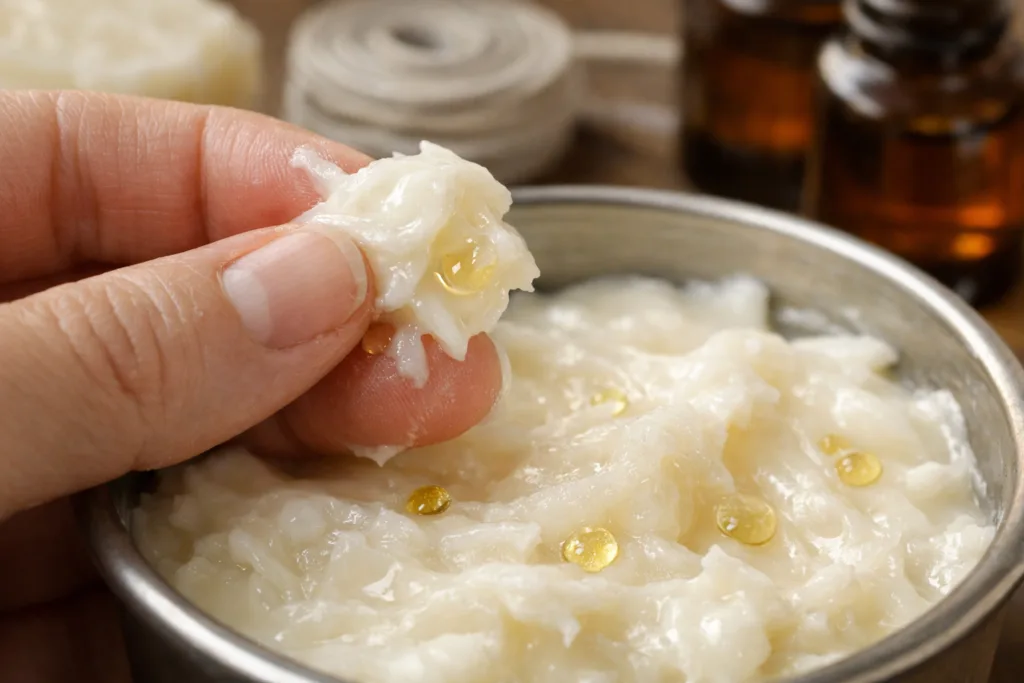
The MOQ sits at the intersection between your candle’s unit price and overall profitability. While it can seem like a tedious technicality, grasping how MOQ shapes pricing in industrial-scale candle production enables brands to budget accurately and scale confidently. Whether you’re ordering 300 or 1,000 units, the structure of fixed and variable costs exercises outsized influence on your cost per candle—and the end retail price.
Decoding Fixed Costs: Why Small MOQs Raise Unit Prices
Let’s ground this in production reality. When you initiate a candle run—especially a customized one—several fixed fees are typically involved:
- Sampling & Development Fee: Covers bespoke fragrance formulation, vessel selection, and initial lab tests.
- Machine Setup Fee: Includes prepping melting tanks, calibrating fills, and configuring pour lines.
- Color Spray/Finish Adjustment Fee: Involves preparing pigments, cleaning spray booths, and test rounds for colored jars.
These costs remain constant whether you produce 300 or 1,000 candles. The difference? With a low MOQ, these expenses are divided across fewer units, making each candle carry more overhead. That’s why smaller orders often feel disproportionately expensive per piece.
Cost Breakdown: 300 vs. 1,000 Unit Orders Compared
The implication of MOQ becomes crystal clear when studying two production scenarios side-by-side:
| Order Size | Fixed Costs (USD) | Variable Costs (USD/unit) | Total Unit Cost (USD) |
|---|---|---|---|
| 300 units | $600 | $4.80 | $6.80 |
| 1,000 units | $600 | $4.80 | $5.40 |
Notice how the fixed cost per candle drops by more than 50% in the higher-MOQ scenario, while the variable cost (wax, fragrance, wick, jar, and packaging) remains steady. This is the heart of MOQ’s impact on pricing strategy for candle brands.
Understanding Key Candle Production Costs
Efficient candle manufacturing is a blend of material science and precision engineering. Each unit passes through a sequence where costs are split into:
- Raw Materials: Wax blend (soy, coconut, rapeseed, beeswax), fragrance (essential oils/fragrance oils), wicks, containers, labels.
- Labor & Energy: Melting, blending, pouring, curing, vessel prep.
- Quality Control: Burn testing, fragrance throw assessment, wick centering, compliance checks.
- Packaging: Outer boxes, inserts, carton printing, protective measures.
In low-MOQ projects, fixed setup time—like preparing custom fragrance or mixing pigmented wax—doesn’t shrink, no matter the order size. This is why production scale is so influential on your candle’s per-unit price.
Wax Blends and Fragrance Load: Cost Implications
The type of wax and the fragrance load are the backbone of luxury candle appeal—and central drivers of price. Premium blends (such as those offered by Circe Home) often include:
- Soy Wax: Clean burn, great scent retention, moderate cost, can frost.
- Coconut/Rapeseed Blends: Superior scent throw, softer texture, higher cost per kg.
- Beeswax: Natural, subtle aroma, higher melting point, premium pricing.
Fragrance systems must be tailored for optimal compatibility: pairing the wax with the correct fragrance oil or essential oil affects burn profile, curing time, and scent throw. Max fragrance load can vary from 6% (beeswax) up to 12% (soy-coconut blends)—this is slated during product development and directly influences cost structure, especially when calculating overall wax and fragrance consumption at scale.
Customization, MOQ, and Their Pricing Relationship
For brands exploring private label or OEM/ODM candle production, customization options may include unique scents, colored or embossed glass, specialty packaging, and compliance labeling. Each layer of personalization triggers additional setup and sampling costs, which, again, are divided over the full run.
This means that launching a highly bespoke candle at 300 units is feasible, but expect a noticeably higher price per candle than if you committed to a 1,000 unit MOQ. Decisions about candle design should always balance creative ambition with scale-based pricing efficiency.
Industrial Candle Production Process: Where MOQ Fits In
The standardized industrial process for candles often runs as follows:
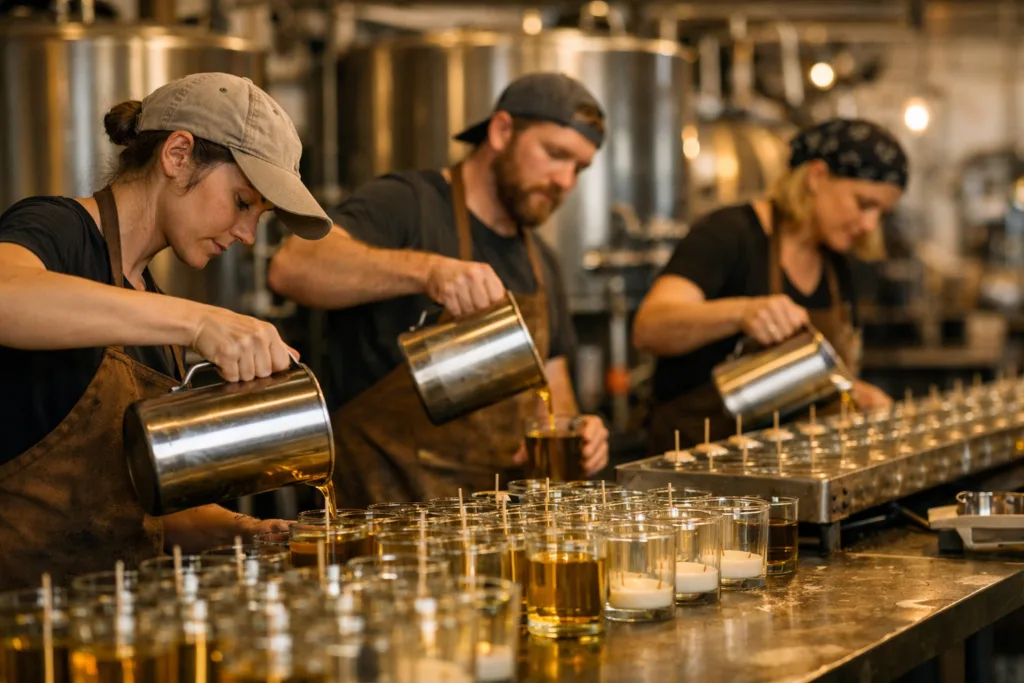
- Raw material inspection and batch testing
- Custom fragrance blending (where required)
- Melting and blending wax to formula
- Container pre-treatment and wick attachment
- Automated or hand-pouring of wax
- Surface finishing, color spraying, or embossing
- Cooling and extended curing time for scent stabilization
- Quality control: burn tests, smoke/soot index, leakage
- Labeling, boxing, IFRA/CLP compliance checks
- Packing and logistics prep
At each step, certain stages—like setting up color spray lines or programming machines for a new label design—require time and manpower independent of order volume, reinforcing why smaller MOQs face higher relative cost.
Circe Home Lab Insight
“In our lab, dialing in a custom fragrance and wax formula for a client’s new line can require over 10 iterations—even for a standard 300-piece MOQ. The development and setup cost is identical, but the per-candle impact drops dramatically at higher volumes.”
Optimizing Your Candle Pricing Strategy: Actionable Tips
Crafting a profitable candle line is about more than just accepting your supplier’s quote. Consider these tactics:
- Bundle SKUs: Order one vessel across multiple fragrances to push towards a higher MOQ per item.
- Simplify Design: Minimize bespoke jar finishes or outer box formats for launch collections.
- Scale with Growth: Use smaller MOQ to pilot-test new scents, but plan to scale SKUs with proven traction.
- Negotiate Setup Fees: Some manufacturers offer partial refunds or apply sampling fees to first bulk order.
For niche, high-end retailers or ambitious startups, absorbing higher unit costs at launch may be viable, provided the market will support the necessary retail price and positioning.
Beyond MOQ: Other Factors Impacting Candle Pricing
While MOQ casts a long shadow over per-candle costs, other variables wield influence, including:
- Container Sourcing: Bespoke vessels (e.g., Italian glass or custom ceramics) come with mold and decal setup fees.
- Fragrance Compliance: Ensuring IFRA and CLP conformity requires batch testing and labeling, which is more efficient at scale.
- Quality Assurance Regimes: Intensive QC testing, such as extended-burn trials, may be built into the unit price at higher MOQs.
- Eco-Packaging: FSC-cert cartons, soy-ink labels, and compostable wraps boost sustainability but incrementally increase cost.
Designing Candle Collections for MOQ Efficiency
To maximize both creative potential and cost efficiency, consider:
- Launching a focused collection (3-5 core SKUs) instead of a sprawling assortment.
- Reusing signature vessels across scent lines for economies of scale.
- Adopting modular packaging with semi-customizable labels to keep outer box MOQ manageable.
- Testing refill systems or minimalist formats that require fewer unique components.
Compliance & Quality Considerations at Scale
Both luxury and mid-tier candles must meet global standards:
- IFRA 51st Amendment: Limits hazardous fragrance allergens, ensures clean burn, requires batch documentation.
- CLP Labelling: Mandated in the EU for all scented products, includes allergen declaration, hazard pictograms, and safety statements.
- Batch Tracking: Serializing production for traceability—vital for recalls or dispute resolution.
- Sustainability Certifications: FSC cartons, soy-based inks, Oeko-Tex wicks or FCS-certified glass encourage brand trust and premium positioning.
Real-World Candle Applications: Cost vs. Market Position
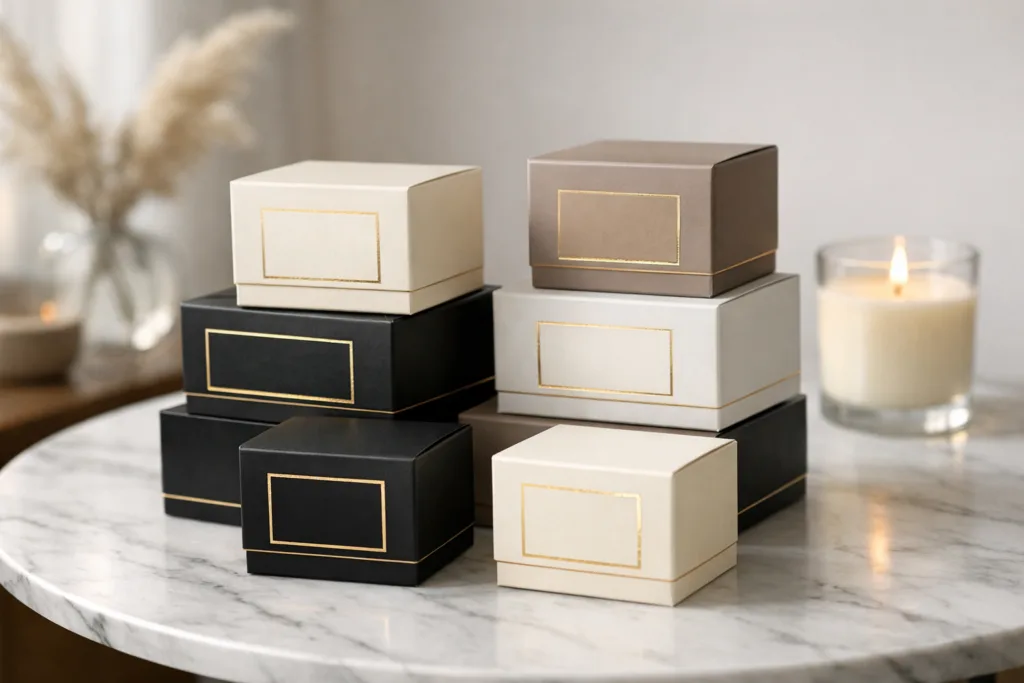
How your MOQ decision feeds into your overall pricing will also depend on end use:
- Luxury gifting: Expect higher material and packaging budgets, minimums may be justifiable for ultra-premium positioning.
- Private-label wellness/spa: MOQ efficiencies let you offer custom scents while maintaining profitability.
- Minimalist home décor: Focus on timeless vessels and neutral palettes for streamlined production and scale economics.
- Seasonal promotions: Strategic MOQ and lower-cost vessels can balance short-term themed runs.
Frequently Asked Questions
What is MOQ and why does it affect candle pricing?
MOQ stands for Minimum Order Quantity—the smallest batch a manufacturer agrees to produce. It impacts candle pricing because fixed costs for setup, sampling, and machine preparation must be spread across all units in the order. Lower MOQs result in higher costs per candle since there are fewer units to absorb these expenses.
Are fixed costs the same for 300 and 1,000 unit candle orders?
Yes, most fixed costs like sample development, machine setup, and color adjustments remain constant across order sizes. However, with a higher MOQ, these costs are divided among more candles, resulting in a lower cost per unit compared to smaller runs.
How do wax type and fragrance load influence my pricing strategy?
The choice of wax blend and the percentage of fragrance (fragrance load) directly impact material costs. Premium waxes like coconut, rapeseed, or beeswax and higher fragrance loads increase the per-candle material cost, emphasizing the importance of balancing quality with your target price point.
Can I customize packaging or fragrance with a low MOQ?
Many manufacturers, including Circe Home, offer customization at lower MOQs, though you’ll pay more per unit. Custom scents, packaging, or vessel colors raise setup fees, so the cost per candle is usually higher when ordering smaller batches.
What other factors beyond MOQ influence candle prices?
Container material and design complexity, compliance and safety testing (such as IFRA/CLP labeling), quality assurance regimes, and eco-friendly packaging also add to overall unit cost. Higher MOQs generally help lower these individual overhead components.
How should new candle brands approach MOQ when launching?
New brands often start with lower MOQs to reduce risk, accepting higher per-unit costs initially. It’s smart to focus on a concise product line with versatile packaging and expand as sales grow, leveraging higher MOQs for better pricing in future production runs.