
Private Label Candle MOQ: What Retailers & Startups Must Budget for
Launching a private label candle line is a thrilling infusion of creativity and commerce. Yet, as dozens of boutiques and ambitious founders quickly discover, understanding MOQ—the minimum order quantity manufacturers require—is critical to shaping a realistic budget and a scalable brand vision. Whether you’re laying the foundation for a boutique retail presence or designing a DTC e-commerce candle brand, unraveling MOQ and all its ripple costs sets the tone for success. Circe Home, an OEM/ODM specialist renowned for luxury blends and refined design services, has seen countless startups succeed by approaching MOQ strategy as a core business question, not an afterthought.
What Is Private Label Candle MOQ?
MOQ stands for minimum order quantity—the smallest batch of bespoke candles a manufacturer is willing to produce per SKU, scent, or vessel customization. For private label projects, MOQ reflects not just the wax and vessels, but labor, scent testing, labeling, and compliance work required per run. Brands must balance creativity against this threshold, since MOQ impacts unit cost, cash flow, shelf risk, and inventory flexibility. Understanding typical MOQ levels by wax type, fragrance system, and design complexity lets you budget intelligently and negotiate more confidently.
Why Do Manufacturers Set MOQs?
- Raw material economies (bulk procurement and waste minimization)
- Production-line efficiency (setup, calibration, cleaning per each custom run)
- Specialized packaging or labeling (print minimums or supplier contracts)
- Quality and regulatory compliance (batch testing, IFRA scent approval)
For Circe Home and their strict luxury standards, these measures also safeguard against inconsistent results—a hallmark of responsible, high-end production.
Typical MOQ Ranges by Candle Type & Customization
The MOQ you face depends heavily on design ambition and technical choices. The table below details common private label MOQ ranges for new brands planning their first runs:
| Wax Type / Feature | Typical MOQ (units/SKU) | Notes on Customization |
|---|---|---|
| Soy / Soy Blends | 300–500 | Accessible MOQs; flexible for custom scents |
| Coconut / Rapeseed Wax | 400–600 | Higher raw cost; more natural but larger batch needed |
| Beeswax | 500–800 | Premium, natural; scent options more limited |
| Paraffin | 250–500 | Cost-effective, bright color throw, but less eco appeal |
| Custom Vessel | 1,000+ | Ceramics, concrete, custom molds—MOQs may be set by vessel supplier |
| Custom Printed Box/Label | 500–2,000 | Dependent on print finishing, foiling, or embossing |
This baseline lets retailers and startups estimate working capital for soft launch, iterative R&D, or ambitious multi-scent debuts.
Cost Structure Breakdown: What Makes Up Your MOQ Budget?
Budgeting for MOQ isn’t a single invoice—it’s a sum of cascading costs, each shaped by your vision for quality and differentiation. Beyond just bulk candles, founders must account for:
- Wax, Scents & Wicks: Premium waxes/complex blends add cost and affect fragrance load compatibility. Wicks must perfectly match burn profile to vessel and blend.
- Vessel Choice: Simple clear glass or painted tin keeps MOQs and unit prices lower, while custom ceramics or colored glasses raise all-in cost and minimums.
- Fragrance System: 100% essential oil candles have lower scent throw and higher per-unit cost. Fragrance oils have broader compatibility but must be certified for IFRA/CLP.
- Labeling & Packaging: Digital-printed wraps let you start small—special finishes require higher print minimums.
- Testing, Compliance, and Logistics: CLP/IFRA documentation, burn and soot tests, and insured shipping to your market.
“Circe Home Lab Insight: Early-stage brands who budget for full burn performance testing and IFRA/CLP compliance avoid costly reformulations—and win better retail placement.”
Wax Blends and Fragrance Loads: Technical Factors That Impact MOQ
The core chemistry inside your candle line affects how feasible—and affordable—lower private label MOQs are:
- Soy, coconut, and rapeseed wax: These offer a clean burn, moderate scent throw, and a wider range of compatible fragrances. Most suppliers will accept lower MOQs for standard blends.
- Pure beeswax: Natural, hypoallergenic, and slow-burning—but high cost and fragrance load limitations require larger run sizes (and thus higher MOQs) to offset equipment Yields.
- Custom blends (e.g., coconut-soy): Require dedicated melting and mixing protocols. Even modest modifications can drive MOQ higher if line changeover is laborious.
Fragrance Load Limits
Maximum fragrance load percentages dictate how potent your candle can be. Standard soy wax supports 8–10% fragrance oils, but push higher—and the scent can leach or cause wick tunneling. Premium blends need extensive R&D to hold strong hot/cold throw, often increasing R&D and test batch costs, and thus MOQ.
Designing Your First MOQ: Startup Budget Scenarios
How should aspiring founders and buyers shape a candle brand budget? Many underestimate just how much MOQ feeds into everything from scent selection to packaging format. Consider these scenarios:
- The Lean Test Run: 300 units per scent, basic glass vessels, digital-printed boxes, standard soy blends. Minimal customization and lowest entry cost—ideal for boutiques and proof-of-concept launches.
- The Statement Debut: 600+ units per SKU, luxury ceramic containers, custom wood lids, bespoke fragrance development. Designed for premium shelf impact and PR, but requires full MOQ across each variant.
- The Modular Line Extension: Small-batch refills and single-wick vessels (400 units each), eco-packaging, simple cold-process scents, no outer box. Keeps cost down and supports DTC refill strategy.
Each approach shapes packaging waste, storage, cash flow, and the brand’s agility in adapting to market feedback. Consultation with experienced partners like Circe Home can clarify necessary vs. optional spend, and help time your scale-up milestones.
Quality Control, Compliance, and Risk: Hidden MOQ Drivers
Meeting MOQ is meaningless if your batch fails performance or safety standards. Every premium candle should pass at least these checks pre and post-pour:
- Consistent burn time (e.g., >35 hrs for 200g standard size)
- Soot index within legal limits (measured during burn test)
- Wick archiving: correct sizing, centering, and mushrooming assessment
- Fragrance distribution tested in cold and hot throw across random samples
- Regulatory labeling (IFRA/CLP) including allergen statements, pictograms, batch code, and safe use warnings
For EU/UK/EU-compliant brands, all formula and labeling changes reset compliance review and may affect MOQ—especially with novel vessel/label treatments or new blend types.
How MOQ Interacts with Scent, Vessel, and Packaging Customization
The drive for distinctiveness in scent, finish, or container inevitably pushes up MOQ. Here’s how each variable interacts:
Scent Customization
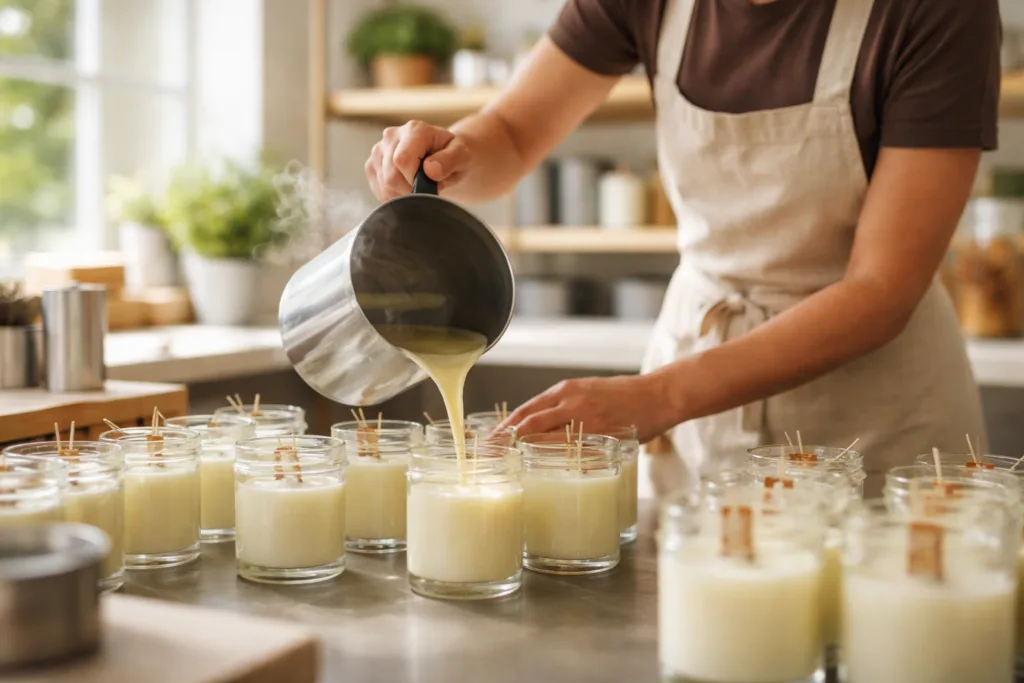
Unique fragrances mean: more R&D, additional test batches, and possibly higher minimum fragrance oil orders. Single-supplier manufacturers may help lower these thresholds using stock scent systems—but true custom blends always require larger runs for cost-effectiveness.
Vessel and Lid Selection
Non-standard or custom-colored glass, ceramics, or candle tins often have their own MOQ (e.g., 1,000+ units) set by glassworks or molders—separate from wax fill MOQs.
Packaging Nuances
Letterpress, foil, and emboss finishes on outer boxes or labels trigger higher print MOQs. Some printers require runs of 2,000+ for specialty techniques. Stock digital wraps allow brands to start lean and iterate as demand grows.
Private Label Candle MOQ: What Retailers & Startups Must Budget for
Mature brands carve out a sustainable niche by making the MOQ budget a core element of candle brand entrepreneurship—not simply an operational hurdle. Align your creative ambitions with technical realities: set a realistic unit volume, partner with a manufacturer who can explain compliance tradeoffs and cost impacts, and prioritize capital for fragrance R&D and safety testing above fleeting trends.
Especially for small batch, high-concept launches, negotiating flexibility on scent or packaging, or starting with hybrid runs (e.g., same vessel with different scent labels) can help meet minimums and free budget for marketing and iterative improvement.
Compliance, Sustainability, and International Shipping: Budget Impact
Regulatory shifts like IFRA’s 51st amendment require full traceability and approved scent documentation. The EU’s CLP labeling rules demand specific icons, warnings, and batch code systems tied to each private label production cycle. These requirements influence MOQ by making small, one-off batches expensive and logistically complex—justifying higher minimums for certified scents and packaging. Sustainability also plays an increasing role in cost planning: eco-wax, soy-ink printing, FSC/compostable outer packaging, and refill programs may raise initial MOQ (through supplier commitments) but favor long-term brand value and compliance in green-minded markets.
Optimizing MOQ for Private Label Candle Brands
Successful candle entrepreneurs treat MOQ not as a barrier but a lever for building reliable, high-quality inventory. Here are strategies for maximizing value:
- Begin with a core line (1–2 scents) in a universal vessel to keep launch MOQ—and risk—low
- Use manufacturer stock fragrances before investing in bespoke scent development
- Negotiate hybrid runs (common vessel, multiple labels) to diversify SKUs within a base MOQ
- Time budget allocation to align with curing/production timelines (e.g., wax blend, fragrance arrival, vessel supply chain)
- Invest in burn and compliance testing before scaling SKUs or design variables
By building your brand plan around expected MOQ commitments, you’ll avoid costly reorders, shelf obsolescence, and compliance missteps, ensuring premium candles that captivate customers season after season.
Frequently Asked Questions
What is a typical private label candle MOQ for startups?
Most manufacturers require an MOQ of 300–500 units per scent or SKU for standard soy candles with stock glass vessels. Customized ceramics, luxury packaging, or unique scents raise this to 1,000 units or higher, depending on supplier policies and technical requirements.
Why does MOQ affect candle brand startup costs so significantly?
MOQ determines your initial inventory investment, including wax, scents, containers, packaging, and compliance testing. High MOQs can inflate budget, tie up working capital, and increase the risk of unsold product if market response is uncertain.
How can I reduce MOQ when launching a new scented candle line?
Opt for stock vessels and fragrances, avoid highly customized packaging for your first run, and work with manufacturers offering low-batch or mixed-variant production. These strategies help lower the financial barrier and let you test market demand before larger investment.
Does the choice of wax and fragrance system impact MOQ?
Yes. Eco waxes like coconut or beeswax usually have higher MOQs due to sourcing and special equipment. Custom fragrance systems also require larger batches to justify R&D, regulatory testing, and consistent scent quality.
What compliance considerations increase private label candle MOQ?
IFRA/CLP regulations, allergen declarations, and required safety testing make one-off or very small batches cost-prohibitive, encouraging higher MOQs for certified blends and packaging. Each customization may reset testing and increase batch minimums.
What’s the most important budget item when planning for candle MOQ?
Investing in product safety, rigorous burn and scent testing, and compliant labeling should take priority in the MOQ budget, ensuring your line is retail-ready and legally marketable in target regions.