
The wellness category has matured. Buyers are more skeptical, retailers are more selective, and consumers have seen enough exaggerated claims to know the difference between a product that merely sounds calming and one that is genuinely well developed.
That shift matters for brands entering the sleep and relaxation space.
A few years ago, it was easy to position a candle with a lavender scent, a beige label, and a few soft lifestyle images as a “sleep product.” Today, that is no longer enough. The market is more crowded, the language around wellness claims is under greater scrutiny, and product lines that rely on generic aromatherapy messaging often blur together.
For brands developing sleep-focused candle lines, the opportunity is still strong—but only if the collection is built with more precision. A sleep-oriented candle line should not be treated as a decorative afterthought or a trend-driven SKU add-on. It should be developed as a carefully structured product system that translates relaxation into scent, burn performance, packaging, visual tone, and merchandising logic.
That is where many brands go wrong.
They start with marketing language before they define product behavior. They talk about “deeper rest,” “better sleep,” or “night rituals” before asking whether the fragrance profile is actually calm enough for evening use, whether the candle burns cleanly in a bedroom environment, whether the jar shape fits a bedside setting, or whether the packaging communicates softness rather than sensory overload.
In other words, they build a concept before they build credibility.
The strongest sleep-focused candle lines do the opposite. They begin with a clear understanding of what consumers are really buying in this category. They are not buying a medical solution. They are not buying proof of sleep improvement in a measurable clinical sense. They are buying a ritual object—a product that helps create a calmer, slower, more intentional transition into evening.
That distinction is critical for brands, importers, and private label buyers. It affects product claims, fragrance development, packaging decisions, product extensions, and the overall commercial positioning of the collection.
This article breaks down what that means in practical terms. If you are building a sleep-oriented home fragrance line, launching a wellness candle collection, or sourcing a custom private label range for retailers, here is what actually matters.

Why “Sleep-Focused” Is a Strong Category—But a Weak Shortcut
The reason this category continues to attract brands is obvious. Sleep remains one of the most universal modern pain points. Consumers talk about burnout, stress, overstimulation, screen fatigue, evening anxiety, and difficulty unwinding. Retail buyers know that “rest,” “reset,” and “calm” have commercial appeal across multiple segments, from boutique gifting and spa retail to e-commerce wellness brands and hotel amenity concepts.
But that does not mean every candle with a lavender note belongs in this category.
Too many products enter the market with shallow positioning. They borrow the visual language of sleep—muted colors, serif fonts, soft photography—but fail to translate that promise into product design. The result is a line that looks appropriate on a mood board but feels generic in the real market.
A better approach is to treat sleep as a product development brief, not merely a storytelling angle.
That means asking practical questions:
What role is the candle supposed to play?
Is it designed to signal the beginning of an evening ritual? Is it meant to sit on a bedside table? Is it part of a gift set for relaxation? Is it one product in a broader wind-down collection that includes wax melts, room spray, or bath accessories? The answer changes how the product should be built.
What should the product communicate without overclaiming?
The best sleep-positioned products imply calm, not cure. They support the mood of rest without turning into pseudo-medical copy. This helps brands stay more credible and more commercially flexible.
What does the buyer actually need from the supplier?
A strong manufacturer or product development partner should not simply offer a “sleep candle” fragrance oil and call the concept finished. Buyers need support with fragrance behavior, vessel selection, packaging design logic, batch consistency, and scalable line-building.
Once you frame the category this way, the entire project becomes more strategic—and much more attractive to serious buyers.
What Consumers Are Really Buying in Sleep-Focused Candle Lines
To build a line that sells, brands need to understand the emotional and behavioral function of the product.
Consumers are not usually buying candles because they believe a candle alone will solve insomnia. Even when brands use strong language, the actual purchase driver is often subtler. People buy sleep-oriented home fragrance because they want support for a ritual of slowing down.
That is a powerful insight for product development.
The candle becomes part of a sequence: dimming lights, putting away devices, taking a shower, applying body care, reading, journaling, breathing more slowly, and signaling that the day is ending. In this context, scent matters—but it matters as part of a larger sensory environment.
That is why the most successful sleep-focused candle lines are not built around one exaggerated promise. They are built around atmosphere.
A buyer may describe the concept in different ways depending on the market:
- a calming evening candle collection
- a sleep ritual product line
- a wellness candle range for better wind-down routines
- a relaxation-focused gift set
- a night-time home fragrance series
The wording changes, but the commercial logic stays the same. The product should help create a lower-stimulation environment and a consistent emotional cue.
This is also why purely scent-led thinking is not enough. A fragrance can be technically pleasant and still feel wrong for the category if the throw is too strong, the vessel too shiny, the flame behavior too aggressive, or the packaging too visually loud.
In sleep-oriented product lines, the whole system has to feel aligned.
The First Rule: Sell the Experience, Not the Cure
One of the biggest mistakes brands make in wellness-adjacent product development is confusing mood support with health outcome claims.
For sleep-focused candle lines, that distinction matters even more.
A candle may contribute to a calm environment. It may help establish a routine. Certain scent families may be commonly associated with rest, softness, comfort, and evening use. But once a brand starts implying that the candle will directly treat sleep problems or deliver guaranteed results, the messaging becomes weaker, riskier, and less believable.
Good positioning is more restrained than most founders expect.
The best brands in this space do not need to shout. They use language that suggests mood, setting, and ritual:
Better positioning language includes:
- designed for evening rituals
- created to support a calming atmosphere
- suitable for wind-down routines
- inspired by restful environments
- blended for soft, quiet scent diffusion
- intended to complement night-time self-care
Weaker language includes:
- cures insomnia
- guarantees sleep
- proven to make you fall asleep faster
- fixes anxiety
- replaces clinical sleep support
This is not only about compliance or caution. It is also about brand quality. Sophisticated buyers, especially in premium retail and wellness distribution, prefer collections that feel grounded. Overclaiming tends to cheapen the concept.
For private label buyers, this is an important sourcing point. If a manufacturer understands how to support claim-safe, premium, emotionally effective positioning, that supplier is far more valuable than one who only thinks in terms of fragrance names and jar stock.
Fragrance Strategy for Sleep-Focused Candle Lines

Fragrance is the obvious center of gravity in any candle project, but in a sleep-focused line, fragrance development needs to be more disciplined than in trend-led gift or seasonal collections.
The goal is not simply to smell nice.
The goal is to create scent behavior that feels compatible with evening use.
That includes three layers: emotional association, intensity control, and compositional balance.
Emotional association matters more than novelty
Consumers do not evaluate sleep scents in the same way they evaluate festive scents, gourmand scents, or high-impact statement fragrances. In this category, recognition often works better than surprise.
That does not mean every product has to smell identical. It means the blend should feel intuitively calm.
Scent directions commonly associated with evening and rest include:
Lavender-led blends
Still one of the most commercially viable routes when developed well. The key is refinement. Cheap lavender can feel sharp, herbal, or dated. Better versions often pair it with woods, powdery musks, tonka, chamomile, soft florals, or subtle amber facets to make it more modern and rounded.
Chamomile-inspired blends
These work well when the brand wants a gentler, tea-like, skin-close profile. Chamomile can feel soft and soothing, especially when paired with white florals, oat-like creamy notes, or light herbal accents.
Sandalwood and soft woods
A good option for brands that want a more elevated or gender-neutral sleep positioning. Woods can anchor a blend and reduce the sweetness that often makes relaxation scents feel overly commercial.
Clean musks and powdery accords
These create a “fresh sheets” or “quiet skin” effect. When used carefully, they can make a candle feel intimate, understated, and appropriate for the bedroom.
Tea, linen, or soft botanical directions
These perform well for brands targeting modern minimal wellness positioning. They tend to feel quiet, spa-adjacent, and less cliché than overtly floral aromatherapy profiles.
Intensity control is essential
One of the least discussed but most important details in sleep-focused candle lines is throw management.
A fragrance that works beautifully in a living room or open-plan retail environment may be too heavy for evening use. If the scent blooms too aggressively, it can feel intrusive rather than calming. That is especially risky in small bedrooms, hotel rooms, or enclosed spaces.
For sleep-positioned products, brands should usually avoid:
- overly sweet gourmand profiles
- highly diffusive perfumey florals
- sharp citrus top notes without grounding elements
- intensely spicy accords
- heavy synthetic intensity that fills a room too quickly
The better target is controlled presence.
A sleep candle should feel like part of the room, not the loudest object in it.
Balance beats trend-chasing
Many early-stage brands make the mistake of choosing fragrance concepts based on what sounds marketable on paper rather than what functions well in the category.
Names like “Moon Milk,” “Deep Sleep,” “Dream Dust,” or “Night Nectar” may sound appealing, but if the underlying scent formula is too sugary, too smoky, or too concept-driven, the product becomes harder to repurchase.
The strongest sleep-oriented lines are often built on stable, wearable, familiar scent structures with enough refinement to feel premium.
That matters commercially. Buyers tend to reorder scents that are easy to live with.
Burn Performance Matters More Than Most Brands Realize
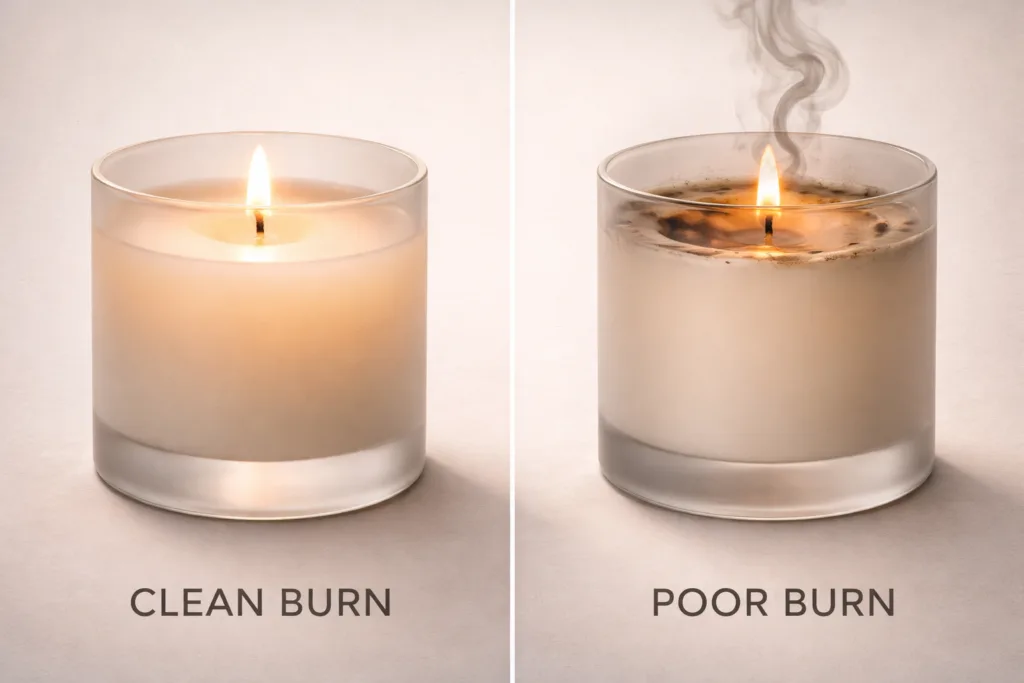
A sleep candle is not just a fragrance decision. It is also a performance object.
If the candle tunnels, smokes, overheats, flickers aggressively, or develops a burnt odor, the entire emotional promise of the product collapses. In categories centered on calm and comfort, technical flaws feel even more disruptive.
This is where product development becomes more serious than branding language.
Why clean burn is part of the brand promise
Consumers may not understand wick sizing or wax adhesion in technical terms, but they immediately notice when a candle behaves badly. A soot mark on a pale jar, unstable flame behavior, or an uneven melt pool makes the product feel less trustworthy.
For sleep-focused candle lines, that matters because the product is often used at the quietest, most intimate part of the day. The environment is lower light, lower noise, and lower tolerance for irritation. Any performance issue becomes more obvious.
This is why brands should prioritize:
- stable flame behavior
- low soot performance
- clean top surface appearance
- well-matched wick and vessel pairing
- even melt pool development
- consistent fragrance release rather than abrupt overperformance
Wax choice affects experience
While the right formula depends on vessel size, climate, fragrance load, and production setup, brands in this category often prefer wax systems that support a softer, cleaner sensory profile.
Soy blends and coconut-based blends are commonly selected for wellness-positioned candles because they align well with premium visual language and slower scent diffusion. That does not mean every project should use the same wax base, but it does mean brands should think carefully about what the wax contributes to the overall experience.
A sleep-focused product should not feel harsh, oily, unstable, or overly industrial.
It should feel gentle, deliberate, and controlled.
The flame itself is part of the sensory design
Founders often focus so heavily on scent that they forget the visual effect of the burn.
But in a night-time candle, the flame contributes directly to mood. A calmer, steady burn creates a more reassuring visual rhythm. A jar proportion that looks elegant in soft light matters. Even the opacity or finish of the vessel can shape how the glow diffuses into the room.
That is why vessel and wax cannot be separated from concept development.
Packaging for Sleep-Focused Candle Lines Should Reduce Stimulation, Not Add It
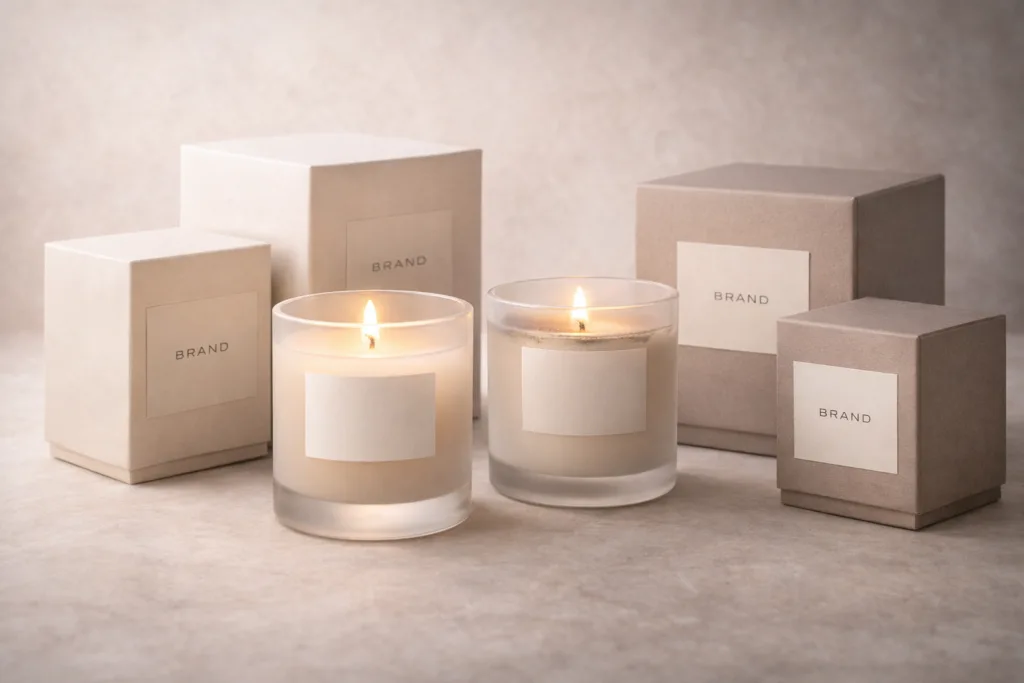
Packaging in this category is often misunderstood.
Many brands assume sleep-positioned products need to look minimal, and that is partly true, but “minimal” alone is not the strategy. The deeper principle is that the visual system should reduce sensory friction.
Everything from color to finish to typography should support the emotional tone of the line.
Visual cues that work well
For many sleep-focused candle lines, successful packaging directions include:
Frosted or matte vessels
These often feel softer than high-gloss finishes. They diffuse light beautifully and support a more muted visual impression in bedroom and wellness settings.
Neutral and low-contrast palettes
Ivory, oat, stone, mist grey, warm taupe, muted green, pale lavender, soft charcoal, and dusty blue can all work depending on the brand identity. The key is restraint.
Tactile materials
Soft-touch paper, textured labels, uncoated cartons, subtle embossing, and understated foil accents can elevate the line without making it visually noisy.
Clear hierarchy and calm typography
The product should be easy to read, not theatrically branded. Overdesigned labels often weaken the concept.
What to avoid
Common packaging mistakes in this category include:
- overly bright or high-saturation color palettes
- packaging that feels festive rather than restful
- glossy or overly reflective finishes with no conceptual reason
- crowded graphics
- excessive messaging on the front panel
- branding that feels louder than the product experience itself
The strongest packaging in this category usually feels edited.
Not empty. Not generic. Edited.
That distinction matters if the line is intended for boutiques, spas, premium gift retailers, or wellness-led online stores.
Build a Product System, Not a Single Candle
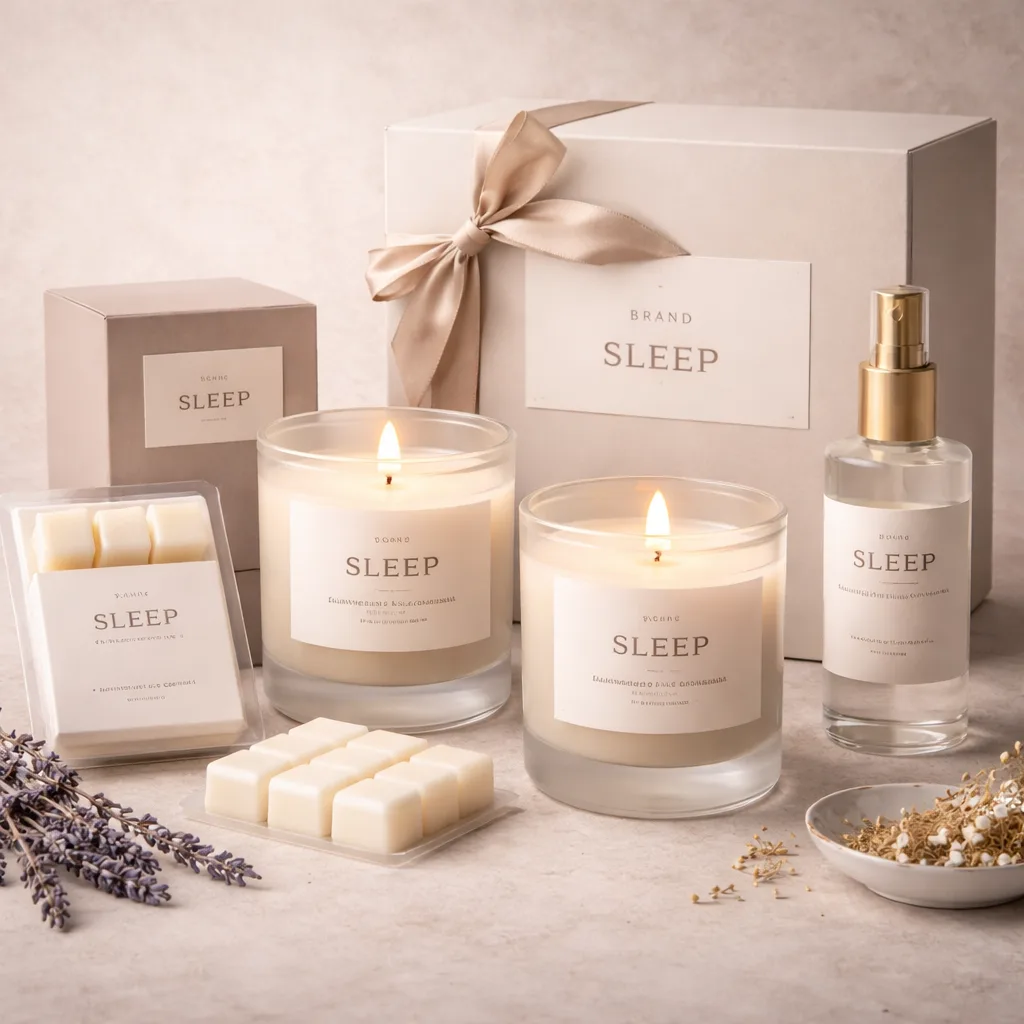
This is one of the most important commercial lessons for brands entering the category.
A sleep product line should rarely stop at one candle SKU.
Single-product concepts are harder to merchandise, harder to expand, and less powerful in gifting, bundling, and retail storytelling. Buyers are more interested in collections that can become rituals, not isolated objects.
That does not mean a brand needs ten SKUs at launch. It means the line should be designed with system logic from the beginning.
A smart sleep-focused product architecture might include:
Core hero candle
The anchor product that defines the scent direction and visual identity of the collection.
Travel or mini version
Useful for discovery, gifting, hospitality, and lower-entry-price merchandising.
Wax melts
A strong extension for markets where open flame is less practical or where customers already buy home fragrance systems.
Room or pillow spray
A natural add-on if the brand wants to broaden the ritual concept. This can increase average order value and make the line feel more complete.
Gift set format
Excellent for holiday, self-care gifting, spa retail, subscription boxes, and introductory bundles.
When buyers see a collection built this way, the concept feels more scalable. It gives them more ways to merchandise the line and more reasons to commit to a brand story.
For private label buyers and importers, this is also where a manufacturer with broader development capability becomes more useful. The supplier is no longer just filling a jar. They are helping build a commercial system.
Common Mistakes Brands Make With Sleep-Focused Candle Lines
The fastest way to improve a product line is to understand what weakens it.
Below are some of the most common mistakes seen in this category.
Treating lavender as a shortcut
Lavender can work, but not all lavender profiles feel premium. Brands that rely on generic lavender fragrance without balancing it properly often end up with a candle that feels dated, medicinal, or mass market.
Making the fragrance too strong
A candle that dominates the room may impress during a first sniff, but it often performs poorly as a repeat-use night-time product. Buyers in this category usually respond better to controlled softness.
Overclaiming results
This weakens trust and limits long-term brand quality. The stronger move is to frame the product around mood, ritual, and environment.
Ignoring burn behavior
Even the most attractive sleep concept fails if the candle smokes or tunnels. In this category, technical flaws are particularly damaging because they break the emotional promise.
Designing packaging for Instagram instead of use context
Beautiful visuals matter, but the product still needs to feel right on a nightstand, in a bathroom, in a boutique display, or inside a gift box. A concept that looks dramatic online may feel too intense in real life.
Launching one SKU and calling it a collection
Retailers and distributors usually respond better to product families than isolated items. Even a small, disciplined system feels stronger than a single hero candle with no extensions.
What Retail Buyers and Importers Actually Look For
From a buyer perspective, the success of sleep-focused candle lines depends on more than concept. Buyers want to know whether the line is commercially coherent, manufacturable, and easy to position.
That means they evaluate practical questions such as:
Is the line differentiated enough?
There are many calming candles on the market. Buyers want to know what makes this one more refined, more giftable, more premium, more design-conscious, or more adaptable to their customer base.
Is the visual system consistent?
If the scent story says “calm” but the packaging says “trend-hopping,” the line feels weak. Consistency builds confidence.
Can the collection scale?
Importers and retailers often think beyond one test order. They want to see whether the product can expand into gift sets, hotel amenities, subscription boxes, or seasonal wellness edits.
Is the supplier capable of supporting long-term development?
This is especially important for private label projects. Buyers want confidence in fragrance consistency, packaging execution, production timing, and technical reliability—not just a one-time sample.
When brands develop a sleep-oriented line with those buyer questions in mind, the entire collection becomes more investable.
How Brands Should Position Sleep-Focused Candle Lines in the Market
Strong positioning is not just about naming. It is about deciding what lane the product belongs in.
A sleep-focused candle line can be positioned through several market identities depending on the brand and buyer target.
Wellness-led positioning
This works well for brands focused on ritual, self-care, and calm living. The emphasis is on routine, reset, and emotional atmosphere.
Spa-inspired positioning
Suitable for hospitality, treatment spaces, boutique spa retail, and clean minimal aesthetics. Here, the line often benefits from refined fragrance restraint and elevated material choices.
Premium home fragrance positioning
Useful for brands that want sleep to be one emotional territory within a broader fragrance house. The language becomes less functional and more atmospheric.
Gift-driven positioning
This works well for curated sets, holiday launches, bridal gifting, and lifestyle stores. In this version, the line needs strong packaging logic and accessible scent appeal.
The key is not to mix all four at once.
The strongest sleep-focused candle lines know exactly what they are trying to be.
A Better Product Development Brief for Sleep-Focused Candle Lines
If a buyer or brand wants to build this category well, the development brief should move beyond “make a lavender candle.”
A stronger brief includes:
Scent objective
What kind of calm is the brand aiming for? Herbal, woody, skin-soft, spa-clean, creamy, linen-fresh, or meditative?
Use context
Where will the product most likely be used? Bedroom, bathroom, hotel suite, gift box, bedside table, or general living space?
Intensity preference
Should the scent feel diffused and subtle or slightly more present? Sleep lines usually perform best with controlled softness.
Vessel and glow effect
Should the jar feel more decorative, minimal, spa-like, or contemporary luxury? How should the candle look when lit at night?
Packaging format
Will the line be sold individually, in sets, online, in retail displays, or in hospitality channels?
Future expansion plan
Will the candle eventually extend into melts, sprays, travel sizes, or accessories? If yes, the visual and fragrance system should be built accordingly.
This is the kind of thinking that attracts serious buyers because it shows the line was developed intentionally, not improvised.
Why This Category Can Generate High-Quality B2B Inquiries
Some brands worry that sleep and wellness topics are too consumer-facing to attract real wholesale or private label buyers. That concern is understandable, but it misses the real opportunity.
Done poorly, yes, this category can become too retail-blog-driven.
Done well, it attracts exactly the kind of buyers many manufacturers want:
- founders building wellness-led brands
- boutique retailers curating self-care assortments
- distributors looking for giftable home fragrance concepts
- hotel and spa buyers sourcing calm lifestyle products
- importers seeking scalable product families rather than one-off novelty candles
The reason is simple. Good sleep-oriented content signals more than trend awareness. It signals product maturity.
A buyer reading a well-developed article on sleep-focused candle lines is not just looking for personal advice. Often, they are evaluating whether the supplier or brand behind the content understands modern product development, claim boundaries, sensory design, packaging logic, and category positioning.
That is why this topic can generate high-quality inquiries when written correctly.
It does not need to sound consumerish. It needs to sound commercially informed.
Final Thoughts: Calm Sells, But Only When It Is Built Well
The market for relaxation and evening ritual products is not disappearing. If anything, it will continue to evolve as wellness, home fragrance, gifting, and hospitality increasingly overlap.
But the bar is higher now.
A successful sleep-focused candle line is not built by naming a scent “Deep Sleep” and adding muted packaging. It is built by aligning fragrance behavior, burn quality, vessel choice, visual restraint, extension strategy, and claim-safe positioning into one credible system.
That is what brands should be building now.
Because the strongest products in this category do not promise miracles. They create conditions. They slow the room down. They make the evening feel softer. They become part of a ritual people actually want to repeat.
And from a B2B perspective, that is exactly what makes them commercially durable.
If your brand is developing sleep-focused candle lines, the opportunity is not in saying more. It is in designing better.
FAQs
Are sleep-focused candle lines a good category for private label brands?
Yes. Sleep-focused candle lines are attractive for private label brands because they connect with strong wellness demand while remaining flexible across gifting, spa, boutique retail, and online direct-to-consumer channels. The key is to position the line around calming rituals and product experience rather than exaggerated sleep claims.
What fragrances work best in sleep-focused candle lines?
The best fragrances for sleep-focused candle lines are usually soft, balanced, and low in sensory aggression. Lavender blends, chamomile-inspired profiles, sandalwood, clean musks, tea notes, and linen-style accords are commonly effective when developed with controlled throw and a refined finish.
How can brands make sleep-focused candle lines feel more premium?
Brands can make sleep-focused candle lines feel more premium by improving fragrance refinement, controlling scent intensity, choosing better vessel finishes such as frosted or matte glass, using tactile packaging materials, and building a product system that includes extensions like gift sets, wax melts, or room sprays.