
Why MOQ Matters in Candle Manufacturing: Full Cost Breakdown Explained
In the world of candle manufacturing, MOQ—or Minimum Order Quantity—is more than a purchase threshold. It directly shapes product quality, customization options, and unit cost. For emerging brands and luxury private-label candle lines, understanding MOQ is foundational for making informed decisions that impact overall profitability and production workflow. Intertwined with every element of the supply chain, MOQ affects wax selection, fragrance development, vessel choices, and packaging aesthetics. This comprehensive guide decodes every aspect of MOQ in the context of candle manufacturing, highlighting real-world scenarios and cost breakdowns that matter for discerning buyers.
Defining MOQ in Candle Manufacturing

MOQ stands for Minimum Order Quantity—the smallest batch a factory will produce per run. For candles, this figure takes into account labor, material sourcing, quality control, and operational efficiency. Candle manufacturers often set MOQs to optimize material yield (such as wax blends or custom fragrance batches), reduce downtime, and maintain pricing advantage for both supplier and buyer. Whether it’s a 500-piece MOQ for a custom soy candle in bespoke glass, or a 1,000-unit run for a multiple fragrance line, the MOQ ensures consistency and cost effectiveness across the production chain.
Why Is MOQ Non-Negotiable?
- Raw material sourcing efficiencies
- Setup and labor amortization
- Fragrance and wax batch stability
- Quality control cadence
- Packaging and carton customization feasibility
Candle Manufacturing Cost Structure Breakdown
To understand why MOQ is intrinsic, it’s essential to unravel the precise cost elements that form candle production. Unlike off-the-shelf gifting lines, luxury and private-label candles demand careful engineering of every component: wax blend, fragrance load, wick specification, vessel, labels, secondary packaging, and rigorous testing. Each of these layers introduces fixed and variable costs that only become cost-efficient at scale. MOQ ensures each layer of this process receives the right balance between craftsmanship and manufacturability.
Key Components of Candle Costs
- Wax and Blends: Formulation of soy, coconut, rapeseed, or beeswax, with varying melt points, visual clarity, and scent retention.
- Fragrance System: Sourcing IFRA-compliant fragrance or essential oils, solubilizing for optimal throw and compatibility with wax type.
- Wicks: Cotton, wood, or paper-core, selected for vessel size and wax blend for safe, soot-free burning.
- Containers: Custom glass, ceramic, concrete, or tin, often requiring unique color-coating or embossing runs.
- Labeling & Packaging: Custom boxes, foil stamping, scent-specific sleeves, FSC or eco-pack materials.
- Quality & Safety Testing: Burn profile validation, soot measurement, cold and hot throw optimization, compliance labeling.
Comparative Table: Wax Blends, Scent Throw & Cost Efficiency
| Wax Blend | Max Fragrance Load (%) | Approx. Burn Time (200g) | Visual Finish | Average Cost per Candle (MOQ: 1000) |
|---|---|---|---|---|
| Soy | 8–10 | 36–44 hrs | Creamy, Frost-Resistant | $3.80 |
| Coconut-Soy | 10–12 | 38–46 hrs | Glossy, Smooth | $4.10 |
| Rapeseed | 7–9 | 35–40 hrs | Matte, Soft | $4.15 |
| Paraffin | 10–13 | 40–50 hrs | Crystal, Clear | $3.40 |
| Beeswax | 6–8 | 44–52 hrs | Golden, Firm | $4.60 |
MOQ and Candle Formula Development
Customization is a powerful differentiator. However, each new fragrance, wax blend, or vessel geometry introduces new material, labor, and certification requirements. When setting a custom formula run, the minimum order quantity ensures:
- Viable batch sizes for wax and fragrance blending (preventing residue loss and instability)
- Dedicated time blocks in R&D and QC labs
- Testing coverage across safety and burn profiling
- Accurate costing for premium ingredients or certifications
Stepwise Customization Process
- Raw material selection: Wax, fragrance, wick
- Lab-scale batch blending
- Fragrance load & burn profile optimization
- Pour tests and visual inspection
- Compliance assessment (IFRA, CLP, burn safety)
- Full-batch production (anchored by MOQ)
How MOQ Impacts Per-Unit Cost and Profitability
MOQ is the silent engine behind pricing in candle manufacturing. Higher MOQs enable material bulk-purchasing, streamlined production shifts, reduced wastage, and more amortized labor relative to the batch. Conversely, small runs can drive per-unit costs up by as much as 35%, even before logistic and compliance factors.
Cost Breakdown by Order Size
| Order Size | Unit Cost (Soy Candle, 220g, Custom Glass) | Customization Options (Labels, Scent) |
|---|---|---|
| 500 | $5.10 | Limited (1 Scent, 1 Label) |
| 1000 | $4.10 | Standard (up to 2 Scents/Labels) |
| 3000 | $3.75 | Full custom (Multiple Scents/Labels) |
A renowned example: Circe Home, a luxury OEM/ODM candle partner, leverages optimized MOQ structures to offer refined blends and fully custom vessel solutions at scale, all while ensuring compliance with international fragrance standards.
MOQ’s Relationship to Fragrance Load, Curing, and Burn Quality
Burn profile and scent throw rest on precise tuning of fragrance load, wick length, and wax blend. These intricate adjustments require batch consistency—making MOQ the unsung guardian of product performance. For instance, a 220g soy candle with 10% fragrance load, wood wick, and glass vessel must be poured, cured, and tested in controlled volumes to ensure even scent distribution, stable flame, and soot-free finish. Low-MOQ runs may compromise this control, risking variation in burning time or fragrance delivery.
Circe Home Lab Insight
“Batch stability at MOQ is the core guarantee of even fragrance diffusion and safe combustion. R&D, QC, and compliance teams collaborate meticulously at every stage in our process.”
Packaging, Labeling, and Compliance: MOQ’s Hidden Costs
Luxury candle projects demand bespoke packaging and compliant labeling. Custom boxes, foil logos, or eco-materials require minimum print runs, while fragrance compliance (IFRA, CLP) and language localization multiply complexity with each SKU. MOQ serves as the economic baseline for activating specialized vendors (printers, carton manufacturers) and for spreading fixed setup costs.
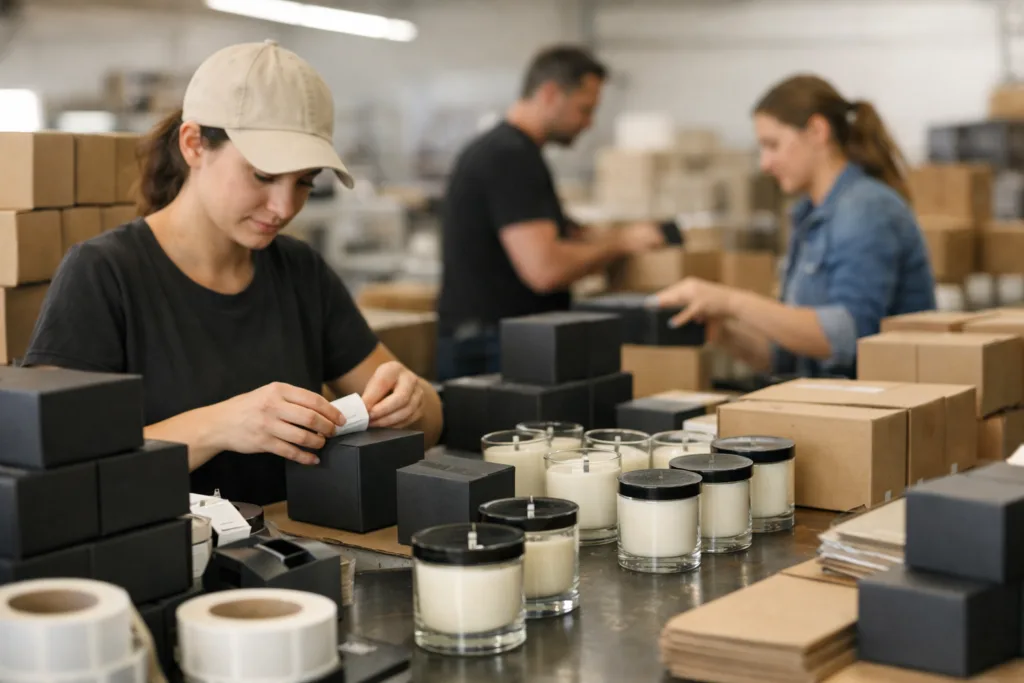
- Secondary packaging and master carton development
- The triggering of compliance assessments for new fragrances or formulations
- Preparation of SDS, IFRA, CLP labels
Quality Assurance at Scale: The MOQ Effect
Consistency isn’t just about ingredients—it’s integral to spirit and performance. Higher MOQ batches undergo systematic burn tests, scent strength validation, and packaging durability assessments before shipment. For private-label clients and luxury hotel partners, this assurance translates to repeatable quality and confident market launches. Slicing batch size below MOQ, however, increases the risk of off-spec performance or aesthetic flaws.
QC Checklist for Candle Orders
- Wick centering precision
- Fragrance load testing (hot & cold throw)
- Wax clarity and pour consistency
- Burn time validation
- Packaging inspection (impact, sealing, print quality)
- Regulatory compliance documentation
Sustainability, Compliance, and MOQ in Candle Production
Contemporary candle brands prioritize sustainability and safety. Achieving FSC-certified carton, soy ink labels, compostable packaging, or refill-friendly container options often involves MOQ thresholds at several supply points. Compliance—such as IFRA 51st for fragrance allergens or CLP for the EU—also necessitates specific run sizes for paperwork, batch traceability, and consumer safety documents. MOQ is thus not a hurdle, but a framework for responsible, legally compliant manufacturing.
Why MOQ Matters in Candle Manufacturing: Full Cost Breakdown Explained
Every aspect of candle creation—from bespoke scent engineering to premium box embossing—intersects with MOQ. Large enough batches unlock enhanced cost-efficiency, full customization, and reliable quality, while too-small runs risk variability and inefficiency. For brands seeking scaled growth, informed MOQ negotiation ensures not only product excellence but also financial sustainability, regulatory alignment, and a superior customer experience. Whether you partner with a specialty producer like Circe Home or another OEM, factoring MOQ into your design, sourcing, and brand launch is an indispensable step toward success.
Frequently Asked Questions
What is MOQ in candle manufacturing and why is it important?
MOQ, or Minimum Order Quantity, is the smallest batch a manufacturer will accept for production. It’s important because it ensures efficient use of raw materials, supports batch consistency, and enables cost-effective pricing for every aspect of a candle project—including wax, fragrance, vessel, and packaging.
How does MOQ affect the cost per candle?
MOQ directly impacts unit cost. Higher MOQs enable material and labor savings, which lowers per-candle pricing. Small orders typically push costs higher due to setup, waste, and sourcing inefficiencies.
Are higher MOQs necessary for custom fragrances or luxury packaging?
Yes. Custom scents, containers, and intricate packaging often require larger MOQs to meet supplier minimums, attain consistent quality, and amortize development costs across each unit.
What happens if I want to order below a manufacturer’s MOQ?
Ordering below MOQ may result in higher unit prices, less customization, or risk that the order won’t be accepted. It can also decrease quality and compliance assurance due to smaller, less stable batches.
Does MOQ impact fragrance load and burn performance?
Yes. MOQ enables optimal batch testing for fragrance integration and burn time calibration. Insufficient batch sizes may yield uneven scent throw, inconsistent combustion, or visual irregularities.
Can MOQ influence sustainability and compliance options?
MOQ is crucial for sustainable materials or compliance paperwork, as eco-packaging and regulatory processes depend on scale to be economically and logistically viable.