
Boutique brands do not win the home fragrance business by copying what mass retail does. They win by building a product line that feels curated, giftable, display-friendly, and commercially sensible at the same time. That balance is where many new fragrance projects fail.
On paper, home fragrance looks simple. A candle is a jar with wax and fragrance. A diffuser is a bottle with sticks and scented liquid. But once a buyer starts building a real product line, the decisions multiply quickly. Should the first launch focus on candles or diffusers? Should the brand use standard vessels or custom packaging? Is it smarter to test with a lower MOQ or commit to a more premium structure from the beginning? How much of the product cost should go into packaging? How many scents are enough for the first collection? What can be customized without pushing the project into an unrealistic budget range?
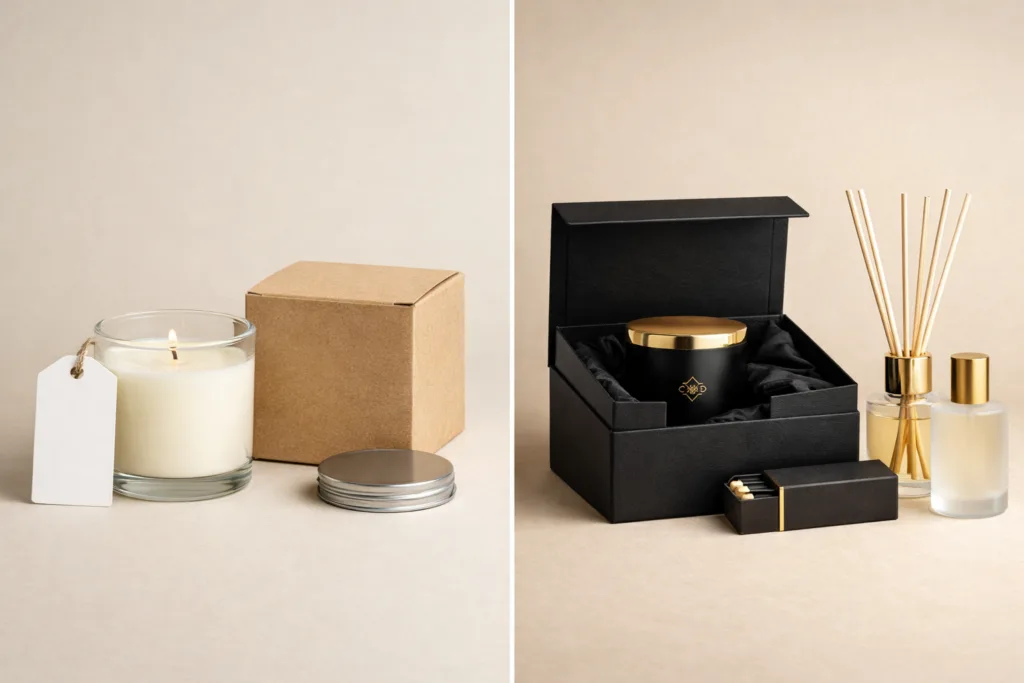
These are not styling questions. They are purchasing questions.
For boutique retail brands, concept stores, design shops, gift businesses, hospitality buyers, and premium private label projects, the real challenge is not finding a product that looks good in a mood board. The real challenge is building a fragrance line that can actually sell, ship, scale, and protect margin.
That is why the best home fragrance programs are rarely built around a single product idea. They are built around a commercial structure: the right vessel, the right packaging level, the right fragrance profile, the right MOQ, and the right timing for launch. A boutique customer may buy because of design, but a boutique buyer places repeat orders because the product works at shelf level and margin level.
In practical terms, most boutique brands are deciding between three paths:
- launching with candles only,
- launching with diffusers only, or
- launching a coordinated home fragrance line that includes both.
Each path can work. The right choice depends on sales channel, price point, visual positioning, shipping plan, gifting potential, and how mature the brand already is.
This guide is written from the B2B sourcing side. It is for boutique buyers who need to make product decisions, not for consumers looking for fragrance inspiration. We will break down how candles and diffusers perform differently, how private label options really work, what drives MOQ, where costs actually come from, and how boutique brands can build a fragrance line that supports bigger, more serious orders over time.
Why Home Fragrance Still Works for Boutique Retail
Home fragrance remains attractive to boutique brands because it sits at the intersection of lifestyle, gifting, repeat purchase, and visual merchandising.
Candles have long benefited from strong gifting demand and broad year-round relevance. In the United States, holiday demand is still powerful, but candle sales are not only seasonal; a large share of sales also comes from non-holiday purchasing, which supports everyday retail placement rather than only event-based selling. That matters for boutique buyers because it means candles can serve both as seasonal hero products and as permanent shelf items.
Diffusers, meanwhile, answer a different retail need. They offer flame-free scenting, easier maintenance for some consumers, and a more continuous product experience in spaces such as bedrooms, bathrooms, offices, studios, hotels, and wellness environments. For many boutique brands, diffusers are less dramatic than candles on first impression, but they are often more stable in terms of routine use and replacement cycles.
This is one reason serious boutique brands increasingly think in product systems rather than one-off SKUs. Candles create visual emotion. Diffusers create ongoing ambient use. Together, they let a brand cover gift-driven sales and everyday replenishment.
From a sourcing standpoint, this is important. If a buyer treats home fragrance as one decorative product, they often underbuild the assortment. If they treat it as a category, they can design a collection with stronger merchandising logic.
What Boutique Buyers Actually Care About
A lot of home fragrance content online talks about scent trends, wellness moods, or aesthetic storytelling. That may help consumer marketing, but it does not solve procurement problems.
Most boutique buyers are evaluating home fragrance using a much more practical checklist:
- What will this look like on shelf?
- What is the landed cost?
- What is the realistic MOQ?
- Can the packaging support my retail price?
- Can the product survive shipping?
- How much customization is possible at my current volume?
- How quickly can samples be developed?
- Is the fragrance documentation and compliance path workable for my market?
- Will the first order structure allow me to reorder smoothly?
The strongest private label suppliers understand this immediately. A buyer does not need twenty vague style options. A buyer needs a narrowed commercial path.
That path usually depends on five things:
1. Sales Channel
A boutique store, museum shop, hotel concept store, online premium gift brand, spa chain, and interior design retailer do not buy in the same way. Shelf depth, replenishment speed, price expectations, and product story are different.
2. Retail Price Target
A product designed to retail at USD 22 should not be built the same way as a product intended to retail at USD 48 or USD 65. Vessel, packaging, fragrance load, and decoration method need to support the target price point.
3. MOQ Tolerance
Some brands can start at 100 to 300 units with a well-edited standard program. Others want a stronger custom look but are prepared for 500, 1000, or more. The decision changes everything.
4. Packaging Role
For boutique home fragrance, packaging is not an afterthought. It often determines perceived value more than the vessel itself. Many buyers underestimate this early and then realize too late that the product looks underpriced or cannot hold the intended retail margin.
5. Long-Term Expansion Plan
A smart first order should not trap the brand. The structure should allow future fragrance additions, packaging upgrades, and higher-volume production once the line proves itself.
Candles vs. Diffusers: Which One Should a Boutique Brand Start With?
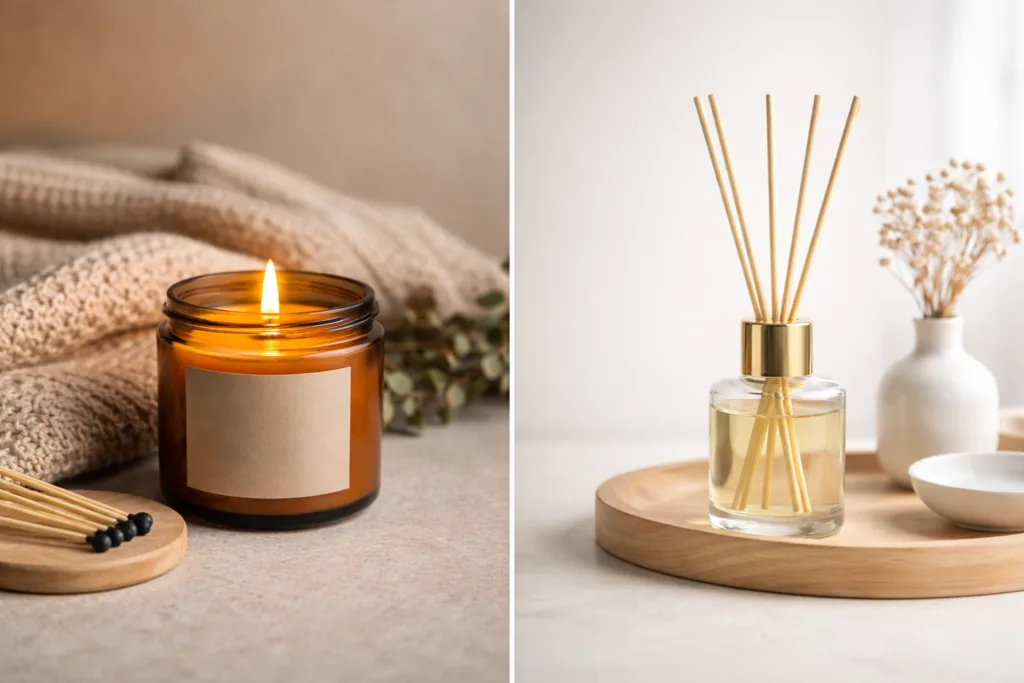
This is the most common strategic question, and there is no universal answer. But there is a clear sourcing logic.
When Candles Make More Sense
Candles are usually the better starting point when the brand needs stronger visual impact, gifting appeal, and emotional display value.
They work especially well for:
- gift stores,
- concept boutiques,
- lifestyle brands,
- seasonal collections,
- premium online stores,
- collaborations,
- limited-edition launches.
Candles create an immediate visual and sensory statement. The vessel matters. The wax color matters. The label or print finish matters. The box matters. They are highly photographable, which makes them useful for digital merchandising as well as physical retail.
From a buying perspective, candles also allow more product storytelling. A boutique brand can build themes around materiality, fragrance names, color directions, or packaging details more easily than with many diffuser formats.
But candles also come with operational realities. They are heavier to ship, more fragile if glass is involved, and they need careful handling in development. Burn performance matters. Wick matching matters. Safety labeling matters. Wax surface appearance can vary by formula and climate. Premium-looking candles that perform poorly are one of the quickest ways to damage a boutique brand’s credibility.
When Diffusers Make More Sense
Diffusers are usually a stronger starting point when the brand values routine use, lower-maintenance scenting, and a flame-free product story.
They work especially well for:
- hospitality projects,
- spa and wellness environments,
- bathroom and bedroom merchandising,
- office-friendly scenting,
- long-life home fragrance programs,
- brands that want lower day-to-day user effort.
A good diffuser can feel elegant, practical, and premium. It is also easier for some retailers to position as an everyday home product rather than an occasional indulgence.
From the sourcing side, however, buyers should not assume diffusers are simpler than candles. Fragrance compatibility, reed performance, bottle selection, evaporation behavior, and regulatory considerations all matter. Diffusers also rely heavily on packaging discipline. A mediocre diffuser in a strong bottle and box may sell once, but repeat orders depend on how well the product actually throws scent and how consistently it performs.
When a Mixed Collection Is the Best Move
For many boutique brands, the most commercially intelligent option is not choosing candles or diffusers. It is choosing both, but in a disciplined way.
A common and effective launch structure is:
- 2 to 3 candle SKUs,
- 2 to 3 matching diffuser SKUs,
- one unified packaging language,
- a small but coherent fragrance family.
This allows the brand to serve two customer behaviors at once. Candles capture gift-led purchasing and create visual merchandising impact. Diffusers support ongoing home use and often make the line feel more complete.
For B2B buyers, this mixed structure can also raise average order value. Retailers often do not want to buy a fragrance line that looks unfinished. When candles and diffusers are presented together under one design system, the collection reads as a more serious program rather than a single experimental product.
The Real Difference Between Standard, Semi-Custom, and Full Private Label
One of the biggest misconceptions in boutique fragrance sourcing is that private label is either fully custom or not custom at all. In reality, the most successful projects usually sit somewhere in the middle.
Option 1: Standard Program with Light Branding
This is the fastest and lowest-risk entry model.
Typical structure:
- standard glass vessel or standard diffuser bottle,
- existing fragrance library,
- sticker label or simple printed label,
- stock carton or very basic custom box,
- lower MOQ.
This model is useful when a brand wants to test positioning, test fragrance preference, or launch quickly. It is not the most distinctive option, but it can be commercially smart when the goal is proof of concept.
Option 2: Semi-Custom Private Label
This is often the best fit for boutique brands.
Typical structure:
- standard vessel or bottle,
- selected fragrance direction,
- custom outer box,
- upgraded label, foil, printing, or decoration,
- more curated insert or presentation,
- manageable MOQ.
This route gives the brand a stronger retail look without the cost and MOQ pressure of developing custom molds or highly engineered packaging from day one. In many cases, semi-custom is where margin, speed, and brand distinctiveness align best.
Option 3: Full Custom Development
This is the premium route, but it needs volume.
Typical structure:
- custom vessel or bottle,
- custom molds,
- bespoke packaging,
- fragrance development around a defined brief,
- more complex decoration methods,
- higher MOQ and longer lead times.
This is the right option for established brands, larger boutique chains, well-funded launches, hospitality groups, or premium retail programs that need exclusivity. It is usually not the smartest starting point for a first order unless the buyer already understands the commercial implications.
The most experienced buyers know this: full custom is not automatically more profitable. It is only more profitable when the volume, price point, and sell-through justify the added development cost.
What Really Drives MOQ in Home Fragrance
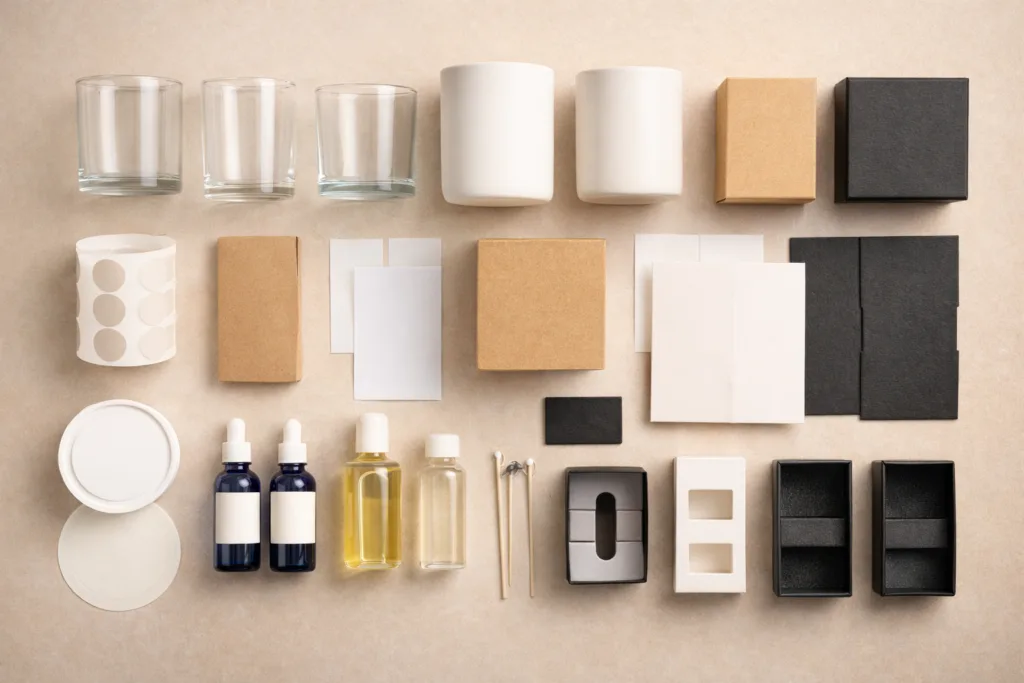
Many buyers ask for the MOQ of the candle or diffuser, but the better question is: what part of this project is creating the MOQ?
In boutique home fragrance, MOQ is rarely controlled by only one element. It is usually shaped by a combination of vessel choice, packaging structure, decoration method, fragrance strategy, and assembly complexity.
Standard Glass and Standard Bottles
These usually allow the most flexible starting quantities. If the supplier already has proven vessel formats and compatible production lines, the brand can often enter at a lower volume.
Custom Ceramic, Specialty Glass, or Molded Components
Once a buyer requests custom ceramic jars, proprietary glass, or new bottle tooling, volume expectations rise quickly. The reason is simple: development, tooling, setup, and production efficiency all need to be absorbed.
Packaging
This is often the hidden MOQ driver. Boutique brands frequently focus on the vessel and forget that rigid gift boxes, foil stamping, special inserts, or unusual carton structures may carry their own production minimums.
A buyer who wants only 200 units may be able to achieve that with a standard jar and label. The same buyer may no longer be able to stay at 200 units if they also want a fully custom rigid box with interior fitment and metallic detailing.
Decoration Method
Sticker labels, paper labels, and simple printing are usually more flexible. Screen printing, sprayed finishes, metallization, embossing, or deep custom decoration often need stronger volume support to stay commercially reasonable.
Fragrance Assortment
A first collection with six fragrances can look attractive on paper, but it divides production, inventory, and packaging. For boutique brands, narrower fragrance architecture is often smarter. A tightly curated range of two to four fragrances is easier to launch well than a broad assortment that spreads volume too thin.
Cost Structure: Where the Money Actually Goes
A common mistake among new buyers is assuming the fragrance itself is the biggest cost driver. Sometimes it is important, especially for richer fragrance compositions, but in boutique retail the overall cost structure is broader and often more packaging-heavy than expected.
For candles, the main cost components usually include:
- vessel,
- wax system,
- fragrance,
- wick and burn-related components,
- decoration,
- labor and filling,
- packaging,
- outer carton and shipping configuration.
For diffusers, the typical cost structure usually includes:
- bottle,
- diffuser base,
- fragrance,
- reeds,
- cap or closure,
- decoration,
- packaging,
- assembly and packing.
In premium boutique programs, packaging can represent a surprisingly large share of total unit cost. That is not a problem if the packaging is doing real commercial work. The problem is when packaging cost rises without improving shelf value enough to support a higher retail price.
A simple but important truth in boutique home fragrance is this: consumers often decide value before they smell the product. The box, vessel silhouette, weight, print finish, and opening experience shape price perception immediately.
That is why a modestly costed candle can retail strongly when packaging is right, while a technically good candle can underperform if presentation feels generic.
The same is true for diffusers. The liquid inside matters, but bottle proportion, reeds, cap design, and carton quality often determine whether the product reads as premium or ordinary.
Packaging Strategy for Boutique Brands
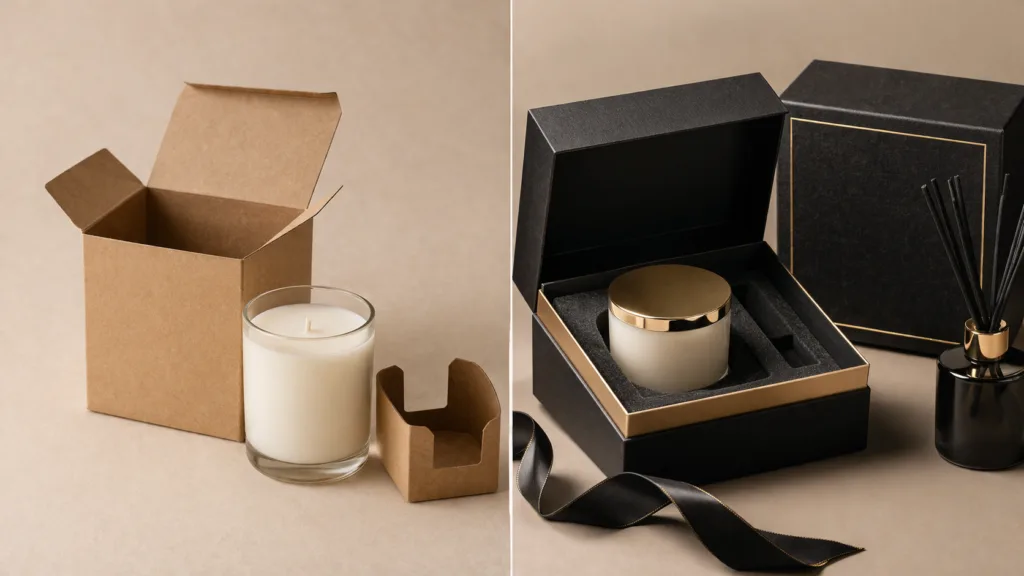 Packaging should not be chosen only for beauty. It should be chosen for shelf impact, shipping reality, and retail positioning.
Folding Cartons
These are usually the most cost-efficient choice and can still look polished when design and paper quality are handled well. They work well for brands that want a clean retail look without pushing packaging cost too far.
Rigid Gift Boxes
These create a stronger premium impression and are often used for higher-ticket candles, gift sets, and limited editions. But they increase cost, volume, and often MOQ. They should be used where the target retail price and gifting strategy justify them.
Inserts and Protection
Foam, pearl cotton, molded pulp, and paper fitments are not only protective elements. They also change perceived value. Boutique buyers should think carefully about the unboxing experience, but they should not overengineer it without a pricing reason.
Unified Visual Language
One of the strongest moves for boutique brands is building a packaging system that works across candles and diffusers. When both products share typography, color logic, and structural coherence, the line feels intentional. This helps retail presentation and can support larger multi-SKU orders.
Fragrance Development: Fewer, Better, More Coherent
Many boutique brands launch with too many scents. This is usually a branding decision rather than a commercial one.
From a B2B perspective, tighter fragrance editing is better. It simplifies production, makes sampling clearer, improves packaging consistency, and helps the buyer focus on what will actually sell.
A strong first collection often includes:
- one broad signature fragrance,
- one warm or comforting option,
- one fresh or clean option,
- optionally one seasonal or more expressive profile.
This keeps the range commercially balanced without creating unnecessary SKU fragmentation.
Consistency across candles and diffusers also matters. Not every fragrance behaves the same way in both formats. A scent that performs beautifully in a candle may not translate as effectively in a diffuser at the same intensity or structure. This is why experienced suppliers do not simply copy formulas across formats without reviewing performance and safe-use constraints.
That point is especially relevant for diffuser development. Fragrance standards and allowable usage can be stricter in some diffuser applications than in candles, so serious suppliers review compatibility carefully rather than treating all formats as interchangeable.
Lead Times, Sampling, and Order Planning

Boutique brands that run the smoothest fragrance projects usually respect the sample stage instead of rushing past it.
A realistic sourcing rhythm often looks like this:
Sampling Stage
This includes vessel confirmation, fragrance review, artwork discussion, packaging structure, and sometimes performance testing. Depending on complexity, sample development can take around one to two weeks, sometimes longer if there are custom elements.
Revision Stage
This is where many details are fixed: logo size, print tone, fragrance adjustment, wick or reed refinement, insert fit, and carton color consistency. This stage is often where the eventual success of the big order is decided.
Production Stage
Once samples are approved and order details are locked, production commonly takes a few weeks, depending on complexity and quantity. Customized packaging, special finishes, or coordinated multi-SKU collections usually need more planning than simple stock-based runs.
Shipping Stage
Air is faster and more expensive. Sea is more economical for larger orders but requires earlier planning. Boutique buyers should not wait until goods are finished to think about freight mode. The shipping decision should be part of the original costing model.
For brands targeting seasonal windows, this matters even more. A product launched late is not simply delayed. It may miss the buying cycle entirely.
Common Mistakes Boutique Brands Make
Mistake 1: Starting Too Custom, Too Early
A new brand sees premium competitors and assumes the first order also needs custom vessels, special finishes, and elaborate boxes. Sometimes that is appropriate, but often it locks the project into cost and MOQ levels that are hard to sustain.
Mistake 2: Underestimating Packaging Spend
Many brands allocate budget to the fragrance and vessel but leave packaging until the end. Then they realize the product looks too ordinary for the intended retail price.
Mistake 3: Launching Too Many SKUs
Too many scents or too many formats in the first order can dilute focus and weaken reorder logic.
Mistake 4: Chasing the Lowest Unit Price
The cheapest quote is rarely the best commercial quote. Buyers should evaluate consistency, packaging execution, communication quality, and supply chain depth, not just piece price.
Mistake 5: Treating Candles and Diffusers as Identical Projects
They may live in the same category, but they do not behave the same way in development, performance, or regulation. Serious sourcing requires format-specific thinking.
What a Strong First Order Usually Looks Like
For many boutique brands, a commercially sound first order is not huge, but it is structured.
A good launch order often includes:
- 2 to 4 fragrances,
- 1 candle vessel size,
- 1 diffuser bottle size,
- one clear packaging direction,
- coordinated artwork,
- realistic replenishment planning.
This is stronger than launching three candle sizes, seven fragrances, two packaging systems, and a custom mold all at once.
Buyers who think in reorder terms from the beginning usually build healthier fragrance programs. The first order should not only look good in a photoshoot. It should be easy to restock, easy to explain to retailers, and easy to expand later.
How Larger Orders Usually Happen
Large boutique orders rarely begin with a random catalog request. They usually begin when the buyer feels that the supplier understands how to structure the business.
A serious buyer wants more than a quotation sheet. They want answers to questions like:
- Which product mix fits my channel?
- Where should I spend more and where should I simplify?
- Which packaging route supports my margin best?
- What can I customize now and what should wait until volume grows?
- How should I build the first collection so the second order is easier?
This is where supply chain depth matters.
A supplier with strong candle and diffuser sourcing capability can do more than fill an order. They can help shape the order. That includes selecting the right vessel family, avoiding packaging mistakes, narrowing fragrance directions, balancing MOQ with positioning, and planning a scalable line instead of an overcomplicated first run.
For boutique brands that want to grow into more serious volume, this guidance matters far more than generic product lists.
Choosing the Right Private Label Partner
When evaluating a supplier for boutique home fragrance, buyers should look beyond whether the supplier can make candles or diffusers. The better question is whether they can support a commercial fragrance program.
A strong partner should be able to help with:
- both scented candles and reed diffusers,
- standard and semi-custom development paths,
- packaging recommendations based on retail price,
- MOQ guidance tied to actual production realities,
- sample refinement,
- freight-friendly order planning,
- documentation and market-specific requirements,
- future scale-up once the line proves itself.
For boutique brands, the advantage of working with an experienced supply chain team is not only manufacturing access. It is decision quality.
That difference becomes especially visible in projects that need a premium look without wasteful complexity. The most efficient fragrance supply chains know when to recommend custom work and when to say no. They understand how to build a line that feels elevated without forcing the buyer into the wrong cost structure.
Final Thoughts: Build the Collection Backward from the Business Model
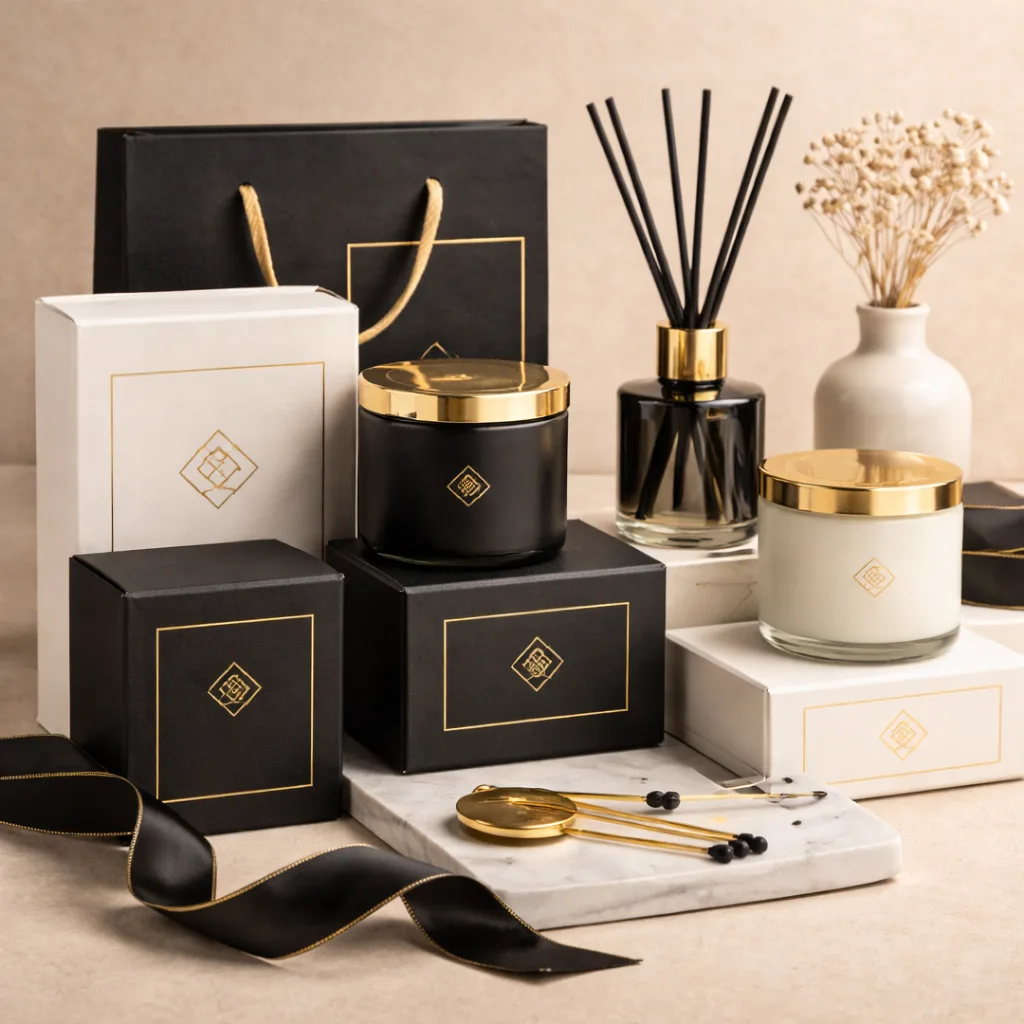
The best boutique home fragrance collections do not start with scent names or Pinterest boards. They start with a business model.
What is the target shelf price? Which product creates the strongest entry point? How much margin is needed? What quantity is realistic? What packaging level matches the brand? Which parts need to look custom now, and which parts can wait until volume increases?
When those questions are answered first, candles and diffusers stop being isolated products and become part of a coherent retail strategy.
That is usually the turning point between a boutique fragrance idea and a boutique fragrance line that can actually scale.
If you are planning a home fragrance collection for a boutique brand, the smartest place to start is not with the most complicated version of the product. It is with the version that best matches your current positioning, budget, and sales channel while leaving room for larger orders later.
In practice, that often means a tightly edited collection, a disciplined packaging system, and a supplier that can support both candles and diffusers with a realistic private label roadmap.
That is how boutique brands move from sampling to reorders, and from small launches to serious volume.
FAQs
1. What is the best home fragrance format for a boutique brand to start with?
For many boutique brands, candles are the easiest starting point because they create stronger visual impact and gift appeal. Diffusers are also a strong option when the brand wants flame-free scenting and a more everyday-use product. In many cases, the best commercial launch includes both candles and diffusers in a small, coordinated collection.
2. What is a realistic MOQ for private label candles and diffusers?
It depends on the structure of the project. Standard vessels and simple labeling usually allow lower MOQs. Custom glass, ceramic, rigid boxes, special decoration, and multi-fragrance assortments typically push MOQ higher. Packaging often drives MOQ more than buyers expect.
3. What matters more in boutique home fragrance: the scent or the packaging?
Both matter, but they do different jobs. Packaging usually creates the first impression and supports the retail price. Fragrance quality and performance drive repeat purchase. A successful boutique product needs both, but packaging is often what determines whether a shopper picks it up in the first place.