
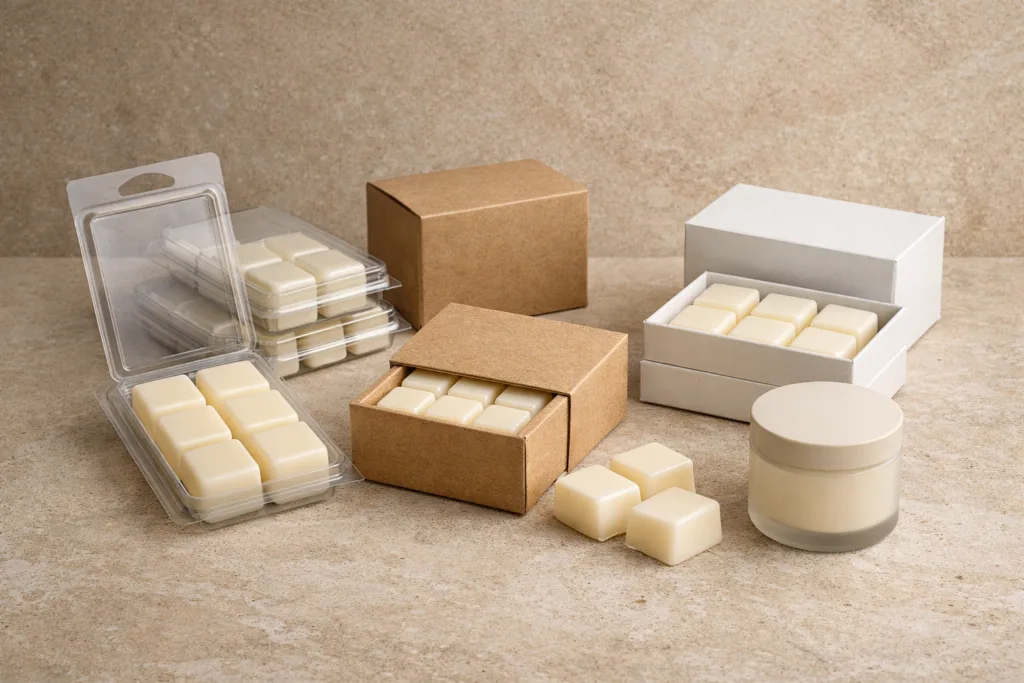
 Expanding a retail product line is one of the most critical growth decisions a candle or home fragrance brand can make. For established brands that have already validated their core candle products, expansion is not simply about adding new SKUs—it is about increasing revenue per customer, improving operational efficiency, and strengthening long-term market positioning.
Among all available expansion options, wax melts consistently emerge as the most effective and lowest-risk entry point. Mature candle brands, boutique retailers, and private label fragrance companies increasingly use wax melts as their first expansion product because they offer exceptional flexibility, high margins, and faster speed to market.
This guide explains the strategic, operational, and financial reasons why wax melts represent the optimal expansion path—and how established retail brands can implement this expansion successfully.
Understanding the Strategic Role of Wax Melts in Retail Expansion
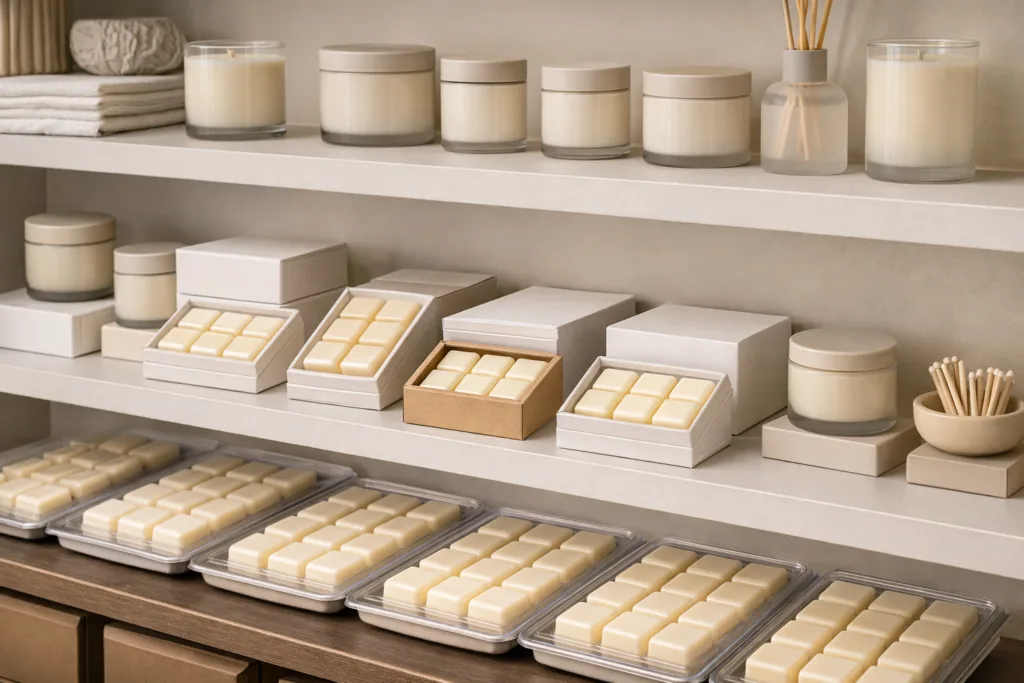 Retail product expansion must achieve three core objectives:
- Increase total revenue per customer
- Reduce operational and inventory risk
- Improve overall profitability and efficiency
Wax melts fulfill all three objectives more effectively than most alternative expansion products.
Unlike container candles, wax melts eliminate the need for expensive vessels, complex packaging, and fragile logistics. This dramatically lowers the barrier to entry while maintaining strong retail appeal and brand value.
More importantly, wax melts function as a complementary product rather than a replacement. They expand the brand ecosystem, allowing customers to engage with fragrance in multiple formats and price tiers.
For mature brands, this is essential. A broader product line increases customer lifetime value and strengthens brand loyalty.

Why Mature Retail Brands Prioritize Wax Melts as Their First Expansion Product
 Successful retail expansion depends on minimizing risk while maximizing return. Wax melts provide several structural advantages that make them uniquely suited for expansion.
Lower Development Cost and Faster Time to Market
Container candles require multiple components, including:
- glass or ceramic vessels
- lids
- rigid packaging
- protective shipping materials
Each component adds cost, complexity, and lead time.
Wax melts remove these requirements entirely. Without containers, production becomes simpler, faster, and more scalable.
This allows brands to:
- launch new SKUs faster
- reduce upfront capital investment
- iterate product offerings more frequently
Speed to market is a competitive advantage. Brands that can test and launch faster gain valuable market feedback earlier.
Lower Minimum Order Quantities Enable Strategic Testing
For many brands, inventory risk is the biggest barrier to expansion.
Container candle production often requires larger minimum orders due to vessel sourcing, packaging setup, and production constraints.
Wax melts typically support lower minimum order quantities, allowing brands to test multiple fragrances without committing to excessive inventory.
This enables brands to:
- evaluate scent performance
- identify best-selling fragrance profiles
- refine product positioning
Expansion becomes a controlled, data-driven process rather than a high-risk investment.
Higher Margins Improve Overall Profitability
Wax melts generally have lower production costs than container candles while maintaining strong retail pricing.
Because wax melts require fewer materials and simpler assembly, brands can achieve higher gross margins.
This margin advantage supports:
- higher profitability
- promotional flexibility
- bundle pricing strategies
- improved marketing ROI
For ecommerce brands, wax melts also serve as effective add-on products that increase average order value.
Lower Shipping Costs and Improved Logistics Efficiency
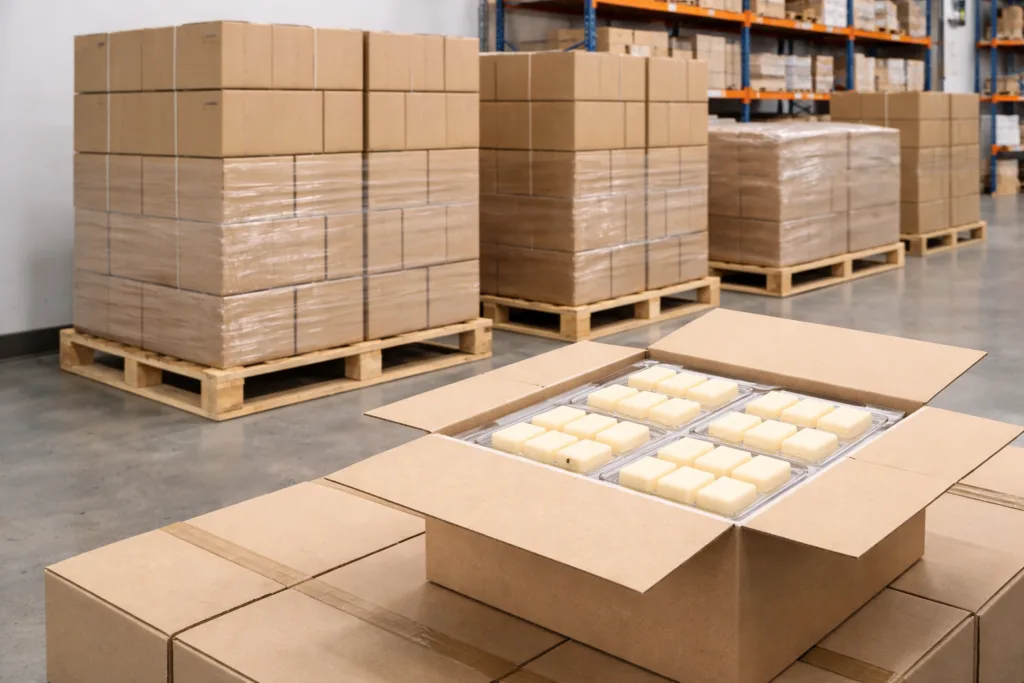 Shipping fragile container candles involves higher costs, increased breakage risk, and more complex protective packaging.
Wax melts significantly reduce shipping weight and eliminate vessel breakage risk.
This improves:
- international shipping efficiency
- ecommerce fulfillment cost
- warehouse storage efficiency
Operational efficiency becomes increasingly important as brands scale.
Wax Melts Enable Customer Acquisition and Product Tier Expansion
Not all customers are ready to purchase premium candles immediately.
Wax melts provide a lower entry price point, allowing new customers to experience a brand’s fragrance quality with lower commitment.
This expands the brand’s customer funnel and creates opportunities for future upselling.
Many successful fragrance brands use wax melts to introduce customers to new scent collections before offering higher-value products.
How Wax Melts Increase Revenue Per Customer
Increasing customer lifetime value is a key driver of retail profitability.
Wax melts support this by expanding the number of products available per fragrance collection.
For example, instead of offering only a container candle, brands can offer:
- candle
- wax melt
- gift set combinations
This allows customers to purchase multiple formats of the same fragrance.
More product formats increase total revenue per customer while reinforcing brand engagement.
How to Implement Wax Melt Expansion Successfully
Expansion must be executed strategically to maximize success.
Step 1: Select Proven Fragrances First
Rather than introducing entirely new scents, brands should begin with their best-performing candle fragrances.
This reduces uncertainty and leverages existing customer demand.
Step 2: Maintain Brand Identity Through Consistent Design
Packaging, labeling, and visual identity should remain consistent with the existing brand.
Consistency reinforces brand recognition and strengthens customer trust.
Step 3: Use Wax Melts to Test New Fragrance Concepts
Once core fragrances are established, wax melts can be used to test new scent profiles.
Successful wax melt fragrances can later be expanded into full candle collections.
This reduces development risk.
Step 4: Integrate Wax Melts into Existing Retail Channels
Wax melts can be sold through:
- ecommerce platforms
- retail stores
- gift sets
Integration into existing channels ensures efficient expansion.
Manufacturing Considerations for Large-Scale Wax Melt Expansion
 Established brands must prioritize manufacturing consistency and scalability.
Key factors include:
- fragrance performance consistency
- clean-burning wax formulations
- scalable production capacity
- quality control systems
Reliable manufacturing ensures product consistency across large production volumes.
Long-Term Strategic Benefits of Wax Melt Expansion
Wax melts provide more than immediate revenue. They strengthen long-term brand growth.
Benefits include:
- expanded product ecosystem
- improved customer acquisition
- increased average order value
- enhanced brand competitiveness
Brands that successfully implement wax melt expansion often see sustained revenue growth and stronger customer retention.
Conclusion
Wax melts represent one of the most efficient and strategic product expansion opportunities for established candle and fragrance brands.
Their lower development cost, higher margins, and operational efficiency make them ideal for scaling retail product lines.
When implemented strategically, wax melts enable brands to expand safely, increase profitability, and strengthen long-term market positioning.
FAQ
Are wax melts profitable for established candle brands?
Yes. Wax melts typically offer higher margins due to lower material and production costs while maintaining strong retail pricing.
What is the typical minimum order quantity for private label wax melts?
Most manufacturers support lower MOQs for wax melts compared to container candles, allowing brands to test multiple fragrances with lower risk.
Should wax melts match existing candle fragrances?
Yes. Starting with proven fragrances reduces risk and improves expansion success rates. New fragrances can be tested later.