
If you are developing a custom candle line for retail, hospitality, gifting, or a private label launch, the candle sample process is not a side step. It is the real beginning of the project.
Most buyers do not lose time or money because they chose the wrong fragrance family or packaging style. They lose it because they underestimate sampling. They assume a supplier can look at a reference image, understand the brand instantly, and send back a perfect first sample. In reality, sampling is where the commercial logic of the whole program gets tested: fragrance accuracy, vessel sourcing, label application, print finishes, safety fit, packing feasibility, freight impact, and whether the final product can actually move into production at a sensible cost.
That is why serious buyers search for the candle sample process before they place larger orders. They are not looking for hobby-level candle making advice. They are trying to reduce development risk.
From a B2B perspective, a sample is doing several jobs at once. It is a visual prototype. It is a performance check. It is a sourcing decision. It is a quality benchmark. And most importantly, it is a filter that tells you whether a supplier can translate a concept into something manufacturable.
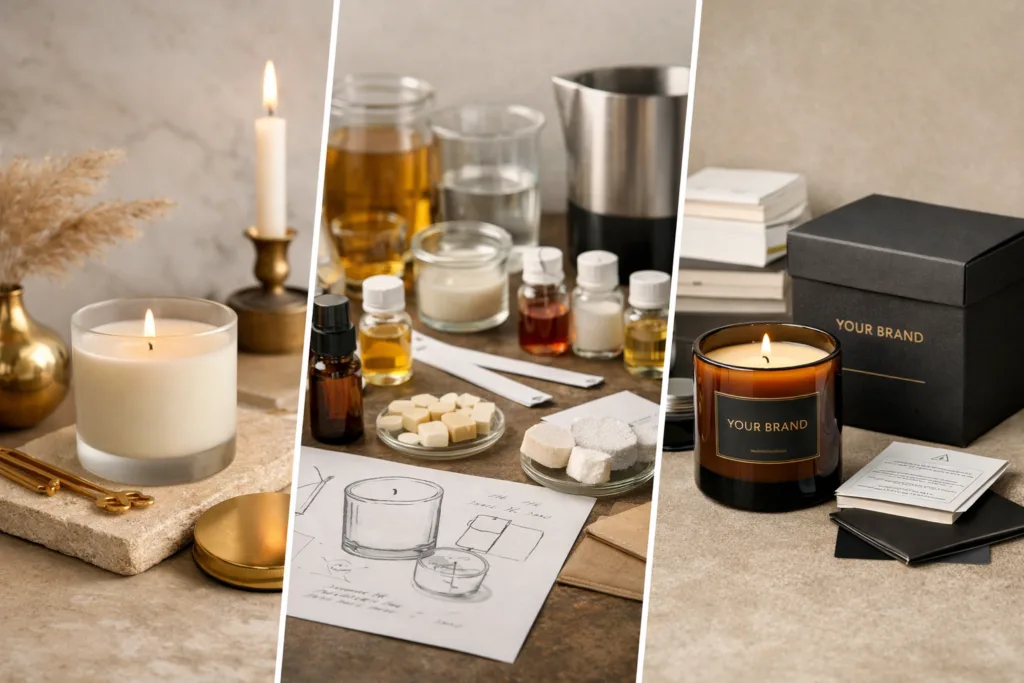
At Circe Home, we treat sampling as a commercial engineering stage, not as a one-off favor before production. That matters because the hardest parts of a custom candle project are rarely the obvious ones. In our experience, the two most difficult variables are fragrance and vessels.
First, fragrance. Clients often say they want a scent to smell “warm,” “clean,” “luxury,” “like a boutique hotel,” or “just like this existing product.” Those are useful creative references, but not production specifications. We have handled wax melt development where one fragrance required four sample rounds before the client felt it was close enough to their target. We only charged one sampling fee for that project because we had already committed to solving the problem, and because we work with a strong fragrance development supply chain that makes fine-tuning possible.
Second, vessels. Buyers frequently send a beautiful reference image taken in a styled interior or social media post and assume the jar in the image is easy to source. Often it is not. The vessel may be discontinued, custom molded, regionally sourced, edited in the photo, or visually similar to several different options with very different costs and MOQs. A good supplier does not just say yes and hope for the best. A good supplier searches for the closest viable vessel that can support your brand look, fill weight, burn performance, packaging, and production target.
This article explains the candle sample process the way a procurement team, brand founder, retailer, or importer actually needs to understand it: from reference image to approval, with the commercial details that influence lead time, cost, MOQ, and production success.
Why the Candle Sample Process Matters in B2B Buying
In consumer-facing marketing, sampling is often described as a creative stage. In manufacturing, it is a risk-control stage.
A buyer looking at a custom candle program usually has several goals at the same time:
- develop a product that fits the intended retail price and margin structure;
- confirm fragrance direction before committing to volume;
- verify that the vessel, wax, wick, and label work together;
- understand whether the packaging concept is realistic at the target MOQ;
- reduce the chance of costly revisions after purchase order approval.
This is why the candle sample process matters more in B2B than many first-time buyers expect. A sample is not only about whether the product looks nice on a table. It needs to answer practical questions.
Can the glass handle the thermal demands of the candle format? Can the fragrance throw match the client’s expectation in a container candle or wax melt? Does the selected vessel support the desired fill weight without making freight too expensive? Will the packaging structure force the MOQ too high? Can the decoration method be repeated consistently in production?
Industry guidance also supports the importance of getting fragrance, container type, and safety fundamentals right. The National Candle Association notes that fragrance is one of the most important factors influencing candle purchasing, and container and jar candles remain among the most popular formats in the market. At the same time, ASTM safety standards cover issues such as candle fire safety, labeling, and glass container performance, while IFRA standards shape fragrance safety usage in finished products. For a serious buyer, that means a sample is not just aesthetic proof. It is the point where design expectations meet technical and compliance reality.
In plain terms, the sample process tells you whether your idea is actually a product.
The Most Common Mistake Buyers Make
The biggest mistake in custom candle development is assuming that a reference image is a complete specification.
It is not.
A reference image tells a supplier what the client likes visually. It does not automatically tell the supplier:
- the exact vessel dimensions;
- the material quality of the jar or lid;
- the fragrance composition;
- the wax blend;
- the desired hot throw or cold throw level;
- the wick system;
- the print process used on the vessel;
- the carton structure;
- the insert material;
- the retail budget target;
- the intended market and compliance needs.
This gap is the reason why weak suppliers tend to overpromise at the sample stage. They say they can do everything. Strong suppliers usually slow the process down just enough to ask the right questions, because they know that the easiest way to destroy trust is to send a first sample that clearly misunderstands the brief.
The candle sample process works best when it is treated as a translation process.
The reference image is the inspiration.
The sample brief is the interpretation.
The first sample is the prototype.
The approved sample becomes the production standard.
Step 1: Start With the Reference Image, but Decode It Properly
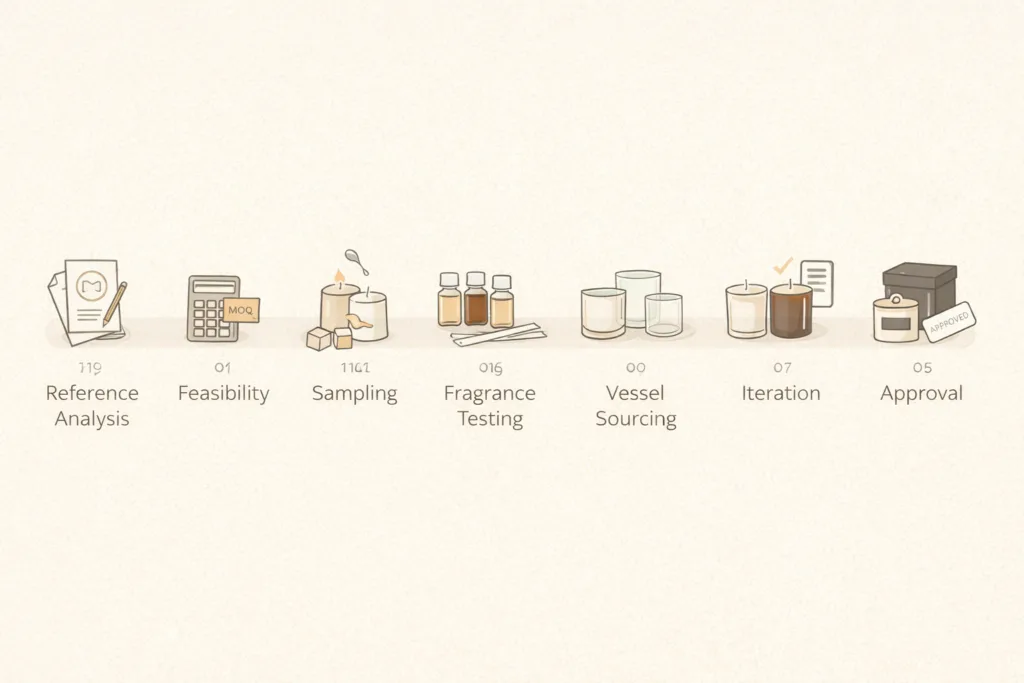
Every custom candle project begins with a reference of some kind. Sometimes it is a Pinterest image. Sometimes it is a competitor product. Sometimes it is a photo from a boutique hotel, a museum store, or an established fragrance brand. Sometimes it is just a rough mood board.
At this stage, the supplier’s job is not to quote too quickly. The job is to decode what the image is actually communicating.
A professional review of a reference image usually breaks into the following elements:
1. Vessel
What is the likely material: standard glass, sprayed glass, electroplated glass, ceramic, concrete, or custom molded vessel? Is the shape common or likely custom? Does the wall thickness look production-safe? Is the opening diameter practical for wick performance?
2. Wax presentation
Does the client want a smooth top luxury container candle, a rustic handmade look, whipped wax styling, layered wax, or wax melts? Each one changes the production method and sampling difficulty.
3. Fragrance direction
Is the client asking for a broad olfactive family such as woody, floral, citrus, amber, spa, gourmand, or marine? Or are they trying to match an existing scent? Matching an existing scent is a different task from choosing a new one from a scent library.
4. Decoration method
Is the logo a sticker, screen print, decal, foil, engraving effect, or direct print? The visual result can look similar online, but the commercial reality is very different.
5. Packaging structure
Is the box a plain folding carton, printed carton, rigid lid-and-base gift box, magnetic rigid box, drawer box, or mailer? Does the image hide the true packaging cost behind minimal styling?
6. Market intent
Is this for mass retail, boutique retail, hotel gifting, event gifting, subscription boxes, or e-commerce? The right sample process changes when the sales channel changes.
When buyers say they want “the same candle as the picture,” what they usually mean is one of three things: the same mood, the same silhouette, or the same level of perceived quality. These are not always the same thing. A good supplier helps separate them.
That is especially important for larger buyers, because the wrong assumption at this first stage often multiplies later through higher MOQ, wrong packaging decisions, or repeated vessel changes.
Step 2: Evaluate Feasibility Before Quoting
Many buyers want a unit price first. That is understandable. But in custom candle manufacturing, quoting before feasibility review often leads to confusion.
A responsible supplier should evaluate feasibility first, because the candle sample process is shaped by what is actually sourceable and manufacturable.
This review normally includes:
- whether the vessel exists as a standard market item or needs custom development;
- whether the fragrance is selected from an existing library or requires matching work;
- whether the requested decoration method is suitable for the planned quantity;
- whether the packaging concept forces a separate MOQ from the candle itself;
- whether the overall design is aligned with the target budget and timeline.
This is where buyers begin to understand a basic truth of candle sourcing: MOQ is not a random number given by a supplier. It is the result of design choices.
For example, a standard clear or amber glass vessel with a simple label may support a relatively accessible MOQ, because the jar already exists in the supply chain. A custom ceramic vessel with special glaze, embossing, and a rigid box with custom insert will usually push the project into a much higher MOQ. Not because the supplier is difficult, but because each custom component has its own production threshold.
This stage is also where experienced suppliers save clients from avoidable mistakes. A buyer may insist on a very specific vessel shape because it looks premium in a photo, but if that shape creates wick placement problems, uneven burn, or protection issues in transit, it may not be the right commercial choice. Likewise, a beautiful heavy vessel may dramatically increase landed cost if the buyer plans to ship by air for launch quantities.
A serious sample process is not there to impress the client with fast replies. It is there to protect the viability of the project.
Step 3: Define the Sampling Plan Clearly
Once feasibility is understood, the next stage is not “send sample.” The next stage is defining what sample should be made, why, and how success will be judged.
This is one of the most overlooked parts of the candle sample process.
A useful sampling plan usually clarifies the following:
- what exactly will be sampled first: fragrance only, vessel only, full finished candle, or full set with packaging;
- whether the project needs one sample round or staged sampling;
- what the sample fee covers;
- how long the sample development should take;
- what feedback format the buyer should provide after review.
In practical B2B projects, not every program needs a fully finished luxury presentation sample in the first round. Sometimes the smart move is to separate the variables.
For example:
- If fragrance is the major risk, test fragrance first.
- If the vessel is uncertain, confirm vessel sourcing first.
- If the branding finish is critical, approve logo treatment before final packaging.
- If the project is cost-sensitive, approve a commercially realistic version instead of the most expensive visual concept.
This approach is often more efficient than trying to solve everything in one beautiful but expensive sample.
At Circe Home, this is especially relevant when fragrance matching is involved. A client may want their candle or wax melts to resemble an existing benchmark scent. That cannot always be solved in one shot. What matters is whether the supplier has the development discipline and fragrance supply chain support to keep adjusting until the result is commercially acceptable.
We have handled wax melt sampling where the scent required four rounds before the client felt it was right. We only charged one sampling fee in that project because the first payment was never meant to buy one physical sample unit only. It was meant to open a development process. That is an important difference. Strong fragrance development is not about getting lucky once. It is about being able to refine.
Step 4: Solve the Hardest Variable First — Fragrance Matching
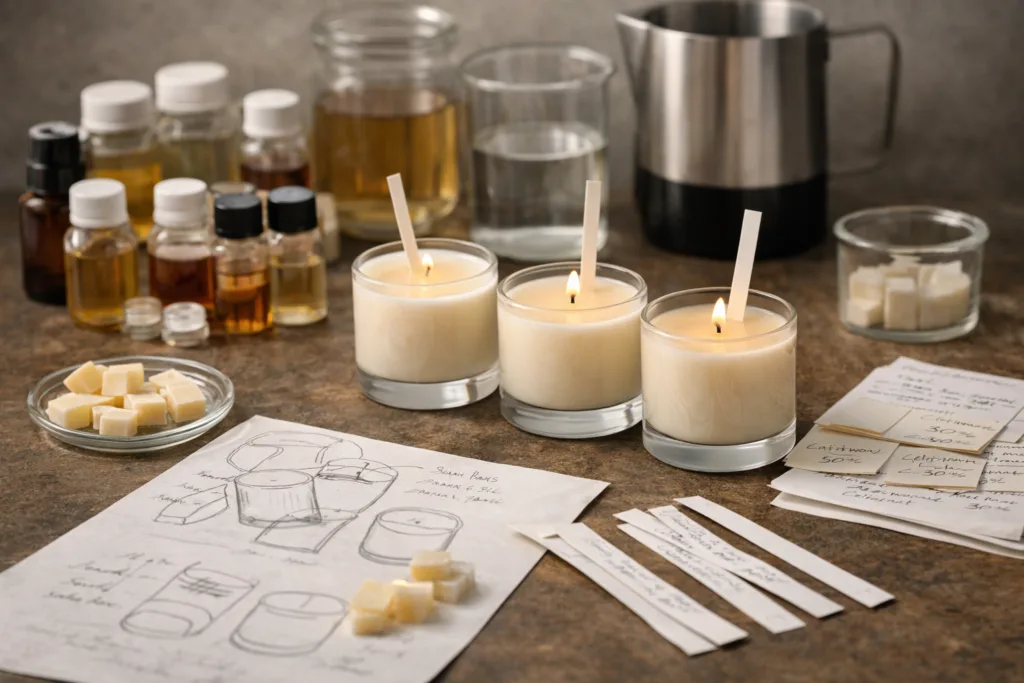
If there is one part of the candle sample process that separates capable suppliers from surface-level traders, it is fragrance.
The reason is simple. Fragrance is subjective in language but technical in execution.
Clients often describe fragrance using emotional or lifestyle words:
- clean hotel lobby;
- warm luxury home;
- expensive but soft;
- sweet without being childish;
- smoky wood but still feminine;
- close to an existing branded candle.
These descriptions are useful, but they are not formulas. A supplier still has to interpret them into something testable.
For B2B buyers, there are usually three fragrance pathways:
1. Choose from an existing fragrance library
This is the fastest and most commercially efficient route. It works well when the buyer wants a strong direction but not a protected signature scent.
2. Modify an existing fragrance base
This is common when a client likes a stock scent but wants it softer, fresher, sweeter, greener, more premium, or more masculine.
3. Match or approximate a target scent
This is the hardest route. It is common for private label brands that want continuity with an existing product, or for wax melts and candles built around a very specific signature identity.
The challenge is not only the fragrance oil itself. It is how that fragrance performs in the final format.
A scent that smells promising in the bottle may behave differently in soy wax, paraffin blend, or wax melts. Cold throw and hot throw may not align. A note that feels refined in a diffuser may feel weak in a candle. A gourmand direction that smells pleasant in the lab may become too sweet after burn.
This is why fragrance matching often requires more than one round.
In our own experience, one wax melt project required four sampling rounds to get the scent close to the client’s target. We only charged once because the point was to reach the right result, not to treat every adjustment as a separate commercial opportunity. That kind of commitment is only realistic when the supplier has a strong fragrance development partner behind the project.
For buyers, the real takeaway is this: if fragrance is central to your brand, do not judge a supplier only by how fast they send one first sample. Judge them by whether they can refine intelligently.
Good questions to ask during fragrance sampling include:
- Is this a stock scent or a matched scent?
- What wax system is being used in the sample?
- Is the feedback based on cold throw, hot throw, or both?
- Are you adjusting the fragrance oil only, or also wax/fragrance balance?
- Can you explain what changed between rounds?
Suppliers who can answer these questions clearly are usually the ones who can support larger orders better.
Step 5: Source the Right Vessel, Not Just a Similar One
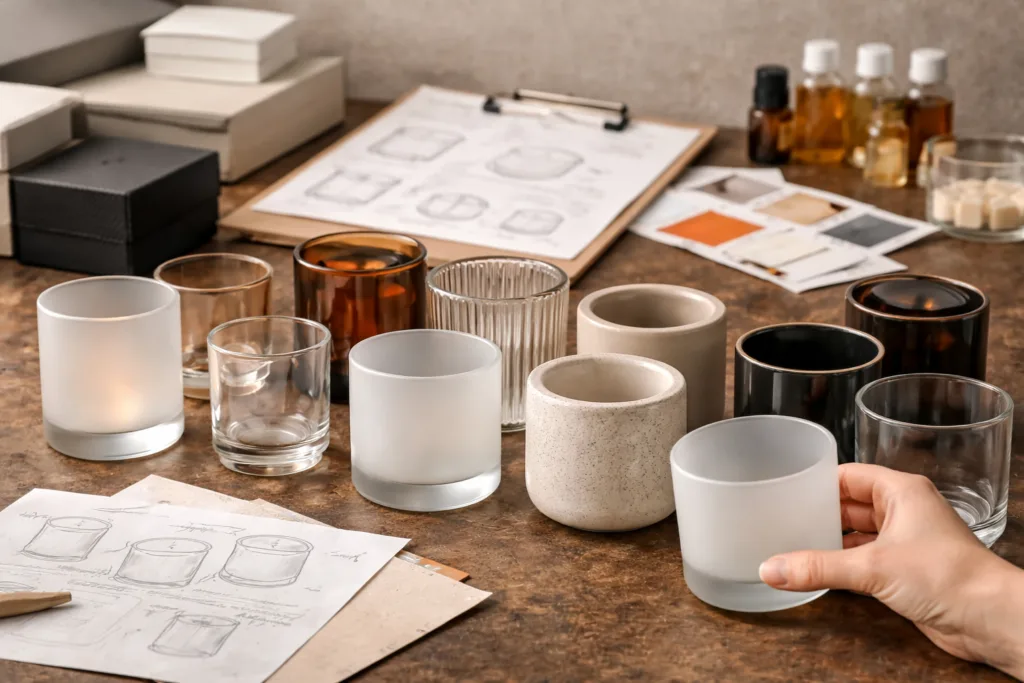
The second major difficulty in the candle sample process is vessels.
This is where a lot of buyers get surprised, especially if they have spent time collecting attractive reference images online.
In photos, vessels can look deceptively simple. In production, they are not.
A vessel decision affects:
- visual identity;
- fill weight;
- burn behavior;
- label area;
- lid compatibility;
- packing structure;
- carton size;
- freight cost;
- minimum order quantity;
- production risk.
When we handle custom candle development, we do not assume the vessel in the image can be sourced exactly as shown. Instead, we search for the vessel that best matches the image while still making sense for the project. This sounds basic, but it is one of the most valuable parts of the service.
A buyer may send a photo of a candle in a thick, softly tinted, clean-lined jar. That look might be achievable through several very different routes:
- standard amber glass;
- sprayed translucent glass;
- solid color coated glass;
- custom molded vessel;
- repurposed decorative jar not designed for candle use.
Those routes do not have the same cost, safety profile, or MOQ.
The supplier’s job is to narrow the field and propose the vessel that gives the closest visual result without quietly damaging the economics of the project.
This is especially important because candle vessels are not just packaging. They are functional components in a heat-generating product. ASTM standards for candle products include specifications related to glass container performance and labeling, which is one reason professional buyers should avoid treating vessels as a purely decorative afterthought.
From a procurement standpoint, the right vessel is usually the one that balances five things:
1. Look
It must fit the intended brand level and visual reference.
2. Availability
It should ideally be sourceable within the timeline and at a commercially realistic MOQ.
3. Performance
The vessel should support proper wick performance and safe use.
4. Packaging fit
It must work with inserts, lids, shipping cartons, and finished gift presentation.
5. Landed cost
It cannot destroy the final cost structure if the project is meant to scale.
This is why strong suppliers often spend more time than buyers expect on vessel selection. We do it because a bad vessel choice is expensive to fix later.
Step 6: Build the First Finished Sample With Commercial Discipline
Once fragrance direction and vessel direction are under control, the first finished sample can be built more effectively.
At this point, the buyer should not expect perfection in every detail. The first finished sample is usually there to test how the chosen decisions work together in real form.
That includes:
- vessel appearance;
- wax fill level;
- fragrance impression in use;
- wick behavior;
- logo application;
- label placement;
- lid fit if applicable;
- packaging structure if included;
- overall perceived quality.
There are several reasons a first sample may still need revision:
Fragrance may still be slightly off
It may be too weak, too sharp, too sweet, too powdery, or not close enough to the client benchmark.
Vessel may need adjustment
The selected jar may be visually close but not close enough, or the scale may look different once filled and boxed.
Branding finish may not match expectation
A gold logo in a mockup can look different depending on whether it is foil, decal, or print.
Packaging may not yet support the target perception
A premium candle can be visually weakened by the wrong carton structure or insert material.
This is where disciplined buyers give structured feedback instead of vague reactions.
Unhelpful feedback sounds like this:
- it is not luxurious enough;
- something feels wrong;
- I want it more premium.
Useful feedback sounds like this:
- the vessel tone should be deeper amber and less orange;
- the logo should sit lower and appear finer;
- the fragrance opening is good but the dry-down is too sweet;
- the box should feel more giftable and less like shipping packaging;
- the vessel height looks correct but the diameter feels too narrow.
The better the feedback, the faster the candle sample process moves toward approval.
Step 7: Approve the Sample as a Production Standard, Not as a Mood Board
The final approval stage is where many smaller buyers stay emotional and larger buyers become disciplined.
An approved sample is not just the version you like best. It is the version that becomes the production benchmark.
That means approval should lock the key specifications, including:
- vessel style and size;
- vessel color or finish;
- wax type and fill weight;
- fragrance direction or approved fragrance code;
- wick system;
- logo artwork and application method;
- label material and position;
- packaging structure and material;
- insert type;
- warning label approach where required.
This matters because once a larger order goes into production, ambiguity becomes expensive. A project should not move to bulk just because the client says “looks good.” It should move because the approved sample answers the right questions.
This is also where the best suppliers help buyers separate aesthetic preferences from production-critical standards. For example, tiny visual variations may be acceptable in handmade or semi-handmade product categories. But major changes to fragrance, vessel color, or packaging construction are not small details. They are specification changes.
An approved candle sample should act like a reference contract in physical form.
What Procurement Teams and Serious Buyers Should Ask During Sampling
If your goal is to move into larger orders, ask better questions during the sample stage. The sample process is where supplier capability becomes visible.
Here are some of the most useful B2B questions:
About fragrance
- Is this a stock scent, modified scent, or custom matched scent?
- How many rounds are reasonable if the first one is close but not correct?
- Is the fragrance being tested in the final wax system?
- Can the scent be reproduced consistently in bulk?
About vessels
- Is this vessel standard or custom?
- If it is custom, what does that do to MOQ and lead time?
- If it is standard, how stable is supply?
- Is the chosen vessel designed and tested appropriately for candle use?
About packaging
- Does the box MOQ differ from the candle MOQ?
- What packaging detail is driving cost the most?
- Is there a lower-risk version for launch and a higher-end version for scale?
About project control
- What exactly does the sample fee include?
- What version becomes the production reference?
- What items are most likely to change cost between sampling and bulk order?
These questions help buyers identify whether a supplier is only reacting or actually managing the development process.
The Commercial Difference Between a Good Supplier and a Useful Supplier
Many suppliers can send a sample.
Far fewer can manage a sample process in a way that supports large orders.
A good supplier may be responsive, polite, and willing to try. A useful supplier does more.
A useful supplier can:
- interpret design intent without pretending every image is easy to copy;
- explain where MOQ comes from instead of giving random numbers;
- source the closest viable vessel, not just the easiest one;
- refine fragrance through multiple rounds when needed;
- connect sample decisions to production risk, packaging, and freight;
- tell the client when a beautiful idea is commercially weak;
- document the approved result in a way that supports bulk production.
That difference is important if you are a retailer, importer, or brand buyer planning a serious launch. The sampling stage often tells you more about future production reliability than the final quotation does.
Final Thoughts: The Candle Sample Process Is Where Serious Orders Begin
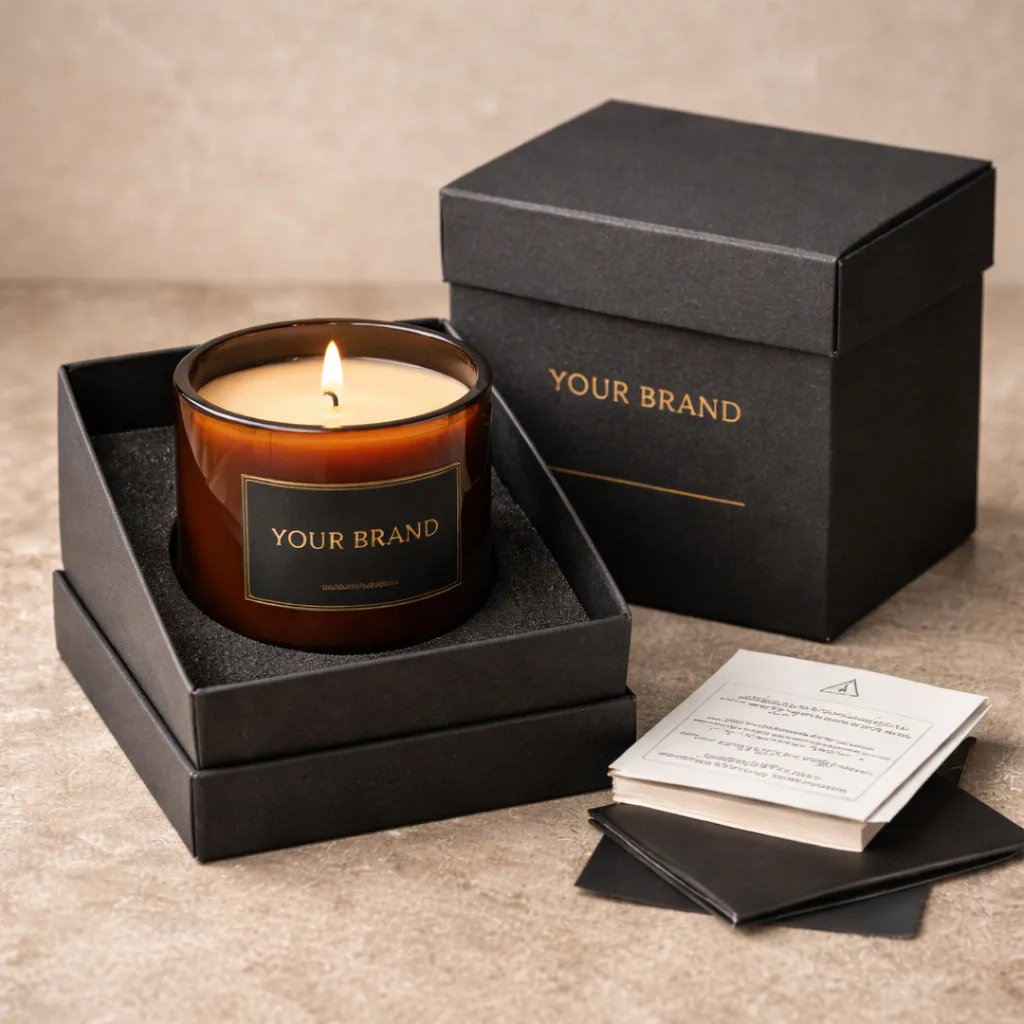
For B2B candle buyers, the candle sample process is not a decorative step before “the real order.” It is the stage where real orders become possible.
If a supplier cannot guide fragrance development, vessel sourcing, and approval logic properly, the project will usually become slow, vague, and expensive later. If the supplier can do those things well, sampling becomes a decision tool instead of a delay.
The two hardest parts in our experience remain the same: fragrance and vessels.
Fragrance is difficult because buyers often know the feeling they want before they know the formula they need. That is why a strong fragrance development supply chain matters. We have supported projects that took four rounds to refine a wax melt scent while only charging one sample fee, because the purpose was to solve the problem, not to count every adjustment as a transaction.
Vessels are difficult because reference images rarely tell the full sourcing story. That is why we put real effort into finding the vessel that best matches the client’s design intent while still making sense for production.
If you are developing a custom candle line for wholesale, private label, retail, gifting, or hospitality, sampling should not be rushed and it should not be treated casually. Done well, it saves time, protects budget, and increases the chances that your final order will be worth placing.
If you already have a reference image, the next step is simple: send it together with your target market, estimated quantity, fragrance direction, and packaging expectation. A professional supplier should be able to tell you what is feasible, what needs adjustment, and what kind of sample process will get you to approval with the least friction.
That is what the best candle sample process is really about.
FAQ
1. How long does the candle sample process usually take?
For a standard private label candle using existing vessels and stock fragrance options, the first sample round often takes around 7 to 15 days, depending on component availability and finishing details. If fragrance matching, custom vessels, or premium packaging are involved, the timeline is usually longer because more development variables need to be confirmed before approval.
2. Why does candle fragrance matching often require multiple sample rounds?
Because fragrance matching is not only about copying how a scent smells in the bottle. The fragrance has to perform correctly in the final wax system and format, whether that is a container candle or wax melt. Notes can shift in cold throw and hot throw, so multiple rounds are common when the buyer wants a close match to a specific target scent.
3. Can a supplier match the exact vessel shown in my reference image?
Sometimes yes, but not always. The vessel in a reference image may be custom molded, discontinued, regionally sourced, or visually edited. A strong supplier will usually try to find the closest commercially viable vessel rather than promise an exact match that cannot be produced reliably at your target MOQ, cost, or lead time.