
A successful scented candle is not created by simply combining wax, fragrance oil, and a wick. Commercial candle manufacturing is a controlled product-development process in which fragrance chemistry, wax behavior, wick performance, vessel construction, filling conditions, curing time, packaging, and transportation must work together.
For professional buyers, understanding the complete candle manufacturing process is essential. It allows purchasing teams to evaluate suppliers more accurately, prevent avoidable delays, control product quality, and scale a successful sample into thousands of consistent retail units.
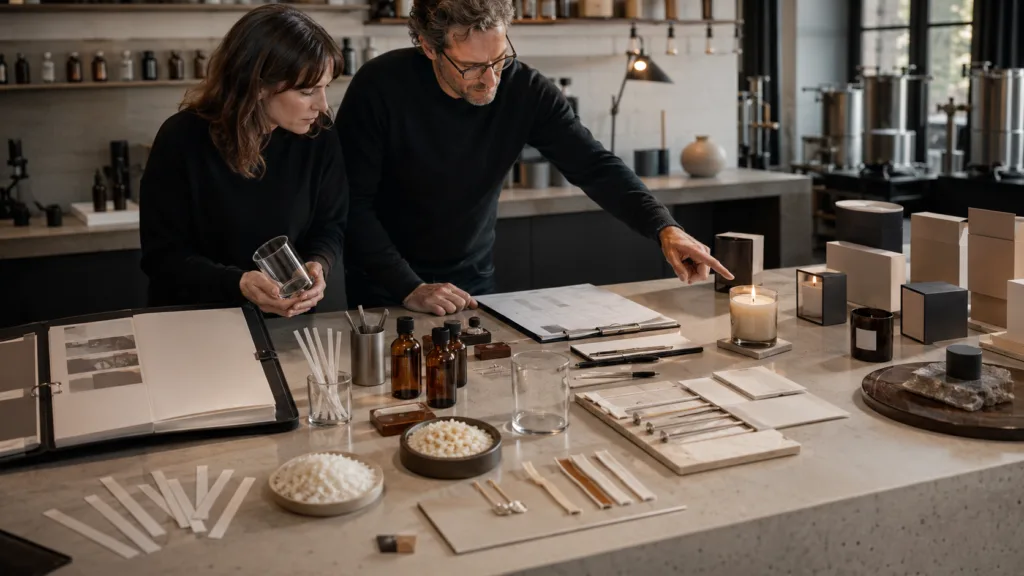
This has become particularly important as fragrance preferences move toward personalization. Pinterest Predicts 2026 identified “Scent Stacking” as an emerging trend, describing how younger consumers are moving away from one-dimensional fragrances and toward bespoke combinations of oils, perfumes, and individual notes. For candle brands, this signals growing demand for distinctive scent collections rather than generic off-the-shelf fragrances.
However, a creative fragrance concept is only commercially valuable when it can be reproduced safely and consistently. This guide explains how candles are manufactured, from the first buyer brief to fragrance development, wick testing, filling, final inspection, and international shipment.
1. Why the Candle Manufacturing Process Matters
Every candle is a combustion system.
When the wick is lit, heat melts the surrounding wax. The liquid wax travels upward through the wick by capillary action, vaporizes near the flame, and becomes the fuel that sustains combustion.
This means that the following components cannot be developed independently:
- Wax
- Fragrance
- Wick
- Dye
- Container
- Candle diameter
- Fragrance concentration
- Filling weight
- Consumer burn instructions
Changing even one variable can affect flame height, melt-pool diameter, burn time, hot scent throw, vessel temperature, visible smoke, and the amount of wax remaining at the end of the candle’s life.
For example, changing from an unscented formula to a fragrance-rich formula may require a different wick. Moving the same formula into a wider vessel may require a larger wick or multiple wicks. Switching from paraffin to a lower-melting vegetable wax may change cooling behavior, surface appearance, and curing time.
The best scented candle is therefore not necessarily the candle with the highest fragrance percentage. It is the candle in which fragrance, wax, wick, and vessel have been engineered and validated as one complete system.
2. Typical Candle Production Timeline
The timeline for custom candle production depends on the complexity of the fragrance, vessel, packaging, testing requirements, and order quantity.
An illustrative commercial project may include:
| Production Stage | Typical Activities | Main Approval |
|---|---|---|
| Product definition | Brief, target price, size, market, packaging | Buyer confirms specification |
| Fragrance development | Fragrance directions, modifications, evaluation | Fragrance approval |
| Formula engineering | Wax, wick, fragrance load, dye | Formula approval |
| Prototype development | Samples, vessel tests, packaging proofs | Golden sample approval |
| Pilot production | Small-scale production under factory conditions | Pilot batch approval |
| Performance testing | Burn test, stability, appearance, transport checks | Test report approval |
| Mass production | Filling, cooling, finishing, packing | In-line QC |
| Final inspection | Quantity, workmanship, labeling, packaging | Release authorization |
| Shipping | Export cartons, documents, freight booking | Shipment confirmation |
Simple private-label projects using an existing vessel and established fragrance can move faster. Fully customized programs involving a new fragrance, embossed ceramic container, molded lid, color-matched wax, and luxury gift box require more development time.
Packaging development should usually run in parallel with candle testing, but printed packaging should not enter full production until the candle dimensions, net weight, warning text, barcode placement, and legal information have been finalized.
3. Step 1: Create a Detailed Product Requirement Brief
The manufacturing process begins with the buyer’s brief.
A vague request such as “We want a luxury soy candle” does not provide enough information for accurate sampling or pricing. “Luxury,” “natural,” “strong scent,” and “eco-friendly” can mean very different things to different buyers.
A professional candle brief should define the commercial and technical expectations.
Essential Information in a Candle Brief
| Requirement | Information to Provide |
|---|---|
| Target market | United States, Canada, EU, UK, Australia, Middle East |
| Sales channel | Retail, hotel, spa, corporate gifting, subscription box, e-commerce |
| Candle format | Jar candle, ceramic candle, tin, pillar, taper, sculptural candle |
| Vessel dimensions | Diameter, height, wall thickness, opening diameter |
| Wax preference | Soy, coconut, paraffin, beeswax, vegetable blend |
| Fragrance direction | Notes, reference perfumes, mood, intensity |
| Net wax weight | Grams or ounces |
| Burn-time target | Expected usable burn duration |
| Wick preference | Cotton, paper-core, wood, single or multiple wick |
| Packaging | Individual box, rigid gift box, sleeve, display carton |
| Branding | Printed logo, label, engraving, embossing, debossing |
| Order quantity | Quantity per fragrance, color, and packaging design |
| Target price | Target ex-factory or landed price |
| Launch date | Required warehouse arrival date |
| Compliance | Market-specific documents and testing expectations |
The brief should also identify non-negotiable requirements. A buyer may accept adjustments to wax color but not to vessel shape. Another buyer may prioritize a certain landed cost over a specific wax claim.
Clear priorities allow the manufacturer to recommend realistic solutions instead of developing a sample that looks attractive but cannot meet the required cost or production schedule.
Commercial Checkpoint
Before sample development, the buyer and manufacturer should confirm:
- Estimated MOQ
- Sample cost
- Mold or tooling cost
- Packaging setup fees
- Fragrance development fees
- Expected production lead time
- Payment terms
- Shipping method
- Who owns custom molds and artwork
Buyer Approval Point
The approved brief becomes the foundation for pricing, sampling, testing, and final inspection.
Production Record to Retain
A controlled product-specification sheet should be assigned a revision number so that future changes can be tracked.
4. Step 2: Develop the Fragrance
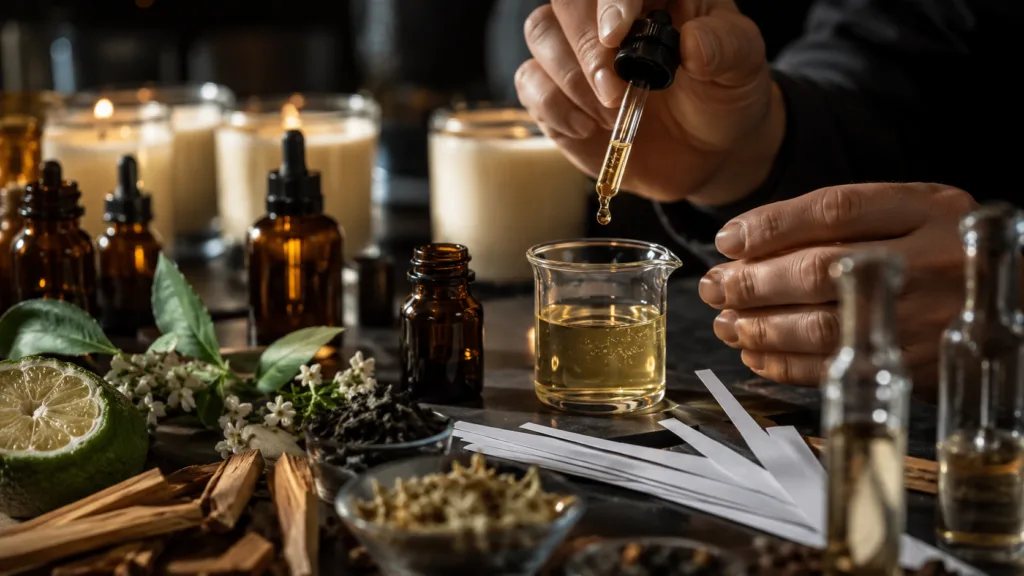
Fragrance development is often the most subjective stage of the candle manufacturing process, but it still requires a structured technical workflow.
Build a Fragrance Direction
Instead of requesting “a fresh fragrance,” the buyer should define:
- Intended customer
- Season or occasion
- Emotional atmosphere
- Fragrance family
- Desired strength
- Notes to include
- Notes to avoid
- Reference products
- Target retail price
A useful fragrance direction might read:
A refined hotel-inspired scent for a premium home collection, opening with bergamot and green tea, followed by orange blossom, and finishing with soft musk, sandalwood, and light amber. The result should feel clean and elegant rather than sweet.
This gives the perfumer a commercial identity, not merely a list of ingredients.
Evaluate Fragrance in Wax, Not Only on Blotter Paper
A fragrance may smell balanced in concentrated oil but behave differently after being mixed into hot wax and burned.
The development team should evaluate:
- Concentrated fragrance oil
- Fragrance mixed into the selected wax
- Cold scent throw after curing
- Hot scent throw during burning
- Fragrance character after several burn cycles
- Potential discoloration over time
Vanillin, citrus materials, natural extracts, resins, and certain colorants may influence the final wax color or long-term appearance.
Confirm Technical Documentation
For commercial production, fragrance suppliers should provide relevant documentation, which may include:
- Safety Data Sheet
- IFRA Certificate of Conformity
- Allergen information
- Technical specification
- Country-of-origin information
- Restricted-substance declaration where required
IFRA Standards are globally recognized guidelines for the safe use of fragrance ingredients. They restrict, prohibit, or set conditions for certain fragrance materials. However, IFRA also makes clear that its standards do not replace applicable national or local regulations. The fragrance supplier is responsible for preparing the applicable Certificate of Conformity.
Fragrance load should not be selected only according to a marketing claim. It must remain within the technical limits of the fragrance, wax, wick, and finished product.
A major scientific candle study used a 5% fragrance load as a representative level for the general European and North American market while noting that actual fragrance concentrations vary according to product type, fragrance, country, and consumer preference.
5. Step 3: Select the Wax or Wax Blend
There is no universal “best” candle wax.
Professional manufacturers select wax according to the candle format, fragrance requirements, target appearance, climate, burn behavior, cost, sustainability positioning, and supply-chain stability.
The National Candle Association notes that paraffin, soy, beeswax, palm, synthetic waxes, gels, and customized blends are all used commercially. It also emphasizes that no single quality wax type is automatically superior for every candle application.
Common Commercial Wax Options
| Wax Type | Typical Advantages | Development Considerations |
|---|---|---|
| Paraffin | Strong fragrance delivery, smooth appearance, flexible formulation | Sustainability positioning and market preference |
| Soy wax | Plant-derived positioning, soft natural appearance | Frosting, adhesion, curing behavior |
| Coconut blend | Creamy appearance, premium positioning, good scent performance | Higher material cost and softer texture |
| Beeswax | Natural identity, firm structure, subtle natural aroma | Cost, color variation, compatibility with added fragrance |
| Vegetable stearin | Hardness, opacity, useful for pillars and tapers | Formula and supply-source requirements |
| Custom wax blend | Balanced appearance, scent throw, stability, and burn | Requires controlled formula and repeatable sourcing |
Wax selection should be based on performance rather than slogans.
A low-melting wax may deliver a wide melt pool but become too soft during hot-weather transportation. A harder wax may improve shipping stability but require a different wick. A natural-looking wax may show minor frosting or color variation that must be accepted as part of the design standard.
The approved wax specification should include:
- Wax supplier and grade
- Blend composition where disclosed
- Melting range
- Recommended processing window
- Maximum validated fragrance load
- Color standard
- Storage conditions
- Batch traceability requirements
6. Step 4: Engineer the Wick System
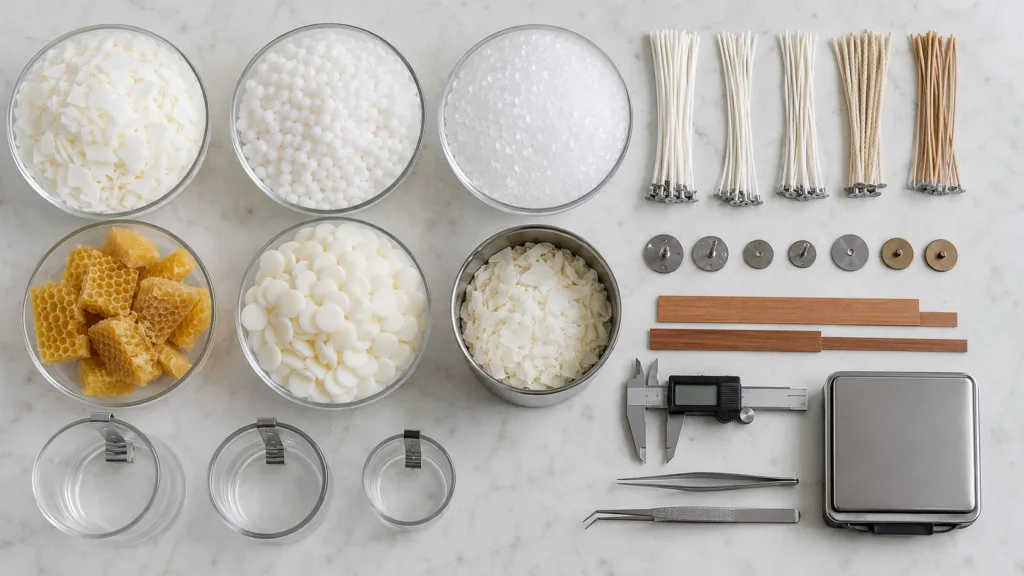
Wick selection is product engineering, not decoration.
The wick controls how quickly wax is consumed and strongly influences:
- Flame height
- Melt-pool width
- Melt-pool depth
- Burn rate
- Hot scent throw
- Vessel temperature
- Soot formation
- Remaining wax
- Self-extinguishing behavior
- Mushrooming or carbon buildup
The correct wick cannot be chosen from vessel diameter alone.
Variables That Affect Wick Selection
- Wax type and hardness
- Fragrance percentage
- Fragrance chemistry
- Dye concentration
- Vessel internal diameter
- Vessel shape
- Fill height
- Number of wicks
- Wick material
- Wick coating or treatment
- Intended burn-cycle duration
Manufacturers normally begin with several candidate wick sizes. Each version is produced using the same wax, fragrance, vessel, filling weight, and curing conditions.
The wick is then evaluated through repeated burn cycles.
A wick that appears suitable during the first two hours may become oversized as the candle burns deeper into the vessel and heat accumulates. This is why one short burn is not sufficient to approve a candle.
Single Wick or Multiple Wicks?
Wide containers sometimes require two or three wicks to produce an even melt pool without an excessively large central flame.
However, adding more wicks also increases:
- Total heat output
- Vessel temperature
- Wax consumption
- Risk of wick interaction
- Sensitivity to wick placement
Multi-wick candles require precise wick spacing and stronger centering controls during production.
7. Step 5: Test the Candle Container
The vessel is both packaging and a functional part of the combustion system.
A visually attractive glass, ceramic, concrete, or metal container should not be approved until its structural and thermal suitability has been evaluated.
Glass Container Testing
For glass vessels, manufacturers should examine:
- Wall thickness consistency
- Base thickness
- Air bubbles
- Cracks
- Chips
- Sharp edges
- Annealing quality
- Thermal-shock resistance
- Dimensional tolerance
- Stability on a flat surface
ASTM maintains several standards relevant to candle products. Current listings include ASTM F2179 for annealed candle glass containers, ASTM F2417 for candle fire safety, ASTM F2058 for candle fire-safety labeling, and ASTM F2326 for visible emissions testing.
Ceramic and Concrete Containers
Ceramic and concrete vessels require additional attention because appearance and absorption may vary between batches.
Testing may include:
- Glaze coverage
- Porosity
- Hairline cracking
- Water absorption
- Internal sealant performance
- Bottom stability
- Color consistency
- Logo depth
- Lid fit
- Dimensional tolerance
An unsealed porous container may absorb fragrance or wax components, causing discoloration, surface marks, or gradual leakage.
Metal Containers
Metal tins should be assessed for:
- Seam quality
- Internal coating
- Corrosion resistance
- Lid fit
- Denting
- Heat transfer
- Label adhesion
The final burn test must always use the actual commercial vessel. A formula tested in one container cannot automatically be approved for another container of similar capacity.
8. Step 6: Produce Samples and a Pilot Batch
Once the initial formula has been selected, the manufacturer produces prototype samples.
A professional sampling round should isolate variables whenever possible. If wax, fragrance, wick, dye, and vessel are all changed simultaneously, the development team cannot identify which change caused an improvement or failure.
Recommended Sample Matrix
A basic test matrix may include:
- Wick A, fragrance load 1
- Wick B, fragrance load 1
- Wick C, fragrance load 1
- Wick A, fragrance load 2
- Wick B, fragrance load 2
- Wick C, fragrance load 2
Samples should be labeled with internal codes rather than evaluated only by appearance.
After the laboratory sample is approved, a pilot batch should be produced using equipment and conditions that are closer to mass production.
The pilot batch verifies whether the product remains stable when:
- A larger quantity of wax is melted
- Fragrance is mixed in a larger tank
- Multiple vessels are filled in sequence
- Cooling conditions vary across a production area
- Operators use production-scale wick-centering equipment
- Packaging is assembled at normal factory speed
Laboratory success does not always guarantee mass-production success. The pilot batch is the bridge between a handmade prototype and repeatable factory output.
9. Step 7: Cure and Age the Candles
Freshly filled candles should not be evaluated immediately.
During curing, the wax solidifies, the crystal structure develops, and the fragrance distributes through the wax matrix. The required curing period depends on the wax system, fragrance, candle size, and supplier recommendations.
The factory should define a validated curing window rather than applying the same number of days to every candle.
Conditions to Control During Curing
- Room temperature
- Airflow
- Humidity
- Exposure to direct sunlight
- Distance between candles
- Lid application timing
- Dust protection
- Movement of partially cooled candles
Moving candles too early can disturb the wick, damage the surface, or create adhesion marks. Applying lids before the candle has cooled sufficiently may trap condensation or affect the finish.
What Is Evaluated After Curing?
- Surface smoothness
- Sinkholes
- Wet spots
- Cracking
- Frosting
- Wax shrinkage
- Wick alignment
- Cold scent throw
- Wax discoloration
- Oil migration or sweating
Minor natural variation may be acceptable in plant-based waxes, but the approval standard must be documented so inspectors know the difference between an acceptable characteristic and a genuine defect.
10. Step 8: Conduct Complete Burn Testing
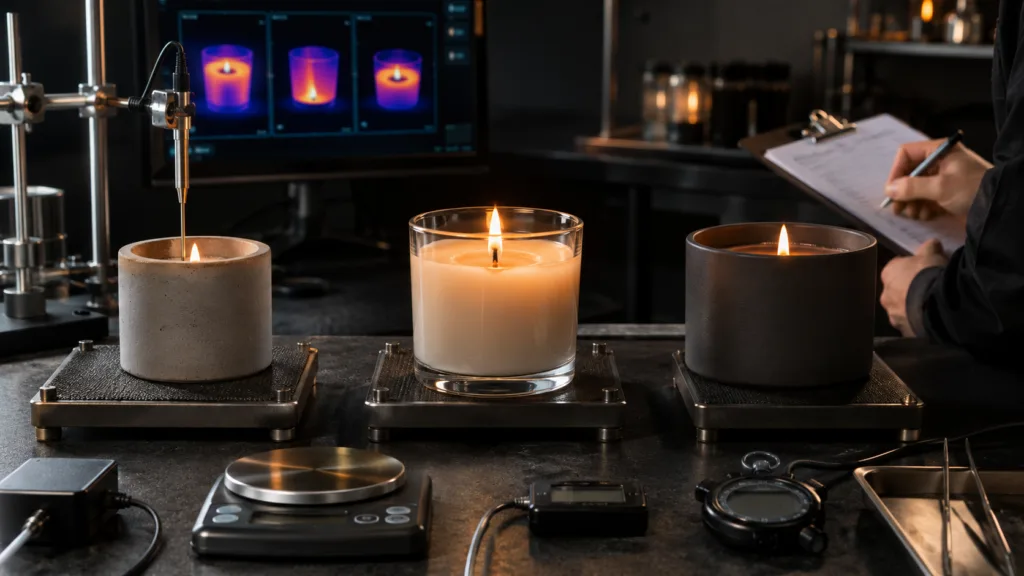
Burn testing is one of the most important stages in determining whether a candle is ready for sale.
A complete test follows the candle from the first lighting to the designed end of its useful life.
Burn Test Conditions
To improve consistency:
- Use cured candles from the intended formula
- Trim wicks to the specified starting length
- Test away from drafts
- Use a stable, heat-resistant surface
- Record room conditions
- Follow consistent burn and cooling cycles
- Weigh the candle before and after cycles
- Photograph the flame and melt pool
- Record all observations
The National Candle Association recommends testing candles away from drafts because moving air can cause irregular burning and flame disturbance.
Performance Data to Record
| Test Item | What the Technician Evaluates |
|---|---|
| Ignition | Whether the wick lights normally |
| Flame height | Whether the flame remains controlled |
| Melt pool | Width, depth, and symmetry |
| Wick behavior | Curling, mushrooming, movement, splitting |
| Burn rate | Wax consumed during each cycle |
| Hot scent throw | Fragrance strength and character |
| Visible smoke | Smoke during steady burning and extinguishing |
| Vessel temperature | Heat pattern at the wall and base |
| Stability | Tipping, movement, or vessel deformation |
| End-of-life behavior | Flame condition near the candle bottom |
| Remaining wax | Whether excessive wax remains |
| Extinguishing | Behavior when the candle is blown out |
A candle should not be rejected only because the wax does not reach the vessel wall during the first short cycle. The melt pool may expand as the candle burns lower and the vessel retains more heat.
Conversely, a candle that develops a full melt pool very quickly may be over-wicked and become too hot later.
Test More Than One Sample
Production materials naturally have tolerances. A reliable validation plan should test multiple units and, where possible, materials from different batches.
This is especially important for:
- Natural waxes
- Handmade ceramic vessels
- Wooden wicks
- Heavily fragranced formulas
- Dark-colored candles
- Multi-wick products
- Large vessels
Any change to the fragrance, wax supplier, wick, dye, vessel dimensions, or filling weight should trigger a documented review and, when material, a new burn test.
11. Step 9: Scale Up Filling and Mass Production
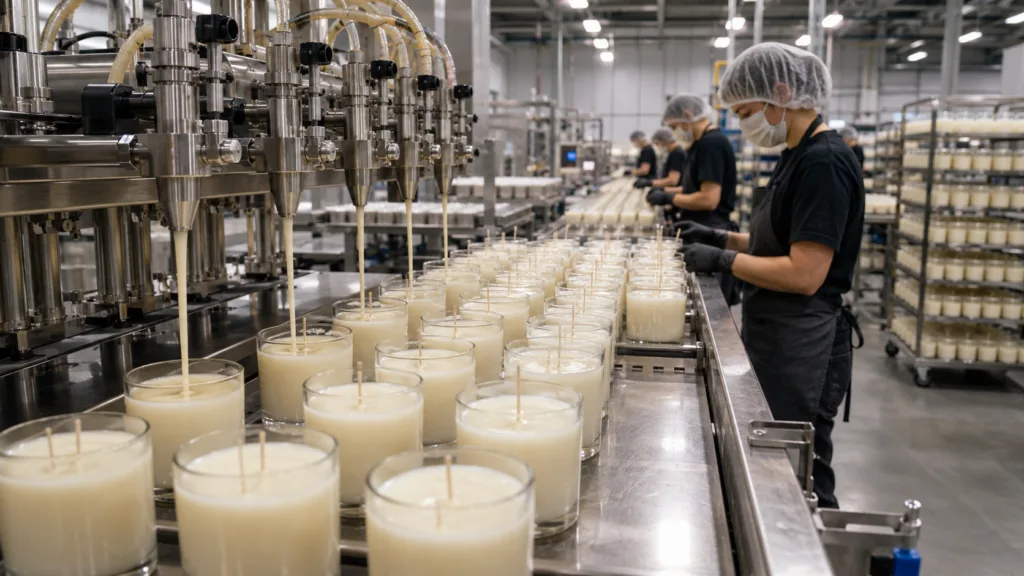
After the formula, vessel, packaging, and pilot batch are approved, production can scale.
The factory creates a master manufacturing instruction containing:
- Raw-material codes
- Batch quantities
- Heating procedure
- Mixing order
- Mixing duration
- Fragrance addition conditions
- Dye addition conditions
- Filling temperature window
- Target net weight
- Cooling conditions
- Wick-centering method
- Finishing requirements
- Packaging instructions
Raw Material Preparation
Before production begins, quality-control staff should verify:
- Wax batch
- Fragrance batch
- Wick model
- Wick-tab size
- Vessel code
- Label version
- Packaging version
- Production quantity
Using an outdated label or incorrect fragrance code can create a complete batch failure even when the candle itself burns correctly.
Wax Melting and Fragrance Mixing
The wax should be heated according to the supplier-approved processing range.
The fragrance must be added under controlled conditions and mixed sufficiently to achieve uniform distribution. Excessive heat may affect volatile fragrance materials, while insufficient mixing can cause fragrance inconsistency between the beginning and end of a batch.
Production records should capture actual temperatures and times rather than relying only on operator memory.
Wick Placement
Wicks should be:
- Securely attached
- Centered at the bottom
- Held vertically
- Positioned consistently
- Spaced correctly in multi-wick vessels
An off-center wick can create uneven heating and leave excessive wax on one side of the container.
Filling Control
During filling, operators monitor:
- Wax temperature
- Vessel temperature where applicable
- Net filling weight
- Fill level
- Foaming or air bubbles
- Spillage
- Wick movement
- Surface contamination
Net weight should be checked throughout the run, not only on the first unit.
Cooling and Finishing
Uneven cooling can cause sinkholes, cracks, pull-away, wet spots, and inconsistent surfaces.
After cooling, candles may require:
- Surface correction
- Wick trimming
- Vessel cleaning
- Bottom-label application
- Dust-cover placement
- Lid application
- Batch-code printing
Approved limits for cosmetic variation should be included in the quality standard.
12. Step 10: Engineer the Packaging
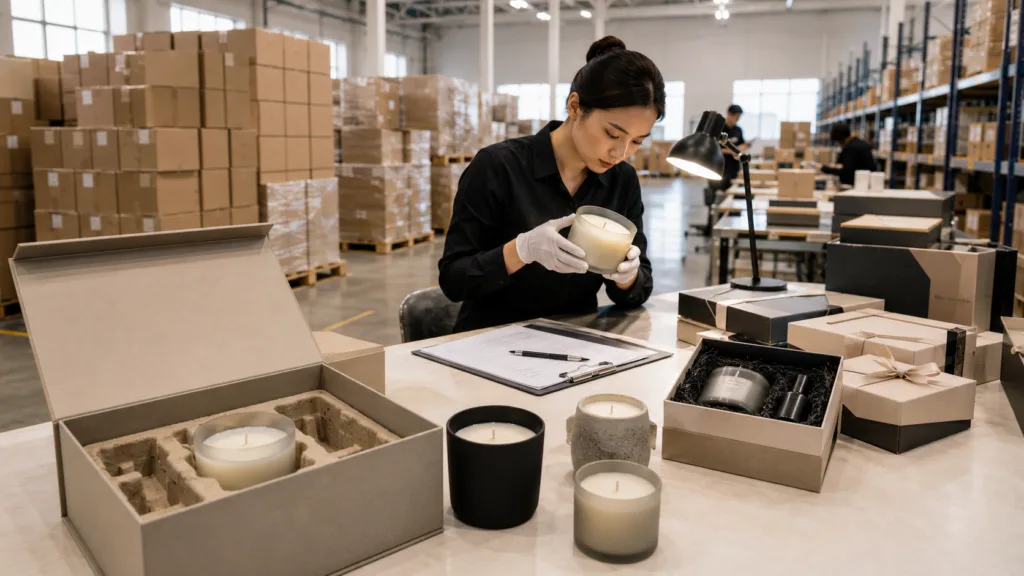
Packaging has four jobs:
- Protect the candle
- Communicate the brand
- Provide required product information
- Survive distribution
A luxury box that looks excellent in a presentation room may still fail if it allows a heavy glass candle to move during courier delivery.
Primary Packaging
Primary packaging may include:
- Glass, ceramic, concrete, or metal vessel
- Lid
- Front label
- Bottom label
- Dust cover
- Wick protector
- Internal seal
- Protective bag
Secondary Packaging
Secondary packaging may include:
- Folding carton
- Rigid gift box
- Paper sleeve
- Molded pulp insert
- Corrugated insert
- Foam insert
- Fabric pouch
- Gift set tray
For environmentally focused collections, buyers may consider recyclable paper, molded pulp, reduced plastic, right-sized cartons, and reusable vessels. Sustainability claims should match the actual material specification and destination-market rules.
Required Label Information
Depending on the market, product labels may need to show:
- Brand
- Product name
- Fragrance name
- Net weight
- Country of origin
- Manufacturer or responsible party
- Batch code
- Burn instructions
- Safety warnings
- Barcode
- Material or recycling information
- Market-specific chemical information where applicable
For the U.S. market, ASTM F2058 addresses fire-safety information placed on candles or candle packaging.
Packaging Tests
Before mass shipment, packaging should be evaluated for:
- Product movement
- Corner crushing
- Glass-to-glass contact
- Lid detachment
- Label scuffing
- Gift-box deformation
- Carton strength
- Pallet stability
- Courier handling
E-commerce packaging often requires more protection than retail master-carton packaging because individual parcels experience more handling and impact.
13. Step 11: Perform Final Quality Inspection
Final inspection determines whether the completed order matches the approved specification and golden sample.
Inspection should include product, packaging, quantity, labeling, and workmanship.
Candle Inspection Checklist
- Correct fragrance
- Correct vessel
- Correct wax color
- Correct net weight
- Wick centered
- Wick cut to specification
- Surface within approved limit
- No visible contamination
- No oil leakage
- No cracked or chipped vessel
- Lid fits correctly
- Labels straight and accurate
- Batch code present
- Safety information correct
Packaging Inspection Checklist
- Correct box artwork
- Correct barcode
- Correct insert
- No scratches or stains
- Candle held securely
- Correct quantity per inner carton
- Correct quantity per master carton
- Shipping marks match documents
- Carton dimensions and gross weight recorded
Inspection plans may use an agreed AQL sampling standard. The buyer and manufacturer should define defect categories before production.
An example classification might be:
- Critical defect: Safety risk, incorrect warning information, cracked container
- Major defect: Wrong fragrance, incorrect artwork, severe off-center wick
- Minor defect: Small cosmetic mark within otherwise usable packaging
The exact acceptance levels should be stated in the purchase contract or quality agreement rather than assumed after production is complete.
14. Step 12: Prepare Shipping and Inventory
A candle order is not finished when the final unit leaves the filling line.
Candles are sensitive to heat, impact, moisture, and prolonged storage conditions. Shipment planning must consider the wax formula, vessel weight, packaging structure, destination, and season.
Export Preparation
Before dispatch, confirm:
- Commercial invoice
- Packing list
- Product description
- HS classification
- Country of origin
- Carton count
- Gross and net weight
- Pallet dimensions
- Shipping marks
- Required safety or technical documents
- Destination warehouse requirements
Heat and Climate Risk
Soft wax systems can be vulnerable during summer transportation, especially when cartons remain in unventilated containers, trucks, or port storage.
Possible preventive measures include:
- Selecting an appropriate wax blend
- Validating high-temperature storage
- Increasing internal packaging support
- Avoiding unnecessary empty space
- Planning the shipping season
- Using temperature-sensitive logistics when commercially justified
Sea Freight, Air Freight, or Courier?
| Shipping Method | Best For | Main Consideration |
|---|---|---|
| Courier | Samples and small urgent orders | High cost per unit |
| Air freight | Launch replenishment and urgent commercial orders | Faster but expensive |
| Sea freight | Large wholesale orders | Longer transit and more climate exposure |
| Local warehouse fulfillment | Regional inventory and repeat orders | Requires inventory planning |
Mature buyers should calculate backwards from the required warehouse-arrival date, not only from the retail launch date.
The schedule must include production, final inspection, booking, export handling, main transportation, customs clearance, and delivery to the final warehouse.
15. Build Quality Control and Traceability Into Every Batch
A scalable candle manufacturer should be able to trace a finished product back to its component batches.
A batch record may include:
- Production order number
- Wax lot number
- Fragrance lot number
- Wick lot number
- Vessel batch
- Packaging version
- Production date
- Filling line
- Operators
- Process temperatures
- In-line weight checks
- QC results
- Retained sample number
Retained samples allow the factory and buyer to investigate future complaints involving fragrance, color, appearance, leakage, or burn behavior.
Golden Sample Control
The final approved sample should be clearly identified and stored under controlled conditions.
The golden sample represents the approved standard for:
- Fragrance
- Wax color
- Vessel finish
- Wick position
- Label placement
- Packaging construction
- Artwork
- Overall workmanship
Digital photographs are useful, but they do not fully replace a physical sample, particularly when evaluating fragrance, texture, color, or subtle surface differences.
Change Management
The manufacturer should notify the buyer before changing:
- Wax supplier
- Fragrance formula
- Wick model
- Vessel factory
- Coating or glaze
- Label material
- Packaging paper
- Adhesive
- Production location
Even a technically similar substitute can affect burn performance, appearance, or regulatory documentation.
16. Choosing a Manufacturer for Large Custom Candle Orders
A capable manufacturer should do more than provide a low unit price.
Professional buyers should evaluate whether the supplier can manage the complete candle manufacturing process and maintain control when production moves from 100 samples to 10,000 or more units.
Questions to Ask a Candle Manufacturer
- Can you develop exclusive fragrances?
- Do you provide fragrance documentation?
- How do you select and validate wicks?
- Do you conduct full-life burn testing?
- Can you test custom glass, ceramic, or concrete vessels?
- How do you control wax and fragrance batches?
- Do you produce a pilot batch before mass production?
- What inspections are performed during filling?
- How do you define cosmetic defects?
- Can you support custom gift packaging?
- What documents are available for the destination market?
- Can you manage large repeat orders and regional inventory?
- How are formulation or material changes controlled?
- Can you provide retained samples and batch records?
- What happens when a test result is outside specification?
The lowest quotation may become the most expensive option if it results in fragrance inconsistency, cracked vessels, unstable wicks, damaged packaging, or missed launch dates.
Custom Candle Production With Circe Home
Circe Home supports brands, retailers, wholesalers, hospitality buyers, and gifting companies developing custom scented candle collections for international markets.
Available development directions include:
- Custom fragrance development
- Soy, coconut, paraffin, beeswax, and blended wax systems
- Glass, ceramic, concrete, and specialty vessels
- Cotton and wooden wick options
- Custom colors and finishes
- Embossed, engraved, printed, or labeled branding
- Luxury gift-box development
- Candle-and-home-textile gift sets
- Eco-conscious material options
- Sample and pilot-batch development
- Burn-performance evaluation
- EU and U.S. documentation support
- Bulk production and global warehousing support
Rather than forcing every project into one standard formula, Circe Home develops the fragrance, wax, wick, container, and packaging around the buyer’s positioning, target price, sales channel, and destination market.
For mature buyers planning a substantial order, the fastest way to begin is to provide:
- Reference images
- Vessel dimensions
- Target filling weight
- Fragrance direction
- Packaging concept
- Quantity per design
- Destination country
- Required delivery date
- Target price range
A precise brief allows the production team to recommend the right materials, identify possible risks, prepare an accurate quotation, and move efficiently from concept to a commercially repeatable candle.
Conclusion
The professional candle manufacturing process is a sequence of controlled decisions rather than a single pouring operation.
A reliable product moves through:
- Requirement briefing
- Fragrance development
- Wax selection
- Wick engineering
- Container testing
- Pilot production
- Curing and aging
- Burn testing
- Mass filling
- Packaging
- Final inspection
- Shipping
Each stage protects the next.
A clear brief improves fragrance development. A stable formula makes wick testing meaningful. A validated wick protects the vessel. Controlled filling improves batch consistency. Strong packaging protects the work completed during production. Traceability makes repeat orders more dependable.
For wholesalers, retailers, hotels, fragrance brands, and corporate gift buyers, this process is what transforms an attractive candle sample into a safe, consistent, and scalable commercial product.
Frequently Asked Questions
1. How long does the custom candle manufacturing process take?
A straightforward private-label project using an existing vessel, established fragrance, and standard packaging can move relatively quickly. A fully customized project involving a new fragrance, custom mold, ceramic container, detailed testing, and luxury packaging requires a longer development period. Buyers should include time for samples, revisions, curing, complete burn testing, packaging production, final inspection, and transportation.
2. What information is needed to receive an accurate candle quotation?
The manufacturer normally needs the vessel size, wax preference, fragrance direction, net filling weight, wick style, packaging requirements, branding method, order quantity, destination country, and delivery schedule. Reference photographs and a target price range can significantly improve the accuracy of the quotation.
3. How is the correct wick selected for a scented candle?
The wick is selected through comparative testing. Manufacturers evaluate several wick sizes using the actual wax, fragrance, vessel, dye, and filling weight. Each version is tested through repeated burn cycles to assess flame height, melt pool, burn rate, scent throw, vessel temperature, smoke, and end-of-life behavior.
4. Why must candles cure before burn testing?
Curing allows the wax structure to stabilize and the fragrance to distribute through the wax. Testing too early may produce misleading results for cold scent throw, hot scent throw, surface appearance, and burn performance. The correct curing period depends on the wax, fragrance, candle dimensions, and validated manufacturing formula.