
 Starting a candle brand used to mean one thing: big cash up front.
You’d pay for custom glass, custom labels, custom boxes, minimum order quantities you weren’t ready for, and a mountain of inventory you’d spend the next six months explaining to yourself.
But the market has changed.
Today, the brands growing fastest aren’t always the ones with the biggest budgets. They’re the ones that launch lean, test faster, and scale only after they’ve proven what sells.
If you want to start a candle brand on a budget—without sacrificing aesthetics or margin—dessert handmade candles are one of the smartest entry points.
They’re visually irresistible, content-friendly, and can be produced in smaller batches than many container-based programs. Most importantly, they let you start like a real brand: with a product people actually want to pick up, photograph, gift, and re-buy.
This guide is written for small buyers and first-time founders—Etsy sellers, boutique retailers, subscription box operators, gift shop owners, and creators building a brand on nights and weekends.
You’ll learn:
- Why dessert handmade candles are a budget-friendly product strategy (not a “cheap product”)
- How to launch with low risk and a clean operational plan
- Pricing and margin math that works for small volumes
- Packaging, shipping, and compliance considerations you can’t ignore
- How to use Circe Home as a practical procurement solution so your “budget launch” still feels premium
Let’s build you a path that’s realistic—and profitable.
Why “Budget” Brands Fail (And How Dessert Candles Fix the Problem)
When people say “I want to start a candle brand on a budget,” they often mean:
- I don’t want to lose money on inventory.
- I can’t commit to high MOQs yet.
- I need something I can sell quickly to fund the next step.
Most budget launches fail because founders pick the wrong first product.
They start with a standard jar candle, then discover:
- Their product looks like every other jar candle online.
- Their packaging eats their margin.
- Their marketing content feels flat.
- Their MOQs force them into too many SKUs too early.
Dessert handmade candles solve these problems because they act like a “hero product” without the hero-level investment.
1) Dessert candles are naturally differentiated
You don’t need expensive custom vessels to stand out. A well-designed dessert candle has built-in visual identity: shape, texture, color, and detail.
2) Dessert candles are content engines
They’re made for social platforms:
- TikTok: satisfying pours, piping details, “real or fake?” reactions
- Instagram: close-ups and gift styling
- Pinterest: product photography that drives evergreen clicks
Content lowers your acquisition cost. Lower acquisition cost makes a budget launch viable.
3) Dessert candles can be launched lean
With the right supplier program, you can start with fewer SKUs, simpler packaging, and smaller batches—then expand based on sales data.
What Exactly Are Dessert Handmade Candles?
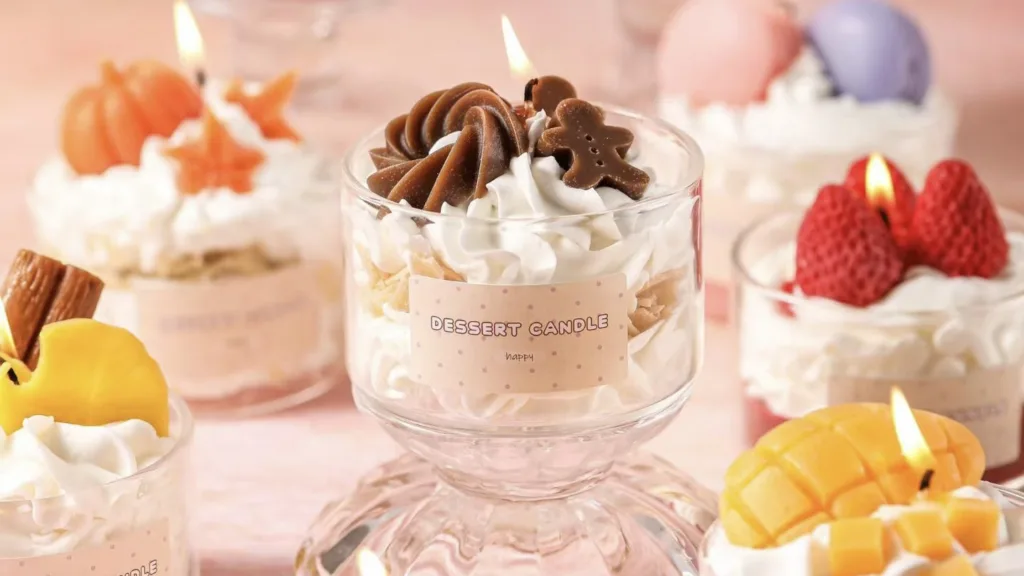 Dessert handmade candles are sculpted or decorated candles inspired by desserts—think whipped-cream piping, layered “parfait” looks, cake-slice shapes, donut designs, coffee-and-cream swirls, fruit toppings, or bakery-style jars.
They typically fall into three categories:
- Decorated container candles (a jar candle topped with “whipped wax” and decorative embeds)
- Shaped candles (cake slices, donuts, croissants, etc.)
- Gift-style sets (a themed assortment that’s easy to merchandise)
For a budget brand start, the sweet spot is often decorated container candles or gift-style sets, because they’re easier to ship and easier to position as premium gifting.
The Budget Launch Strategy: Start With One Hero, Not Ten SKUs
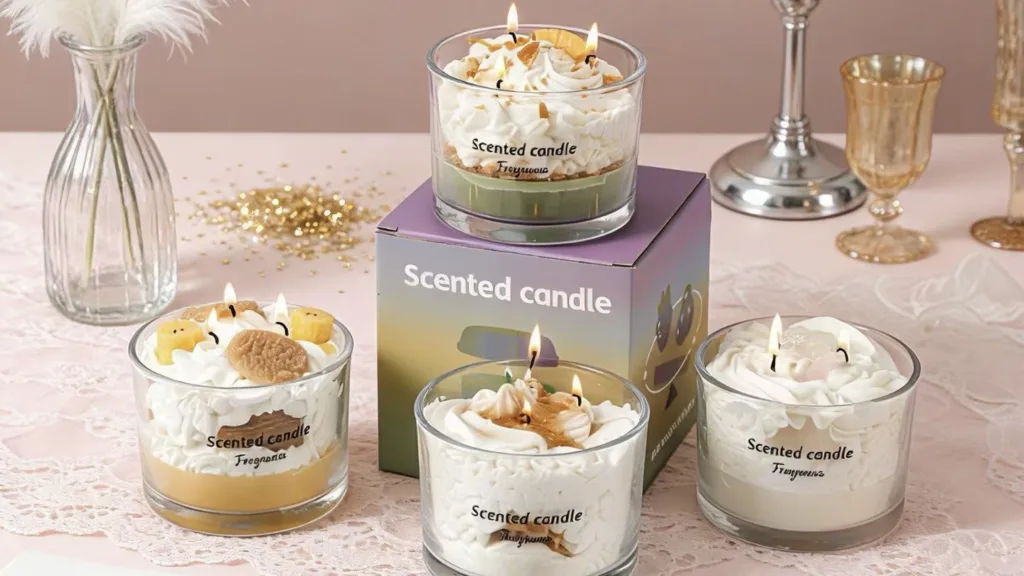 The biggest operational mistake new candle brands make is trying to launch like a department store.
Ten scents. Three sizes. Two vessels. Four labels. Three box styles.
That’s not a brand launch. It’s a logistics nightmare.
A budget brand needs a tight SKU strategy:
- 1 hero product format (e.g., dessert jar candles)
- 3–5 scent options max
- 1 packaging system (one box size, one label system)
Why?
Because every extra SKU multiplies:
- Sampling cost
- Inventory risk
- Label complexity
- Storage complexity
- Forecasting errors
A dessert candle program lets you create “variety” without exploding your operations.
You can keep the same jar and label system, but rotate:
- topping styles
- color accents
- seasonal decorative elements
The brand feels dynamic, while your supply chain stays simple.
The Real Cost Drivers in Candle Launches (And How to Lower Them)
 A candle product’s cost isn’t just wax and fragrance. The budget pressure usually comes from these five areas:
1) Custom vessels
Custom glass or ceramic requires tooling, sampling cycles, and high MOQs.
Budget fix: start with standard vessels or an existing program.
2) Packaging complexity
Rigid boxes, inserts, multi-part assemblies—beautiful, but expensive at low volume.
Budget fix: use one scalable packaging system and upgrade later.
3) Too many scents
Each scent requires testing, documentation, and forecasting.
Budget fix: start with a tight scent portfolio that matches gifting.
4) Shipping damage and returns
Breakage eats your margin.
Budget fix: prioritize ship-safe formats and protective inner packaging.
5) Compliance gaps
If you sell in the EU/UK or major retail, missing documents will slow you down.
Budget fix: choose a supplier who can provide the paperwork and guidance.
This is where dessert handmade candles shine. You can launch with standard vessels, gift-friendly presentation, and fewer variations—while still looking distinctive.
How to Choose Dessert Candle Styles That Actually Sell
 Dessert candles go viral easily, but not all “viral” products are profitable.
For a budget brand start, pick styles that balance:
- visual impact
- production stability
- shipping safety
- repeat purchase potential
Here are three proven directions:
A) “Bakery Minimal” (premium, adult, giftable)
Think: creamy neutrals, espresso tones, subtle garnish.
Why it works:
- looks premium
- fits boutiques
- works year-round
B) “Playful Pop” (TikTok-friendly)
Bright colors, fruit details, whipped textures.
Why it works:
- high social share
- impulse buying
- strong seasonal hooks
C) “Seasonal Limited” (controlled scarcity)
One or two seasonal toppings per quarter.
Why it works:
- keeps SKUs contained
- creates urgency
- supports higher pricing
The best budget strategy is to lead with Bakery Minimal (broad appeal) and add controlled Seasonal Limited drops.
Scent Strategy for Budget Brands: Fewer, Better, Easier to Explain
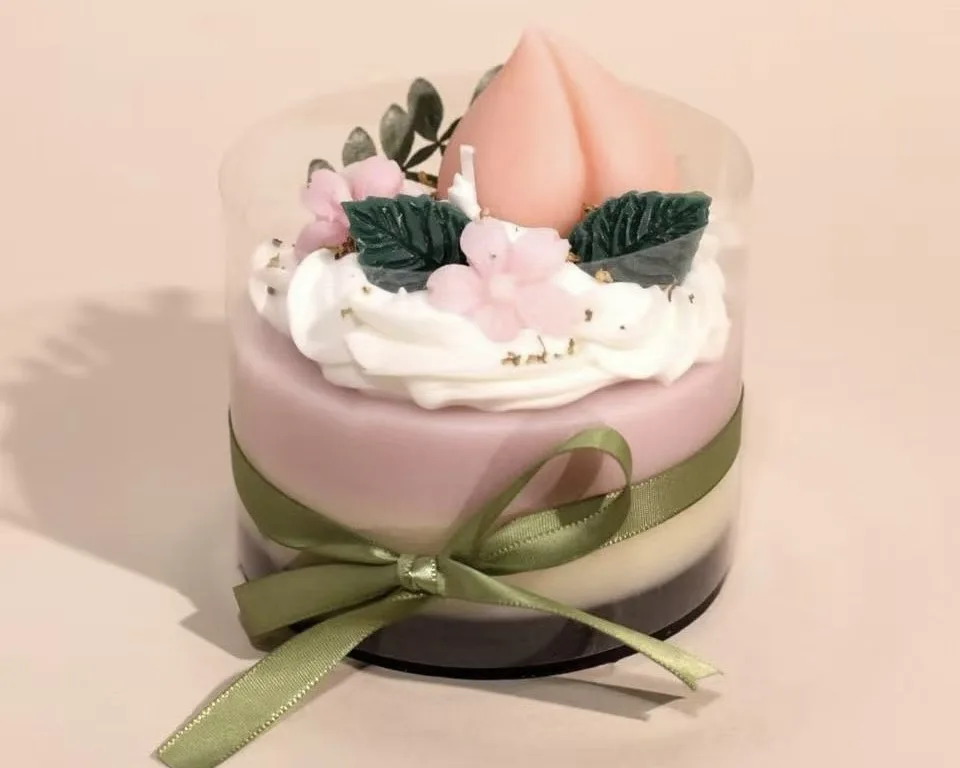 Dessert visuals suggest gourmand scents, but you don’t want to lock yourself into “too sweet” only.
For a small brand, choose scents that:
- sell as gifts
- work across seasons
- are easy to describe online
A practical starter set:
- Vanilla + Tonka (warm, crowd-pleasing)
- Coffee + Cocoa (gourmand, cozy)
- Berries + Cream (playful, bright)
- Citrus + Sugar (fresh but still dessert-adjacent)
- Clean Cotton / Soft Musk (a non-food option for balance)
Keep it simple. You can always expand after you learn what sells.
Pricing and Margin: The Math That Keeps You Alive
A budget brand can’t survive on “cute product” alone. You need margin that can fund growth.
A realistic margin framework:
- Wholesale buyers: aim for 2.0–2.5× landed cost as wholesale price (depending on category)
- Direct-to-consumer: aim for 3.0–4.0× landed cost retail price
Where “landed cost” includes:
- product unit cost
- inner packaging
- master carton allocation
- freight and duties
- damage allowance (yes, include it)
Example (simplified)
If your landed cost per unit is $6.50:
- Wholesale target price: $13–$16
- Retail target price: $22–$26
Dessert handmade candles can often support higher retail because:
- they look like gifts
- they photograph well
- they feel “special” compared to basic jars
Your budget advantage is not “cheap.” It’s high perceived value.
Packaging That Looks Premium Without Premium Cost
Packaging is where small brands bleed money.
The goal is to look intentional, not expensive.
Step 1: Choose one scalable system
A good starter system is:
- one box size
- one label layout
- one insert format (or a protective sleeve)
Step 2: Use “modular upgrades”
Instead of reinventing packaging every season, upgrade by swapping:
- outer sleeves
- stickers/seals
- ribbon color
- small message cards
This gives you seasonal storytelling without new tooling.
Step 3: Don’t ignore shipping
A beautiful box is worthless if candles arrive broken.
Budget brands should prioritize:
- foam or molded pulp inserts
- corrugated outer cartons
- drop-tested packing approach
Compliance and Safety: Don’t Build a Brand That Can’t Scale
Even if you start small, you should build as if you’ll grow.
At minimum, your supplier should be able to support:
- ingredient and allergen guidance
- safety labeling direction (market-specific)
- SDS/CLP-style documentation where applicable
- burn testing or burn guidance
If you plan to sell into Europe/UK, compliance becomes non-negotiable.
A budget launch doesn’t mean cutting corners. It means choosing a pathway where compliance is available when you need it.
Procurement Reality: Why Small Buyers Get Stuck
Small buyers often face a harsh reality:
- Factories want big MOQs.
- Trading companies can be vague.
- Handmade artisans can’t scale.
So you end up trapped between:
- too big (factory MOQs)
- too small (artisan capacity)
This is exactly the gap that Circe Home is positioned to solve.
Where Circe Home Fits: A Practical “Small Buyer” Supply Path
If you’re building a candle brand on a budget, you need a supplier who understands two things at once:
- You’re not ordering container loads yet.
- You still need a product that looks brand-ready.
Circe Home supports small and growing buyers with a procurement model designed for early-stage launches:
- Dessert handmade candle programs that work for smaller batch starts
- Private label support (label/box customization options based on your stage)
- Global warehousing support for smoother fulfilment planning
- Full certification readiness for EU/US expectations as you scale
- Fast sampling so you can test and launch without endless iteration
Instead of forcing you into expensive custom ceramic development on day one, Circe Home can help you start with a proven program—then upgrade your packaging, vessel, or collection architecture after your first sales cycle.
What this means for you
You get a “small buyer” route that isn’t embarrassing.
You can launch something that:
- looks premium enough for retail
- ships reliably
- has repeat purchase potential
- doesn’t trap you in dead stock
And you can build your way up.
A 30-Day Budget Launch Plan (Realistic and Repeatable)
Here’s a lean plan that works for small brands.
Week 1: Define your offer
- pick 1 dessert candle format
- pick 3–5 scents
- set your price points
Week 2: Sample + content
- order samples
- film unboxing + burn + close-up
- build product pages and listing assets
Week 3: Packaging + labeling
- finalize label design
- confirm box system
- lock shipping tests
Week 4: Launch + collect data
- soft launch to your audience
- track conversion by scent/style
- reorder winners only
Circe Home can support this cadence by keeping the product development cycle short and the procurement steps structured.
Common Mistakes to Avoid (So Your Budget Launch Doesn’t Collapse)
Mistake 1: Launching too many SKUs
Keep it tight. Expand later.
Mistake 2: Over-investing in packaging before product-market fit
A premium box doesn’t fix a product that doesn’t sell.
Mistake 3: Pricing like a hobby
You are not selling “cute.” You are selling value.
Mistake 4: Ignoring shipping protection
Damage will quietly destroy your profit.
Mistake 5: Treating compliance as “later”
Build the foundation early so you can scale.
The Bottom Line
If you want the best budget candle brand start, you need a product that:
- stands out without expensive customization
- creates content naturally
- can launch in smaller batches
- feels giftable and premium
Dessert handmade candles check every box.
And if you want a realistic procurement route—one that helps small buyers launch without getting trapped by factory MOQs—Circe Home is built for exactly this stage.
Next step
If you’re considering a dessert handmade candle launch, request:
- a starter style catalog
- a sample plan (3–5 scents)
- private label options that match your budget
- shipping-safe packaging recommendations
Build lean. Launch fast. Scale smart.
FAQs
1) Are dessert handmade candles safe to ship for e-commerce?
Yes—if you choose ship-friendly formats (especially decorated container candles) and use protective inserts and outer cartons designed for drops.
2) What’s the best number of scents to start with on a budget?
Three to five. Fewer scents reduce sampling, labeling complexity, and inventory risk while still giving customers meaningful choice.
3) Can I private label dessert handmade candles with small batches?
Often yes, depending on the supplier’s program. Circe Home supports private label pathways designed for early-stage brands that need a lower-risk start.