
Choosing a candle manufacturer is not simply a matter of finding the lowest unit price.
A candle may appear simple, but its performance depends on the interaction between wax, fragrance oil, wick, dye, container dimensions, pouring temperature, curing conditions and end-use environment. A supplier can produce an attractive prototype and still fail to reproduce the same fragrance, burn quality or appearance across a 10,000-piece order.
That is why experienced importers, retailers, hospitality groups and private-label brands evaluate manufacturers as production partners rather than quotation providers.

The commercial opportunity is significant. The global scented-candle market was valued at approximately $2.3 billion in 2025 and is projected to reach $3.5 billion by 2033, representing a forecast compound annual growth rate of 5.4%. Google Trends also shows recurring holiday-season peaks for “scented candles,” along with a gradual rise in overall interest. Related searches increasingly focus on ingredients and safety, demonstrating that customers are asking more detailed questions about what they burn in their homes.
Pinterest’s 2026 “Scent Stacking” forecast points in a similar direction: younger consumers are becoming interested in layered, customized fragrance experiences rather than one generic home scent. For candle brands, this creates opportunities for coordinated fragrance collections, seasonal launches and private-label scent systems—but only when the manufacturer can manage development and production consistently.
This guide explains how to choose a candle manufacturer using a practical, buyer-focused evaluation process.
1. Understand Why Manufacturer Selection Matters
The wrong supplier does more than delay a shipment. It can create problems throughout the product lifecycle:
- Weak or inconsistent hot throw
- Tunneling or incomplete melt pools
- Excessively high flames
- Wick mushrooming
- Visible smoke or soot
- Fragrance sweating
- Cracked glass containers
- Uneven candle surfaces
- Incorrect fill weights
- Color differences between production batches
- Packaging damage during transportation
- Missing or inaccurate compliance documents
- Delayed retail launches
Many of these problems do not become obvious during a short visual inspection. They appear only after several burn cycles, prolonged storage, high-temperature transportation or full-scale production.
A reliable manufacturer must therefore achieve two separate objectives:
- Develop a candle that meets the approved specification.
- Reproduce that specification consistently during mass production.
An impressive sample is not enough. The approved sample must become the measurable quality benchmark for the production order.
2. Define Your Candle Project Before Contacting Suppliers
Before searching for manufacturers, prepare a clear product brief. A vague request usually produces vague quotations that cannot be compared accurately.
“Please quote a luxury scented candle” is not a usable manufacturing specification.
At minimum, define the following requirements.
Candle Construction
- Candle type
- Finished dimensions
- Wax fill weight
- Total product weight
- Single-wick or multi-wick construction
- Expected burn time
- Intended room size
- Indoor or outdoor use
Wax and Fragrance
- Soy, coconut, paraffin, beeswax, vegetable or blended wax
- Fragrance family
- Custom fragrance or stock fragrance
- Desired fragrance intensity
- Fragrance-oil percentage target
- Unscented or scented construction
- Dye-free, colored or Pantone-matched wax
Container and Components
- Glass, ceramic, metal, concrete or freestanding format
- Inner diameter
- Outer diameter
- Container height
- Wall thickness
- Lid material
- Wick tab and adhesive requirements
- Decorative accessories
Branding and Packaging
- Printed label
- Screen printing
- Decal
- Laser engraving
- Embossing or debossing
- Individual box
- Gift set
- Insert card
- Barcode
- Retail price label
- Master-carton requirements
Commercial Requirements
- Sampling quantity
- Trial-order quantity
- Expected annual volume
- Destination market
- Target delivery date
- Preferred Incoterm
- Required testing or documentation
A reference image is useful for communicating style, but it cannot replace technical dimensions. Two candles that look identical in a photograph may have different wax weights, glass thicknesses, wick systems and packaging costs.
3. Decide What Type of Manufacturing Partner You Need
Not every buyer needs the same supplier structure.
A startup testing a stock jar with a custom label has different requirements from a retailer developing 12 proprietary fragrances across three vessel sizes.
Stock Product Supplier
This model is appropriate when you need:
- Lower initial quantities
- Faster production
- Existing candle vessels
- Standard fragrances
- Label or box customization
- Limited development costs
The trade-off is reduced exclusivity.
Private Label Candle Manufacturer
A private-label supplier typically offers an existing candle construction with customizable branding, fragrance selection and packaging.
This is suitable for:
- Retailers
- Gift companies
- Lifestyle brands
- Hotels
- Subscription-box businesses
- Corporate gifting programs
Fully Custom Candle Manufacturer
A fully custom project may involve:
- Exclusive fragrance development
- Custom wax blends
- Proprietary container molds
- Custom colors
- Engineered wick systems
- Original packaging structures
- Market-specific compliance work
This model requires higher minimum quantities, longer development cycles and a larger budget.
The manufacturer should explain which elements can be customized economically and which require new tooling or higher material minimums. A supplier that promises unlimited customization at a very low MOQ may not fully understand the production constraints—or may be planning to substitute materials later.
4. Verify the Supplier’s Legal Identity and Factory Credentials
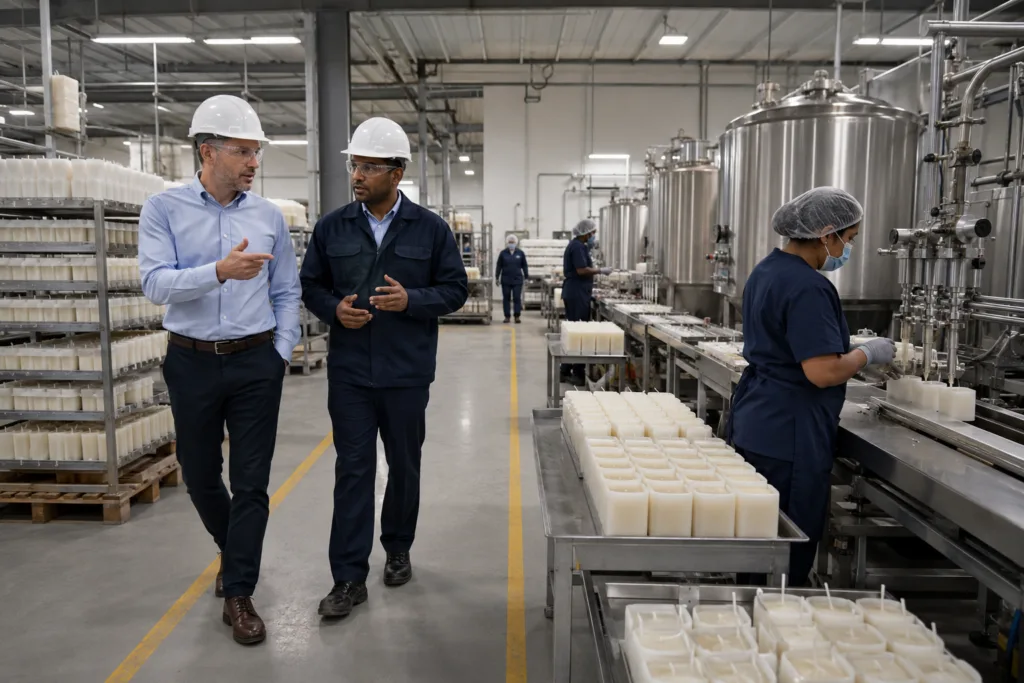
A professional candle factory audit begins with identity verification.
Request:
- Registered company name
- Business license
- Factory address
- Exporting entity name
- Years in operation
- Main product categories
- Primary export markets
- Factory photographs
- Production videos
- Live video-tour availability
Ask whether the company is a direct manufacturer, an integrated manufacturer-exporter or a trading company.
A trading company is not automatically unsuitable. Some trading businesses offer strong project management and access to specialized factories. The important issue is transparency.
The supplier should clearly explain:
- Where the candles are poured
- Where containers are produced
- Where fragrance is blended
- Where packaging is printed
- Which operations are outsourced
- Who controls final quality
- Who is responsible for corrective action
A factory audit should also examine whether the facility is organized by production stage. Raw materials, work-in-progress products, approved samples, defective items and finished goods should not be mixed without identification.
5. Evaluate Production Capacity and Scalability
A supplier may be capable of producing 500 candles but struggle with 50,000.
Ask for realistic monthly capacity by product type rather than a single headline number. Container candles, taper candles, pillar candles and gift sets may use different equipment and production lines.
Review:
- Number of wax-melting tanks
- Tank capacity
- Manual versus automated pouring
- Wick-placement methods
- Cooling-space capacity
- Labeling equipment
- Packaging lines
- Warehouse capacity
- Peak-season utilization
- Number of production workers
- Quality-control staffing
Capacity should be evaluated against your expected growth.
For example, a trial order of 1,000 units may become a seasonal order of 20,000 units. Ask how the factory would handle that increase without changing the approved wax, fragrance, wick or container supplier.
A useful capacity question is:
What changes would be required if our order volume increased fivefold?
The answer reveals whether the supplier has planned sourcing channels, equipment capacity and production controls—or is simply accepting the current order.
6. Assess Product-Development Capabilities
A capable custom candle manufacturer should do more than combine wax and fragrance.
Product development involves balancing several variables:
- Wax melting point
- Wax viscosity
- Fragrance compatibility
- Fragrance concentration
- Wick material
- Wick diameter
- Container diameter
- Dye loading
- Flame behavior
- Melt-pool formation
- Curing time
- Ambient temperature
Changing one variable may affect several others.
For example, switching from one fragrance to another can alter viscosity and combustion performance. Increasing fragrance concentration does not automatically improve hot throw and may contribute to sweating, unstable flames or incomplete combustion.
Similarly, a larger container does not simply require “more wick.” The manufacturer may need to test:
- A larger single wick
- Two smaller wicks
- Three-wick placement
- Different wick series
- Different wax blends
Fragrance-Development Questions
Ask whether the supplier can:
- Match a fragrance reference
- Develop an exclusive fragrance
- Adjust top, middle and base notes
- Provide fragrance evaluation samples
- Recommend market-appropriate scent profiles
- Maintain batch consistency
- Protect exclusive formulas
- Provide relevant fragrance documentation
A professional manufacturer should be able to explain why a formula is recommended, not simply say that it is “our standard recipe.”
7. Audit Raw-Material Sourcing and Traceability

A dependable candle supplier checklist must include raw-material traceability.
Important materials include:
- Wax
- Fragrance oil
- Essential oils
- Wicks
- Dyes and pigments
- Glass or ceramic containers
- Metal lids
- Wooden lids
- Adhesives
- Labels
- Gift boxes
- Inserts
- Master cartons
Ask the manufacturer how each material is identified when it arrives.
A basic traceability system should record:
- Supplier name
- Material name
- Internal material code
- Batch or lot number
- Arrival date
- Inspection result
- Production batches in which the material was used
This information becomes essential when a defect appears after shipment. Without batch traceability, the factory may be unable to determine whether the issue came from one fragrance lot, one wax batch or one container shipment.
Material Substitution Control
Include a written rule stating that the manufacturer cannot change an approved material without authorization.
Substituting a similar-looking wick, adhesive or fragrance oil may change the final candle’s performance. Even a replacement glass vessel with the same dimensions may respond differently to heat if its composition or annealing quality changes.
For large orders, buyers should request a bill of materials or an approved component list.
8. Verify Safety and Compliance Documentation
Certificates should be evaluated carefully rather than collected as marketing files.
Depending on the product and destination market, relevant documents may include:
- Safety Data Sheet or SDS
- Fragrance documentation
- IFRA Certificate of Conformity
- Allergen information
- Wax specifications
- Heavy-metal test reports
- Container test reports
- Packaging material declarations
- FSC documentation
- Factory quality-management records
- Country-specific labeling files
An IFRA Certificate of Conformity applies to a fragrance mixture for a specified intended use. IFRA itself does not issue the certificate; the fragrance mixture supplier prepares it. IFRA also states that the certificate does not replace a complete product safety assessment or compliance with national and regional regulations.
This distinction matters. A supplier should not present an IFRA document as proof that the complete finished candle is automatically compliant in every market.
U.S. Candle Standards
The U.S. Consumer Product Safety Commission lists several ASTM standards relevant to candles, including:
- ASTM F2058 for candle fire-safety labeling
- ASTM F2179 for annealed glass candle containers
- ASTM F2326 for visible emissions
- ASTM F2417 for candle fire safety
- ASTM F2601 for candle accessories
ASTM’s current candle-product listings include F2058-07(2021), F2179-26, F2326-04(2021), F2417-24 and F2601-25.
Do not merely ask, “Do you have U.S. certification?” Ask which standard, product, material and production version the document covers.
9. Examine the Sampling and Approval Process
Sampling is not only an appearance check. It is the stage where the buyer and manufacturer establish the production standard.
A structured sampling process should include:
- Technical specification review
- Material selection
- Fragrance approval
- Prototype production
- Curing
- Burn testing
- Packaging fitting
- Buyer evaluation
- Revision
- Final approval
Approve the Actual Production Configuration
The final sample should use the materials planned for mass production:
- Final wax blend
- Final fragrance oil
- Final fragrance concentration
- Final wick
- Final dye
- Final container
- Final fill weight
- Final lid
- Final label
- Final packaging
A burn test performed in a “similar jar” with a “similar fragrance” provides limited assurance.
Create a Golden Sample
Once approved, create a signed or clearly identified reference sample.
Both buyer and manufacturer should retain one.
The golden sample should be accompanied by:
- Product specification sheet
- Component list
- Approved color reference
- Fragrance code
- Wick code
- Net-weight tolerance
- Label-placement guide
- Packaging instructions
Record Every Approved Change
Changes agreed through email or messaging should be added to the official specification rather than left in disconnected conversations.
Final Approval Rule
Mass production should begin only after the final construction, artwork and packaging specifications are approved in writing.
10. Review the Candle Burn-Testing System
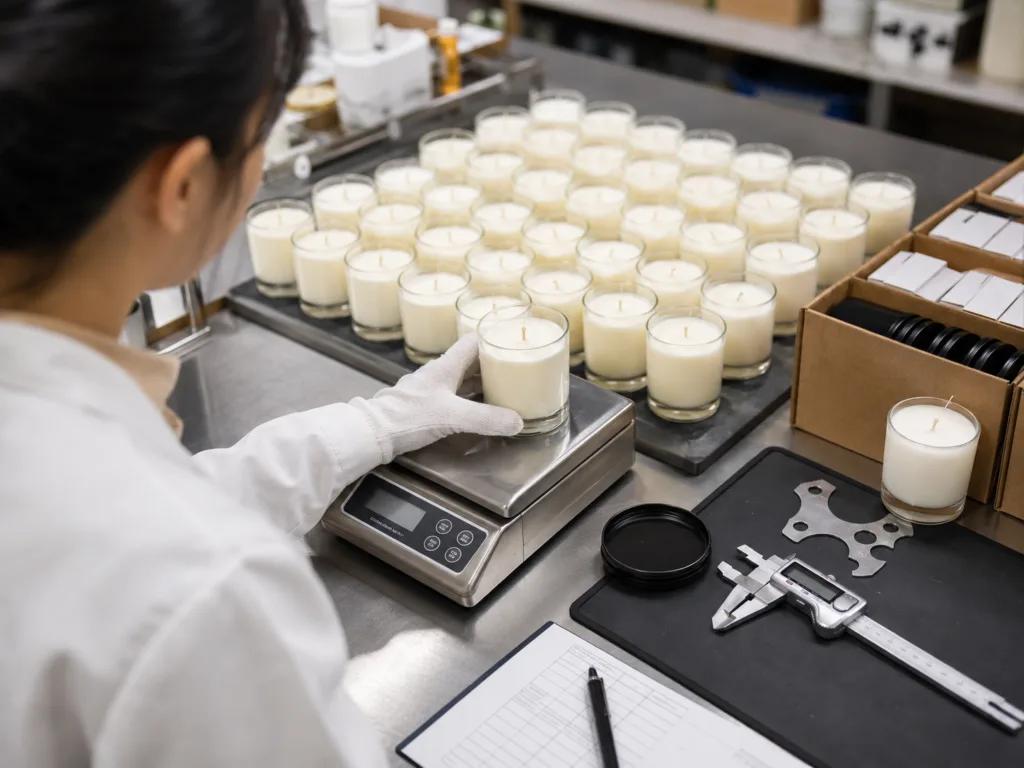
Burn testing is one of the most important factors when deciding how to choose a candle manufacturer.
A candle cannot be approved based only on its first 30 minutes of burning. Problems may emerge after repeated cycles or near the end of the candle’s useful life.
What Should Be Evaluated?
A proper burn test may examine:
- Flame height
- Flame stability
- Melt-pool diameter
- Melt-pool depth
- Time required to form the melt pool
- Wick mushrooming
- Wick leaning
- Visible smoke
- Soot deposition
- Tunneling
- Container temperature
- Container cracking
- Fragrance throw
- Wax discoloration
- Remaining wax
- End-of-life behavior
Cold Throw and Hot Throw
Cold throw describes the fragrance perceived before the candle is lit.
Hot throw describes fragrance diffusion while the candle burns.
A strong cold throw does not guarantee a strong hot throw. Hot throw depends on the complete wax-fragrance-wick system, room conditions and burn duration.
A Better Test Record
Ask the supplier to document:
| Burn Cycle | Burn Duration | Flame Height | Melt Pool | Wick Condition | Container Condition | Notes |
|---|---|---|---|---|---|---|
| Cycle 1 | 3–4 hours | Recorded | Recorded | Recorded | Recorded | Initial performance |
| Cycle 2 | 3–4 hours | Recorded | Recorded | Recorded | Recorded | Mid-stage behavior |
| Cycle 3+ | 3–4 hours | Recorded | Recorded | Recorded | Recorded | Long-term consistency |
| Final cycle | Until safe stop point | Recorded | Recorded | Recorded | Recorded | End-of-life review |
The exact protocol should reflect the candle design and applicable market requirements. The essential point is that the factory uses a repeatable system rather than an informal visual impression.
Retesting After Changes
Burn testing should be repeated when changing:
- Fragrance
- Fragrance load
- Wax blend
- Wick
- Dye
- Container dimensions
- Container material
- Fill weight
A supplier should never assume that one test result automatically covers an entire collection.
11. Understand MOQ, Tooling and Total Landed Cost
Minimum order quantity is rarely one simple number.
A candle project may involve separate minimums for:
- Candle filling
- Fragrance production
- Custom-colored wax
- Glass color
- Ceramic glaze
- Printed labels
- Printed boxes
- Wooden lids
- Metal lids
- Custom molds
- Carton printing
For example, the factory may accept 500 finished candles, while the custom box printer requires 1,000 boxes and the ceramic supplier requires 2,000 vessels.
Ask for an MOQ breakdown by component.
Compare Total Project Cost
A serious quotation should identify:
- Unit price
- Sample fee
- Development fee
- Mold fee
- Printing setup fee
- Testing fee
- Packaging cost
- Inner-carton cost
- Master-carton cost
- Pallet cost
- Inspection cost
- Freight
- Insurance
- Duties and taxes where applicable
The cheapest ex-factory price may not produce the lowest landed cost.
A weak container can increase breakage. Poor carton engineering can raise claims. An inaccurate barcode can disrupt warehouse receiving. Delayed production can cause airfreight costs or missed seasonal sales.
Mature buyers evaluate the cost of risk, not only the price per candle.
12. Validate Production Lead Times
Ask the supplier to separate the schedule into stages.
A realistic custom-candle timeline may include:
- Project evaluation
- Fragrance development
- Container sampling
- Candle sampling
- Curing and burn testing
- Sample shipment
- Buyer approval
- Raw-material procurement
- Mass production
- Packaging
- Final inspection
- Export booking
Clarify when the quoted production time begins.
Does it begin after:
- Purchase-order confirmation?
- Deposit payment?
- Artwork approval?
- Sample approval?
- Raw-material arrival?
These dates can differ by several weeks.
Seasonal Capacity
For holiday launches, discuss peak-season capacity early. Candle orders often rise before autumn, Christmas, gifting periods and major retail promotions. Google Trends shows recurring holiday peaks for scented-candle searches, which means retail demand and factory workloads can increase at the same time.
A mature supplier should provide milestone dates rather than only promising shipment “within 30 days.”
13. Inspect the Quality-Control System
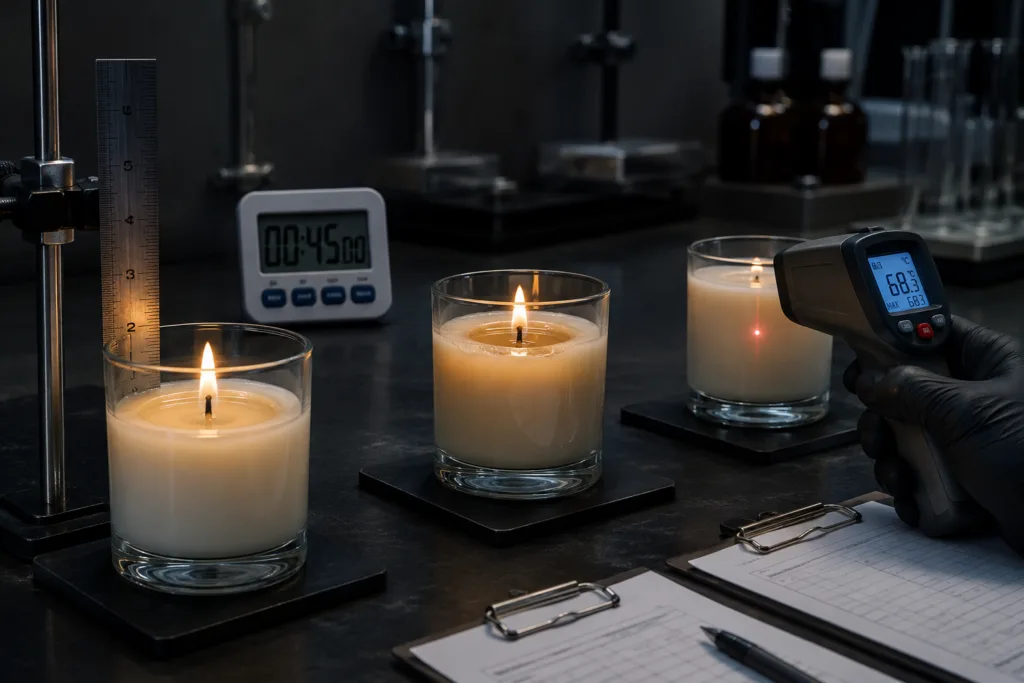
Effective candle quality control begins before production and continues through shipment.
Incoming Quality Control
Incoming inspection may cover:
- Wax appearance and documentation
- Fragrance batch and code
- Wick dimensions
- Glass dimensions
- Glass defects
- Lid fit
- Label color
- Box dimensions
- Printing quality
- Carton strength
In-Process Quality Control
During production, the factory should monitor:
- Wax temperature
- Fragrance-addition temperature
- Mixing time
- Pouring temperature
- Fill weight
- Wick centering
- Wick tension
- Cooling conditions
- Surface appearance
- Color consistency
- Fragrance batch usage
Final Quality Control
Finished-product inspection may include:
- Net weight
- Product dimensions
- Wick position
- Surface defects
- Container cleanliness
- Label alignment
- Lid fit
- Packaging completeness
- Barcode readability
- Carton quantity
- Shipping marks
- Drop-test performance
- Random burn testing
Questions to Ask
- What tolerances are used for candle weight?
- How is label placement measured?
- How are defects classified?
- What sampling plan is used?
- Are inspection results recorded?
- Can we receive a pre-shipment report?
- Can a third-party inspector visit?
- How are rejected products isolated?
- What corrective action is taken when defects exceed the limit?
Quality control should not consist of someone opening a few cartons before shipment. It must connect the approved sample, written specification, production records and final inspection.
14. Evaluate Packaging and Transit Protection
Packaging serves three purposes:
- Present the product.
- Protect the product.
- support warehouse and retail handling.
For candle projects, packaging engineering should consider:
- Glass-to-box clearance
- Protective inserts
- Lid movement
- Label abrasion
- Wax surface protection
- Box compression
- Carton stacking
- Vibration
- Drop impact
- Temperature exposure
- Pallet configuration
A gift box that looks premium may still fail during international shipping.
Request:
- Packaging dimensions
- Material specifications
- Insert structure
- Carton quantity
- Gross and net carton weights
- Carton dimensions
- Drop-test method
- Pallet-loading plan where relevant
For large retail orders, confirm barcode type, barcode position, case-pack quantity, carton markings and warehouse labels before production.
Packaging errors can be expensive because they may affect every finished unit even when the candle itself is acceptable.
15. Confirm Export and Logistics Capabilities
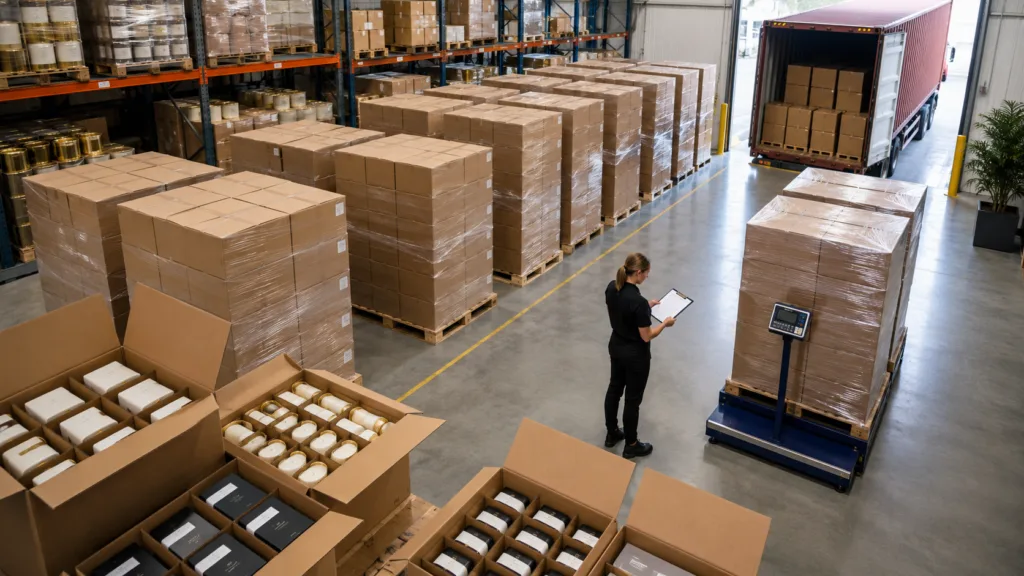
A capable production factory is not automatically an experienced exporter.
Ask which countries the supplier regularly serves and whether it can prepare:
- Commercial invoices
- Packing lists
- Certificates of origin
- Customs information
- Product descriptions
- Harmonized tariff codes
- Shipping marks
- Pallet details
- Container-loading records
- Inspection documents
- Material or safety documents
The supplier should understand the responsibilities under the agreed Incoterm.
For example, FOB, CIF and DDP quotations allocate transportation, customs and risk differently. Do not compare quotations unless the commercial terms are identical.
Export-Readiness Checklist
Confirm whether the supplier can:
- Communicate in clear business English
- Review destination-market requirements
- Coordinate with your freight forwarder
- Provide carton and shipment data promptly
- Support third-party inspections
- Prepare English-language technical files
- Adapt labels and packaging to the destination market
- Maintain export records
At Circe Home, we approach custom candle projects as a coordinated process involving product specification, supplier communication, sample approval, burn-performance review, packaging and export support. This reduces the number of separate vendors and follow-up steps the buyer must manage.
16. Send a Complete Candle RFQ
A complete request for quotation allows qualified suppliers to respond accurately and helps you identify manufacturers that pay attention to detail.
Candle RFQ Checklist
| Category | Information to Provide |
|---|---|
| Product | Candle type, size and intended use |
| Wax | Wax preference or performance target |
| Fill | Net wax weight |
| Fragrance | Scent direction, custom or stock fragrance |
| Wick | Single, double or multi-wick preference |
| Container | Material, size, color and finish |
| Branding | Label, printing, engraving or embossing |
| Packaging | Individual box, gift set, insert and carton |
| Compliance | Destination market and required documents |
| Quantity | Sample, trial order and annual forecast |
| Logistics | Destination, Incoterm and target date |
Information the Supplier Should Return
Request:
- Recommended product construction
- MOQ by component
- Unit price
- Sample cost
- Tooling cost
- Packaging cost
- Development schedule
- Production lead time
- Payment terms
- Price validity
- Product tolerances
- Testing process
- Available documents
- Export experience
- Carton information
Supplier Scoring Matrix
Instead of selecting a supplier based on instinct, score each candidate.
| Evaluation Area | Suggested Weight |
|---|---|
| Product-development capability | 20% |
| Burn-testing system | 15% |
| Quality-control process | 15% |
| Raw-material traceability | 10% |
| Compliance documentation | 10% |
| Price and commercial terms | 10% |
| Production capacity | 10% |
| Communication and responsiveness | 5% |
| Export and logistics capability | 5% |
The lowest-priced supplier should not win automatically. A manufacturer that scores highly in development, testing and consistency may save significantly more money during production and after-market sales.
Candle Manufacturer Red Flags
Be cautious when a supplier:
- Refuses to provide a factory address
- Avoids factory videos or live inspections
- Gives a final price before confirming specifications
- Guarantees a burn time without testing
- Cannot identify the wick used
- Has no raw-material batch records
- Cannot explain the burn-testing process
- Offers every custom option at an unusually low MOQ
- Provides certificates unrelated to the actual product
- Changes materials without approval
- Refuses third-party inspection
- Promises an unrealistic production schedule
- Gives inconsistent answers from different team members
- Cannot provide carton or shipment information
- Says that all fragrances can use the same wick
Another warning sign is the repeated answer, “No problem,” without technical follow-up questions.
An experienced manufacturer will sometimes challenge a request. That is not necessarily poor service. It may demonstrate that the supplier understands tooling, material, safety or production limitations.
Final Candle Supplier Checklist
Before placing a production order, confirm that you can answer “yes” to the following questions.
Factory and Capacity
- Is the supplier’s legal identity verified?
- Do you know where production takes place?
- Can the factory support your projected volume?
- Are outsourced processes disclosed?
Product Development
- Has the final wax-fragrance-wick system been tested?
- Can the supplier explain its technical recommendations?
- Are custom fragrance and packaging capabilities proven?
- Is the approved construction documented?
Materials and Compliance
- Can raw materials be traced by batch?
- Are material substitutions controlled?
- Do documents match the actual materials?
- Have destination-market requirements been reviewed?
Samples and Testing
- Does the final sample use production materials?
- Has the candle completed repeated burn cycles?
- Are burn-test results recorded?
- Do both parties retain an approved sample?
Quality and Shipment
- Are tolerances written into the specification?
- Is there an incoming, in-process and final inspection system?
- Can the supplier provide a pre-shipment report?
- Has packaging been evaluated for international transport?
- Are carton and export details confirmed?
Why Mature Buyers Work With Circe Home
Large candle orders require more than a catalog and a price list.
They require coordination between fragrance, wax, wick, vessel, decoration, packaging, testing, production and shipping. When these responsibilities are divided among disconnected suppliers, the buyer spends more time chasing answers and managing avoidable errors.
Circe Home supports private-label and custom candle projects for wholesalers, retailers, importers, hospitality businesses and established brands.
Our project approach focuses on:
- Clear technical specifications
- Customized candle and packaging options
- Sample-based quality approval
- Burn-test communication
- Raw-material and documentation support
- Competitive manufacturing solutions
- U.S. and European market experience
- Global warehousing and shipment coordination
- Fast, structured project follow-up
Most importantly, the approved sample is treated as the production benchmark. The purpose of sampling is not to create one perfect display piece. It is to establish a repeatable standard for the entire order.
Request a Custom Candle Manufacturing Assessment
To receive a project evaluation, prepare:
- Product image or concept
- Candle dimensions
- Wax fill weight
- Fragrance direction
- Container material
- Packaging requirements
- Estimated order quantity
- Destination country
- Target delivery date
Circe Home can then evaluate the most practical production route, including existing components, full customization, MOQ, sampling requirements and estimated lead time.
A reliable manufacturer should not simply tell you what you want to hear. It should help you identify risks, test the product properly and move from concept to mass production with fewer delays and fewer surprises.
Frequently Asked Questions
1. How do I know whether a candle manufacturer is reliable?
Verify the company’s legal identity, factory address, production capability, testing system, quality-control records and export experience. Request production videos, relevant documentation and examples of similar products. A reliable supplier should also explain technical limitations rather than accepting every request without evaluation.
2. What documents should a candle manufacturer provide?
The required documents depend on the destination market and product construction. Common documents include an SDS, fragrance documentation, an IFRA Certificate of Conformity, wax specifications, material test reports, container information and quality-inspection records. Remember that an IFRA certificate applies to a fragrance mixture for an intended use and does not replace finished-product safety assessment or local compliance.
3. How many candle samples should be tested before mass production?
There is no universal quantity for every project. The sample plan should cover the final wax, fragrance, wick, color and container combinations. Every materially different formula should be evaluated through repeated burn cycles. For multi-fragrance collections, do not assume that one tested fragrance represents every SKU.
4. What is a reasonable MOQ for a custom candle manufacturer?
MOQ depends on the level of customization. Stock containers with custom labels may support lower quantities, while exclusive fragrances, custom-colored vessels, ceramic glazes, printed packaging and new molds usually require higher minimums. Ask for the MOQ of each component rather than only the finished-candle MOQ.
Recommended Internal Links
- Custom Candle Manufacturing
- Private Label Scented Candles
- Wholesale Candle Packaging
- Candle Burn Testing Guide
- Custom Candle Jars and Vessels
- Candle Sample Approval Checklist
- Candle Safety and Compliance
- Request a Candle Quotation
Recommended Image Alt Text
- how to choose a candle manufacturer factory audit
- candle supplier checklist for private label buyers
- custom candle manufacturer burn testing process
- candle quality control inspection
- candle raw material traceability
- wholesale candle packaging inspection
- Circe Home custom candle manufacturing