
A weak-smelling candle is one of the fastest ways to lose a customer.
For a candle brand, scent is not decoration. It is the product experience. The label may attract the first click. The vessel may justify a higher retail price. The gift box may create a beautiful unboxing moment. But once the customer lights the candle, one question decides whether they feel satisfied or disappointed:
Can they actually smell it in the room?
That is why so many candle buyers, brand founders, Amazon sellers, boutique retailers, and private label clients ask the same question at the beginning of development:
What is the best wax for strong scent throw?
It is a fair question. But it is also an incomplete one.
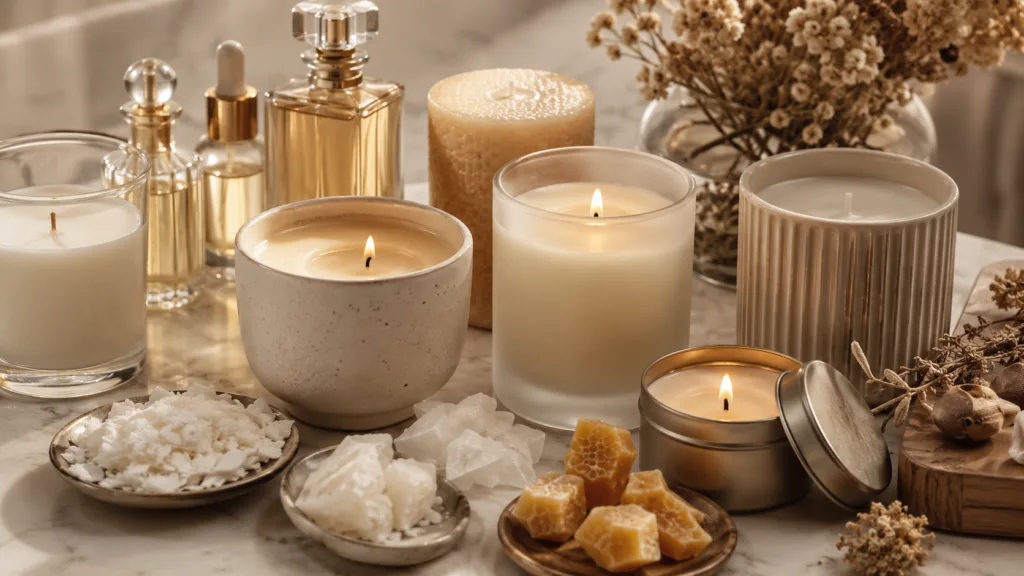
Serious candle brands do not choose wax only by trend. They choose wax based on scent performance, brand positioning, burn quality, cost structure, and production stability. A wax that sounds attractive on a label is not always the wax that performs best in real customer use. A wax that gives strong fragrance in one vessel may perform very differently in another. A candle that smells powerful in the jar may become disappointing once burned.
In commercial candle development, strong scent throw is not a wax-only decision. It is a formulation decision.
Wax matters. But wax does not work alone. A high-performing scented candle depends on the relationship between wax, fragrance oil, wick, vessel, fragrance load, curing time, melt pool, burn temperature, packaging, shipping conditions, and batch consistency. When these elements are balanced, the candle smells strong, burns safely, looks beautiful, and can be produced repeatedly at scale. When they are not balanced, even an expensive wax can produce weak hot throw, sweating, tunneling, soot, unstable flame, or poor shelf appearance.
This guide is written for serious candle brands and private label buyers who want to make better product development decisions. It does not simply rank waxes from “best” to “worst.” Instead, it explains how experienced candle brands choose the right wax system for strong scent throw, realistic pricing, brand fit, and mass production.
The Direct Answer: Which Wax Gives the Strongest Scent Throw?
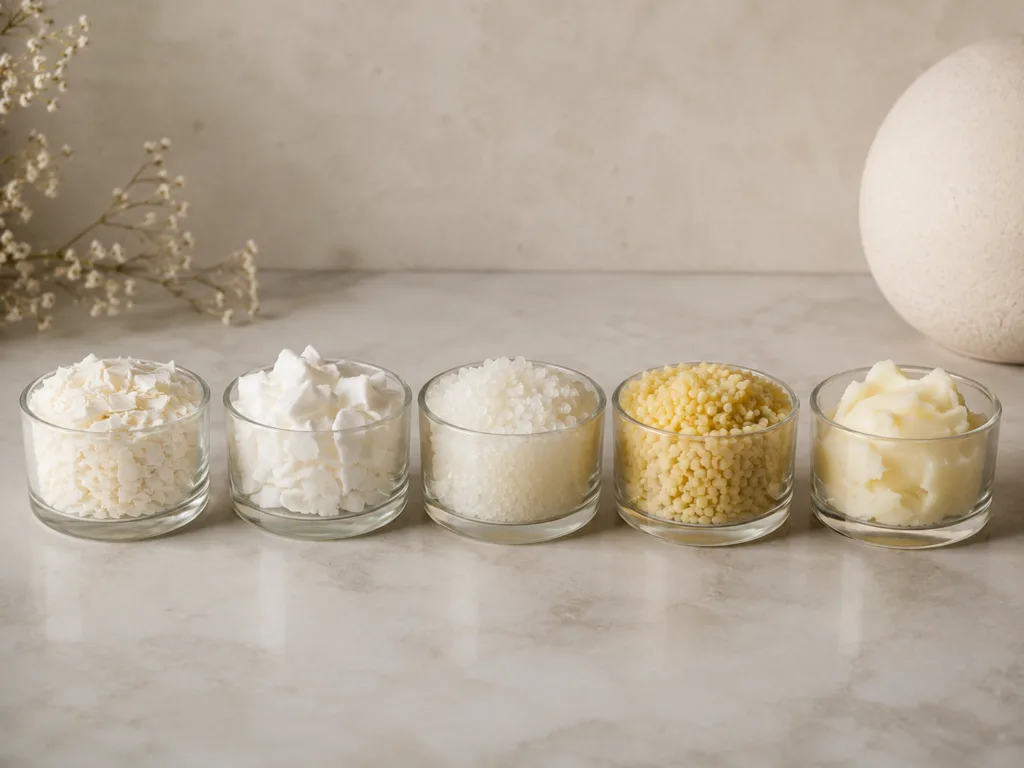
If the only goal is maximum hot throw, paraffin wax usually performs strongest. It releases fragrance efficiently, works well with many fragrance oils, and has a long history in commercial scented candle production.
But the strongest wax on paper is not always the best wax for your brand.
For premium private label candles, coconut-soy blends often offer a better commercial balance. They can provide good scent performance, a smoother surface, a more premium appearance, and a more natural ingredient story than pure paraffin. For clean-label and plant-based brands, soy wax can work well, but it requires careful fragrance selection, wick testing, curing, and formulation control. Beeswax is beautiful and natural, but it is usually not the first choice when the goal is strong added fragrance.
A practical summary looks like this:
| Wax Type | Scent Throw Potential | Best For | Main Concern |
|---|---|---|---|
| Paraffin wax | Very strong | Mass-market scented candles, strong hot throw, competitive pricing | Less suitable for natural or wellness positioning |
| Soy wax | Medium to good | Natural-positioned container candles, clean-label brands | Needs stronger formulation and wick testing |
| Coconut wax | Good to strong | Premium candles, luxury private label lines | Higher cost, often too soft alone |
| Coconut-soy blend | Strong and balanced | Premium private label candles, boutique brands, gift sets | Formula must be tested by fragrance and vessel |
| Beeswax | Mild to moderate | Natural, wellness, lightly scented or unscented candles | Not ideal for strong room-filling fragrance |
| Rapeseed wax | Good | European natural candle lines, plant-based positioning | Supply chain and formulation vary by market |
| Paraffin blend | Very strong and stable | Strong scent with improved cost or performance balance | Brand story depends on target customer |
The better question is not “Which wax is strongest?”
The better question is:
Which wax system supports my fragrance profile, vessel size, target market, retail price, brand story, and production requirements?
That is how serious candle brands make decisions.
Serious Brands Do Not Choose Wax by Trend

New candle brands often start with ingredient trends.
They may say they want “100% soy wax” because it sounds natural. They may ask for coconut wax because it sounds luxurious. They may reject paraffin immediately because they assume it is not suitable for modern consumers. They may request beeswax because it feels more traditional, premium, or wellness-oriented.
None of these instincts are necessarily wrong. But they are not enough.
A serious candle brand does not choose wax simply because a material name looks good in marketing copy. A serious brand asks deeper questions:
- What kind of scent experience do we want customers to have?
- Are we selling a strong room-filling candle or a soft atmospheric candle?
- Will this product be sold online, in boutique retail, in hotels, in spas, or as a gift set?
- Is our target customer more sensitive to natural ingredients, strong fragrance, price, or luxury presentation?
- What is our target retail price?
- What gross margin do we need?
- What vessel size and diameter are we using?
- Is the candle single-wick, double-wick, or three-wick?
- Can this formula remain stable during storage and shipping?
- Can the same formula be reproduced consistently for bulk orders?
- What compliance documents will buyers require?
For serious candle brands, wax is not a trend-driven choice. It is a performance and positioning decision.
A luxury candle brand may accept a higher material cost if the wax improves surface finish, burn quality, and perceived value. A mass-market retail candle may prioritize strong hot throw, low unit cost, and stable large-volume production. A wellness brand may choose plant-based wax even if the scent throw is softer, because the ingredient story matters more to its customers. A hotel candle may need a controlled, elegant fragrance profile rather than an aggressive one.
The “best wax” changes depending on the business model.
That is why mature buyers do not develop candles by choosing wax first and solving everything else later. They start with the intended customer experience, then build the formula around it.
What Does Strong Scent Throw Actually Mean?
Before comparing waxes, it is important to define scent throw correctly.
Scent throw is the way a candle releases fragrance into the surrounding environment. In candle development, buyers usually need to consider two different types: cold throw and hot throw.
Both matter, but they matter in different commercial situations.
Cold Throw: The First Retail Impression
Cold throw is the fragrance a candle releases before it is lit. It is what a customer smells when they open the jar, remove the lid, open the gift box, or test the product in a store.
Cold throw matters because it affects first impressions.
For boutique retail, gift sets, holiday collections, trade shows, and buyer sample reviews, cold throw can influence whether someone feels the product is desirable immediately. If a candle looks beautiful but smells faint when opened, the buyer may assume the product lacks quality before they ever burn it.
For e-commerce brands, cold throw also affects the unboxing experience. A customer who opens a candle box and immediately gets a pleasant fragrance impression is more likely to feel that the product is premium and giftable.
But cold throw is not enough.
A candle can smell strong in the jar and still perform poorly when burning. This is one of the most common problems in scented candle development. A formula may impress a buyer during sample smelling, then disappoint customers during real use.
Hot Throw: The Real Customer Experience
Hot throw is the fragrance a candle releases after it is lit and a melt pool has formed. It is the real in-room scent performance.
Hot throw affects customer satisfaction, reviews, repeat purchase, and brand reputation. If a customer burns a candle for one or two hours and can barely smell it, they may describe it as weak, cheap, disappointing, or not worth the price.
For Amazon sellers, this can become a review problem. For boutique brands, it can become a repeat purchase problem. For wholesale buyers, it can become a product quality concern.
A strong hot throw does not always mean an overpowering fragrance. It means the candle performs appropriately for its size, room type, and product positioning. A 90g candle for a bathroom should not be judged the same way as a 450g three-wick candle for a living room. A spa candle may need a soft, clean aromatic throw, while a holiday candle may need richer projection.
Serious candle brands define scent throw in context.
They do not simply ask, “Is it strong?”
They ask:
- Is the cold throw attractive enough for retail and unboxing?
- Is the hot throw noticeable after a proper burn period?
- Does the scent profile remain true when burned?
- Is the fragrance too weak, too sharp, too smoky, or too heavy?
- Does the candle fit the room size it is designed for?
- Does the fragrance experience match the price point?
That is a much better way to evaluate scented candles.
The Common Mistake: Asking for More Fragrance Oil
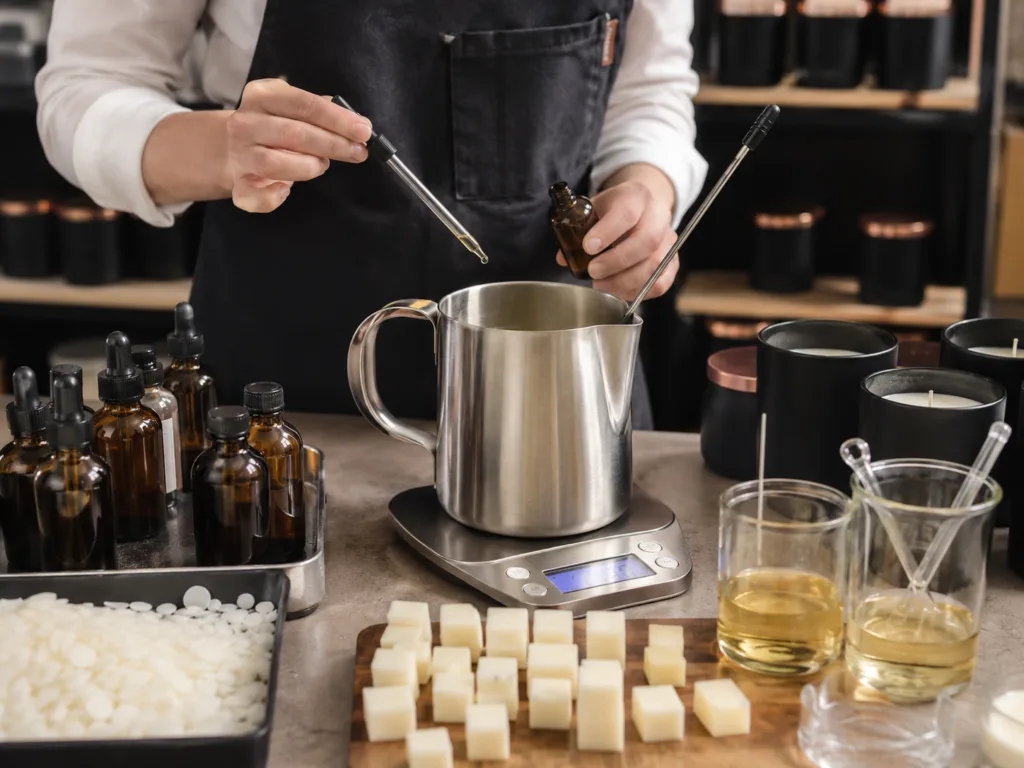
When a candle does not smell strong enough, many buyers assume the solution is simple:
Add more fragrance oil.
In real candle production, this is often the wrong starting point.
Fragrance load matters, but more oil does not automatically create stronger scent throw. Every wax has a fragrance-holding capacity. Every fragrance oil behaves differently. Every wick has a limit. Every vessel creates a different burn environment.
If fragrance oil is increased without testing the whole system, the candle may develop new problems:
- Oil sweating on the wax surface
- Poor adhesion or surface defects
- Clogged wick
- Weak or unstable flame
- Excessive flame height
- Sooting
- Uneven melt pool
- Fragrance distortion during burning
- Shortened burn time
- Container overheating risk
- Failed internal safety checks
- Poor stability during shipping or storage
A well-balanced candle with 7% fragrance load can outperform a poorly formulated candle with 10% fragrance load.
This is especially important for private label buyers. A supplier who simply agrees to add more fragrance oil without discussing wax compatibility, wick size, vessel diameter, and burn testing is not solving the real problem. They may be creating a bigger one.
Strong scent throw comes from controlled release, not just higher concentration.
The wax must hold the fragrance properly. The wick must generate the right melt pool. The burn temperature must help fragrance release without destroying the scent profile. The vessel must support the formula. The fragrance oil must be suitable for candle use and safe within the relevant usage limits.
For serious brands, fragrance load is a formulation variable, not a marketing slogan.
Paraffin Wax: Strong Hot Throw, But Not Always the Right Brand Story
Paraffin wax is often considered one of the strongest options for hot throw.
From a performance standpoint, paraffin has clear advantages. It works well with many fragrance oils, releases scent efficiently during burning, and is stable in mass production. It has been widely used in commercial scented candles for a long time because it can deliver strong fragrance performance at a competitive cost.
For buyers who prioritize maximum room-filling scent, paraffin wax or paraffin blends can be a practical choice.
It is especially suitable for:
- Mass-market scented candles
- Strong fragrance collections
- Seasonal candles
- Promotional candles
- Large-volume retail programs
- Price-sensitive product lines
- Candles where hot throw matters more than natural positioning
However, paraffin does not fit every brand story.
Many modern candle brands sell more than fragrance. They sell lifestyle, wellness, natural materials, clean home aesthetics, eco-conscious design, or luxury gifting. For these brands, the ingredient story matters. Even if paraffin performs well, customers may prefer plant-based waxes such as soy, coconut, rapeseed, or blends.
This does not mean paraffin is automatically bad. It means brand positioning must be considered.
Paraffin may win on scent power, but it does not always win on brand perception.
For a mass retail candle line, paraffin may be a smart commercial choice. For a premium wellness brand, it may create a mismatch between product performance and customer expectations. For a private label buyer, the decision depends on the market channel, price point, and brand message.
A serious candle brand does not reject or choose paraffin emotionally. It evaluates paraffin based on product goals.
Soy Wax: Popular, Natural, But Needs Better Formulation
Soy wax is one of the most popular waxes in modern scented candles.
It is plant-based, widely recognized by consumers, and commonly used in container candles. Many candle brands choose soy wax because it supports a natural, clean-label, or eco-conscious product story. It also works well for private label candle lines that want a familiar ingredient claim without moving into very high-cost wax systems.
Soy wax can deliver good scent throw, but it is not automatically the strongest wax.
This is where many new brands misunderstand it.
Soy wax may need more careful formulation than paraffin. It can be more sensitive to fragrance oil selection, pouring temperature, curing time, wick choice, and vessel design. Some soy candles smell pleasant when cold but do not project strongly when burned. Some formulas may show frosting, wet spots, rough tops, sinkholes, or inconsistent surfaces. Some fragrances perform beautifully in soy, while others become flat or weak.
This does not make soy wax a weak wax.
Soy wax is simply a wax that requires proper formulation and testing.
For brands that want to use soy wax, the key is not to demand “100% soy” and assume performance will follow. The better approach is to test:
- Which fragrance oils work best in soy
- What fragrance load is stable
- What wick creates the right melt pool
- How long the candle needs to cure
- Whether the vessel diameter supports strong hot throw
- Whether the final burn experience matches the brand promise
Soy wax is a strong choice for:
- Natural-positioned candles
- Clean-label private label lines
- Wellness and lifestyle brands
- Boutique retail candles
- Brands that want a plant-based wax story
- Container candles with moderate to good scent expectations
But if the buyer wants maximum hot throw above all else, pure soy may not always be the best starting point. In many commercial projects, a soy blend may perform better than pure soy.
That is why serious brands often test soy-based blends instead of relying on pure soy alone.
Coconut Wax: Premium Texture and Strong Scent Potential
Coconut wax has become popular in premium candle development because it offers a smooth, creamy appearance and a more luxury-oriented ingredient story.
It is often associated with high-end candles, boutique brands, and soft lifestyle aesthetics. It can provide good cold throw and strong scent potential when blended properly. Its surface finish can look more refined than many basic waxes, which matters for brands selling candles as decorative objects or gift products.
Coconut wax is valuable because it can improve both performance and perceived quality.
However, coconut wax also has limitations.
Pure coconut wax can be too soft for many commercial applications. It may need blending to improve hardness, melting point, surface stability, burn behavior, and shipping performance. It is also usually more expensive than soy or paraffin, which affects the final cost structure.
For this reason, many commercial candles marketed as coconut wax are actually coconut wax blends. They may be blended with soy, paraffin, palm-free vegetable waxes, or other waxes depending on the target performance.
For premium candle brands, coconut wax is often valuable not because it is trendy, but because it can improve texture, scent performance, and perceived quality when used in the right blend.
Coconut wax or coconut-based blends are suitable for:
- Luxury private label candles
- Boutique retail collections
- Gift candles
- High-end home fragrance lines
- Smooth-surface container candles
- Brands that want a premium natural image
- Products where visual finish matters as much as scent
But again, the formula must be tested.
A coconut wax blend that performs well with a warm amber fragrance may not perform the same way with a light green tea fragrance. A blend that works in a wide glass jar may behave differently in a tall ceramic vessel. A formula that looks perfect in a small sample may need adjustment for a larger production run.
Coconut wax can be excellent, but it is not magic. It works best as part of a controlled candle system.
Coconut-Soy Blend: The Balanced Choice for Many Premium Brands
For many serious private label candle brands, a coconut-soy blend is one of the most practical starting points.
It offers a strong commercial balance between scent performance, ingredient story, surface appearance, burn quality, and perceived value. It can often deliver better scent performance than basic pure soy while still supporting a more natural and premium brand position than paraffin.
This is why coconut-soy blends are especially useful for brands that want candles to feel elevated but still commercially scalable.
A well-developed coconut-soy blend can offer:
- Good cold throw
- Good hot throw
- Smooth visual finish
- Better premium perception
- Plant-based positioning
- More flexible fragrance development
- Good fit for luxury vessels and rigid gift boxes
- Better alignment with boutique and DTC retail channels
For a premium candle brand, the best wax is not always the wax with the strongest raw scent power. It is the wax blend that delivers strong enough scent throw while supporting the brand’s price point, ingredient story, and customer experience.
This point is critical.
A candle brand is not selling fragrance strength alone. It is selling a complete product experience. The wax must support the fragrance, but it must also support the packaging, the vessel, the brand language, the target customer, and the retail price.
For example, a boutique brand selling a $35 candle in a rigid gift box may benefit more from a smooth coconut-soy formula than from a cheaper high-throw paraffin formula. The customer expects scent, but they also expects elegance, clean design, a refined burn, and a premium material story.
On the other hand, a value-driven seasonal candle program may not need coconut-soy wax if the buyer’s priority is strong fragrance and competitive pricing.
This is why serious brands choose wax by commercial fit, not by material popularity.
Beeswax: Beautiful and Natural, But Not Built for Strong Added Fragrance
Beeswax has a beautiful natural story.
It is traditional, natural, and often associated with wellness, purity, craft, and slow burning. It also has its own warm honey-like aroma, which can be very attractive in the right product.
But beeswax is usually not the first choice when the goal is strong added fragrance.
There are several reasons. First, beeswax already has its own natural scent, which can interfere with delicate fragrance profiles. Second, it does not always release added fragrance as strongly as paraffin or well-designed wax blends. Third, it is usually more expensive, making it less practical for some large private label programs. Fourth, it may be better suited to lightly scented or unscented products than to strong room-filling candles.
Beeswax can be a good choice for:
- Natural wellness candles
- Meditation candles
- Lightly scented candles
- Unscented candles
- Premium craft collections
- Brands that want a traditional natural wax story
It is less suitable for:
- Strong fragrance collections
- Large room-filling candles
- Highly perfumed candles
- Price-sensitive private label programs
- Brands that need consistent added fragrance projection across many scents
Beeswax is a beautiful wax for natural storytelling, but it is usually not the first choice when the goal is strong room-filling fragrance.
For brands that love the beeswax story but still want better scent throw, a blend may be more practical than pure beeswax.
Wax Blends Are Often More Practical Than Pure Wax Formulas
Many buyers ask for pure wax because it sounds cleaner in marketing.
“100% soy wax.”
“Pure coconut wax.”
“Natural beeswax.”
These claims may be useful for some brands, but pure wax formulas are not always the best technical solution. In commercial candle production, wax blends are often more practical than pure wax formulas.
Why?
Because every wax has strengths and weaknesses.
Soy may support natural positioning but need help with hot throw or surface finish. Coconut may improve texture but need help with hardness and stability. Paraffin may improve scent throw but may not fit natural branding. Beeswax may add a beautiful natural story but may not release added fragrance strongly enough. Rapeseed wax may appeal to European plant-based positioning but still requires careful testing.
Wax blends allow manufacturers to balance:
- Scent throw
- Cold throw
- Hot throw
- Surface finish
- Hardness
- Melting point
- Burn time
- Fragrance load
- Wick compatibility
- Seasonal stability
- Shipping stability
- Cost
- Production consistency
This is why experienced candle developers often think in terms of wax systems rather than single wax names.
A wax blend is not a shortcut. It is a formulation tool.
For private label brands, the right wax blend can help create a candle that smells better, looks better, burns more consistently, and fits the target price more realistically.
The Wick Is the Engine of Scent Throw
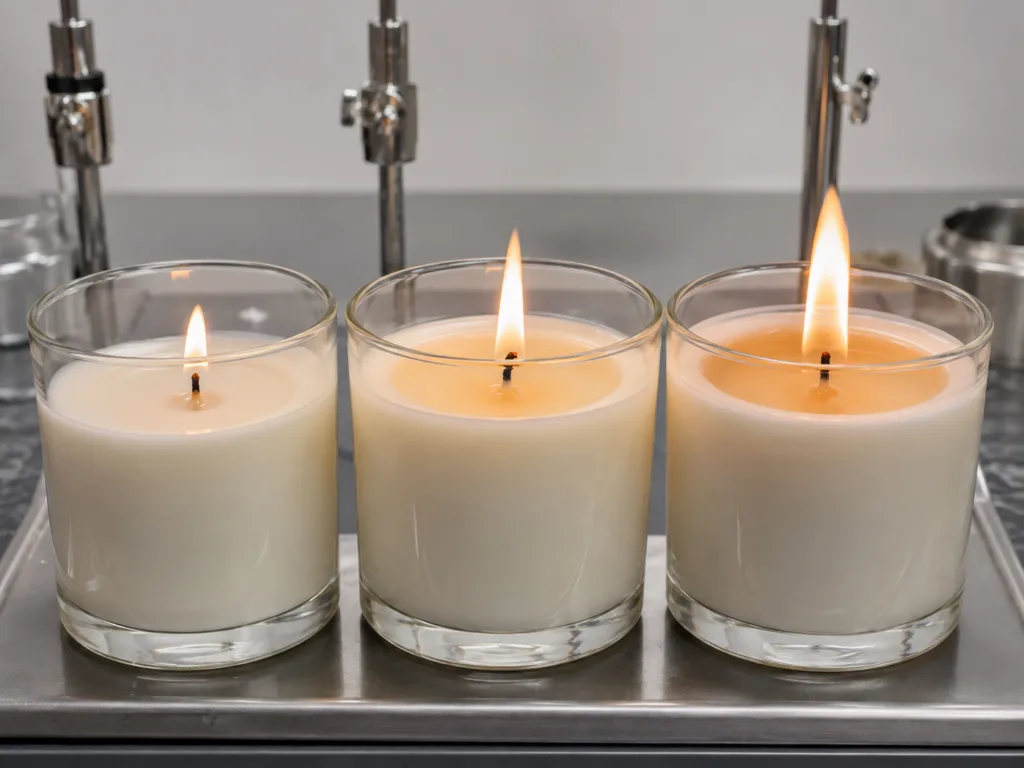
Wax gets most of the attention. But the wick often decides whether the candle actually performs.
The wick is the engine of the candle. Wax and fragrance can only perform when the wick creates the right melt pool.
When a candle burns, the wick draws melted wax and fragrance oil upward. Heat creates the melt pool, and fragrance is released into the air. If the wick is too small, the candle may not generate enough heat or enough melt pool. If the wick is too large, the candle may burn too hot.
Both problems hurt performance.
If the wick is too small, the candle may show:
- Tunneling
- Incomplete melt pool
- Weak hot throw
- Poor fragrance release
- Excess wax left on the vessel wall
- Unstable or drowning flame
If the wick is too large, the candle may show:
- Excessive flame height
- Soot
- Fast burn rate
- Overheating vessel
- Harsh fragrance release
- Burnt or distorted scent
- Safety concerns
This is why wick testing is not optional for serious candle brands.
A wax may perform well with one wick series and poorly with another. A fragrance oil may require a different wick than another fragrance in the same wax. A larger jar may require a thicker wick or multiple wicks. A ceramic vessel may behave differently from glass because heat transfer changes the burn environment.
The correct wick is not chosen by guessing. It is chosen by burn testing.
For strong scent throw, the goal is not the biggest flame. The goal is the right melt pool, stable burn, proper fragrance release, and safe performance throughout the candle’s life.
Vessel Size Changes the Scent Throw Result
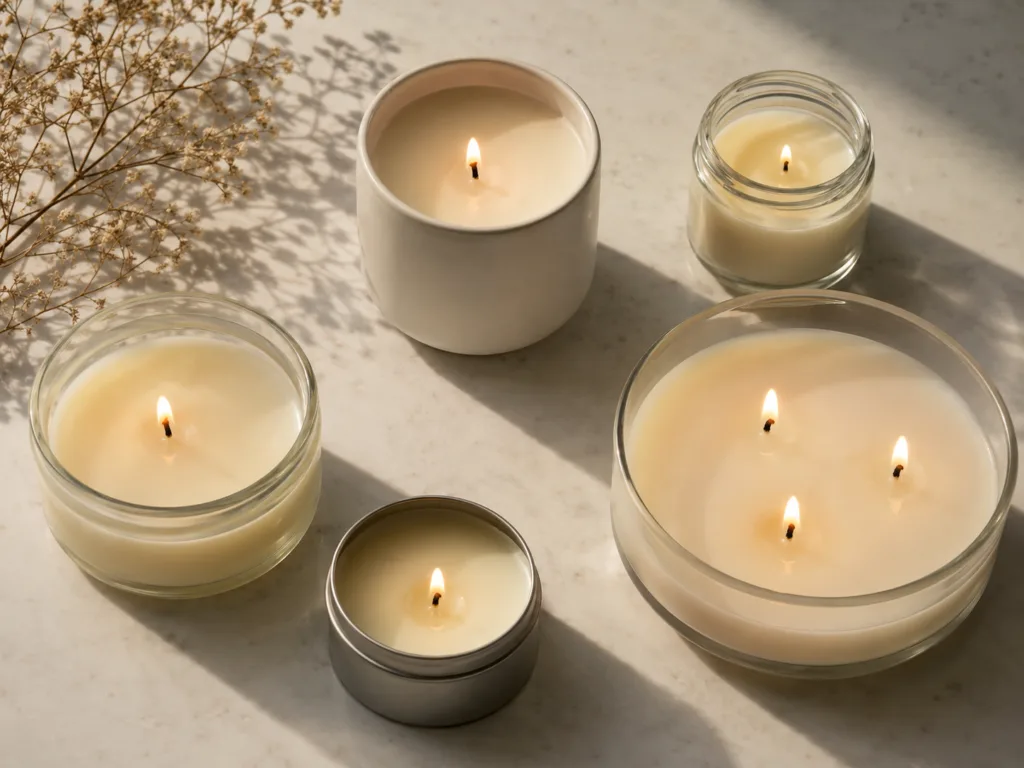
A wax that performs well in one vessel may perform differently in another vessel.
This is a major reason why serious candle brands test wax, fragrance, and wick together with the actual vessel before production.
The vessel affects heat, melt pool, burn rate, and scent release. Diameter matters. Depth matters. Wall thickness matters. Material matters. Shape matters.
A small narrow jar may struggle to create enough scent throw for a large room even with a good wax. A wide jar may require a stronger wick or multiple wicks to create a full melt pool. A thick ceramic vessel may hold heat differently than thin glass. A deep vessel may create different burn behavior near the end of the candle.
Common vessel-related issues include:
- Weak hot throw due to small melt pool
- Tunneling in narrow or poorly wicked jars
- Overheating in vessels with aggressive wicks
- Uneven burn in unusual shapes
- Poor performance when scaling from small sample to larger size
- Different scent results between glass, ceramic, and tin
This is why candle size should be matched to the expected room size and product use.
A 100g candle may be suitable for a bathroom, desk, or small bedroom. A 200g to 250g candle may fit a bedroom or small living area. A larger 300g to 450g candle, especially with a wider diameter or multiple wicks, may be more appropriate for stronger room-filling performance.
If a buyer wants a strong scent throw for a living room, the solution may not only be a stronger wax. It may require a larger wax weight, wider vessel, different wick, stronger fragrance profile, or multi-wick design.
Serious candle brands do not separate wax choice from vessel design.
Fragrance Type Also Affects Scent Throw
Not all fragrance oils project the same way.
Some scent profiles naturally feel stronger, richer, or more room-filling. Others are delicate, transparent, or subtle by design. Even in the same wax system, two fragrances can perform very differently.
Stronger scent profiles often include:
- Vanilla
- Amber
- Sandalwood
- Oud
- Musk
- Cinnamon
- Eucalyptus
- Peppermint
- Coffee
- Caramel
- Gourmand notes
- Warm spices
- Resinous woods
More delicate profiles may include:
- Green tea
- Soft citrus
- Light florals
- Watery notes
- Fresh linen
- White musk
- Herbal notes
- Minimalist spa scents
This does not mean delicate fragrances are bad. It means they need realistic expectations and careful formulation.
A soft linen candle is not supposed to perform like a cinnamon amber candle. A fresh citrus fragrance may have a bright cold throw but may need support to remain strong during burning. A floral fragrance may smell beautiful in the jar but become thin in hot throw if the wax and wick are not suitable.
Some fragrances naturally project better than others, even in the same wax system.
For private label development, this matters because many brands want a full scent collection. A brand may develop five or eight fragrances under one candle line, but each scent may require testing. The same wax and wick may not be ideal for every fragrance.
This is especially important for mature buyers planning large orders. A supplier should not only provide a fragrance list. They should help evaluate how each fragrance performs in the selected wax, vessel, and wick system.
Cure Time Matters, Especially for Plant-Based Waxes
Cure time is the resting period after a candle is poured, before it is evaluated or used.
During this period, the wax and fragrance oil continue to bind and stabilize. For many plant-based waxes, especially soy-based formulas, curing can affect scent throw and burn behavior.
If a candle is tested too soon, the hot throw may seem weaker than it will be after proper curing. The wax surface may also continue to change as it settles. This is one reason sample evaluation should be done carefully.
For serious candle brands, sample testing should follow a controlled process:
- Record the pouring date
- Allow proper curing time
- Test cold throw before burning
- Burn the candle for a realistic period
- Evaluate hot throw in an appropriate room size
- Check melt pool development
- Measure flame behavior
- Observe surface changes after cooling
- Repeat the test if needed
A buyer who smells a candle immediately after pouring may not get an accurate result. A brand that approves a formula without proper curing and burn testing may face surprises during bulk production.
Strong scent throw is not only about what goes into the candle. It is also about when and how the candle is evaluated.
Burn Quality Is Part of Scent Performance
A candle can smell strong and still be a bad candle.
Serious brands care about burn quality because the customer experience is more than fragrance strength. A candle should burn cleanly, safely, evenly, and attractively. It should not create excessive soot, overheat the vessel, tunnel badly, or leave too much wax behind.
Strong scent throw should never be developed at the expense of basic burn performance.
Important burn quality checks include:
- Flame height
- Melt pool diameter
- Melt pool depth
- Burn rate
- Soot level
- Mushrooming on the wick
- Vessel temperature
- Tunneling
- Wax hang-up
- Fragrance stability during burn
- Surface appearance after cooling
- End-of-life behavior
For brand buyers, burn quality affects more than safety. It affects perceived value.
A luxury candle that tunnels badly feels poorly made. A candle with heavy soot may damage the customer’s trust. A candle that burns too quickly may feel expensive for the amount of use it provides. A candle that smells burnt rather than fragrant may receive negative reviews even if the cold throw is excellent.
This is why serious brands do not approve candles only by smelling the sample jar. They approve formulas after controlled burn testing.
Cost Structure: Strong Scent Throw Must Still Make Commercial Sense
A formula can be technically excellent but commercially unrealistic.
Private label buyers must consider cost structure from the beginning. Wax choice affects unit cost, but it is only one part of the full candle cost. A finished retail candle may include:
- Wax
- Fragrance oil
- Wick
- Vessel
- Lid
- Label
- Dust cover
- Inner packaging
- Rigid gift box
- Insert
- Outer carton
- Labor
- Testing
- Freight
- Duties and import costs
If a buyer chooses a high-cost wax, high fragrance load, custom ceramic vessel, rigid gift box, foam insert, and low MOQ, the unit price can rise quickly.
This does not mean premium development is wrong. It means the formula must support the price point.
A luxury brand can often justify higher material costs if the product sells at a strong retail price. A mass-market brand may need to protect margins and choose a more cost-efficient wax system. A boutique brand may choose a balanced coconut-soy formula rather than the cheapest or most expensive option.
Serious candle brands do not chase the most expensive wax. They choose the wax that fits the business model.
The best wax for scent throw is not useful if the final product cannot be priced profitably, produced reliably, or sold into the intended market.
Production Stability: Samples Must Translate Into Bulk Orders
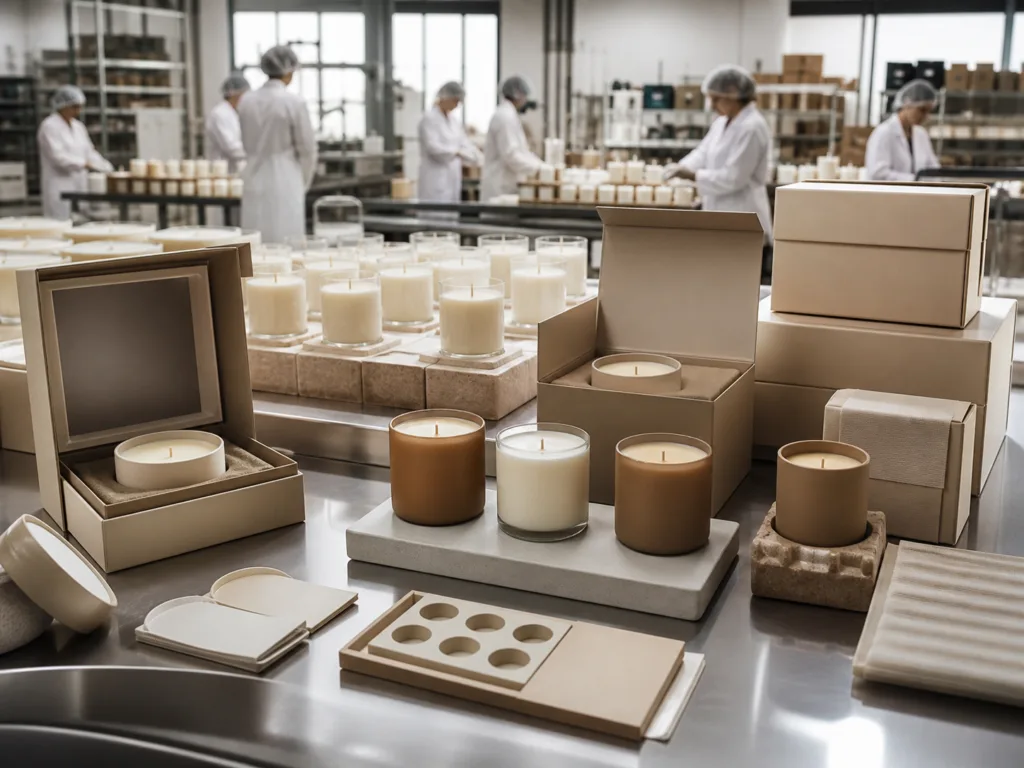
One of the biggest differences between hobby candle making and private label manufacturing is production stability.
A sample can be adjusted by hand. A bulk order must be repeatable.
For large orders, the wax system needs to perform consistently across batches. The supplier must control pouring temperature, fragrance mixing, wick placement, cooling conditions, packaging timing, and quality inspection. A formula that works once in a small sample batch must also work in hundreds or thousands of units.
Production stability includes:
- Consistent scent strength
- Consistent wax surface
- Correct fragrance load
- Accurate wick centering
- Stable vessel adhesion
- Controlled cooling
- Minimal sweating
- Minimal cracking or frosting
- Reliable burn performance
- Packaging compatibility
- Safe transport conditions
This is especially important for buyers selling through retail chains, boutique stores, Amazon, or international distribution. Inconsistent batches can create customer complaints, return risks, and brand damage.
A serious candle brand should ask suppliers about formulation control, sample-to-bulk consistency, and testing procedures before approving a large order.
Strong scent throw is valuable only if it can be reproduced.
Choosing Wax by Brand Positioning
The right wax depends on what kind of candle brand you are building.
For Mass-Market Strong Fragrance Candles
If the priority is strong hot throw and competitive pricing, paraffin wax or a paraffin blend may be the most practical choice.
This direction works well for:
- Seasonal candles
- Promotional candles
- Supermarket or mass retail lines
- Strong fragrance collections
- Price-sensitive programs
- Large-volume private label orders
The brand story may be less natural, but the scent performance and cost structure can be strong.
For Premium Private Label Candles
If the goal is a premium candle with strong scent throw, beautiful surface appearance, and a more elevated ingredient story, a coconut-soy blend is often a strong starting point.
This direction works well for:
- Boutique retailers
- Gift sets
- DTC candle brands
- Luxury home fragrance lines
- Lifestyle brands
- High-end private label projects
The wax supports both product performance and perceived value.
For Natural or Clean-Label Brands
If the brand must emphasize plant-based ingredients, soy wax, rapeseed wax, coconut-soy blends, or other vegetable wax blends may be more suitable.
This direction works well for:
- Wellness brands
- Eco-focused brands
- European retailers
- Natural lifestyle stores
- Clean home brands
The challenge is to manage scent throw expectations through better fragrance and wick testing.
For Minimalist Wellness Candles
If the goal is a soft, natural, lightly scented, or unscented candle, beeswax or soy-beeswax blends may work well.
This direction fits:
- Meditation candles
- Natural wellness products
- Minimalist interiors
- Lightly scented collections
- Premium craft positioning
The focus is less on powerful fragrance projection and more on natural atmosphere.
How Serious Brands Test Wax Before Production
A serious candle brand does not approve a formula only by smelling the jar.
It tests.
A professional candle development process may include:
- Define the target customer and sales channel.
- Choose the vessel size, material, and wax weight.
- Select fragrance profiles based on brand positioning.
- Choose one or more wax systems for testing.
- Test fragrance load ranges.
- Match wick options to the wax, fragrance, and vessel.
- Allow proper curing time.
- Evaluate cold throw.
- Burn test for hot throw.
- Check melt pool, flame height, soot, and vessel temperature.
- Adjust wick or formula if needed.
- Confirm packaging compatibility.
- Prepare compliance documents where required.
- Approve the final sample before bulk production.
This process may seem slower than simply choosing a wax and placing an order. But it reduces risk.
For mature buyers, testing is not a delay. It is part of product development.
A candle that performs well in testing is more likely to satisfy customers, protect reviews, reduce complaints, and support repeat orders.
Compliance and Documentation Matter for Serious Buyers
For mature candle buyers, especially those selling into North America, Europe, the UK, or Australia, documentation matters.
A private label candle project may require documents such as SDS for the finished scented candle, IFRA-related fragrance documentation, warning labels, and safety testing references depending on the market and buyer requirements. Candle safety standards and labeling expectations should be discussed early, especially for retail buyers and importers.
This is another reason wax and fragrance decisions should not be made casually.
A high fragrance load may sound attractive, but the fragrance oil must be used within appropriate safety limits. A candle may smell strong, but it still needs safe burn behavior. A beautiful botanical decoration may look attractive, but decorative materials can create safety concerns if not designed properly.
Serious brands want a candle that is not only fragrant, but also commercially responsible.
That means the development process should consider:
- Fragrance usage limits
- SDS documentation
- IFRA-related fragrance information
- Warning label content
- Candle fire safety expectations
- Burn testing
- Packaging and transport stability
- Market-specific buyer requirements
For private label manufacturing, documentation is not an afterthought. It is part of building a retail-ready product.
Our Practical Recommendation for Private Label Candle Buyers
For private label buyers, we usually do not recommend choosing wax by material name alone.
The better approach is to start with the brand goal.
If your brand wants maximum scent power, a paraffin blend may be worth testing. If your brand wants a premium natural image, a coconut-soy blend is often a better starting point. If your brand requires clean-label positioning, soy wax or plant-based blends can work, but they need stronger testing around fragrance oil, wick, and curing. If your brand wants a soft wellness candle, beeswax or soy-beeswax blends may be suitable.
The best wax is the one that supports your scent profile, vessel, price point, brand story, and customer experience.
At Circe Home, we help candle brands test wax, fragrance, wick, vessel, and packaging together before mass production. Our role is not only to manufacture candles, but to help brands build a candle formula that fits their market, price point, and real customer use.
Our private label candle development support can include:
- Wax blend recommendation
- Fragrance library selection
- Custom scent development
- Scent matching
- Fragrance oil adjustment
- Wick testing
- Burn testing
- Vessel sourcing
- Glass, ceramic, and tin candle options
- Label and packaging development
- Rigid gift box design
- Compliance document support
- Bulk production management
- DDP shipping support for international buyers
This matters because a candle is not a single material. It is a system.
Wax, fragrance, wick, vessel, and packaging must work together. When they do, the candle smells better, burns better, looks better, and sells better.
Final Takeaway: The Best Wax Is a Business Decision
So, how do serious candle brands choose wax for strong scent throw?
They do not choose by trend alone.
They do not assume that more fragrance oil automatically means better scent throw.
They do not approve a candle only because it smells strong in the jar.
They do not treat wax, wick, fragrance, and vessel as separate decisions.
Instead, they choose wax based on scent performance, brand positioning, burn quality, cost structure, and production stability.
If the goal is the strongest hot throw, paraffin is often the strongest performer. If the goal is premium scent performance with a more natural brand image, coconut-soy blends are often one of the best commercial choices. If the goal is clean-label positioning, soy wax can work well with careful formulation. If the goal is natural wellness rather than powerful room-filling fragrance, beeswax may be a beautiful option.
But the real answer is this:
Strong scent throw is not a wax-only decision. It is a formulation decision.
For serious candle brands, the best wax is not simply the wax that smells strongest in theory. It is the wax system that performs consistently in real customer use, supports the brand story, fits the target price, passes internal testing, and can be produced reliably at scale.
That is how professional candle products are built.
FAQ
1. What is the best wax for strong scent throw?
Paraffin wax usually gives the strongest hot throw, but it may not fit every brand’s positioning. For premium private label candles, coconut-soy blends often provide a better balance of scent performance, surface finish, and brand story. Soy wax can also work well, but it needs proper fragrance, wick, and burn testing.
2. Does adding more fragrance oil make a candle smell stronger?
Not always. A higher fragrance load can cause sweating, wick clogging, unstable flame, soot, poor burn quality, or fragrance distortion if the wax and wick are not properly matched. A well-formulated candle with a moderate fragrance load can perform better than a poorly balanced candle with too much fragrance oil.
3. Is soy wax good for strong scent throw?
Soy wax can deliver good scent throw, especially with the right fragrance oil, wick, vessel, and curing time. However, pure soy wax may not always produce the strongest hot throw compared with paraffin or well-developed wax blends. For brands that want natural positioning and stronger performance, soy-based blends are often worth testing.