
Hotel Candles: Procurement Guide
For hotel buyers, candles are rarely just candles.
A candle placed in a lobby, spa suite, guest room, retail corner, or presidential suite is part of a bigger operating system: brand image, guest experience, fire safety, housekeeping workflow, replenishment planning, and margin control. The same is true for reed diffusers and other non-flame fragrance formats. If the fragrance is too weak, it gets ignored. If it is too strong, guests complain. If the label is wrong, the shipment gets delayed. If the packaging is overbuilt, landed cost rises. If the supplier cannot maintain consistency, the second order becomes a problem even if the first one looked good.
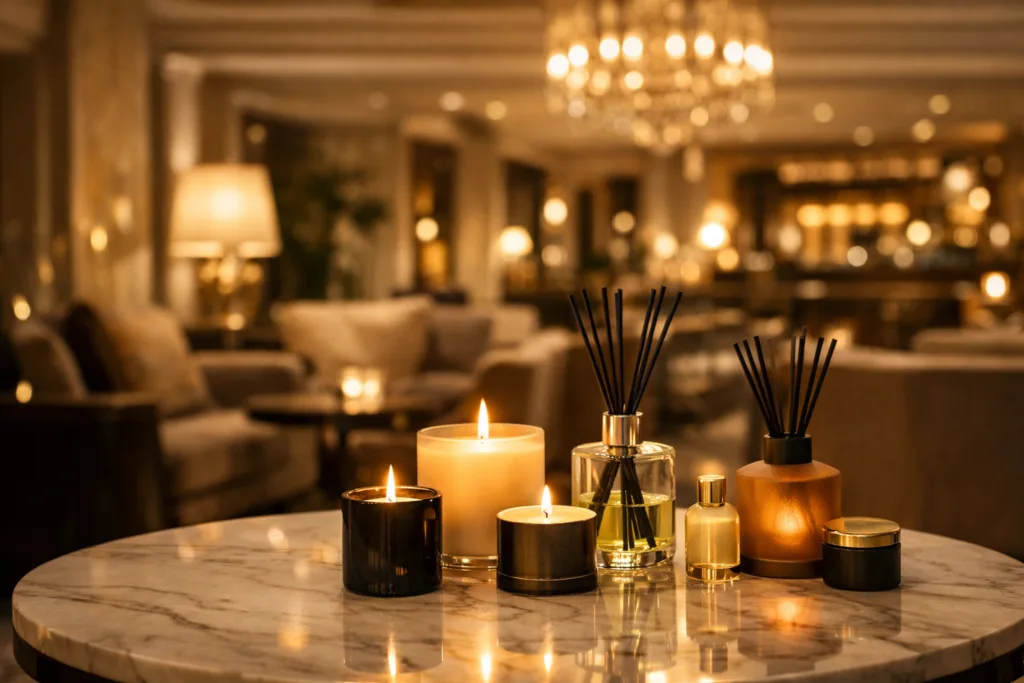
That is why serious hospitality sourcing should never start with a simple question like “How much is your candle?” It should start with a more useful question: What fragrance format, design level, compliance path, and supply model actually fit this hotel project?
This guide is written from a B2B procurement perspective for hotel chains, boutique hotels, design hotels, serviced apartments, resort groups, spa operators, and premium vacation rental brands. It also applies to high-end guesthouses and branded homestays that want to use fragrance more strategically. The goal is not to impress you with lifestyle language. The goal is to help you source hotel candles and reed diffusers with fewer surprises, better consistency, and a better fit between guest experience and operating reality.
We have spent years working across home fragrance supply chains, including scented candles and flame-free fragrance formats such as reed diffusers, and one thing is clear: the best hotel projects are not built around the most complicated design. They are built around the most disciplined procurement decisions.
Why Hotels Buy Candles in the First Place
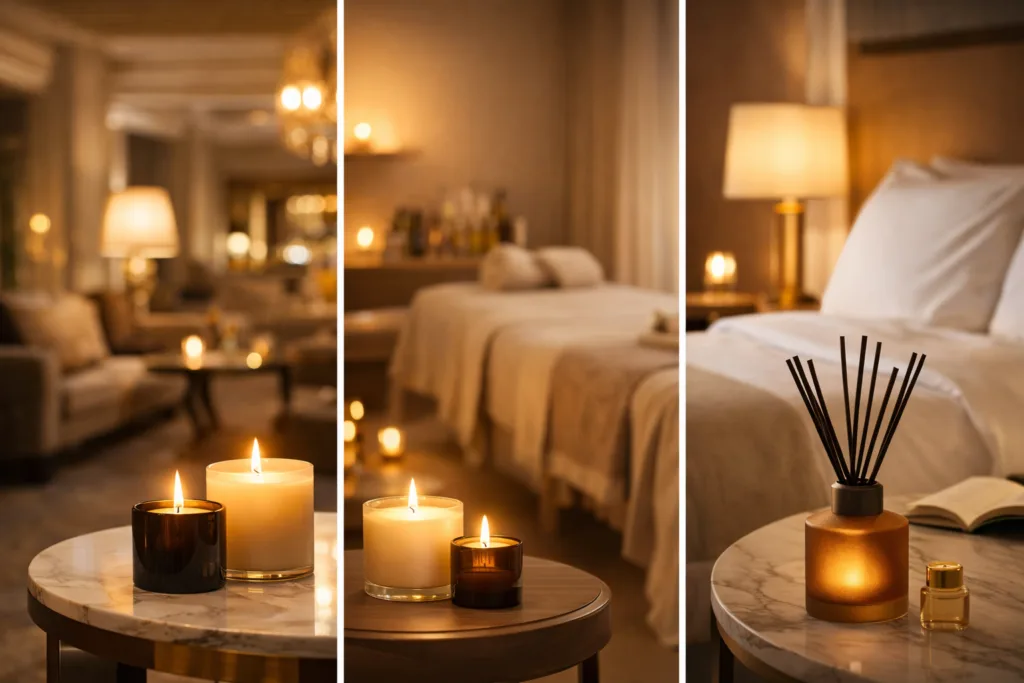
Hotels do not purchase candles for the same reason as a small lifestyle boutique or an online gift brand.
A retailer may buy candles to fill shelf space and create seasonal merchandising. A hotel buyer, by contrast, usually buys them for one or more of these five business reasons:
1. Brand atmosphere
A hotel may want a recognizable scent language that supports its positioning. A city business hotel, a wellness retreat, and a coastal boutique resort should not all smell the same. Fragrance helps turn “design concept” into something guests can actually feel.
2. Guest experience
Candles and diffusers are often used to shape emotional tone in spaces where guests slow down: spas, suites, lounges, reception desks, bathrooms, and premium amenities corners. In luxury hospitality, details that look small on a unit level often have outsized effect on perceived quality.
3. Retail and ancillary revenue
Many hotel groups now treat branded fragrance as a merchandise category. A guest who likes the lobby atmosphere may be willing to buy a candle or diffuser before checkout. In that case, procurement is not only about operations. It is also about retail margin, packaging appeal, and shelf durability.
4. Standardization across properties
Chain hotels often need the same product quality across multiple sites, sometimes in different countries. This adds another layer to sourcing: documentation, repeatability, carton planning, and stable lead time matter as much as fragrance quality.
5. Seasonal or campaign use
Some hotels do not run candles year-round in all spaces. They may use them for Christmas gifting, wedding packages, spa promotions, loyalty programs, room upgrades, media kits, or VIP onboarding. That changes the MOQ and packaging strategy.
The procurement implication is simple: before asking for price, define the use case. A spa candle, a retail candle, a guest-room welcome candle, and a lobby fragrance gift set should not be sourced as if they were the same item.
First Decision: Candle, Reed Diffuser, or a Mixed Hospitality Fragrance Program?
Many hotel buyers begin by assuming they need candles. In practice, some projects are better served by reed diffusers, or by a mixed system where each format is assigned to the right zone.
When candles make sense
Candles are usually better when the goal is:
- visual warmth and atmosphere
- premium gifting
- in-room upgrades for suites or special packages
- spa ritual programs
- retail merchandise
- branded seasonal collections
Candles create emotional value because flame changes the mood of a space in a way diffusers cannot. They also photograph well, which matters for social content, room styling, and gift presentation.
When reed diffusers make more sense
Reed diffusers are often the better choice when the goal is:
- continuous fragrance without open flame
- lower housekeeping intervention
- fragrance use in guest rooms, corridors, smaller lounges, or front desk areas
- safer operation where candle-burning policies are restricted
- wider deployment across multiple rooms or properties
For many hotel projects, reed diffusers are operationally easier to scale. They remove the flame issue, extend fragrance life, and can be replenished more predictably.
When a mixed program is best
The strongest hotel fragrance programs often combine both:
- Lobby or suite styling: candles
- Guest rooms and corridors: reed diffusers
- Spa retail shelf: both candles and diffusers
- VIP gifting: candle + diffuser set
From a supply-chain perspective, this is where an experienced fragrance supplier adds value. Hotels do not always need one hero SKU. Sometimes they need a fragrance family deployed in multiple formats with consistent branding and adjusted strength.
What Hotel Buyers Actually Care About
Procurement teams and hotel operators usually care about five issues more than any supplier brochure admits.
1. Safety and compliance
For hospitality buyers, fragrance cannot be treated as a purely aesthetic purchase. Candles involve flame, heat, glass behavior, warning text, and usage instructions. Reed diffusers involve fragrance concentration, labeling, transport classification, and storage conditions. Depending on your market, you may also need supporting documents such as SDS, IFRA-related fragrance documentation, ingredient or allergen-related declarations, and market-specific label support.
A capable supplier should be able to discuss these topics clearly, not vaguely.
2. Batch consistency
The first sample often looks beautiful. The real test is whether the second and third production runs still smell, burn, and present the same. Hotel chains in particular need repeatability. Small variation can damage brand consistency across properties.
3. Lead time reliability
Luxury hospitality launches are often tied to opening dates, holiday campaigns, procurement calendars, or designer timelines. A supplier that gives a low price but misses the delivery window is not actually low cost.
4. Packaging that survives operations
Hotels do not only receive products. They store them, move them, sometimes distribute them across properties, and in retail scenarios place them in public-facing environments. Packaging must survive warehousing, internal handling, and shipping without becoming wastefully expensive.
5. MOQ logic that fits rollout reality
A hotel group may need 300 pieces for pilot use, 1,000 pieces for a single-property retail launch, or 5,000-plus pieces for multi-property rollout. The right supplier should know which parts of the product drive MOQ upward: vessel type, decoration method, box style, insert, fragrance complexity, and custom accessories.
The 7-Step Procurement Framework for Hotel Candles
Below is a practical procurement framework that works for both hotel candles and reed diffuser programs.
Step 1: Define the deployment scenario
Before requesting quotes, decide:
- Which properties will use the product?
- Is it for operational use, gifting, retail, or all three?
- Which spaces will it go into?
- Is flame allowed in those spaces?
- Will the product be used continuously or seasonally?
This step sounds basic, but it prevents expensive misalignment. A product made for spa retail should not automatically be copied into guest rooms. A guest-room diffuser should not be designed as if it were a gift-box hero SKU.
Step 2: Clarify your fragrance strategy
Hotel buyers should brief fragrance in operational terms, not abstract language alone.
Instead of only saying “we want something luxurious,” define:
- target mood: calming, clean, warm, woody, coastal, urban, botanical
- strength level: light, moderate, or statement scent
- seasonality: all-year vs festive
- gender positioning: neutral, feminine-leaning, masculine-leaning
- market: North America, Europe, Middle East, etc.
- sensitivity concerns: lower-throw guest-room fragrance may be safer for broader acceptance
For candles, scent throw must be balanced with burn quality. For reed diffusers, fragrance performance must be balanced with format restrictions and room size. Not every fragrance formula performs equally well across all applications.
Step 3: Choose the right vessel and format
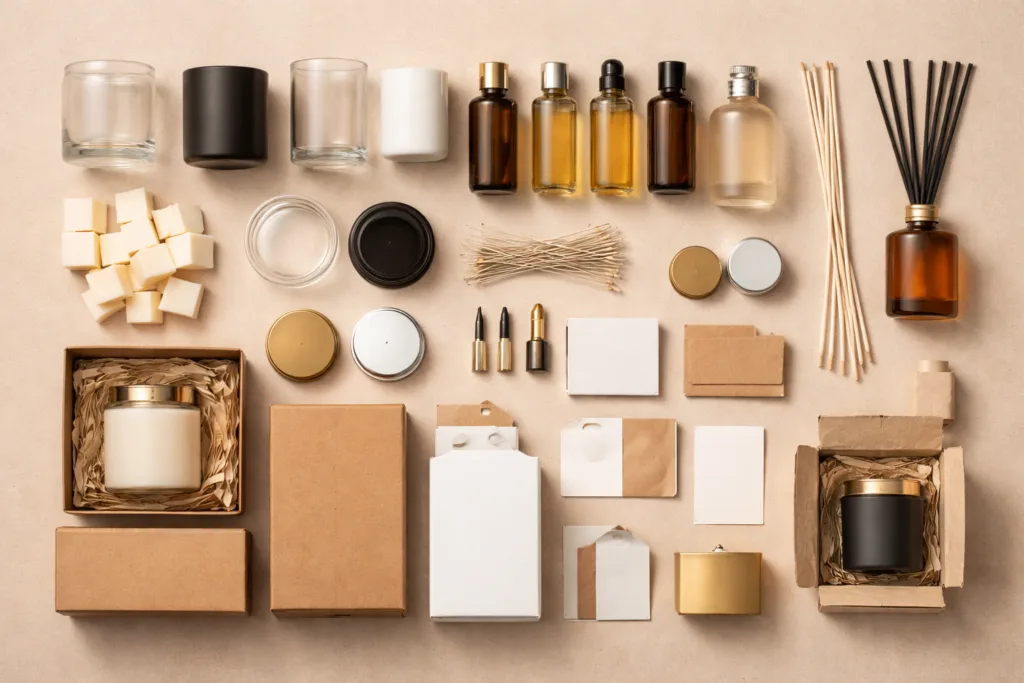
This is one of the biggest cost and MOQ drivers.
Standard glass
Best for hotel buyers who want:
- lower development risk
- more controlled MOQ
- easier replacement and repeat orders
- broad compatibility with labeling and outer packaging
Ceramic or custom vessels
Better for design-led hotels and signature retail programs, but usually with:
- higher MOQ
- longer development time
- more quality control variables
- more breakage and packaging complexity
Reed diffuser bottles
Bottle shape, neck design, cap style, and reed material all affect both cost and presentation. For hotels, simple elegant bottles often outperform overdesigned ones because they are easier to standardize and replenish.
Procurement rule: customize where the guest notices it most, and standardize where the cost burden is highest.
Step 4: Decide how much customization you truly need
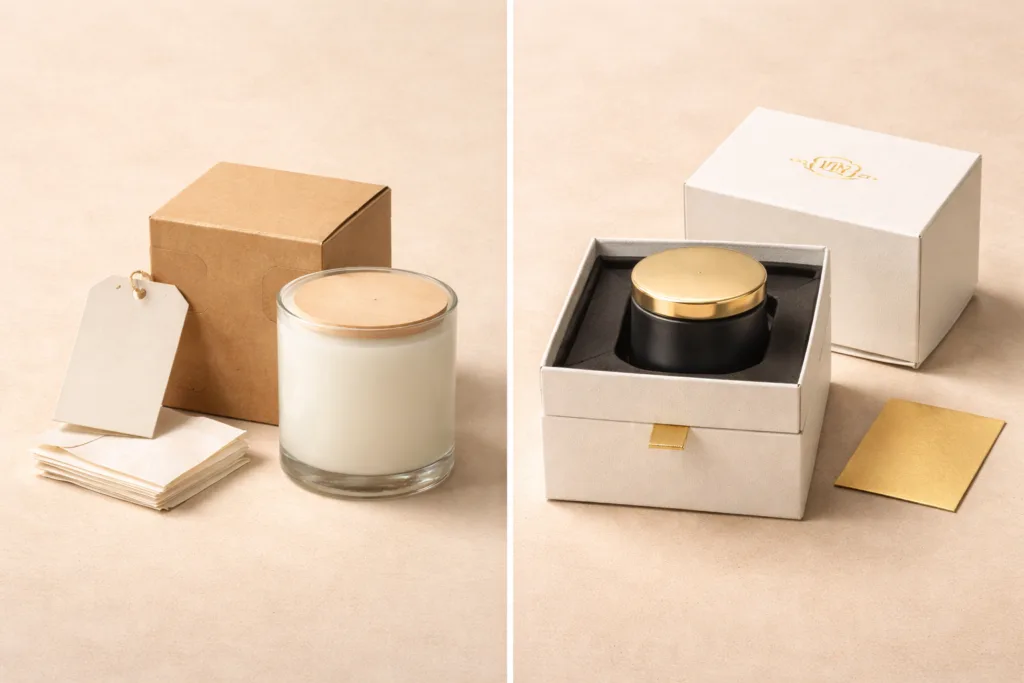
This is where many hotel projects become needlessly expensive.
There are roughly four customization levels:
Level 1: Fastest and most efficient
- standard vessel
- stock box or plain folding carton
- custom label or sticker
- existing fragrance or lightly adjusted fragrance
Good for pilot runs, seasonal projects, and lower-risk retail tests.
Level 2: Controlled brand upgrade
- standard vessel
- screen print, decal, or foil label details
- printed folding carton
- custom fragrance selection
Good for most boutique hotel and smaller chain programs.
Level 3: Premium branded program
- upgraded vessel finish
- printed or foiled rigid gift box
- insert tray
- stronger visual branding system
- fragrance developed closer to signature positioning
Good for luxury hotels, suites, VIP gifting, and retail shelves.
Level 4: Full bespoke development
- custom mold or vessel development
- fully custom packaging structure
- tailored inserts and accessories
- extended testing and approvals
Best reserved for major hotel groups, flagship projects, or brands with enough volume to absorb tooling and development cost.
The mistake many buyers make is jumping to Level 4 when Level 2 or 3 would already achieve the guest experience target.
Step 5: Ask for the right documentation early
Buyers often wait too long to ask for paperwork, then discover that product claims and market requirements do not align.
Depending on product type and destination market, useful documentation may include:
- SDS for relevant fragrance products or materials
- IFRA-related fragrance compliance support
- label guidance for warnings and usage instructions
- product specs
- packaging specs
- burn test or performance-related information where applicable
- transport carton details
- barcode or retail packaging support if you plan to sell on-site
A professional supplier should explain what is available, what is market-specific, and what will be finalized only after fragrance and formula are confirmed.
Step 6: Evaluate sample quality the way a hotel operator would
Do not approve a sample based only on looks.
Evaluate it through the full operating lens:
- Does the fragrance fit the space it is intended for?
- Is the scent level appropriate, or likely to cause fatigue?
- Does the candle burn evenly?
- Does the glass become too hot for your use case?
- Is the warning text acceptable for your market?
- Is the box practical for storage and display?
- Can housekeeping handle the product easily?
- If it is a diffuser, does evaporation rate feel too fast or too slow?
It is wise to let multiple teams review samples: purchasing, operations, housekeeping, spa or retail managers, and sometimes brand or design teams.
Step 7: Build the order around repeatability, not just launch aesthetics
For first production, buyers should confirm:
- approved fragrance code or reference
- approved vessel and finish
- label artwork sign-off
- packaging structure and print files
- master carton packing details
- production lead time
- shipping method and incoterm
- replenishment plan
A good launch order should make the second order easier, not harder.
How Cost Works in Hotel Candle Procurement
Many hotel buyers ask for “best price,” but hotel fragrance cost is rarely decided by wax alone.
The biggest cost drivers usually are:
1. Vessel
Glass is usually more cost-efficient than custom ceramic. Heavier vessels increase freight and breakage risk.
2. Fragrance load and formula
Fragrance is not just a perfume choice. It changes product performance and cost. In diffusers, allowable usage can also affect feasibility. In candles, stronger is not always better if burn performance suffers.
3. Decoration method
Sticker, screen print, hot stamping, engraving, coating, decal, and electroplating all change cost, lead time, and MOQ.
4. Packaging
For hotel projects, packaging is often one of the most underestimated budget items. A plain folding carton and a rigid gift box with insert can create very different landed costs.
5. Quantity and SKU complexity
One fragrance in one box style is easier to price efficiently than six fragrances across multiple box designs and vessel colors.
6. Freight

Hospitality buyers should always think in landed terms. A product that is slightly cheaper ex-works can become more expensive once breakage, carton inefficiency, and shipping mode are factored in.
That is why experienced buyers ask not only for unit price, but also for a clear breakdown of:
- product cost
- packaging level
- MOQ per design or fragrance
- production lead time
- estimated shipping mode options
Common Mistakes Hotel Buyers Should Avoid
Overbuilding the packaging
A luxury result does not always require the heaviest or most complex box. In many hotel projects, a refined printed carton with good paper, disciplined color work, and clean logo treatment performs better commercially than an oversized rigid box.
Using one scent profile everywhere
A grand lobby signature can feel too heavy in guest rooms. Space matters.
Approving samples too quickly
A sample that looks good in a meeting room may not perform well after burn testing, housekeeping handling, or on-property review.
Ignoring replenishment from the start
If the first batch works and the second batch becomes difficult due to material changes or vague approvals, the project loses momentum.
Choosing a supplier based only on low quote
Hospitality sourcing is a reliability game. Documentation, response quality, repeatability, and problem-solving capacity matter more than headline price.
Supplier Checklist for Hotel Chains and Boutique Hotels
When comparing hotel candle or reed diffuser suppliers, buyers should ask:
- Can you support both candles and non-flame fragrance formats?
- Can you explain the MOQ impact of vessel, printing, and packaging choices?
- Can you provide documentation support for relevant markets?
- Can you maintain fragrance consistency across repeat orders?
- Have you handled premium B2B fragrance programs before?
- Can you adapt the same fragrance concept into multiple formats?
- Can you advise on packaging based on both presentation and shipping logic?
- Can you support hotel-scale replenishment and not just sampling?
A supplier who only talks about fragrance notes but not master cartons, warning labels, or reorder stability is not thinking like a hospitality partner.
Procurement Advice by Hotel Type
Hotel chains
Chain buyers need repeatability, documentation discipline, and scale logic. Standardized vessel platforms and controlled fragrance libraries often work better than over-customized development.
Boutique hotels
Boutique projects usually have more room for design expression. Here, the best value often comes from choosing one or two high-impact custom elements rather than fully custom everything.
Resorts and spas
These buyers often care deeply about atmosphere and ritual. A mixed program of candles for treatment rooms or retail, plus reed diffusers for guest-facing circulation spaces, can be very effective.
Premium homestays and design-led guesthouses
These projects often want upscale fragrance impact without chain-level volume. Smart sourcing means prioritizing brand fit while keeping MOQ realistic.
Why Hotels Should Consider One Supplier for Candles and Reed Diffusers
Hospitality fragrance works better when sourced as a system instead of separate disconnected items.
If your candle supplier and diffuser supplier are completely different, you may face:
- mismatched scent character
- inconsistent packaging style
- duplicated development effort
- fragmented documentation
- slower replenishment
Working with a fragrance supply partner that can support both scented candles and reed diffusers creates better alignment across branding, scent direction, packaging, and ordering.
That matters even more if you plan to expand into:
- branded retail gift sets
- seasonal hotel campaigns
- VIP suite amenities
- spa collections
- opening gifts for developers or investors
Final Thoughts: Buy for Operations, Brand, and Repeat Orders
The best hotel candle programs are not the ones with the most dramatic packaging or the most complicated fragrance story. They are the ones that still work six months later, when the hotel needs replenishment, the operations team needs consistency, and the brand team expects the product to still feel premium.
If you are sourcing for a hotel chain, a boutique property, a spa, or a design-led hospitality project, treat fragrance procurement as both a branding decision and an operations decision. Start by defining use case. Match product format to space. Control customization carefully. Ask for documentation early. Test samples like an operator, not just a designer. And choose a supplier that understands not only candles, but the broader fragrance supply chain behind them.
A good hotel fragrance partner should be able to guide you from concept to bulk production, across both candles and flame-free formats, with practical advice on compliance, packaging, MOQ, lead time, and scaling.
Because in hospitality, a beautiful sample is easy. A reliable long-term program is the real standard.
FAQs
1. What is the best fragrance format for hotels: candles or reed diffusers?
It depends on the space and operating policy. Candles are better for atmosphere, gifting, and premium presentation. Reed diffusers are often better for continuous fragrance in guest rooms or public areas where open flame is restricted. Many hotels use both.
2. What usually drives MOQ higher in hotel candle projects?
The main factors are custom vessels, complex decoration methods, rigid gift boxes, inserts, and multi-SKU development. Standard glass with controlled packaging usually keeps MOQ more manageable.
3. What documents should hotel buyers ask for when sourcing candles or diffusers?
Requirements vary by market and product type, but buyers commonly ask for SDS, fragrance-related compliance support, labeling guidance, product specifications, and packaging details early in the sourcing process.