
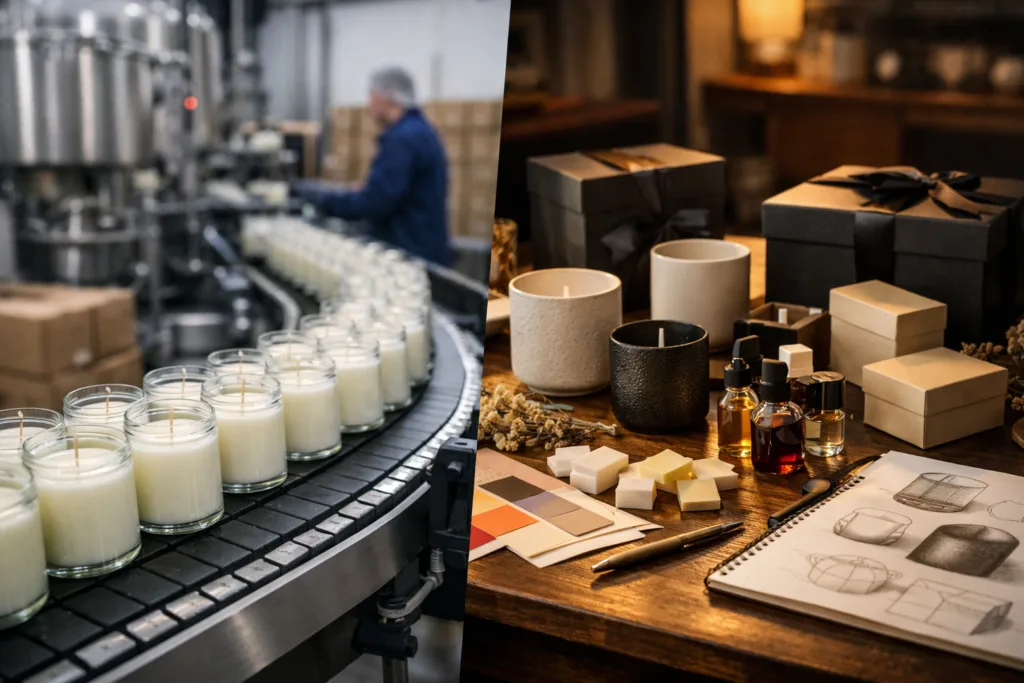
 There is a romantic version of the candle business, and then there is the real one.
The romantic version starts with a founder choosing beautiful jars, blending a few fragrances, posting moody lifestyle photos, and watching orders roll in. The real version starts with margin pressure, packaging lead times, compliance questions, freight decisions, inconsistent batch quality, and the much less glamorous question that determines whether the business survives year two:
Should you launch through private label candles, or should you invest in building a fully developed brand from the ground up?
That question matters far more than most founders realize.
In the candle industry, the difference between a business that scales and a business that stalls is rarely about fragrance alone. It is usually about structure. How you enter the market determines your cash exposure, your product development speed, your ability to test demand, your control over quality, your packaging flexibility, and your long-term brand equity.
For first-time founders, private label often looks like the “easy” route, while building your own brand looks like the “serious” route. That framing is too simplistic. In reality, these are not moral choices or status choices. They are strategic models. Each model has its own economics, risk profile, operational burden, and expansion logic.
More importantly, this decision is no longer relevant only to beginners.
Today, many of the most promising candle inquiries do not come from people starting from zero. They come from buyers who already have an audience, already run a retail business, already operate a beauty, spa, hotel, gift, or lifestyle brand, and want to extend that brand into fragrance. For them, the real question is not “Can I start a candle line?” It is:
- Should I use private label candles to launch faster?
- Should I build a deeper custom collection from scratch?
- Which products should stay standardized, and which deserve full development?
- How do I expand without overbuilding inventory or destroying margin?
This is where strategy separates amateurs from operators.
In this guide, we will break down the real difference between private label candles and building your own candle brand, explain when each model makes sense, show how startup founders and established retailers should think differently, and map out the smartest route from market entry to serious product-line expansion.
If your goal is not simply to sell a few candles, but to build a scalable and commercially sound candle business, this comparison matters.
What Private Label Candles Actually Mean
 The term gets used loosely, which creates confusion.
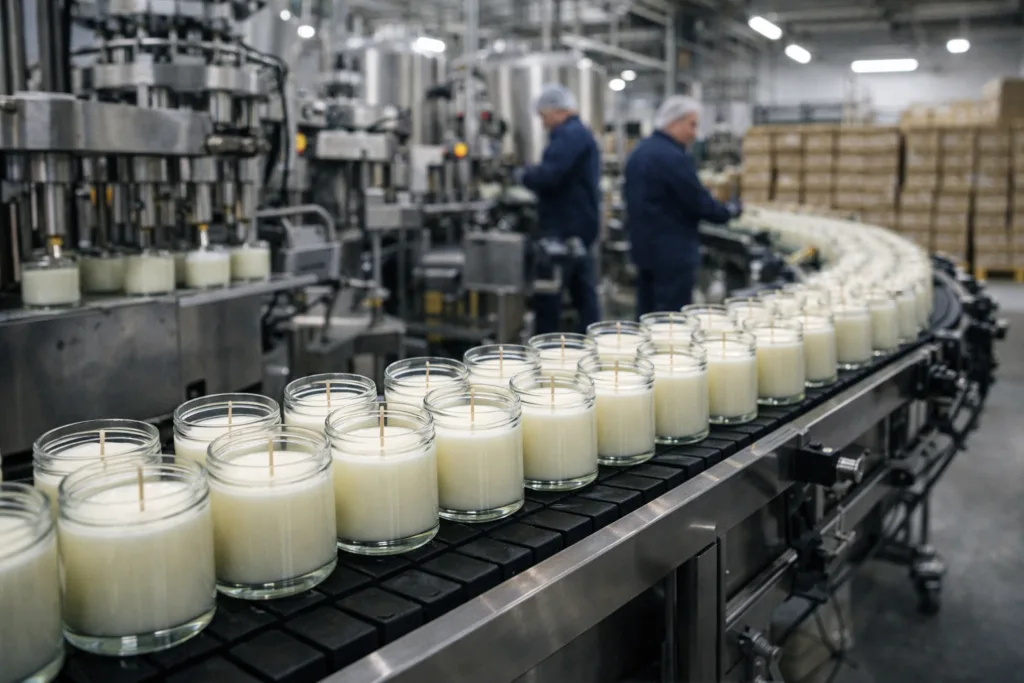
In practical B2B terms, private label candles are candles manufactured by an experienced supplier and sold under your brand name. The product may be based on existing molds, standard vessel sizes, proven wax systems, and already-tested production processes, while still allowing room for branding and selected customization.
That customization may include:
- your logo label
- your carton or gift box design
- your fragrance selection from an existing scent library
- your preferred jar color from standard options
- your lid finish
- your wick preference within tested combinations
- your outer packaging language and market-specific labeling
In other words, private label is not the same as buying a generic unbranded product and simply sticking a logo on it. At the better end of the market, it is a structured manufacturing model that allows buyers to move faster by building on an existing production base instead of reinventing every component.
For candle buyers, that distinction matters.
A serious private label program should give you access to manufacturing efficiency, not just decoration. It should help you reduce development mistakes by using combinations that are already workable: vessel dimensions that suit the fill weight, wick systems that match the wax blend, packaging formats that can be packed at scale, and fragrance formats that can be reproduced consistently.
That is why private label candles are often the strongest entry path for:
- boutique retailers
- ecommerce founders
- gift companies
- hospitality brands
- subscription box businesses
- wellness studios
- home decor brands
- established importers adding fragrance to an existing catalog
The benefit is not only lower effort. It is better commercial discipline.
Instead of spending months on components that have not yet proved their value, a buyer can focus on the questions that actually determine early success: target customer, price point, fragrance direction, packaging style, channel strategy, reorder logic, and launch timing.
What Building Your Own Candle Brand Really Involves
 Now let us define the other side properly.
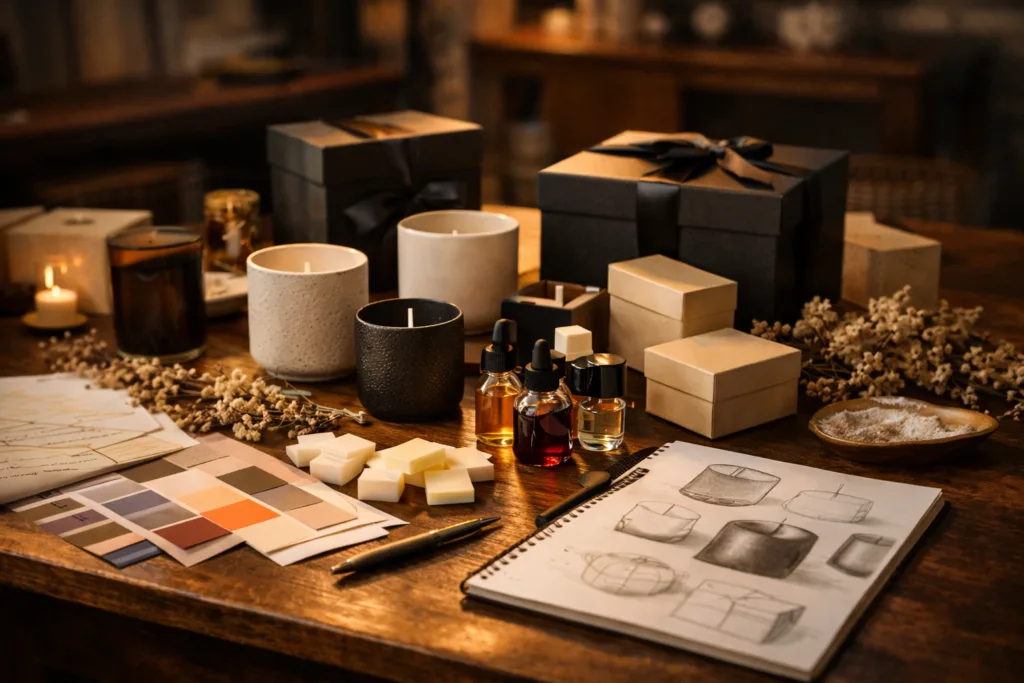
When people say they want to “build their own brand,” they usually mean more than having their own logo. They mean they want to create a differentiated product system with stronger control over aesthetics, product architecture, story, and market position.
That can involve any or all of the following:
- custom vessel development
- proprietary fragrance direction
- custom wax performance targets
- exclusive packaging structures
- signature color palette
- branded unboxing experience
- custom accessories or gift set components
- a clearly defined price ladder
- a retailer-ready assortment strategy
- a long-term brand identity that extends beyond one SKU
This is not simply a production question. It is a business design question.
Building your own candle brand means making deliberate choices about who you serve, what emotional position your product occupies, where it sits in the market, how it will scale, and what kind of margin structure can support that scale. The strongest brands do not begin with scent names. They begin with architecture.
For example, a founder building a luxury candle brand may need to decide:
- Are we targeting gifting, self-purchase, or hospitality?
- Are we premium modern, apothecary-inspired, minimalist, playful, or seasonal?
- Will our hero product be a single-wick tumbler, a ceramic statement vessel, wax melts, or a gift set?
- Are we optimizing for wholesale, DTC, or both?
- Do we need refillable formats?
- Are we building a collection, or are we launching one flagship line first?
Those decisions affect everything downstream, including MOQ, tooling cost, sample timelines, packaging structure, carton efficiency, and shipping cost.
The advantage of building your own brand is obvious: when done well, it creates differentiation, stronger perceived value, better storytelling, and more defensible pricing. The drawback is equally obvious: it takes more money, more time, more iteration, and much better decision-making.
Many founders say they want a unique brand, but what they actually build is an expensive custom version of a product that has not yet earned the right to be so complicated.
That is where businesses get into trouble.
Private Label Candles vs Building Your Own Brand: The Strategic Difference
The easiest way to understand the difference is this:
Private label candles optimize for speed, testing, and operational efficiency. Building your own brand optimizes for differentiation, long-term asset value, and deeper control.
Both can be profitable. Both can be smart. Both can be done badly.
Here is the real comparison buyers should make.
1. Speed to Market
Private label wins decisively when speed matters.
If you are selecting from standard jars, existing wax systems, tested scent libraries, and established packaging formats, your path to sampling and production becomes much shorter. There is less technical uncertainty, fewer approvals, fewer compatibility risks, and fewer expensive dead ends.
That matters for buyers who need to launch around:
- holiday gifting season
- retail calendar resets
- hotel opening dates
- seasonal collections
- corporate gifting windows
- subscription box schedules
Building a fully custom brand is slower because every custom choice adds a layer of coordination. New vessels may require molds or sourcing rounds. New packaging may need structural testing. New fragrance systems may require repeated wax-and-wick validation. Custom decoration can introduce color variation, print issues, or damage risk in transit.
When buyers underestimate timeline complexity, they almost always miss launch windows.
A fast launch is not “less serious.” Often, it is more commercially intelligent.
2. Capital Requirement
Private label candles usually require less capital at the start because you are building on existing manufacturing infrastructure rather than funding every layer of development.
That does not mean private label is cheap. Serious candle programs still require sampling, packaging, freight planning, inventory commitment, and working capital. But the financial burden is usually more controlled because you avoid some of the heaviest custom-development costs.
Building your own brand can quickly increase cost exposure through:
- mold fees for custom vessels
- repeated sampling rounds
- custom gift box tooling or print plates
- more expensive component sourcing
- smaller runs across too many SKUs
- design revisions that delay mass production
- higher defect risk during first production
The key issue is not whether you can afford development. It is whether your projected sales justify it.
Too many founders build as though they already have stable demand. Mature buyers do the opposite. They structure development in proportion to proven sales potential.
3. Risk of Wrong Product Decisions
This is one of the most overlooked differences.
When you build from scratch, every wrong decision becomes more expensive.
You can choose a beautiful jar that fills inefficiently, a fragrance that smells great cold but performs weakly when burned, a label material that wrinkles, a carton that damages easily, or a premium insert that looks impressive but adds unnecessary labor and shipping volume.
Private label candles reduce these decision risks because the manufacturer has already solved many of the production variables. The combinations may not be infinitely flexible, but they tend to be more stable.
That stability matters, especially for brands that do not yet have enough order history to know what their customers actually repurchase.
A candle business does not fail only because it lacks creativity. It often fails because it commits too much money to an unverified product logic.
4. Differentiation and Brand Equity
This is where building your own brand becomes powerful.
A private label line can look polished and sell well, but there are natural limits to how differentiated it can become if too many brands are choosing from the same pool of jars, lids, and stock packaging structures.
If your long-term strategy depends on premium positioning, high visual recognition, stronger IP value, category leadership, or retail memorability, then deeper customization eventually becomes necessary.
This does not always mean extreme customization. Sometimes strong brand equity comes from disciplined curation rather than novelty for its own sake. But in general, the more mature and ambitious the brand, the more important it becomes to control:
- signature look and feel
- packaging hierarchy
- fragrance storytelling
- price architecture
- product assortment logic
- shelf presence
A true brand is not just a logo on a vessel. It is a repeatable sensory system.
5. Operational Complexity
Private label is usually easier to operate.
Fewer custom parts mean fewer suppliers, fewer QC variables, fewer production steps, and fewer things to go wrong. That operational simplicity is valuable, especially when a buyer is managing multiple product categories or a lean team.
Building your own brand increases complexity fast. The more customized your line becomes, the more you need disciplined forecasting, technical communication, approval management, packaging control, and post-production QC.
That is why mature businesses often do something clever: they do not customize everything. They customize selectively.
They identify which parts of the line create real market value and which parts can remain standardized without hurting the customer experience.
That hybrid thinking is where the best commercial outcomes usually sit.
Who Should Choose Private Label Candles First
Private label is often the right first move for founders, but not only for founders.
It is also ideal for any buyer who needs proof before complexity.
Private label makes sense if you are:
A startup founder testing product-market fit.
You need market feedback before building a complicated product stack. A clean, well-positioned private label line lets you test fragrance families, price points, packaging response, and reorder behavior without carrying the full weight of custom development.
A retailer adding candles as a complementary category.
If your core business is bath, beauty, home decor, gifting, towels, or lifestyle accessories, private label candles allow you to extend your assortment quickly and cohesively. You do not need to become a candle lab. You need a commercially viable extension.
A hotel, spa, or wellness business building branded ambiance.
In hospitality, consistency and speed often matter more than creative experimentation. Standardized but premium private label candles can help unify scent identity across guest rooms, retail corners, and gift programs.
An importer or wholesaler entering a new category.
If you already know logistics, margins, and distribution, private label is an efficient way to enter fragrance without rebuilding the entire production chain.
An established brand exploring limited collections.
Sometimes you do not need a fully custom line to test a seasonal scent set, a holiday gift box, or a capsule launch. Private label is often the most rational way to validate demand first.
In all of these cases, the question is not whether you are “serious enough” for custom development. The question is whether the business case already warrants it.
Who Should Invest More Heavily in Building Their Own Brand
There are clear situations where deeper brand development makes sense.
You should consider building your own brand more aggressively if:
You already have a customer base and repeat demand.
Once demand is real, investment decisions become less speculative. If you know your customers respond to certain scent directions, product sizes, or gifting formats, it becomes much safer to develop signature products.
You are positioning at the premium or luxury end.
Higher price points require stronger reasons to believe. A premium candle cannot rely only on fragrance copy. It needs packaging quality, visual coherence, vessel quality, tactile finish, and a refined product story.
Your line extension needs to reinforce a larger brand world.
For an established lifestyle, beauty, hotel, or concept-store brand, candles are rarely standalone. They are part of a broader emotional universe. In that case, deeper control over materials, color systems, packaging language, and merchandising becomes more important.
You are planning broader wholesale placement.
Retail buyers are more responsive when the line feels intentional, cohesive, and commercially structured. A line built for wholesale should not feel like random SKUs. It needs hero products, margin logic, assortment clarity, and reliable replenishment.
You want something defensible.
The more successful your candle category becomes, the more likely competitors are to imitate surface-level elements. Stronger brand systems create stronger defensibility.
For these buyers, the issue is not whether to customize. The issue is where customization creates the highest return.
The Smarter Candle Growth Path: Start Lean, Expand With Intent
 One of the biggest mistakes in candle entrepreneurship is assuming there are only two routes:
- do the simplest private label launch possible, or
- build an elaborate fully custom brand from day one.
The strongest operators usually choose neither extreme.
They use a staged growth model.
Stage 1: Launch Through Controlled Private Label
Start with products that are operationally clean and commercially easy to understand.
That often means:
- standard glass jar candles
- proven wax systems
- a focused fragrance range
- clean label design
- carton packaging that protects product without unnecessary complexity
- a small but coherent assortment
The objective here is not to impress yourself. It is to generate real market data.
You need to learn:
- which fragrance families convert
- which price points move fastest
- what customers reorder
- what breaks in shipping
- what packaging earns compliments versus silence
- which channels respond best
- what your realistic lead-time tolerance is
That information is worth far more than speculative branding exercises.
Stage 2: Build Assortment Discipline
Once you have sales signals, your next job is not to add ten more products. It is to understand your assortment structure.
Which SKU is the hero? Which one is the easy gift? Which one is the best entry price? Which one carries margin? Which one is most suitable for wholesale accounts? Which one is best for seasonal rotation?
Many candle brands underperform because they expand horizontally instead of strategically. They add more scents, more jars, and more one-off ideas without building a strong product ladder.
A healthier assortment may look like this:
- one hero single-wick candle in standard packaging
- one elevated gift-ready version
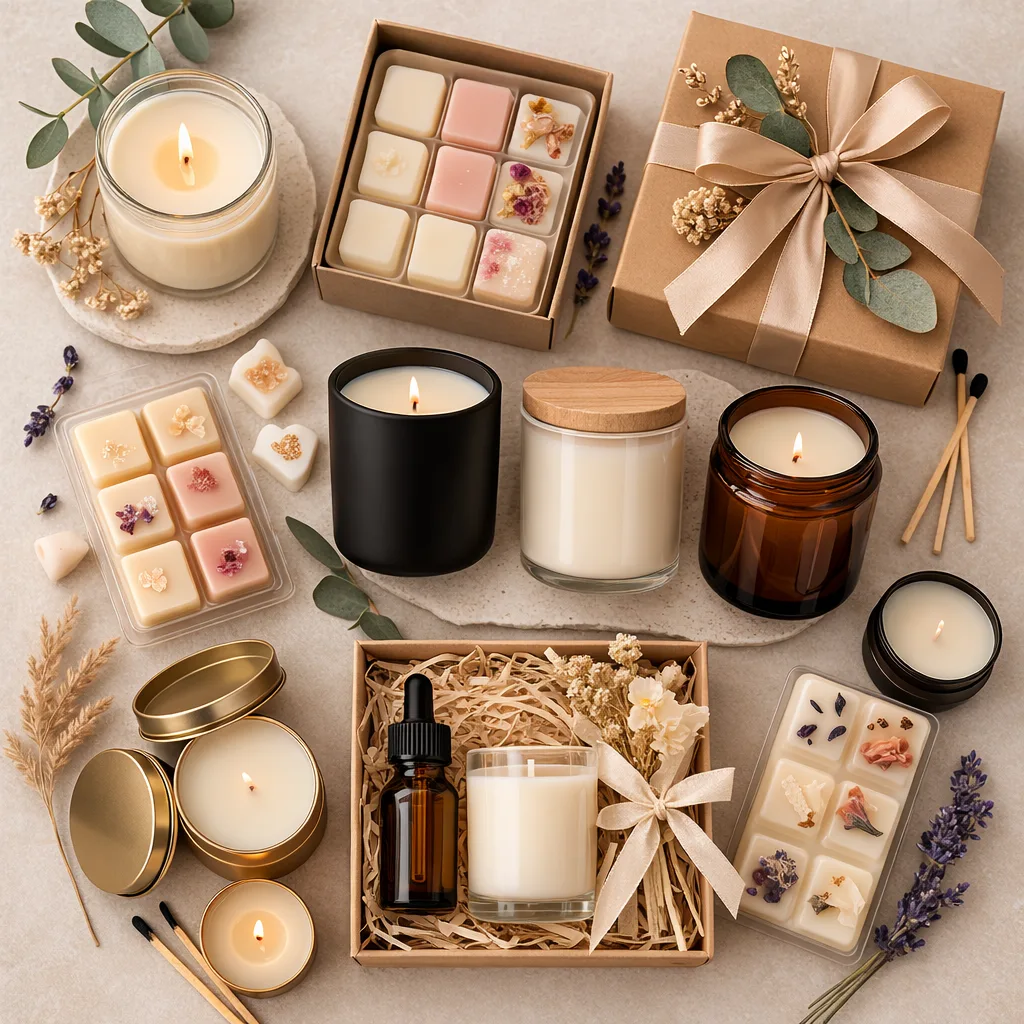
- one seasonal rotation
- one easy add-on product such as wax melts or travel tin candles
That structure scales far better than a chaotic scent explosion.
Stage 3: Customize What Customers Actually Notice
This is where brand building becomes more valuable.
After the market has spoken, invest in the elements that shape perception most strongly. In candles, those are usually:
- vessel quality and finish
- fragrance identity
- packaging detail
- giftability
- consistency across the line
Not every component deserves equal attention.
For example, upgrading from a generic carton to a better-textured rigid presentation box may significantly improve perceived value in gifting. Developing a more refined fragrance family may strengthen repeat purchase. Moving to a signature vessel shape may improve shelf identity. But overengineering hidden internal components the customer barely notices may not improve sales enough to justify cost.
Mature brand building is selective, not emotional.
Stage 4: Expand Into Channel-Specific Collections
This is the stage where established clients become especially interesting.
If you already sell towels, bath products, room sprays, personal care, home accessories, or seasonal gifts, candles can become a very strong line-extension category. But the expansion should be channel-aware.
For example:
- Retail collection: visually consistent, shelf-friendly, replenishable
- Gift collection: presentation-led, packable, margin-protected
- Hospitality collection: scent identity, repeatability, operational simplicity
- Corporate gifting collection: branding flexibility, shipping durability, broad appeal
- Seasonal collection: faster-turn, campaign-friendly, controlled SKU count
Not all candle lines need to serve all channels. In fact, trying to build one line for every channel often weakens performance.
The more mature the buyer, the more precisely the candle line should fit the intended commercial route.
Why Established Brands Often Benefit Most From Private Label Candles First
 This may sound counterintuitive, but many established brands should not start with full custom development either.
If you already run a successful business in adjacent categories, candles can look deceptively simple. The temptation is to jump straight into a heavily customized line because the parent brand already has visual identity, loyal customers, and merchandising experience.
But the manufacturing logic of candles is different.
Burn performance, fragrance throw, vessel compatibility, packaging protection, seasonal freight risk, and compliance documentation are technical realities. An established non-candle brand may understand customers very well but still underestimate candle-specific production variables.
That is why private label candles are often the smartest first step even for mature businesses. They allow a brand to:
- enter the category quickly
- test category demand under its own name
- understand consumer response to scent and format
- validate merchandising logic
- evaluate replenishment behavior
- avoid costly overdevelopment
Then, once the candle line proves itself, the brand can deepen customization with much more confidence.
This is especially effective for:
- beauty brands adding home fragrance
- home textile brands adding candles and gift sets
- boutique retailers creating exclusive house collections
- hotels building scent-led retail products
- importers adding private label fragrance to existing B2B catalogs
For these buyers, private label is not a compromise. It is a category-entry strategy.
Common Mistakes Buyers Make in the Candle Business
A strategic comparison is only useful if it also shows what to avoid.
Here are the mistakes that hurt both startups and established buyers.
Mistake 1: Starting With Too Many SKUs
More fragrances do not automatically create more business. They often create confusion, lower MOQ efficiency, more packaging complexity, and weaker replenishment.
A focused line nearly always performs better at launch.
Mistake 2: Overcustomizing Before Demand Exists
This is one of the costliest errors. Custom ceramic, complex gift boxes, specialty lids, and multi-component packaging can look exciting in development, but if the sales model is not yet proven, they become expensive assumptions.
Mistake 3: Treating Candles as Purely Aesthetic Products
A candle is not just decor. It is a performance product. Vessel, wick, wax, fragrance load, burn behavior, label material, and packaging protection all matter.
Mistake 4: Ignoring Margin After Packaging
A product may look premium and still fail commercially if too much cost is trapped in nonessential packaging or inefficient component choices.
Mistake 5: Choosing a Manufacturer Only by Lowest Quote
The cheapest quote often hides problems: unstable quality, poor communication, weak documentation, inconsistent lead times, or limited ability to support scaling. Serious buyers should evaluate manufacturing partnership, not just unit price.
Mistake 6: Not Designing for Reorder Logic
A launch is only the beginning. Serious candle programs are built around repeatability. If the product is too complicated to replenish, too fragile to ship, or too inconsistent to reproduce, the business remains fragile.
How to Choose the Right Manufacturing Path
If you are deciding between private label candles and a deeper own-brand build, ask the following questions honestly:
- Is this a market test, a line extension, or a long-term flagship category?
- Do I have proven customer demand, or am I still guessing?
- Which parts of the product truly need customization to support my price point?
- Am I building for e-commerce, wholesale, gifting, hospitality, or all four?
- What launch timing matters most?
- How many SKUs can I realistically reorder and manage?
- Can my supplier support both initial efficiency and future customization?
That last question is critical.
The best supplier is often not the one who says yes to everything immediately. It is the one who helps you sequence development intelligently: standardize where it saves money, customize where it creates value, and avoid decisions that increase complexity without strengthening the commercial outcome.
Final Verdict: Which Strategy Wins?
There is no universal winner. There is only the right model for your stage, your channel, and your growth objective.
If you are entering the market, testing demand, or extending into candles for the first time, private label candles are often the most commercially sound starting point. They reduce risk, shorten timelines, and help you focus on selling rather than overengineering.
If you already have traction, a clear customer base, a stronger brand position, or a premium retail strategy, building your own brand more deeply can unlock stronger differentiation, higher perceived value, and longer-term equity.
But for most successful candle businesses, the smartest route is not choosing one forever.
It is using private label as a disciplined launch platform, then customizing strategically as demand, confidence, and category knowledge grow.
That is how serious buyers scale the candle category without wasting time, cash, or momentum.
And that is why the real strategic question is not “private label or own brand?”
It is this:
Which parts of your candle line should be standardized now, and which parts deserve deeper brand investment once the market proves they are worth it?
Answer that well, and you are no longer just launching candles.
You are building a category with staying power.
FAQs
1. Are private label candles a good option for established brands?
Yes. Private label candles are often the fastest and most efficient way for established retailers, hotels, spas, beauty brands, and lifestyle brands to enter or test the candle category before investing in deeper customization.
2. What is the difference between private label candles and fully custom candles?
Private label candles usually build on existing manufacturing systems, standard vessels, and tested production formats while allowing brand-specific packaging and scent choices. Fully custom candles involve deeper development, such as custom jars, exclusive packaging, and more complex product engineering.
3. When should a candle business move from private label to deeper brand development?
A candle business should invest more heavily in custom brand development after it has clearer demand signals, reorder data, stronger margin visibility, and a defined channel strategy for retail, gifting, hospitality, or wholesale.