
 If you’re starting a candle brand, you’ve probably heard the same advice in different outfits:
“Go natural.”
“Use only essential oils.”
“Organic sells.”
It sounds clean. It sounds premium. It sounds like the safest story to tell.
But once you step from mood boards into manufacturing—where you’re paying for fragrance, testing burn performance, and trying to hit a retail margin—the essential-oil-only idea starts to fall apart.
Here’s the reality most people discover late (after they’ve already sunk money into a first run): commercial scented candles rarely rely on pure essential oils alone. Not because brands are “cutting corners,” but because essential oils and candles are a difficult match—technically, financially, and legally.
This article breaks down what brands often don’t say out loud:
- why essential oils are often a poor value in candles
- where essential oils fail on performance (even when they’re “high quality”)
- why “natural = safer” is often a misunderstanding
- what high-performing fragrance oils actually are
- how smart brands combine materials to build products customers love and businesses that survive
If you’re an entrepreneur, consider this your shortcut around expensive learning.
1) The “Natural Candle” Myth: Why Founders Get Stuck Here
The essential-oil obsession usually comes from two places:
- Borrowed logic from skincare. In skincare, “natural oils” can be a meaningful selling point and often stay stable at room temperature.
- Aesthetic marketing. “Organic,” “clean,” “plant-based,” and “non-toxic” are emotionally powerful ideas.
Candles are different.
A candle isn’t a bottle of serum. It’s a controlled burn system—wax, wick, fragrance, and vessel working together under heat.
When you’re selling candles, the customer judges you on:
- cold throw (how it smells unlit)
- hot throw (how it smells burning)
- scent clarity (does it smell like the promise?)
- burn stability (tunneling, soot, wick mushrooming)
- consistency between batches
That’s why the most useful “natural” question is not “Is it essential oil only?”
It’s:
“Does this candle perform beautifully and consistently, at a price that supports a real business?”
2) The Cost Reality: Essential Oils Can Break Your Economics
 Let’s say you’re building a mid-to-premium candle.
Typical fragrance load for many wax systems is 6%–10% (sometimes less, sometimes more depending on wax, wick, vessel diameter, and fragrance chemistry).
Now imagine your fragrance is purely essential oils.
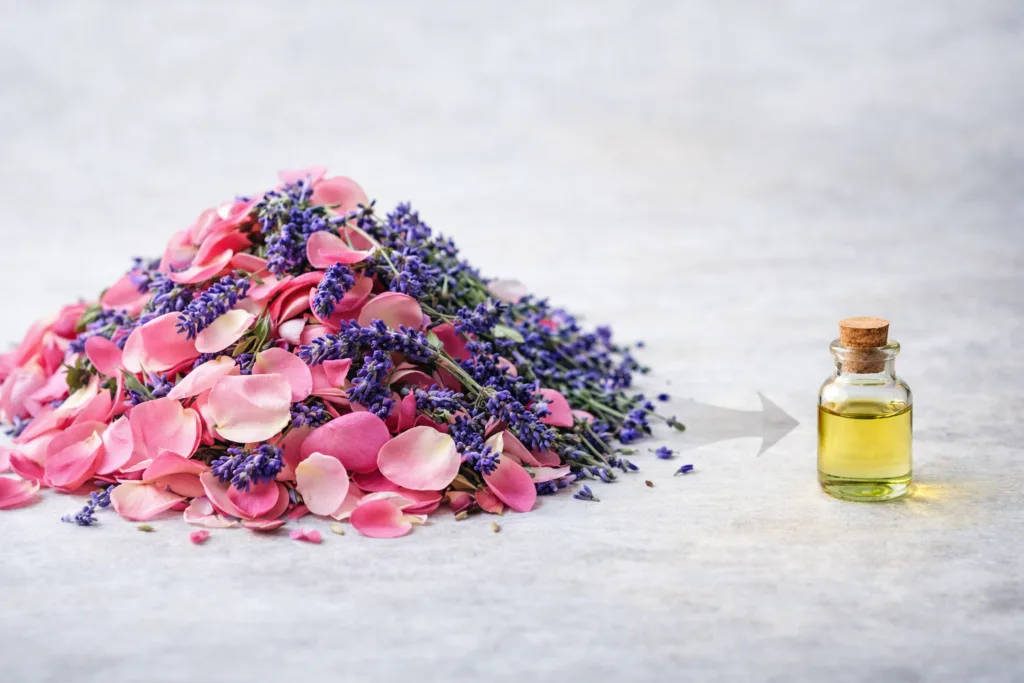
Essential oils can cost multiples of candle-grade fragrance oils—sometimes dramatically more for florals and woods. Even when you buy at “wholesale,” certain materials remain expensive because their production is inherently resource-heavy.
Why essential oils are expensive (even before branding)
- Low yield: many botanicals produce tiny amounts of oil relative to raw material.
- Labor and processing: harvesting windows, distillation time, storage, and shipping are not cheap.
- Supply volatility: weather, crop disease, geopolitical risks, and sustainability restrictions can spike costs.
- Quality variance: two batches of the “same” essential oil can smell different.
What that means in candle math
If fragrance becomes your largest cost line, you lose flexibility:
- you can’t run promos without destroying margin
- you can’t absorb shipping spikes
- you can’t scale without constant pricing pain
- you can’t compete in wholesale where buyers expect stable cost and lead time
A founder can love the “organic” concept and still end up pricing themselves out of the market.
The harsh truth:
If your product economics depend on pure essential oils, your brand strategy becomes fragile.
That’s not “anti-natural.” It’s pro-survival.
3) Performance: Why Essential Oils Often Underperform in Candles
 Essential oils can smell stunning in a diffuser, on skin (properly diluted), or in a cold blend. But in candles, they’re asked to do something difficult:
- dissolve into wax
- remain stable during heating and cooling
- release cleanly through the burn cycle
- stay recognizable at combustion temperatures
Many don’t.
3.1 Heat changes the scent
Candles generate heat at the melt pool. Some essential oil components are volatile or heat-sensitive. The result can be:
- the top notes vanish quickly
- the scent shifts into something flatter or sharper
- the “pretty” part of the oil disappears under heat
You may think you’re selling “lavender,” but the burning experience can feel medicinal or thin.
3.2 Hot throw can be weak
Some essential oils are simply not strong throwers in wax. You might compensate by adding more, but then:
- costs explode
- safety limits become a concern
- the candle may burn poorly (wick struggles, soot increases, or the melt pool behaves unpredictably)
3.3 Consistency is hard
Essential oils are agricultural products. Two batches can vary in:
- aroma profile
- intensity
- minor component chemistry
That matters because candles are sensitive systems. If fragrance changes, burn behavior can change too.
For scaling brands, this becomes a nightmare: customers want their favorite scent to smell the same every time.
4) Scent Creation: Many Popular Notes Don’t Exist as Essential Oils
 This is the part many founders don’t realize until they start building a collection.
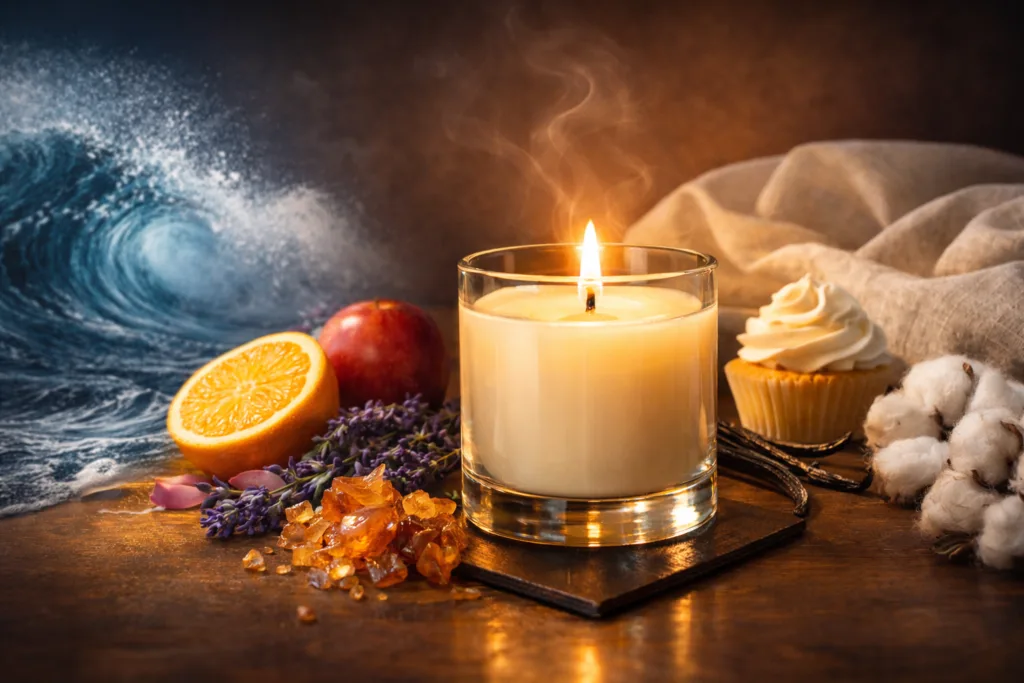
A lot of the most-loved modern profiles are not achievable with essential oils alone, including many “perfume-style” accords:
- clean laundry / cotton / linen
- ocean / rain / marine air
- sweet gourmand desserts (vanilla cupcake, caramel, marshmallow)
- “amber” as used in perfumery
- many fruits at realistic intensity
- musk, cashmere, suede, lipstick, paperback book, etc.
Essential oils are real botanical extracts.
But a modern candle fragrance is often a designed scent: layered, balanced, and built for performance.
That’s what high-quality fragrance oils are engineered to do.
5) Safety and Compliance: “Natural” Doesn’t Mean “Unrestricted” or “Safer”
This is a sensitive topic because marketing loves the idea that natural equals harmless.
In reality:
- many essential oils contain allergens (just like many fragrances)
- certain essential oils are restricted in specific applications
- different regions require different labeling standards (and claims can be risky)
What matters is not the origin—it’s the chemistry and usage level
A responsible approach looks like this:
- use materials that comply with relevant guidance (often including IFRA recommendations)
- ensure your finished product meets labeling and safety documentation expectations (SDS, allergen disclosure where applicable)
- avoid overclaiming “non-toxic” or “chemical-free” (everything is chemicals, including water)
You can absolutely build a clean, premium brand—but you do it with rigorous formulation and accurate claims, not with a simplistic “100% essential oil” badge.
6) What Fragrance Oils Actually Are (When You Buy the Good Ones)
A common misunderstanding is that fragrance oils are “cheap fake smells.”
Yes, low-quality fragrance oils exist.
But high-quality candle-grade fragrance oils are typically:
- professionally composed blends
- designed for stability in wax
- tested for performance (cold throw, hot throw)
- built to repeat consistently across production
They can include:
- aroma molecules found in nature
- nature-identical components
- safe synthetic aroma materials that make modern perfumery possible
The goal isn’t to trick customers.
The goal is to create a scent that performs well, smells beautiful, and can be produced reliably.
Why fragrance oils often win in candles
- stronger and more predictable throw
- better stability at burn temperature
- broader scent palette
- consistent batch-to-batch aroma
- controllable cost for scaling
In other words: better product experience at a sustainable business cost.
7) What Successful Brands Do Instead of Going “Essential-Oils-Only”
Here’s what many brands quietly do:
Option A: Use premium fragrance oils (the mainstream professional choice)
This is the most common approach for commercial candles, from affordable to luxury.
You win on:
- performance
- repeatability
- scent complexity
Option B: Use essential oils as accents (the smart “best of both” approach)
This is where your original idea becomes useful without ruining your economics.
You can add small amounts of essential oils to:
- boost authenticity in certain notes (like true citrus or herbal facets)
- create a marketing story that’s honest and meaningful
- add nuance without relying on essential oils for the full structure
This can be communicated responsibly as:
- “infused with essential oils”
- “contains natural essential oils”
…but avoid implying the entire fragrance is essential oil unless it truly is.
Option C: Build a natural-leaning line with realistic performance goals
If your audience truly demands “natural,” you can design around it:
- choose wax systems and wicks optimized for lighter profiles
- accept that some scents won’t be possible
- price accordingly and target a customer who values the ideology enough to pay
This can work—but it’s a positioning choice, not a default assumption.
8) A Practical Decision Framework for Founders
 If you’re choosing between essential oils and fragrance oils for candles, use this framework:
Step 1: Define your customer promise
Are you selling:
- bold scent throw that fills a room?
- subtle natural aromatherapy mood?
- perfume-like complexity?
- gifting and lifestyle aesthetics?
Different promises require different materials.
Step 2: Build the unit economics first
Before you fall in love with a concept, run the math:
- wax + vessel + packaging + labor + fragrance + freight + overhead
- wholesale margin expectations (often 50% off retail)
If essential oils make the product impossible to price, your “organic dream” becomes a liability.
Step 3: Make performance your gatekeeper
Even if something is natural, if it burns poorly or smells weak, customers won’t repurchase.
Performance is not a detail—it’s the product.
Step 4: Keep your claims clean
Avoid claims that create legal or reputational risk.
Instead of vague “non-toxic,” anchor your message in tangible quality:
- clean-burning tested system (wax/wick match)
- compliant fragrance sourcing
- transparent scent development
- responsible documentation where relevant
9) A Note on “Organic”: Don’t Let the Word Run Your Brand
“Organic” is powerful because it makes people feel safe.
But in candles, the word can become a trap:
- it narrows your scent options
- it inflates costs fast
- it creates claim pressure you may not be able to support
- it encourages founders to optimize for ideology over product experience
If you’re building a real business, aim for something more durable than a buzzword:
A candle that smells exceptional, performs consistently, and supports healthy margins.
Then build a brand story that’s honest:
- quality materials
- thoughtful design
- responsible sourcing
- transparency without overpromising
That story lasts longer.
10) Bottom Line: The “Best” Choice Is the One That Scales Without Compromising the Product
Essential oils are beautiful ingredients.
But in candles, they’re not automatically the superior choice.
For most commercial brands, especially new ones, high-quality fragrance oils deliver what customers actually pay for:
- strong, stable scent
- consistent repeatability
- realistic costs for wholesale and growth
The smartest path is rarely extreme.
It’s often this:
- use premium fragrance oils as your foundation
- use essential oils strategically where they add real value
- price and position your products based on performance, not ideology
If you want, you can still build a brand that feels natural, clean, and elevated.
Just don’t let a concept destroy your margins.
FAQ
1) Can I make candles with 100% essential oils?
Yes, but many essential oils perform poorly in wax and costs can become prohibitive. Expect lighter throw, scent shifts under heat, and limited scent profiles.
2) Are fragrance oils unsafe compared to essential oils?
Not automatically. Safety depends on formulation, usage level, and compliance. Essential oils also contain allergens and may have restrictions.
3) What’s the best approach for a new candle brand?
For most founders, start with high-quality candle-grade fragrance oils for performance and margin, then add essential oils selectively for nuance and storytelling.