
OEM vs ODM in Custom Scented Candles
Navigating your manufacturing options starts with distinguishing OEM (Original Equipment Manufacturing) from ODM (Original Design Manufacturing). Both models serve unique needs in custom candle production and impact your control, cost, and lead times.
OEM: Your Vision, Factory Realization
OEM service means the manufacturer fabricates candles to your exact specifications—fragrance, vessel, packaging, and all. You provide the design; the factory delivers precision execution. This route is ideal for established brands and those with distinct creative direction.
ODM: Factory’s Innovation, Your Brand
ODM entails the factory offering a portfolio of ready-made designs and fragrance options. You select, perhaps customize surface details, and the finished product emerges under your label. It’s the perfect solution for entries into the market or rapid line expansions.
| Aspect | OEM | ODM |
|---|---|---|
| Design Control | Full—your specifications | Factory template, minor tweaks |
| Speed to Market | Custom timelines (longer) | Faster (catalog-driven) |
| MOQ | Typically higher | Lower—prefab models |
| Cost per Unit | Higher, custom inputs | Lower, economies of scale |
Step 1: Vessel Selection—The Foundation of Your Candle
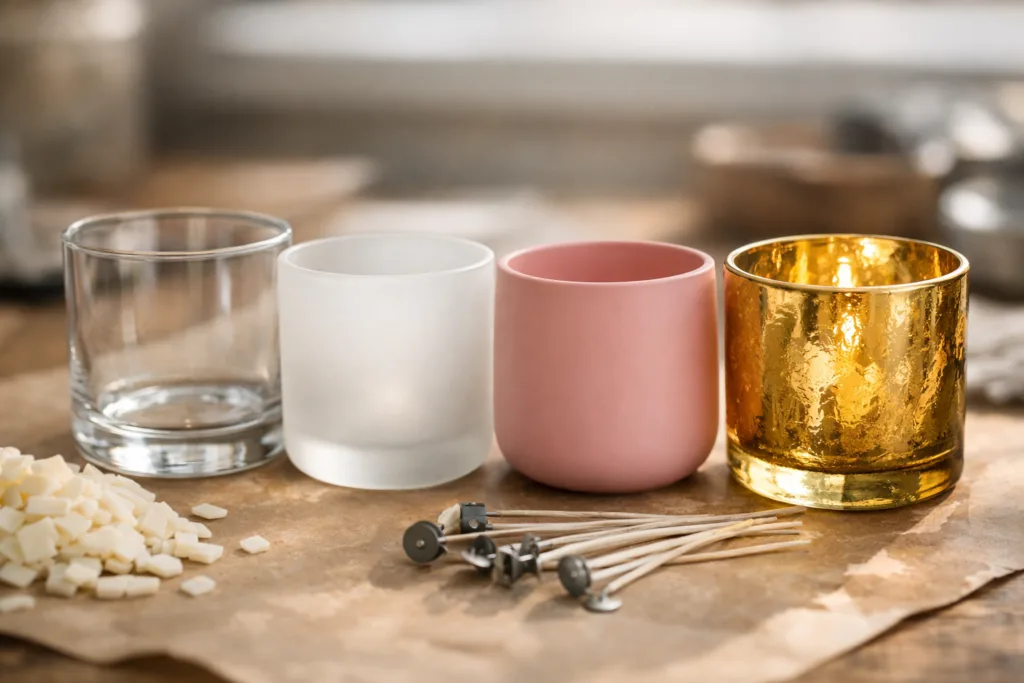
The container shapes a candle’s aesthetic, performance, and user experience. Glass jars, tins, ceramics, and concrete each offer distinct design and branding potential.
- Glass: Classic, available in clear, frosted, colored, or decorated (painting, screen printing, spraying, foiling).
- Tins: Lightweight and cost-effective, with a clean, portable profile.
- Ceramics or Concrete: Heavier, artisanal, excellent heat retention, premium feel.
Specialty finishing—such as matte spraying, gold foiling, and intricate embossing—elevates custom candles into luxury territory. Circe Home specializes in these high-end techniques, supporting everything from minimalist home décor to giftable statement pieces.
Balancing Form and Function
Beyond aesthetics, consider vessel diameter (impacts wick sizing and burn), wall thickness (for heat resistance), and compatibility with your intended wax blend. Safety compliance means every vessel must also pass rigorous heat and shatter tests.
Step 2: Fragrance Development—Crafting Signature Scents
A scented candle’s soul lies in the fragrance. Custom-scented candles require balancing olfactory artistry with technical formulation for clean burn, strong throw, and safe diffusion.
Choosing Fragrance Materials
- Essential Oils: Pure botanical extracts, ideal for wellness-driven brands but sensitive to heat and blend compatibility.
- Fragrance Oils: More stable, wider scent range, and often yield a stronger cold/hot throw.
Formulation Principles
- Maximize fragrance load without risking seepage or incomplete combustion (usually 7-12%, depending on wax type).
- Balance top, middle, and base notes for a multi-dimensional scent experience.
- Verify IFRA compliance and request allergen declarations for safe, global distribution.
“Circe Home Lab Insight: Achieving a powerful, consistent scent throw means curing test candles for at least 10 days, observing both cold and hot phases before sign-off.”
Step 3: Wax Blends, Wicks, and Performance
Superior wax selection shapes burn quality, scent diffusion, and the tactile experience of your brand.
- Soy Wax: Clean-burning, popular for wellness lines, moderate max fragrance load (up to 10%).
- Coconut Wax: Super-smooth finish, high adhesion to vessels, blends well for luxury candles.
- Rapeseed and Beeswax: Allergen-friendly or ultra-premium with subtle natural aromas.
- Custom Blends: Engineered for optimal burn, hot/cold throw, and surface aesthetics.
Wick Science
Wick selection matches vessel diameter, wax blend, and fragrance volatility. Common choices include cotton, wood, and paper-core wicks. Proper sizing prevents issues like tunneling, excessive soot, or ‘mushrooming.’ Pre-tabbed, precisely centered wicks ensure each batch burns consistently.
Step 4: Packaging—From Labels to Gift Boxes
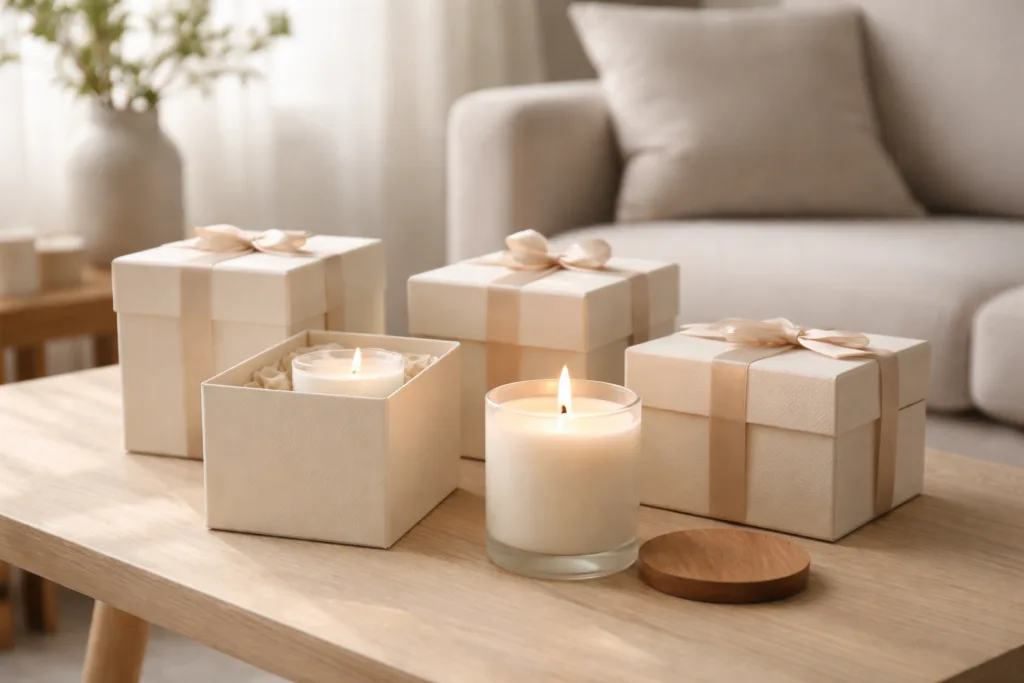
The right packaging transforms a candle into a coveted object. Options range from minimalist wraps to ornate rigid gift boxes. Consider both brand impact and logistics when specifying your packaging design.
- Label Design: Custom shapes, art paper, foil-stamping, or soy ink for a premium touch.
- Box Types: Tuck-end cartons for efficiency; drawer boxes or magnetic lids for elevated gifting.
- Sustainability: FSC-certified papers, compostable inserts, and low-impact print processes appeal to eco-conscious consumers.
Compliance & Information
For every market, ensure packaging includes CLP warnings, IFRA scent info, and safe-use instructions. Custom candle factories such as Circe Home handle these nuances for global clients.
Step 5: Production—From Pre-Pour to Curing
The production line for custom scented candles involves a precise orchestration of formulation, pouring, and finishing steps to achieve both batch consistency and luxury-level detail.
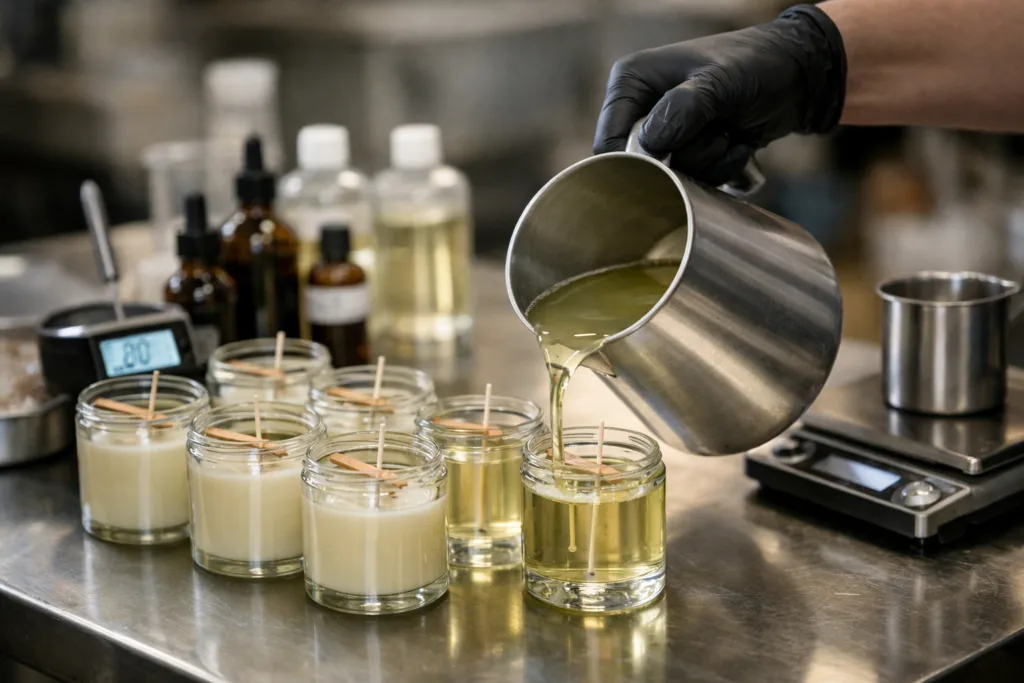
- Pre-Pour: Vessel washing, wick gluing, and preheating for optimal wax adhesion and safety.
- Wax Melting & Blending: Temperature-controlled tanks blend waxes and fragrances to avoid flash point risks and maximize scent infusion.
- Pouring: Slow, carefully targeted pour (single or double-pour methods) to avoid bubbles and guarantee a flawless surface.
- Cooling & Curing: Controlled room temp and humidity for gradual setting. Curing can range from 7–14 days for full scent bloom and stable burn profiles.
- Surface & Topping: Post-cure top-offs, gold foiling, or botanicals applied by hand for artistry points.
- Final QC: Visual and burn tests, weight checks, wick centering adjusted, and random batch scent assessments before boxing.
MOQ and Custom Candle Production Costs
Understanding MOQ (Minimum Order Quantity) and cost structure is pivotal in custom candle manufacturing.
MOQ Factors
- Standard Designs (ODM): Lower MOQs (often 500–1000 units) due to streamlined production
- High-End Custom (OEM): Higher MOQs (1500–3000 units), accounting for custom molds, specialty glass, intricate boxes, or unique fragrances
Cost Breakdown
| Component | Standard | High-End Custom |
|---|---|---|
| Wax & Fragrance | Commodity blends | Specialty, high-load blends |
| Vessel | Catalog glass/tin | Custom-molded, decor finishes |
| Packaging | Straightforward carton | Rigid box, foil, ribbon, filler |
| Labor & QC | Automated, standard test | Hand-inspection, batch testing |
Investing in luxury details—such as multi-layer gift boxes or custom-embossed vessels—significantly enhances both visual impact and perceived value but increases both MOQ and cost per unit.
Custom Scented Candle Manufacturing Timeline
Custom candle production is a careful balance of speed and craftsmanship. Typical timeframes run as follows:
- Sample Development: 7–10 days (fragrance alignment, vessel and label prototyping, small-batch burn testing)
- Full-Scale Production: 15–30 days depending on complexity, line-up size, and order volume
Clear, early communication accelerates both styling and compliance checks, helping your project move smoothly from concept to finished product.
Applications: Where Custom Candles Create Value
Custom-scented candles offer the perfect sensory signature for a range of businesses and lifestyles:
- Luxury gifting collections and event favors
- Private-label retail for boutiques and chains
- Spa, hotel, and wellness blends for ambiance
- Minimalist or seasonal lines with branded story-telling
Advanced manufacturers also offer eco-packaging, refill options, and personalized scent development for modern, sustainable markets.
Quality Assurance & Safety for Custom Scented Candles
Every factory batch must pass rigorous testing across appearance, performance, and safety lines:
- Burn time (>35 hours for 200g standard)
- Soot index and visual clarity assessment
- Fragrance throw consistency (cold and hot test burns)
- Wick centering within ±2mm tolerance
- Packaging durability and label legibility
- IFRA/CLP labeling and allergen documentation
Committing to these standards—foundational at trusted partners like Circe Home—ensures your candles not only captivate, but also deliver a premium, compliant burn to every end user.
Frequently Asked Questions
What is the difference between OEM and ODM in scented candle manufacturing?
OEM means you provide the specific designs and formulas, and the manufacturer produces according to your requirements. ODM offers factory-created designs and fragrances you can customize with your branding and packaging.
What is the usual minimum order quantity (MOQ) for custom scented candles?
The MOQ varies by customization level. Standard (ODM) runs can start at 500–1000 units, while highly bespoke (OEM) orders may require 1500–3000 units or more per SKU.
How long does it take to produce custom scented candles?
Sample development typically takes 7–10 days. Full-scale production generally takes 15–30 days depending on design and order complexity.
What are the main waxes used in custom candle manufacturing?
Common waxes include soy, coconut, rapeseed, beeswax, and custom blends that balance scent throw, burn cleanliness, and vessel compatibility.
What compliance and labeling are needed for custom candles?
Every candle must follow IFRA guidelines, provide CLP warnings for the EU, and display proper safety and allergen information on packaging.
How is packaging tailored for luxury custom candles?
Luxury candles often use custom-embossed vessels, rigid gift boxes, foil labels, or sustainable materials to elevate appearance and support premium positioning.