
Introduction:Candle Market Trends 2026
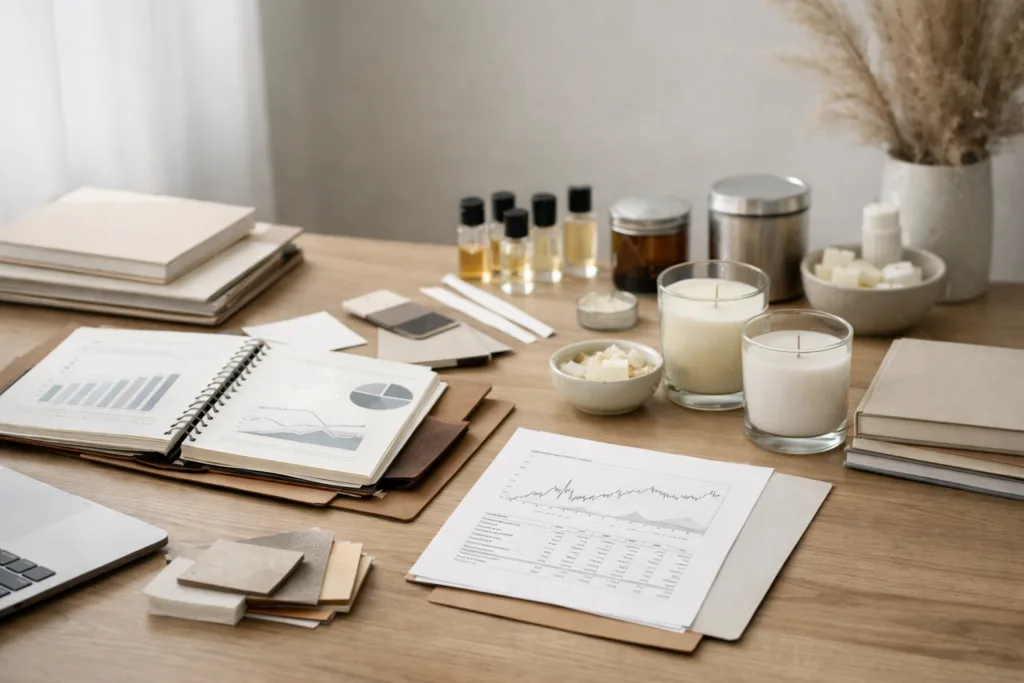 The global scented candle industry has entered a new phase.
Not a phase of collapse. Not even a phase of stagnation. But a phase of filtration.
For almost a decade, candles benefited from a rare combination of trends: the rise of home aesthetics, the wellness economy, gifting culture, and emotional consumption. The pandemic years accelerated this further, turning candles from a decorative object into a daily emotional tool.
By 2025, the market was already crowded. By 2026, it is no longer forgiving.
This article is written for buyers and brand owners who do not need inspiration, but need clarity. It is based on manufacturing-side observations, retail sourcing behavior, and commercial performance data across mid-to-premium markets in North America, Europe, and Oceania.
Our focus is not “what is fashionable.” It is:
• What is structurally changing.
• What is becoming risky.
• What is becoming more profitable.
• And what will still make commercial sense in 24–36 months.
1. Market Overview: From Expansion to Selection
1.1 The End of Easy Growth
Between 2018 and 2024, the candle market experienced continuous category expansion. New brands entered rapidly. Private label programs scaled easily. Entry barriers were relatively low, and differentiation was often visual rather than structural.
In 2025, this model began to weaken.
Retail data across multiple regions shows three clear signals:
• Shelf space is no longer expanding at the same speed as brand.
• Retailers are reducing SKU complexity.
• Buyers are replacing underperforming lines faster than before.
In other words, the market is no longer about adding. It is about choosing.
1.2 2025 vs 2026: Buyer Logic Shift
| Dimension | 2025 Typical Logic | 2026 Emerging Logic |
|---|---|---|
| Core Goal | Volume growth | Margin stability |
| Product Strategy | Trend-driven | Longevity-driven |
| Fragrance | Popular & seasonal | Mood & ritual-driven |
| Design | Decorative & Instagram-first | Interior & lifestyle integration |
| Sustainability | Differentiator | Requirement |
| Customization | Private label | Bespoke identity |
| Supply Chain | Cost-first | Risk & flexibility-first |
| Compliance | “Available” | “Non-negotiable” |
This shift is financial, not aesthetic. In 2026, poor structure is more expensive than high unit cost.
2. Trend One: From Fragrance Product to Emotional System
2025 Reality
In 2025, most product communication still centers on scent notes:
• Top / Middle / Base
• Seasonal bestsellers
• Trend accords
The candle is treated primarily as a fragrance item.
2026 Direction
In 2026, buyers and brands increasingly frame candles as emotional tools:
• Calm
• Focus
• Sleep
• Energy
• Reset
• Ritual
The language shifts from olfactory to psychological.
Collections are no longer built by season, but by use-case and emotional moment. This directly improves:
• Gifting conversion
• Cross-sell potential
• Brand memorability
Commercial observation:
Mood-positioned lines consistently show 15–25% stronger gifting performance compared to purely scent-named collections.
3. Trend Two: Sustainability Becomes Structural
2025 Reality
“Sustainable” is often used as a marketing descriptor, but implementation is inconsistent:
• Partial soy blends
• Limited documentation
• Decorative but non-recyclable packaging
2026 Direction
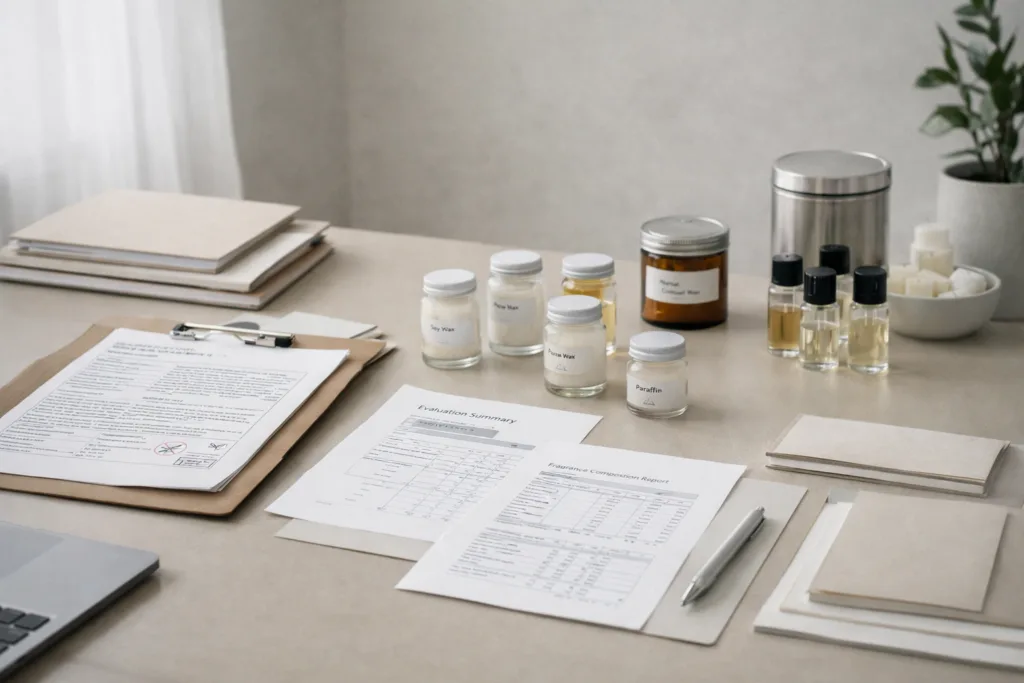
Sustainability becomes a sourcing condition:
Buyers increasingly require:
• Clear wax composition (soy, coconut, rapeseed, beeswax, or certified blends)
• Clean-burn and low-soot testing
• IFRA-compliant fragrance systems
• EU CLP & CPSR readiness
• Refillable or reusable vessels
Financial logic:
Sustainable structure reduces regulatory risk, return rates, and brand liability. In 2026, sustainability is not about image. It is about cost control.
4. Trend Three: Bespoke Over Private Label
2025 Reality
Private label dominates speed-to-market:
• Standard jars
• Existing fragrances
• Label customization
2026 Direction
Brands increasingly seek:
• Signature fragrance DNA
• Custom vessel texture or finish
• Brand-specific ritual systems
Bespoke does not mean large volume. It means recognizable difference.
Commercial impact:
Bespoke programs demonstrate higher margin stability and lower price erosion over 12–18 months compared to standard private label lines.
5. Trend Four: Design Moves Toward Quiet Luxury
2025 Reality
• Trend colors
• Decorative novelty
• Visual noise
2026 Direction
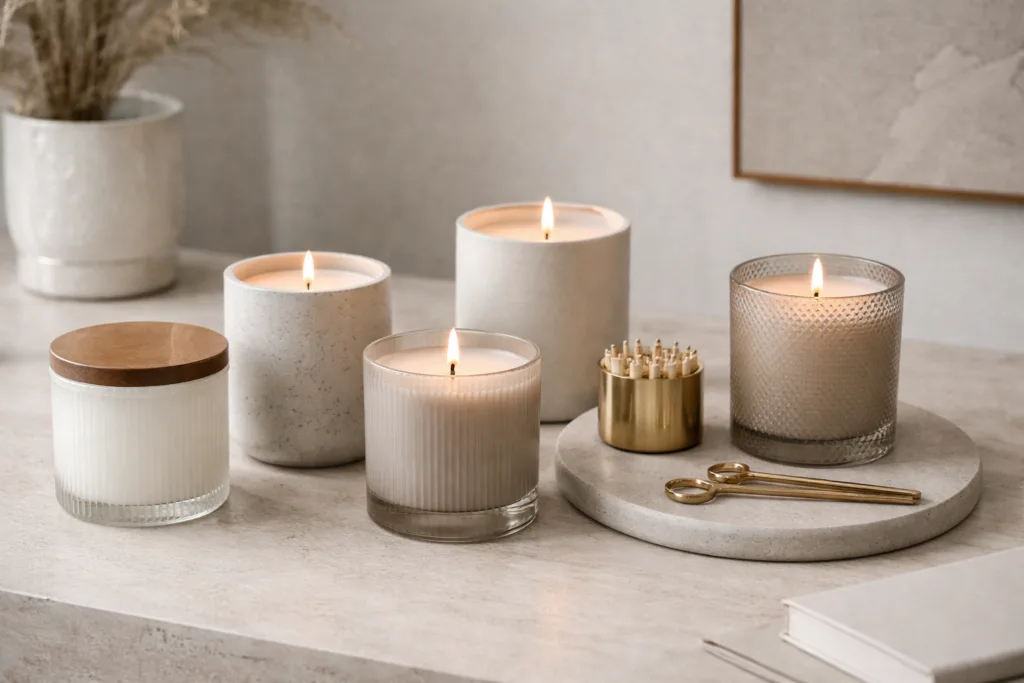
• Neutral, stone, sand, warm grey, earth tones
• Ceramic, marble, textured glass, natural wood
• Packaging designed for long-term interior presence
Design is no longer for display only. It is for living spaces.
6. Trend Five: Smarter, Smaller, Faster Supply Chains
2025 Reality
• Larger MOQ
• Slower iteration
• Inventory pressure
2026 Direction
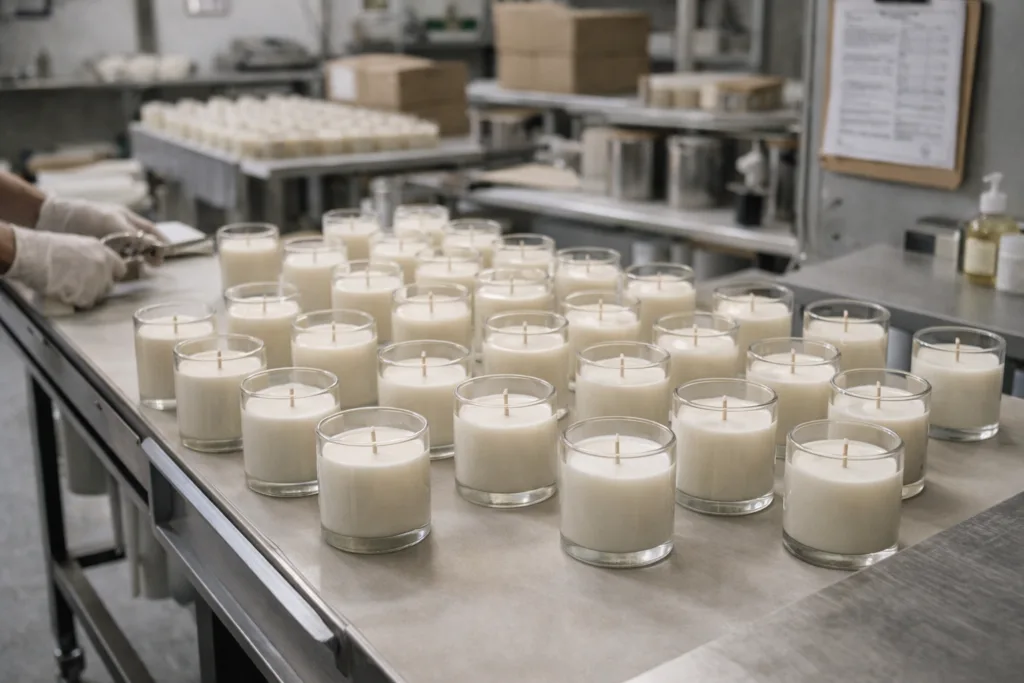
Flexible sourcing becomes competitive advantage.
Low MOQ in 2026 means:
• Standard container candles: 300 pcs per design
• Handmade dessert candles: 100 pcs per design
Low MOQ enables testing, controlled risk, and data-driven scaling.
7. Trend Six: Compliance as Commercial Advantage
In 2026, compliance is no longer background work.
Retailers increasingly evaluate:
• Label accuracy
• Safety documentation
• Transport compliance
• Market-entry readiness
Compliance reduces onboarding time by 30–40% with large retail accounts and lowers long-term legal exposure.
8. Performance Data & Industry Benchmarks
Observed across mid-to-premium sourcing programs:
• Refillable systems improve repeat purchase rates by 15–30%.
• Mood-based collections outperform scent-only lines by ~20% in gifting channels.
• Compliance-ready SKUs shorten retail onboarding cycles significantly.
• Bespoke fragrance programs show more stable gross margins over time.
These are operational results, not marketing assumptions.
9. Buyer Strategy for 2026
- Reduce SKU count, increase identity strength.
- Invest in fragrance storytelling and emotional positioning.
- Require compliance at sampling stage.
- Design for longevity, not novelty.
- Use low MOQ strategically for testing.
10. Supplier Selection in 2026
Beyond price, evaluate:
• Fragrance development capability
• Compliance expertise
• Quality consistency
• Production flexibility
• Material transparency
The right supplier is not a factory. It is a manufacturing partner.
Conclusion
The candle market in 2026 is not shrinking. It is filtering.
Brands that rely on sameness will face margin pressure.
Brands that invest in structure, emotion, and compliance will scale with stability.
In 2026, quality is no longer a feature. It is the foundation.
FAQ – Candle Market Trends 2026
1. What are the biggest differences between the candle market in 2025 and 2026?
The main shift is from volume-driven growth to structure-driven profitability. In 2025, many buyers focused on trend products and fast launches. In 2026, buyers prioritize margin stability, emotional positioning, compliance readiness, and long-term design relevance rather than short-term novelty.
2. What does “low MOQ” realistically mean for candle sourcing in 2026?
In practical manufacturing terms, low MOQ in 2026 usually means around 300 pcs per design for standard container candles, and about 100 pcs per design for handmade dessert candles. This level supports testing and controlled market validation without excessive inventory risk.
3. Why is compliance more important for candle brands in 2026?
Regulations in the EU and US are becoming stricter, and retailers are less willing to handle non-compliant products. Compliance-ready candles reduce onboarding time, minimize legal risk, and improve buyer confidence, making them commercially safer and easier to scale.
4. How can brands build a future-proof candle line for 2026 and beyond?
Brands should focus on fewer, more distinctive SKUs, invest in bespoke fragrance identity, design for quiet luxury and interior longevity, and work with suppliers who offer flexibility, documentation, and consistent quality rather than only low pricing.