
Sustainable candles are no longer a niche product for small artisan shops. They have become a serious category for home fragrance brands, lifestyle retailers, wellness stores, hotel gift programs, corporate gifting companies, and private label buyers who want products that feel responsible, premium, and commercially scalable.
But in candle sourcing, “sustainable” is often used too casually. A supplier may call a candle eco-friendly because it uses soy wax. A brand may call a package plastic-free because the retail box is made from kraft paper. A retailer may ask for a “natural candle” without knowing whether the fragrance, dye, wick, vessel, label, insert, and export carton support that claim.
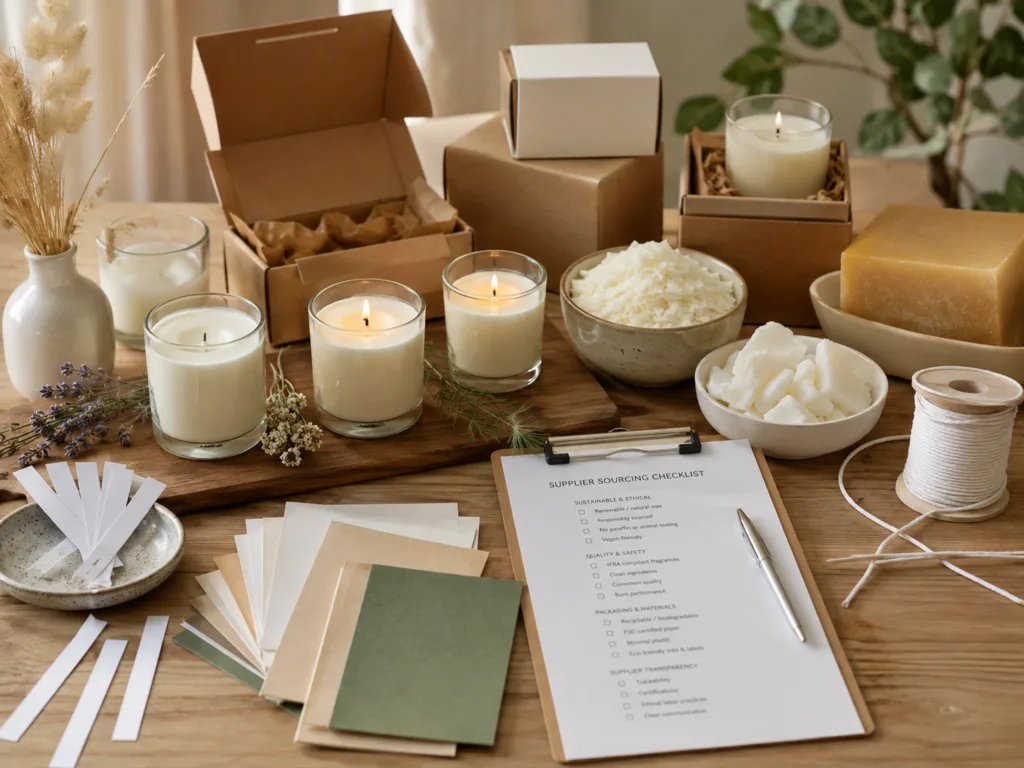
For mature buyers, sustainable candle development is not about choosing one green-looking material. It is about building a complete product system that balances environmental responsibility, burn performance, safety, compliance, packaging protection, MOQ, cost, repeatability, and retail presentation.
A candle that looks sustainable but breaks during international shipping is not truly sustainable. A beautiful natural wax candle that tunnels, smokes, or has weak scent throw will not create repeat orders. A plastic-free package that cannot protect glass jars in transit may increase waste instead of reducing it. A “natural fragrance” claim without documentation can create labeling and compliance risks in export markets.
This guide is written for eco-conscious brands that are serious about developing sustainable candles at wholesale or private label scale. It explains what actually makes a candle sustainable, how different sourcing choices affect cost and MOQ, what documents buyers should ask for, and how to evaluate a supplier before placing a large order.
What Makes a Candle Truly Sustainable?
A sustainable candle is not defined by wax alone. It should be evaluated across the entire product lifecycle: raw materials, production practicality, packaging, transport, use, disposal, and repeat purchase potential.
In practical B2B sourcing, a sustainable candle usually includes several of the following features:
- Plant-based or responsibly sourced wax options
- Safe, compliant fragrance materials
- Recyclable, reusable, refillable, or lower-impact vessels
- Reduced plastic packaging or paper-based alternatives
- FSC, recycled, kraft, or responsibly sourced paper packaging
- Clear safety labeling and export-ready documentation
- Reasonable MOQ that allows stable production rather than wasteful trial-and-error
- Packaging strong enough for international shipping
- A supplier who can support repeat production with stable quality
The key word is “balance.” A candle can be more sustainable without being perfect. In commercial sourcing, the best sustainable product is often not the most extreme version. It is the version that can be produced consistently, shipped safely, priced correctly, and reordered by the buyer.
For example, a stock glass jar with soy wax, an IFRA-compliant fragrance, a recyclable paper label, and a kraft box may be more practical for a first 500-piece private label order than a fully custom ceramic vessel, molded pulp insert, FSC rigid box, natural essential oil blend, and refill system. The second concept may sound more sustainable, but if the MOQ, cost, timeline, and testing complexity are too high, it may never become a profitable product.
Sustainable Candle Wax Options
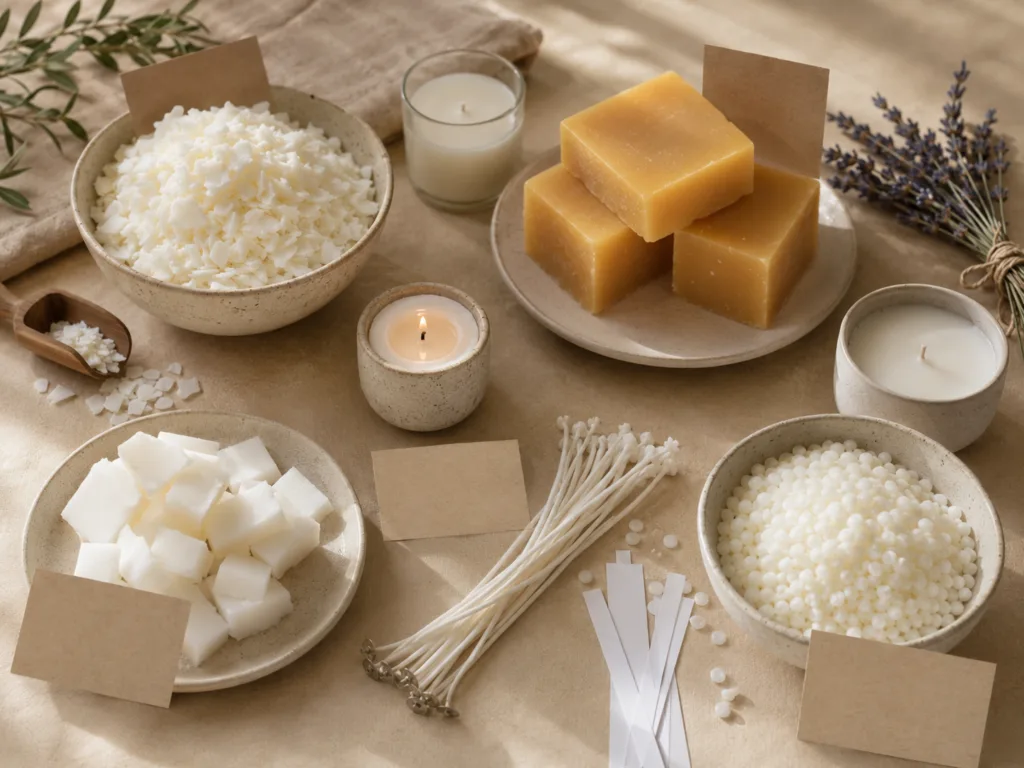
Wax is usually the first material buyers ask about, and it is one of the easiest sustainability signals for consumers to understand. However, each wax type has different sourcing, cost, scent throw, appearance, and production implications.
Soy Wax
Soy wax is one of the most common choices for private label sustainable candles. It is plant-based, widely available, suitable for container candles, and generally well accepted by North American and European home fragrance buyers.
For brands, soy wax works well because it supports a clean, natural, modern positioning without making the production process too complicated. It can be used for classic scented candles, gift sets, wellness collections, seasonal candles, and boutique retail lines.
However, buyers should understand that soy wax is not a magic material. It may show frosting, wet spots, surface texture changes, or temperature-related variation. These visual details are common in plant-based wax systems and do not always mean poor quality. What matters more is whether the supplier can control wick selection, fragrance load, wax temperature, cooling conditions, and bulk production consistency.
Soy wax is usually a strong option for brands that want a sustainable positioning with realistic MOQ and stable cost.
Beeswax
Beeswax has a strong natural story. It is often associated with traditional craft, wellness, heritage, and premium natural products. It may carry a naturally warm honey-like scent and can be attractive for brands that want a simple ingredient story.
But beeswax is more expensive than many plant-based waxes and can be more difficult to pair with strong fragrance profiles. If a buyer wants a very light honey scent or a natural beeswax candle, the sourcing conversation must be precise. Does the buyer want only beeswax? Is a small amount of soy or coconut wax acceptable to improve texture or burn performance? Does the buyer expect a strong hot throw, or is a subtle natural scent acceptable?
Beeswax is suitable for premium natural collections, but it requires realistic expectations on cost, scent strength, and batch variation.
Coconut Wax and Coconut Blends
Coconut wax blends are often used for luxury candle positioning because they can offer a smooth appearance and strong fragrance performance. They feel modern and premium, especially for boutique candle brands, spa products, and high-end gift sets.
In most commercial production, coconut wax is used as part of a blend rather than as a pure single wax. Buyers should ask the supplier to explain the wax system clearly. A “coconut wax candle” may actually be a coconut-soy blend or coconut-apricot-soy blend depending on the supplier and formula.
Coconut blends can support higher-end pricing, but they usually cost more than standard soy wax. They are best suited for brands that have a clear premium retail positioning rather than buyers competing only on low unit price.
Rapeseed Wax and Other Plant-Based Blends
Rapeseed wax, plant-based wax blends, and regionally preferred wax systems can be useful for European eco-conscious brands. These materials may support a local or lower-impact sourcing story depending on the market and supplier chain.
The main concern is availability and consistency. Before building an entire product line around a less common wax, buyers should confirm whether the supplier can support repeat orders, stable lead times, and consistent performance across seasons.
Fragrance: Natural Is Not Always the Safest or Most Practical Choice
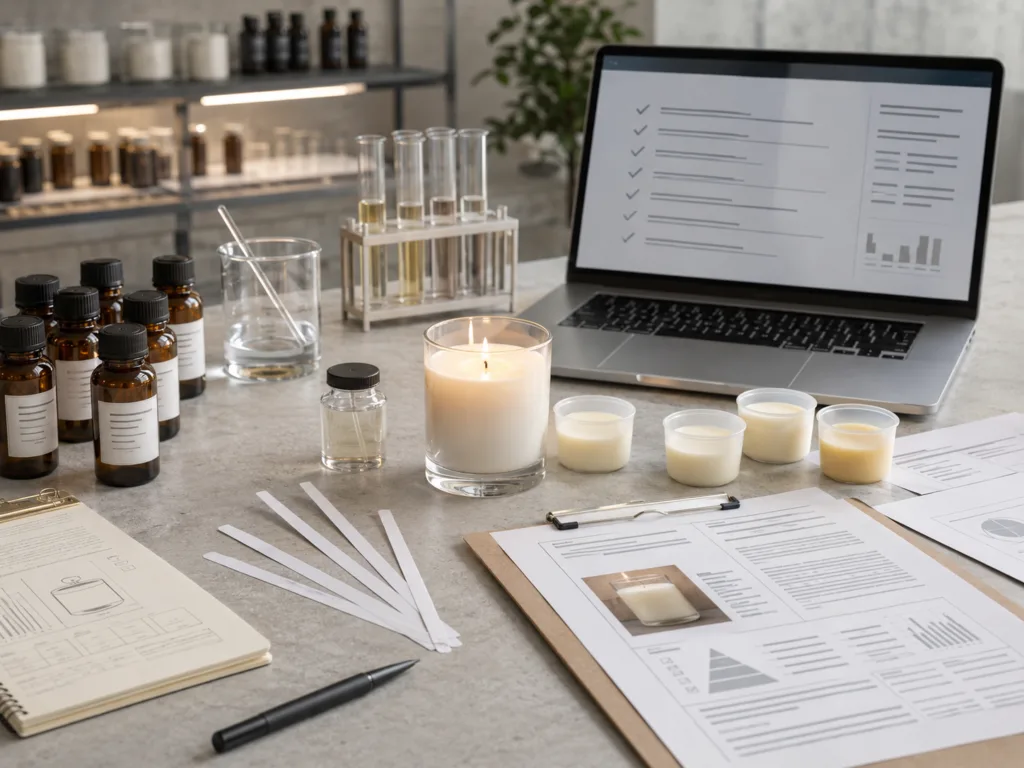
Fragrance is one of the most misunderstood parts of sustainable candle sourcing. Many buyers assume that essential oils are automatically better than fragrance oils. In reality, commercial candle development requires a balance between natural positioning, safety, scent performance, stability, cost, and documentation.
Essential oils can support a natural story, but not all essential oils are suitable for candle burning. Some are unstable under heat. Some have weak hot throw. Some are expensive. Some may contain naturally occurring allergens that still need proper labeling. Natural does not mean risk-free.
High-quality fragrance oils can be designed for candle use, offer better scent stability, and allow broader scent development. For B2B buyers, the more important question is not simply “natural or synthetic?” It is:
- Is the fragrance suitable for candle application?
- Can the supplier provide IFRA documentation?
- Can the finished scented candle be supported with SDS?
- Is the fragrance load appropriate for the wax system?
- Does the scent perform well in both cold throw and hot throw?
- Can the supplier reproduce the fragrance in bulk orders?
For mature brands, sustainability should be connected to compliance and performance. A beautiful fragrance concept is not useful if it cannot be documented, scaled, or repeated.
Sustainable Candle Vessels: Recyclable, Reusable, or Refillable?
The candle vessel affects appearance, cost, MOQ, shipping weight, breakage risk, and sustainability positioning.
Glass Jars
Glass is one of the most practical vessel choices for sustainable private label candles. It is recyclable, reusable, widely available, and visually flexible. Clear, amber, frosted, colored, and sprayed glass can support different brand styles.
For lower MOQ testing, stock glass jars are usually the best choice. A buyer can customize the label, lid, wax, fragrance, and box without investing in a custom mold. This is often the most realistic route for brands testing a new market.
Custom glass color, custom mold, special surface treatment, or exclusive jar shapes can increase MOQ and cost. For large orders, these options can create stronger brand differentiation, but buyers should not expect full vessel customization at very low quantities.
Ceramic Vessels
Ceramic vessels are excellent for premium home décor candles. They feel reusable, giftable, and design-driven. They are suitable for luxury candle brands, hotel retail products, interior boutiques, and high-end gift sets.
The trade-off is MOQ and breakage protection. Ceramic vessels usually require higher minimums, longer development time, more careful packaging, and stronger quality control. Custom ceramic development may not be commercially viable for small trial orders.
Metal Tins
Metal tins are practical for travel candles, outdoor candles, promotional gifts, and lightweight collections. They are less fragile than glass, easier to ship, and often more cost-effective.
However, they may not communicate the same premium value as glass or ceramic unless the design, label, and packaging are carefully developed. Tins are useful when portability and shipping efficiency matter more than luxury presentation.
Refillable Candle Systems
Refillable candle systems are one of the strongest sustainability concepts for mature brands. They can reduce packaging waste, increase customer retention, and turn one vessel into a repeat-purchase platform.
But refill systems require precise planning. The refill must fit the vessel, the wax shrinkage must be controlled, the consumer instructions must be clear, and the brand must plan replenishment inventory. A refillable candle is not just a candle; it is a product system.
Eco-Friendly Candle Packaging Options
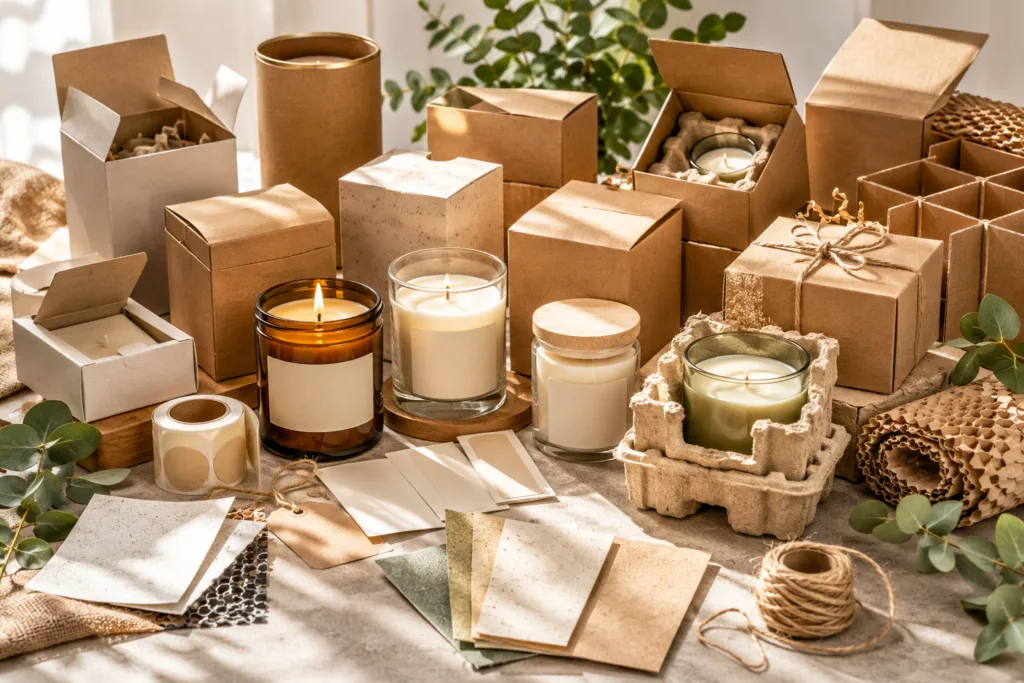
Packaging is where many sustainable candle projects become complicated. Buyers want recyclable, plastic-free, premium, low-cost, protective, and low-MOQ packaging at the same time. In reality, each packaging choice creates a trade-off.
Kraft Paper Boxes
Kraft paper boxes are popular for natural, minimalist, organic, handmade, and wellness brands. They communicate sustainability quickly and are usually more cost-effective than luxury rigid boxes. They work well for simple private label candle lines and small-to-medium wholesale orders.
Recycled Paper and FSC Paper Packaging
Recycled paper and FSC paper can support a more credible sustainability story. For brands selling into Europe, the UK, North America, or premium retail channels, paper sourcing claims should be handled carefully. If a brand wants to mention FSC packaging, it should confirm whether the material and printing supplier can support that claim properly.
Paper Tubes
Paper tube packaging can look premium and eco-conscious at the same time. It is suitable for single candles, wellness collections, gift candles, and boutique retail displays. However, tube packaging may have its own MOQ and tooling requirements, depending on size, printing, and finish.
Rigid Gift Boxes
Rigid boxes are often used for premium candle gift sets. They improve perceived value and protect the product better than simple folding cartons. But they also use more material, cost more, and usually require higher MOQ.
A rigid box can still be part of a sustainable product strategy if it is recyclable, made from responsible paper, designed without unnecessary plastic, and used for a product with high gift value. But it is not automatically the lowest-impact packaging option.
Plastic-Free Inserts and Protective Packaging
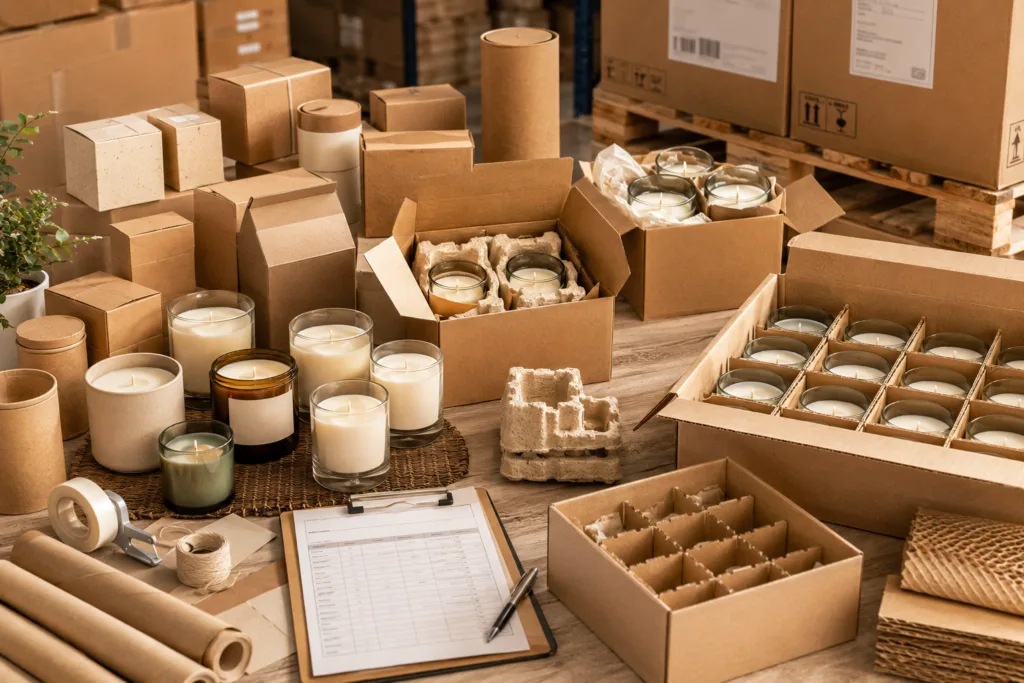
Plastic-free inserts may include molded pulp, corrugated paper dividers, kraft paper structures, or paper-based cushioning. These options can reduce plastic use, but buyers must test whether they protect the candle during export shipping.
This is critical: the most sustainable packaging is not simply the one with the least plastic. It must protect the candle. Broken glass, damaged wax, dented boxes, and rejected shipments are also waste.
For international candle orders, especially DDP shipping to the US, EU, UK, Canada, or Australia, packaging must be tested for protection, carton strength, weight, and handling conditions.
Certifications and Documents Buyers Should Ask For
Sustainable candle sourcing should never rely only on verbal claims. Mature buyers should ask suppliers what documents can support the product, fragrance, packaging, and export market.
Important documents may include:
- SDS for finished scented candles
- IFRA certificate for fragrance materials
- Allergen information when required by the target market
- ASTM-related candle fire safety support for the US market
- CLP labeling support for EU and UK markets when applicable
- FSC documentation if using FSC paper packaging
- Declarations for recycled, biodegradable, or special eco materials when relevant
- Product warning labels and candle care instructions
Not every project needs every document. Requirements depend on destination market, sales channel, product type, and brand claims. However, serious buyers should avoid suppliers who cannot discuss documentation clearly.
MOQ and Cost: Why Sustainable Candles Are Not Always Cheap
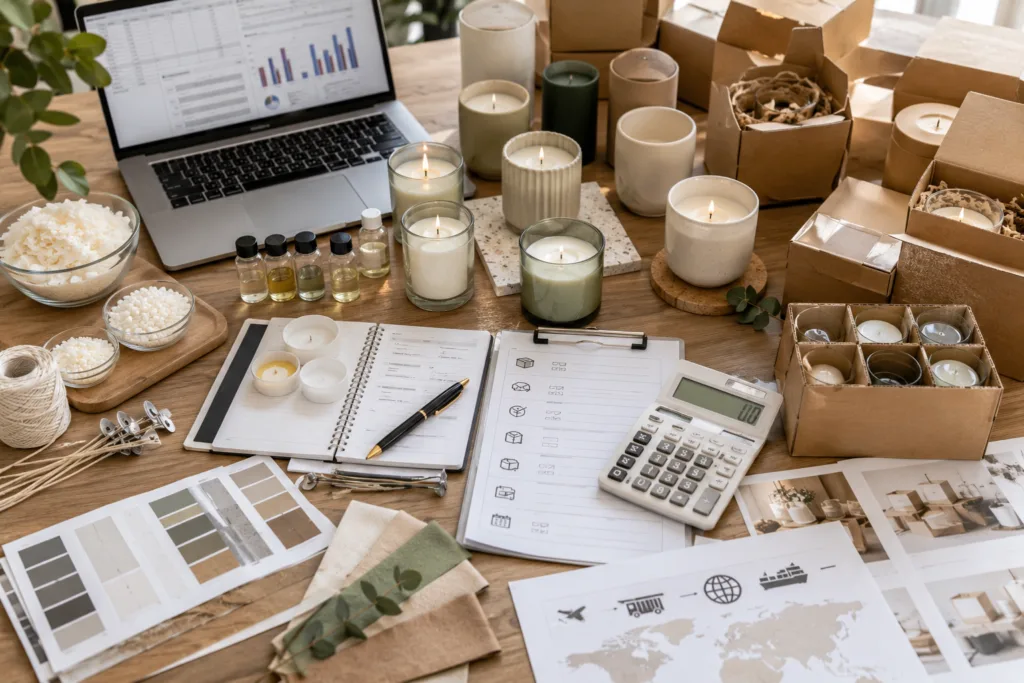
Many buyers assume sustainable materials should be simple and affordable. In reality, sustainable candle sourcing can increase cost and MOQ depending on the material choices.
Several factors affect price:
- Wax type and wax blend
- Fragrance quality and fragrance load
- Essential oil versus candle-grade fragrance oil
- Vessel material and customization level
- Label printing method
- Box material and structure
- FSC, recycled, or specialty paper requirements
- Plastic-free insert development
- Testing and documentation needs
- Export carton and protective packaging
- Shipping method and destination
A realistic low-MOQ sustainable candle usually uses stock components: existing glass jar, soy wax, available fragrance library, simple label, and standard paper packaging. This can be practical for a test order.
A more developed private label sustainable candle may include a custom fragrance, branded label, custom paper box, selected wax blend, and export-ready packaging. This is often more realistic at around 500 pieces or above, depending on the supplier and packaging design.
A fully custom sustainable candle line with custom vessel color, ceramic jar, exclusive fragrance, rigid gift box, molded pulp insert, FSC paper, and full documentation may require 1,000 pieces or more to make commercial sense.
For mature buyers, MOQ should not be seen only as a barrier. It is also a way to stabilize production, reduce per-unit cost, justify packaging development, and create better quality control.
How to Evaluate a Sustainable Candle Supplier
A good sustainable candle supplier should not simply say yes to every request. They should help the buyer understand what is practical, compliant, scalable, and cost-effective.
Before placing a large order, buyers should ask:
- What wax options do you recommend for our target market?
- Can you explain the difference between soy, beeswax, coconut blend, and other wax systems?
- Can you support custom fragrance development?
- Can you provide IFRA and SDS documents?
- What eco-friendly packaging options are realistic for our MOQ?
- Can you offer stock vessels for lower-MOQ testing?
- What is the MOQ for custom glass, ceramic, or special packaging?
- Can the packaging protect candles during international shipping?
- Do you support DDP, FOB, or other shipping terms?
- Can you help us plan samples, bulk production, and repeat orders?
The best supplier is not always the cheapest factory. For sustainable candles, the right supplier should understand materials, fragrance, packaging, compliance, export logistics, and brand positioning.
Common Mistakes Eco-Conscious Candle Brands Should Avoid
Mistake 1: Treating Soy Wax as the Whole Sustainability Story
Soy wax is useful, but sustainability also includes fragrance, vessel, label, box, insert, shipping, and end-of-life use.
Mistake 2: Making Vague Claims Like “Chemical-Free”
No candle is literally chemical-free. Better claims are specific and supportable, such as plant-based wax, recyclable glass jar, FSC paper box, or IFRA-compliant fragrance.
Mistake 3: Choosing Plastic-Free Packaging Without Drop Protection
For export orders, packaging must protect the candle first. A damaged shipment destroys margin and creates waste.
Mistake 4: Expecting Full Customization at Very Low MOQ
Custom vessel, custom box, custom insert, and custom fragrance all require development resources. Low MOQ projects should simplify the structure.
Mistake 5: Ignoring Fragrance Compliance
A scent may smell beautiful, but if the supplier cannot support documentation or repeat production, it is risky for serious retail buyers.
A Practical Development Roadmap for Sustainable Candle Buyers
Start by defining your sustainability priority. Do you care most about plant-based wax, plastic-free packaging, reusable vessels, FSC paper, refill systems, natural fragrance positioning, or lower shipping waste? Trying to optimize everything at once can make the project too expensive or too complex.
Next, choose the wax and fragrance system together. A fragrance that works well in soy wax may perform differently in beeswax or coconut blends. The supplier should test cold throw, hot throw, wick stability, wax surface, and burn pool.
Then select the vessel. For first orders, stock glass is often the best balance of sustainability, cost, MOQ, and visual quality. For premium launches, ceramic or custom vessels can work if the order quantity supports development.
After that, build packaging around both brand story and shipping protection. A sustainable package must be attractive on the shelf, clear for labeling, efficient in cartons, and strong enough for export handling.
Finally, confirm documentation, warning labels, sample approval, production timeline, and shipping terms before bulk production. Mature buyers should think beyond the first order and ask whether the product can be reordered smoothly.
Final Thoughts: Sustainable Candles Must Be Practical, Scalable, and Brand-Ready
Sustainable candles are a strong opportunity for eco-conscious brands, but only when the product is developed with commercial discipline. The goal is not to create the most complicated eco concept. The goal is to create a candle line that customers trust, retailers can sell, and buyers can reorder.
A truly sustainable candle should balance responsible materials, safe fragrance, reliable burn performance, protective packaging, clear documentation, realistic MOQ, and stable supply.
For brands planning large private label or wholesale candle orders, the best sourcing strategy is to start with a practical product architecture, test the right materials, simplify where necessary, and invest in customization where it actually improves retail value.
Circe Home supports eco-conscious candle brands with plant-based wax options, custom fragrance development, private label packaging, recyclable and plastic-reduced packaging solutions, compliance document support, sample development, bulk production, and export shipping coordination.
If you are developing a sustainable candle line for retail, gifting, hospitality, or wholesale distribution, we can help you evaluate the right wax, vessel, packaging structure, MOQ, and shipping plan for your market.
FAQ
1. What is the best wax for sustainable candles?
Soy wax is usually the most practical choice for private label sustainable candles because it is plant-based, widely available, cost-effective, and suitable for scented container candles. Beeswax, coconut blends, and rapeseed wax can also be used depending on brand positioning, budget, fragrance needs, and target market.
2. Are essential oil candles more sustainable than fragrance oil candles?
Not always. Essential oils can support a natural story, but some are expensive, unstable under heat, weak in scent throw, or difficult to document for candle use. High-quality IFRA-compliant fragrance oils may be more practical for commercial candle production because they offer better consistency, wider scent options, and stronger repeatability.
3. What is the MOQ for custom sustainable candles?
MOQ depends on the level of customization. A simple sustainable candle using stock glass, soy wax, existing fragrances, and standard paper packaging may be possible at lower quantities. Custom fragrance, custom box, or private label packaging often becomes more practical around 500 pieces. Full custom vessels, ceramic jars, rigid boxes, or molded inserts may require 1,000 pieces or more.
4. What packaging is best for eco-friendly candles?
The best packaging depends on the product and shipping method. Kraft paper boxes, recycled paper, FSC paper, paper tubes, and molded pulp inserts can all support sustainable positioning. However, candle packaging must also protect the product during international shipping. A plastic-free package that fails in transit is not a good sustainable solution.