
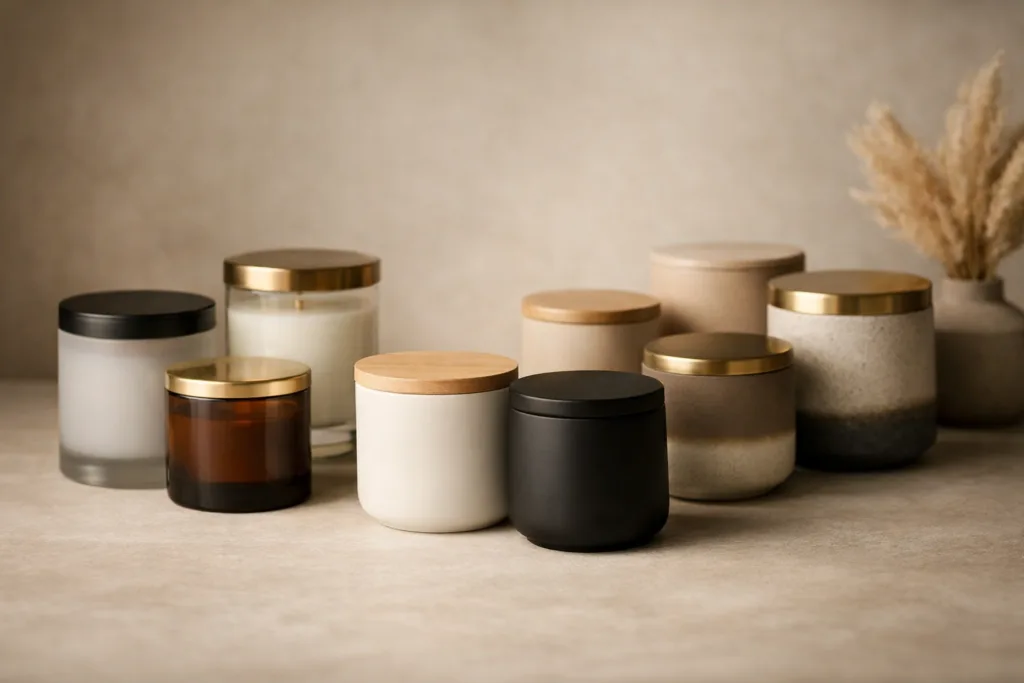
 If you’re building a luxury candle brand, you’ve probably been told some version of this:
- “To look premium, you need custom ceramic.”
- “To be unique, you need a bespoke vessel mold.”
- “To feel luxurious, you need rigid boxes from day one.”
That advice sounds elegant—but it can quietly destroy your launch.
Here’s the reality from the manufacturing side:
Most successful private label collections do not start with custom molds. They start with standard candle jars, then layer customization in a way that looks fully proprietary—without trapping the brand in high tooling costs, slow lead times, and unscalable SKUs.
This guide is built for real buyers: North American wholesalers, European retailers, and Oceania importers who want a premium collection that can scale. It explains the practical supply-chain logic behind “standard vs custom,” what “fully custom” actually means, and how to build a collection that looks high-end on shelf.
You’ll get:
- A 7-step system to make standard jars look fully custom
- Realistic MOQ logic (including the non-negotiable 1,000 pcs threshold for standard ceramic)
- A packaging ladder that protects margin and launch speed
- A “collection architecture” method used by premium brands
- Vendor questions that save you from expensive mistakes
1) What “Standard Candle Jars” Really Means in Manufacturing
In B2B sourcing, “standard” does not mean “generic.” It means:
- The jar shape already exists in a stable production line
- Dimensions are fixed and repeatable
- Lids and accessories have matching supply chains
- The manufacturer has established yields and quality control
- Reorder is reliable (you’re not rebuilding the product each time)
A standard jar is essentially a ready-made industrial platform. You can still create a luxury product—but you’re doing it by customizing the layers that customers actually notice:
- fragrance identity
- visual branding
- packaging engineering
- collection architecture
- finish and texture details
That’s why “standard jar + strong system” often looks more premium than “custom jar + messy execution.”
Luxury is coherence, not chaos.
2) Why Luxury Candle Brands Start With Standard Jars
A luxury candle brand has two jobs at launch:
- Look premium immediately (so the shelf price makes sense)
- Stay flexible (so you can iterate fast and scale what sells)
Custom molds fight job #2.
The three hidden risks of custom molds
Risk A: You lock your cash into tooling instead of marketing.
A custom vessel mold eats budget before you’ve proven demand.
Risk B: You lengthen your timeline (and miss seasonal windows).
Luxury candles are seasonal by nature. A slow mold timeline means you can easily miss Q4 gifting.
Risk C: You make reorders harder, not easier.
If the mold is exclusive but unstable, every reorder is a stress test.
That’s why many premium buyers start with standard jars and focus on:
- a signature scent profile
- brand storytelling
- packaging that feels deliberate
- consistent visual system
In other words: the parts that customers reward.
3) The 7-Step System to Make Standard Jars Feel Fully Proprietary
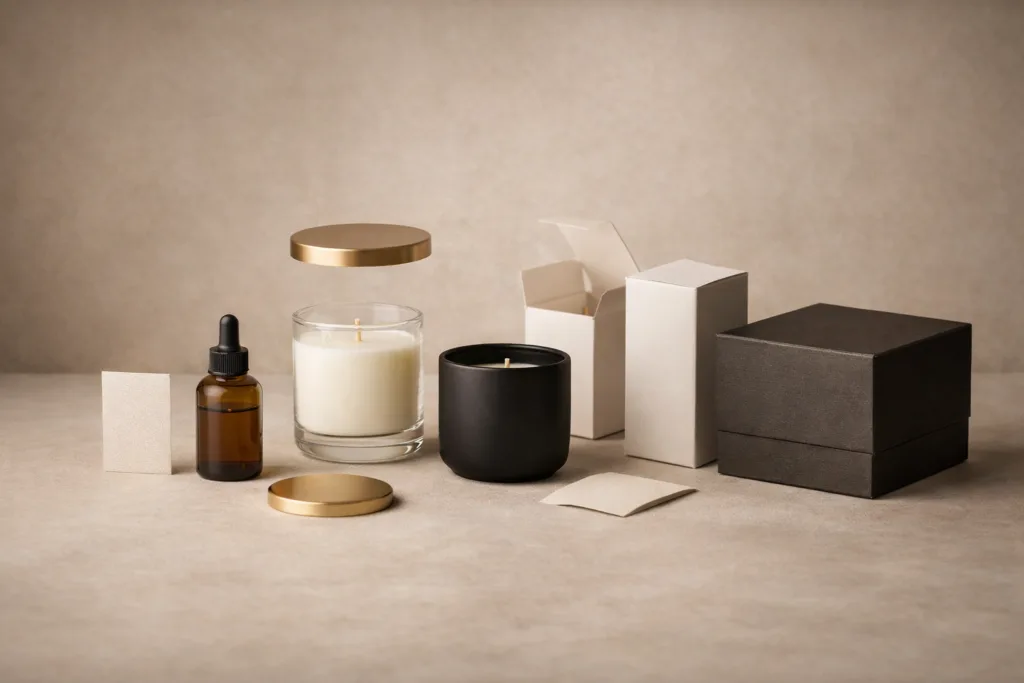 If you want “fully custom private label,” don’t start with a mold. Start with a system.
Step 1 — Define your luxury anchor: price point + channel
Before you pick a jar, decide:
- Your target retail price (example: $28, $38, $52)
- Your channel (boutique retail, hotel/spa, corporate gifting, e-commerce)
A jar that works for boutique retail may fail for hotel gifting due to breakage and logistics.
Rule: choose the jar that supports your channel economics.
Step 2 — Choose a jar “family,” not a single SKU
Luxury brands don’t build one candle. They build a collection architecture:
- core size (e.g., 8 oz / ~240–260g wax)
- hero size (e.g., 10–12 oz)
- travel / tin size
- gift set format (2 pcs or 3 pcs)
This creates a ladder for average order value and wholesale reorders.
Step 3 — Lock your fragrance strategy early
Fragrance is the fastest way to feel proprietary.
Two common luxury approaches:
- Signature house accord: your base DNA across multiple scents
- Collection storytelling: a themed set (coastal, botanical, noir, seasonal)
For private label buyers, the simplest scalable model is:
- 1 signature scent (anchor)
- 2 bestsellers (broad appeal)
- 1 seasonal drop (limited)
This is enough to look like a “real brand” without SKU explosion.
Step 4 — Use visual branding layers that look expensive
On the shelf, customers don’t read your factory story. They read visual cues.
High-impact customization layers:
- label material: textured paper, cotton paper, soft-touch
- finishes: hot foil, emboss, deboss, spot UV
- print discipline: fewer colors, better typography
- icon system: consistent scent icons or collection symbols
Luxury is often less ink, more restraint.
Step 5 — Pick one “premium detail” and repeat it
Luxury brands win by repeating a detail consistently:
- a signature lid finish
- a recurring metallic accent
- a consistent label placement ratio
- a unified color palette across scents
Random premium details look like cheap variety. A repeated premium detail looks intentional.
Step 6 — Build a packaging ladder
Don’t jump straight to rigid boxes unless your channel demands it.
Use a ladder:
- white box (fast testing)
- printed folding carton (brand scale)
- rigid gift box (premium gifting)
The ladder protects your cash flow and makes iteration fast.
Step 7 — Plan for logistics and reorders
Luxury must survive real-world shipping.
Before you commit, check:
- carton count per master carton
- breakage protection (insert, partition)
- total shipping weight per case
- warehouse replenishment needs
A candle that looks luxurious but arrives damaged is not luxury.
4) Standard Glass Candle Jars: The Low-Risk Luxury Entry
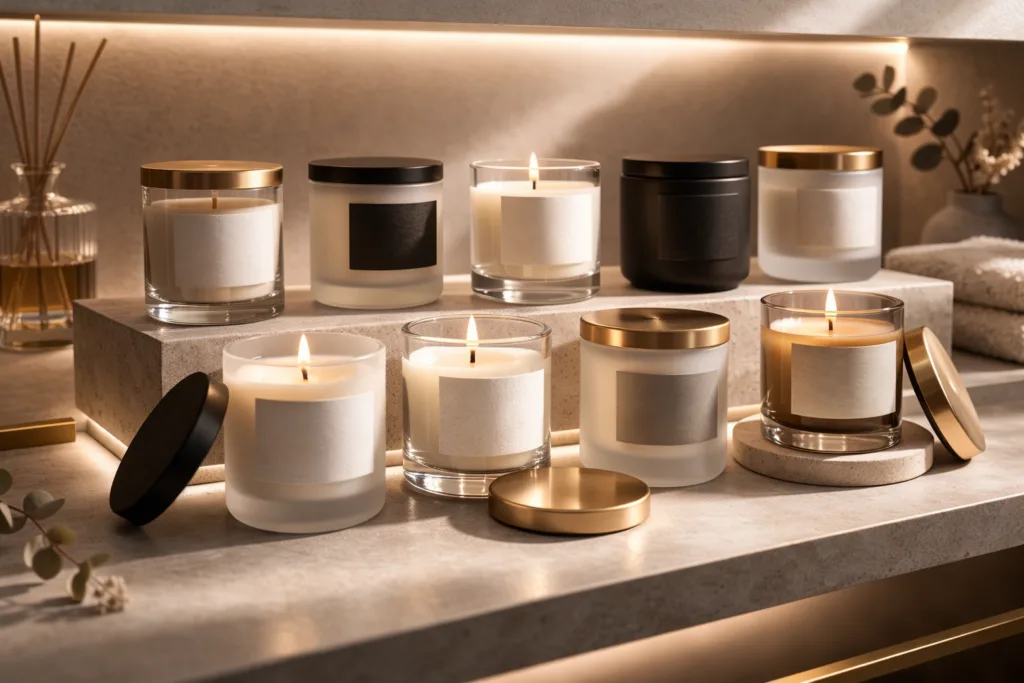 Glass is the most common “premium entry” vessel because the supply chain is mature.
Why glass works for private label luxury
- Stable dimensions and consistent production
- Lower MOQ possibilities
- Faster sampling and lead time
- Better price-to-premium ratio
- Easier labeling and printing options
Typical MOQ range for glass (practical reality)
Depending on decoration method:
- standard glass + label: can be as low as 100 pcs (for testing)
- standard glass + custom color spray: usually 500–1,000 pcs
- standard glass + direct screen printing: often 1,000 pcs per design
If you’re launching a new luxury candle brand and you want speed, standard glass with premium labeling is often the most efficient path.
Glass finish options that look premium
- clear glass with minimal label (modern)
- frosted glass with tonal printing (spa/hotel feel)
- matte black glass with foil label (noir luxury)
- tinted glass (amber, smoke, deep green) for brand mood
Lid choices that change perceived value
Lids often create the “luxury click” more than the jar itself.
Common premium options:
- metal lids (matte black, brushed gold)
- wooden lids (beech, walnut) with seal ring
- glass lids (heavy feel, boutique style)
In many cost structures, the lid and packaging drive more perceived value than upgrading wax type.
5) Standard Ceramic Candle Jars: Premium Look, 1,000 pcs MOQ Reality
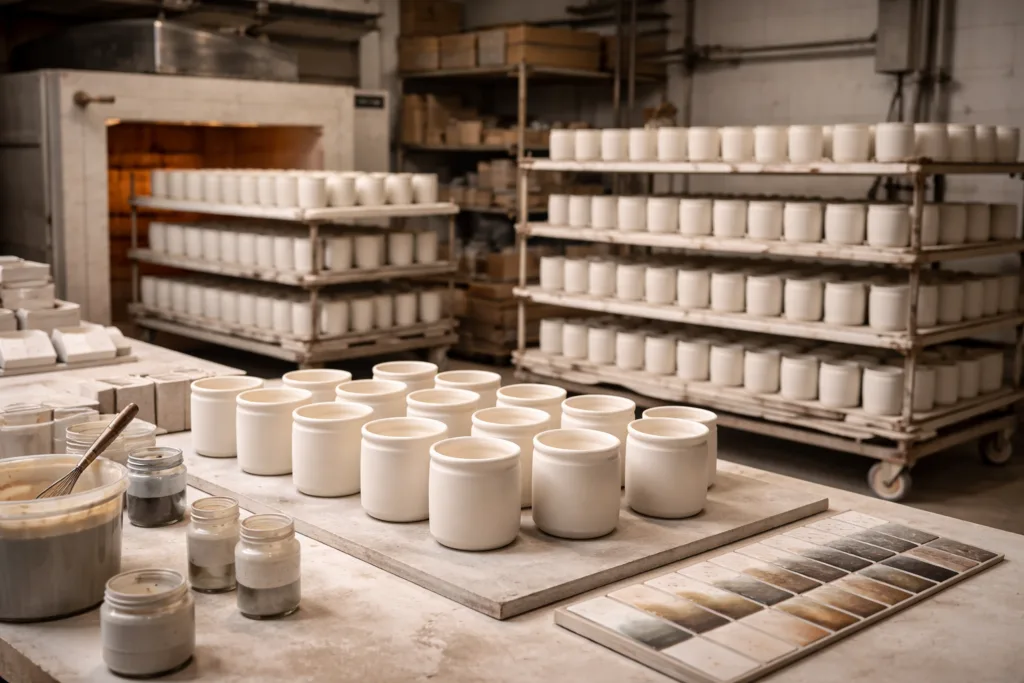 Ceramic candle jars are visually powerful. They can instantly read as “designer” and “boutique.”
But ceramic is not glass. The manufacturing logic is fundamentally different.
The truth buyers need to hear (without sugar-coating)
Even if the shape is “standard,” ceramic production involves:
- kiln firing cycles
- glaze preparation and testing
- color consistency control (batch variance is real)
- higher rejection rates
- more complex scheduling
Because of this, standard ceramic jars typically require:
MOQ: 1,000 pcs per style
And for fully custom ceramic molds:
2,000–3,000 pcs or more
This is not a supplier being difficult. It’s production viability.
A ceramic factory can’t efficiently run 300–500 pcs because kiln loads, glaze batches, and labor allocation don’t scale down nicely. Small runs create disproportionate setup cost and yield instability.
When ceramic is the right decision
Choose standard ceramic when you:
- are already confident in reorder volume
- target premium retail / boutique distribution
- need shelf differentiation as a core strategy
- plan to scale 1,000+ units per SKU
When you should be cautious (and why it’s smart)
Be cautious if you:
- are launching your first collection
- are still testing scent demand
- haven’t proven reorders
- are uncertain about channel performance
In those cases, a smart luxury approach is:
- launch with standard glass (low risk, fast)
- validate bestsellers and reorder behavior
- upgrade the winning SKUs into ceramic later
This creates a luxury brand trajectory that investors and retailers respect: prove demand, then elevate packaging and vessel.
Ceramic details that truly look high-end
If you commit to 1,000 pcs, make it count. Premium ceramic cues include:
- matte exterior with glossy interior glaze
- reactive glaze (subtle variation, artisan feel)
- tonal color system across scents
- soft-touch coating
- clean, thick-walled silhouette
Avoid: overly complex shapes that increase defect rate and breakage.
6) Metal Tins and Travel Formats: How Luxury Brands Use Them
Tins are often dismissed as “cheap,” but that’s a positioning problem, not a material problem.
Luxury brands use tins for:
- travel sets
- discovery kits
- subscription formats
- add-on items that raise AOV
Why tins are operationally smart
- lower shipping weight
- lower breakage risk
- easy to bundle into gift sets
- strong margin when branded correctly
To make tins feel luxury:
- avoid thin, flimsy lids
- use matte coatings or textured labeling
- design a cohesive color system
- add a premium outer box or sleeve
A tin can feel premium if it looks like part of a deliberate collection.
7) Packaging Ladder: White Box → Printed Box → Rigid Gift Set
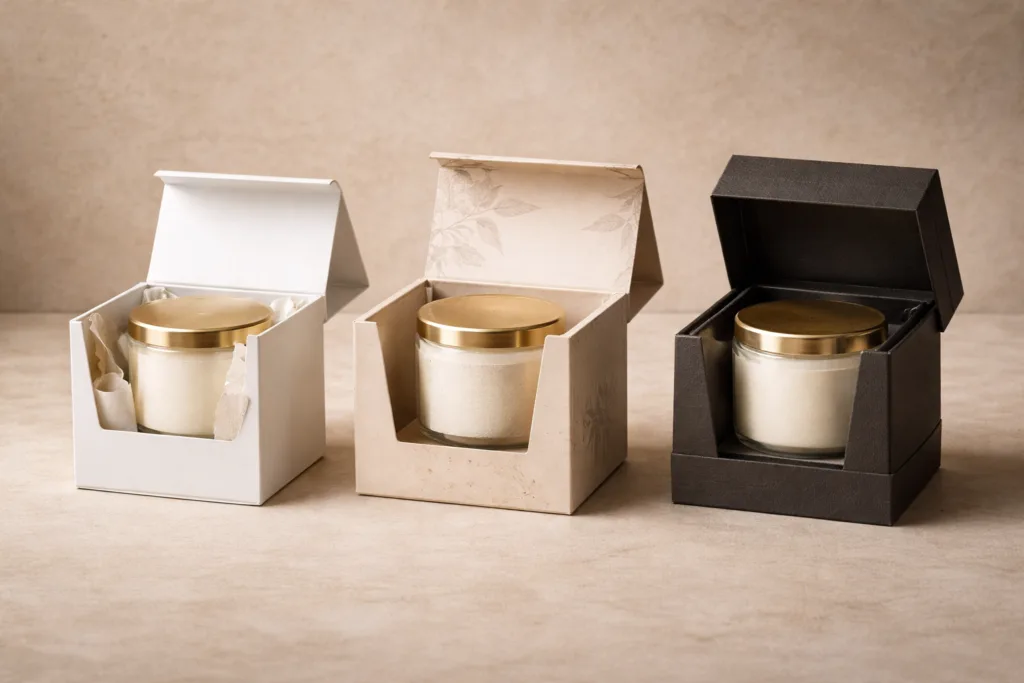 Packaging is where most brands accidentally destroy margin.
They jump into rigid boxes too early, then wonder why they can’t scale.
Level 1: White box (fast testing)
Use when:
- you’re testing the market
- you’re verifying scent performance
- you need speed and flexibility
White boxes can still look premium when paired with:
- strong label design
- consistent branding
- an intentional seal sticker
Level 2: Printed folding carton (brand scale)
This is the workhorse of private label luxury.
It gives you:
- shelf presence
- brand storytelling space
- stable retail packaging
Typical MOQ often starts around 1,000 pcs per design (varies by supplier and finish).
Level 3: Rigid gift box (gifting and premium programs)
Rigid boxes work when:
- your channel is gifting-focused
- your retail price supports it
- you want high perceived value and unboxing experience
But rigid boxes add:
- cost
- weight
- shipping volume
A luxury candle brand wins when packaging is used strategically—not emotionally.
8) Pricing and Margin: What Actually Drives Cost in Luxury Candles
A common misconception:
“Luxury candle cost is mainly about wax.”
In reality, for many premium private label projects, the bigger cost drivers are:
- vessel (especially ceramic)
- packaging (especially rigid)
- decoration (foil, emboss, screen printing)
- logistics (weight and breakage protection)
Wax matters—but it’s rarely the #1 driver.
A grounded way to think about cost
Instead of asking “What’s the cheapest candle?” ask:
- What retail price am I targeting?
- What margin do I need at wholesale?
- What packaging level supports that price?
A luxury candle brand must protect margin, because marketing and retail distribution are expensive.
If you under-budget packaging and vessel, your shelf price collapses. If you over-budget too early, your cash flow collapses.
The right answer is a system.
9) Compliance and Market Readiness (US/EU) Without Slowing Launch
For US and EU markets, luxury doesn’t excuse compliance. Retailers will ask.
Areas you should plan for:
- CLP labeling for EU
- IFRA fragrance compliance
- proper warning labels and burn instructions
- carton labeling consistency
- packaging materials requirements (where applicable)
A supplier that can support the compliance workflow is not a “nice to have.” It’s part of scaling.
For many private label buyers, the best approach is:
- start with compliant, tested fragrance options
- align label format early
- keep packaging structure stable to reduce rework
10) Mistakes That Make “Luxury” Look Cheap
Mistake 1: Too many SKUs too early
Luxury is consistency. Too many scents, too many jar types, too many colors = chaos.
Mistake 2: Random packaging upgrades
A rigid box doesn’t fix a weak label system.
Mistake 3: Ignoring lid and finish details
Lids and tactile finishes are the “luxury cues” customers notice.
Mistake 4: Weak typography
Luxury brands are typography brands.
Mistake 5: No collection architecture
If customers don’t understand your range, they won’t buy multiples.
11) Buyer Checklist: What to Send a Supplier for Accurate Quoting
If you want a quote that’s actually usable, send:
- Target market: US / EU / AU
- Channel: retail, hotel/spa, corporate gifting, e-commerce
- Estimated order quantity per SKU
- Preferred vessel type: glass / ceramic / tin
- Size preference (oz or ml)
- Lid preference
- Packaging level (white box, printed carton, rigid gift box)
- Number of scents
- Target retail price range
- Timeline (launch window)
This reduces back-and-forth and prevents inaccurate assumptions.
12) FAQs
Can standard candle jars still feel fully custom?
Yes—if fragrance, branding, and packaging are built as a coherent system. “Fully custom” is usually a layered result, not a mold.
What MOQ should I expect for a first luxury launch?
A practical entry is often standard glass with premium labeling at 100–500 pcs for testing, then scaling into printed cartons.
What is the MOQ for standard ceramic candle jars?
In most real manufacturing scenarios, standard ceramic jar MOQ is 1,000 pcs per style.
When should I invest in custom ceramic molds?
When you have reorder confidence and can support 2,000–3,000 pcs+ per design without squeezing cash flow.
What’s the fastest way to look premium on shelf?
Strong typography + premium label material + coherent color system + a lid that feels intentional.
Closing: The Luxury Shortcut Is Not a Mold—It’s a System
If you want to build a luxury candle brand that looks premium and scales, the smartest play is:
- Start with standard candle jars
- Build a proprietary system around fragrance, design, and packaging
- Use MOQs strategically (glass for speed, ceramic for proven scale)
- Upgrade the winners—not the guesses
That’s how modern private label collections launch like established brands.
If you’re building a new collection and want a manufacturer-style recommendation (jar family + MOQ plan + packaging ladder), Circe Home typically starts by reviewing your target channel, price point, and quantity so the collection is feasible from day one.