
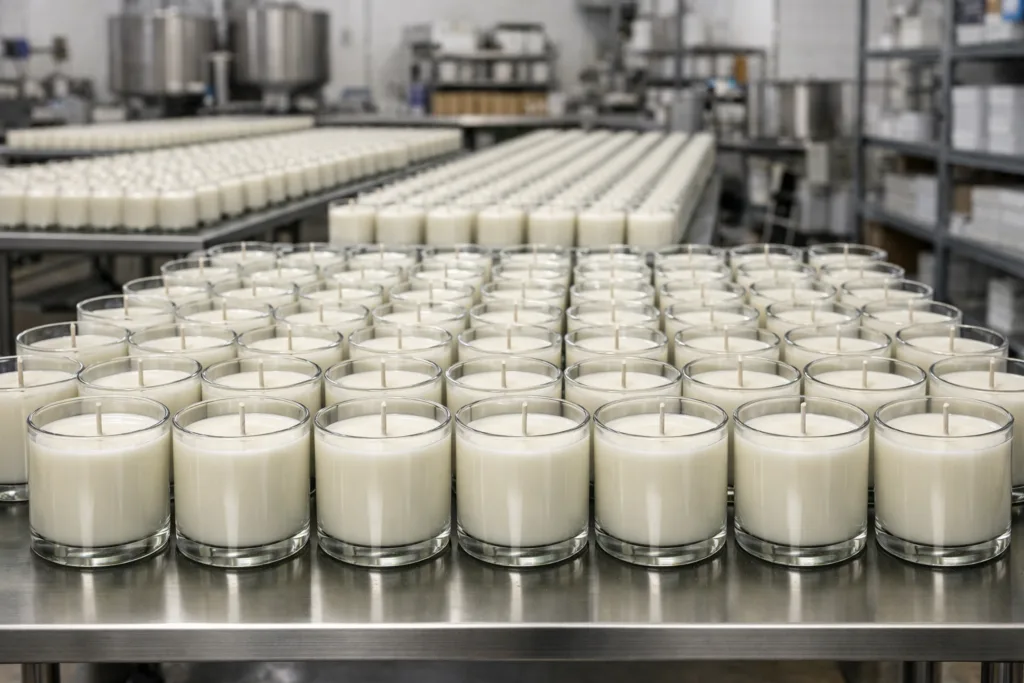
 Seasonal candles are everywhere.
Every holiday, every gifting season, every peak retail moment brings a wave of limited-edition candles into the market. New scents. New packaging. New storytelling. On the surface, they look like fast wins — visually strong, emotionally appealing, and easy to sell.
And yet, for many brands and buyers, seasonal candles quietly become one of the most inefficient parts of the business.
They sell — but they don’t scale.
They generate excitement — but not repeatable systems.
They move during the holiday — and turn into dead inventory right after.
This article is not written for hobby brands, one-off holiday projects, or low-volume experiments.
It is written for mature buyers, retailers, distributors, and brand owners who care about:
- Predictable demand planning
- Stable margins at scale
- Repeatable production models
- MOQ-efficient manufacturing
- Long-term supplier relationships
If you are sourcing 1,000+ units per SKU or planning to, seasonal candles should not be treated as creative side projects.
They should be treated as commercial systems.
1. The Core Misunderstanding About Seasonal Candles
Most seasonal candle strategies fail because they start with the wrong question.
The usual question is:
“What should we design for this holiday?”
The better question is:
“How does this holiday fit into our annual production and sales system?”
Seasonal demand is not random.
It is cyclical, predictable, and recurring.
Christmas comes every year.
Valentine’s Day comes every year.
Mother’s Day, autumn gifting, year-end corporate orders — none of these are surprises.
Yet many brands behave as if each season is a first-time event.
They redesign everything:
- New candle sizes
- New vessels
- New wax formulas
- New packaging structures
From a manufacturing and inventory perspective, this is a structural mistake.
If a seasonal candle can only be sold once, it is not a scalable product. It is a design project.
And design projects do not scale.
2. Why Seasonal Candles Look Profitable but Rarely Scale
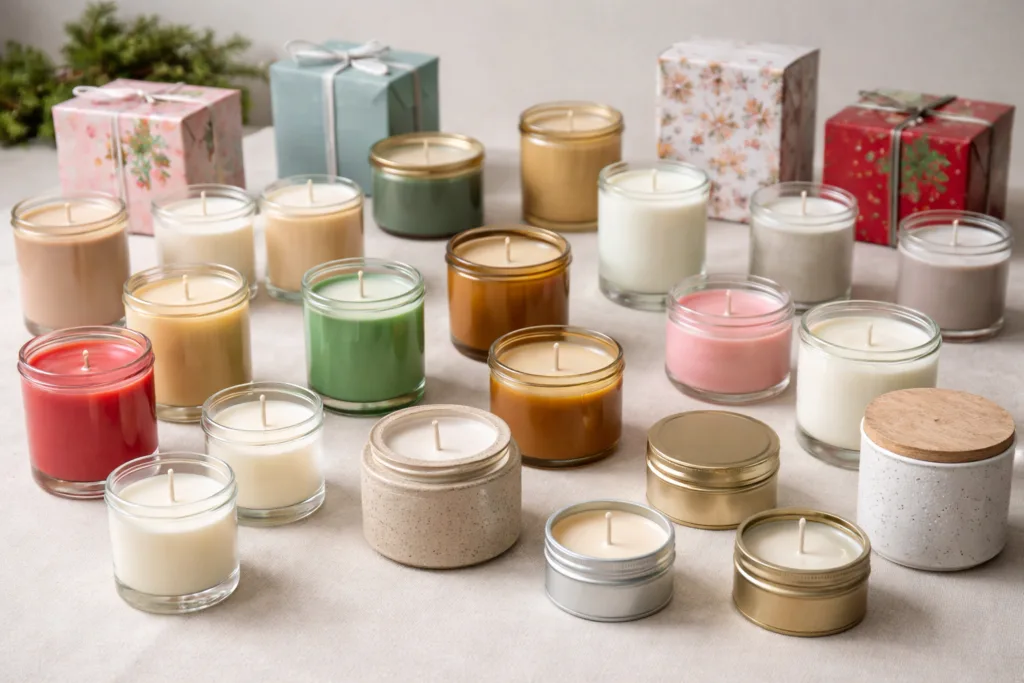 From the outside, seasonal candles appear to be high-margin products.
They are giftable, premium-positioned, and emotionally driven.
But once you look at them from a production and supply-chain perspective, three problems appear immediately.
2.1 Fragmented SKUs Destroy Efficiency
Seasonal collections often multiply SKUs:
- Multiple limited scents
- Multiple colors
- Multiple packaging formats
Each variation reduces production efficiency.
At low volumes, this may be manageable.
At 1,000+ units per SKU, it becomes expensive fast.
Factories price stability, repetition, and predictability.
Seasonal chaos does the opposite.
2.2 Seasonal Packaging Creates Hidden MOQ Traps
Custom seasonal packaging is one of the biggest cost traps.
Unique rigid boxes, inserts, special finishes, or unusual dimensions often push packaging MOQs far beyond candle MOQs.
Brands end up in one of two bad positions:
- Over-ordering packaging to meet MOQ
- Downgrading materials to stay within budget
Neither supports scale.
2.3 Post-Holiday Inventory Risk Is Real
A candle that visually screams “Christmas” on December 26 has almost zero commercial value.
Seasonal overstock ties up cash, warehouse space, and attention.
At scale, inventory mistakes hurt more than missed sales.
3. Scalable Seasonal Candle Strategy: The Fundamental Principle
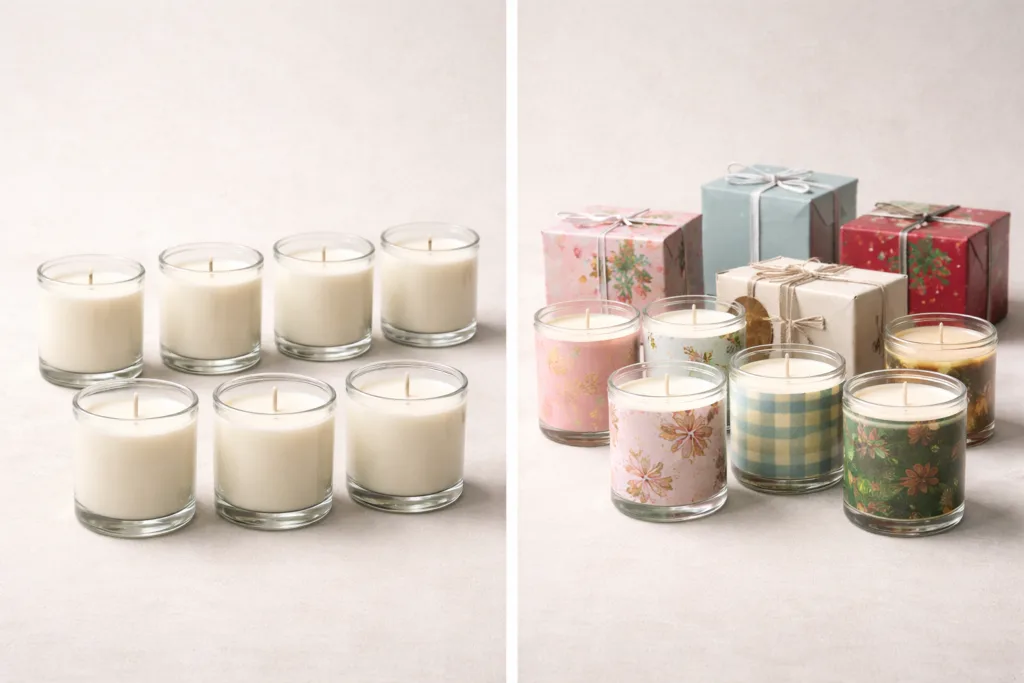 Scalable seasonal candles are built on one principle:
Keep the product system stable. Change the seasonal layer.
This is where mature buyers think differently from emerging brands.
3.1 The Stable Core (What Should Not Change)
A scalable seasonal candle shares its core with your year-round collection:
- Standardized vessel (glass, ceramic, or tin already in production)
- Fixed fill volume and burn time
- Proven wax formula
- Existing wick and safety testing
- Established supplier and MOQ structure
From a factory’s perspective, this is not a new product.
It is a variation of an existing one.
That distinction matters.
It lowers unit cost, improves consistency, and increases production priority.
3.2 The Seasonal Layer (What Can Change Safely)
Seasonality should live in layers that are cheap to change and easy to remove:
- Fragrance combinations (using existing fragrance library)
- Outer packaging (sleeves, labels, wraps)
- Color stories
- Naming and messaging
- Gift set configuration
This allows brands to create seasonal relevance without breaking the production system.
4. Fragrance Strategy: Seasonal Without Reinventing the Formula
One of the most common mistakes in seasonal planning is over-developing new scents.
From a buyer’s perspective, fragrance development is expensive, time-consuming, and risky.
A more scalable approach:
- Maintain a core fragrance palette
- Recombine notes for seasonal storytelling
- Rename and reposition, not reformulate
For example:
- A woody-amber base can become “Winter Hearth”
- A floral-citrus blend can become “Spring Light”
- A vanilla-based profile can shift between autumn and holiday gifting
This reduces:
- Development cost
- Testing cycles
- MOQ pressure on fragrance oils
And it increases:
- Speed to market
- Consistency across seasons
- Reorder potential
5. Packaging Strategy That Survives Beyond the Holiday
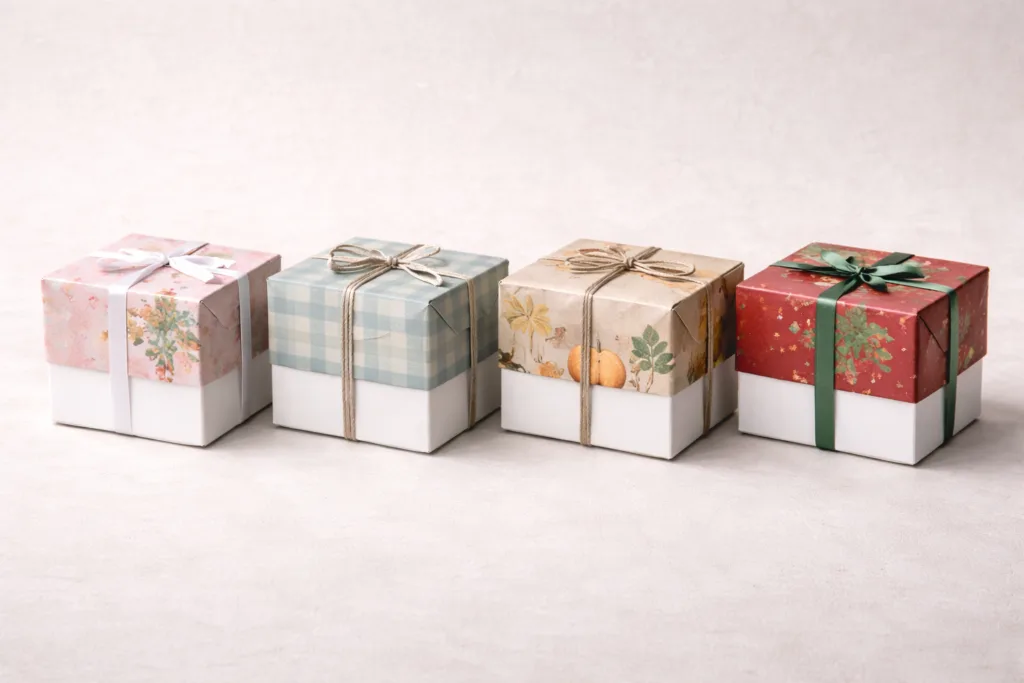 Packaging determines whether a seasonal candle is a one-time product or a reusable asset.
5.1 Avoid Single-Use Structural Packaging
Structural packaging should be season-neutral:
- Same box size year-round
- Same insert structure
- Same protection level
Seasonal expression should be added via:
- Printed sleeves
- Belly bands
- Stickers
- Color shifts
This allows unused packaging to roll into the next season.
5.2 Plan Packaging MOQ Backwards From Candle Volume
If your candle MOQ is 1,000 units, your packaging system must support that number.
Experienced buyers plan packaging after confirming:
- Annual volume
- Seasonal split
- Reorder frequency
Not the other way around.
6. Annual Seasonal Mapping: Thinking in Cycles, Not Campaigns
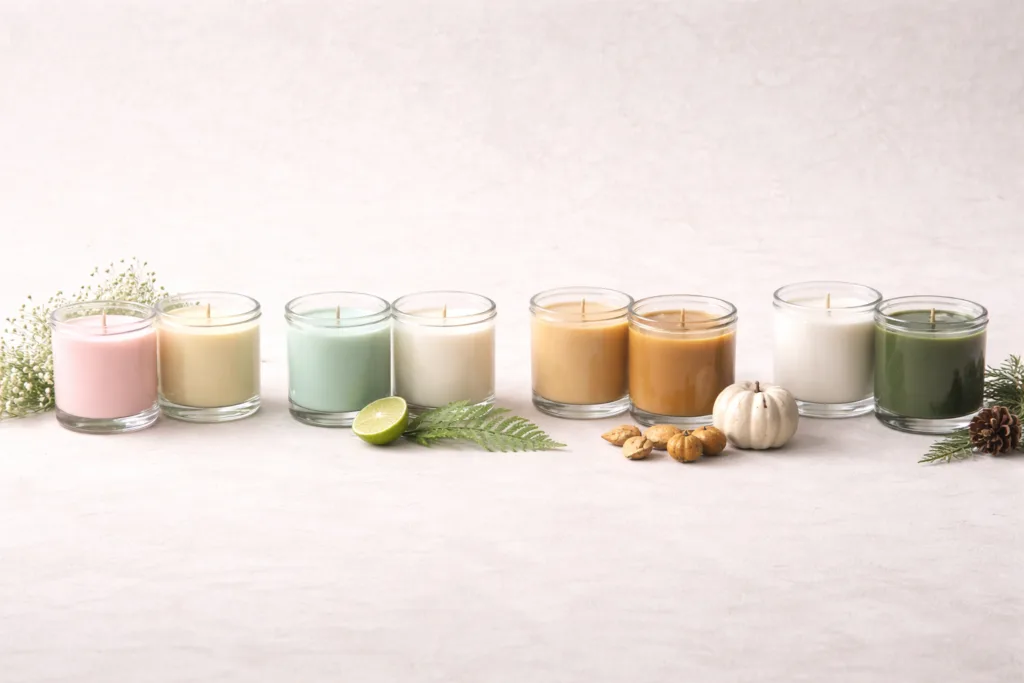 Seasonal candles should be planned on a 12-month calendar, not a holiday-by-holiday basis.
A scalable framework looks like this:
- Q1: Valentine’s / Spring gifting
- Q2: Mother’s Day / Home refresh
- Q3: Autumn transition / Pre-holiday buildup
- Q4: Holiday gifting / Corporate orders
Each season draws from the same production base.
What changes is the story.
This allows factories to forecast, buyers to budget, and brands to scale without chaos.
7. How Seasonal Candles Actually Drive Year-Round Sales
Seasonal candles should not replace core collections.
They should accelerate them.
At scale, seasonal products serve three commercial purposes:
7.1 Creating Reorder Momentum
Seasonal launches give retailers a reason to reorder core SKUs.
7.2 Increasing Average Order Value
Gift-oriented products raise basket size naturally.
7.3 Testing Without Risk
Seasonal variants are controlled environments for testing new directions without committing to permanent SKUs.
8. What Mature Buyers Do Differently
Buyers sourcing at scale rarely ask:
“Can we make something completely new?”
They ask:
“How does this fit into what already works?”
They prioritize:
- MOQ efficiency
- Supplier stability
- Packaging reuse
- Inventory flexibility
Seasonal candles are not emotional decisions.
They are operational ones.
9. From Seasonal Products to Repeatable Systems
A seasonal candle strategy is successful when:
- The factory sees it as a variation, not a disruption
- Packaging can be reused or adapted
- Fragrance development stays controlled
- Inventory risk is minimized
- Reorders are easy
If your seasonal candles disappear after the holiday, the problem is not demand.
It is structure.
Seasonality should amplify your business — not fragment it.
Frequently Asked Questions
1. What is the ideal MOQ for scalable seasonal candles?
For brands aiming at stable margins and supplier priority, 1,000 units per SKU is typically the threshold where seasonal candles become commercially efficient.
2. Can seasonal candles work for smaller volumes?
They can, but the strategy must be simplified. At low volumes, reuse of vessels, wax, and packaging is even more critical to avoid cost inflation.
3. How far in advance should seasonal candle production be planned?
For reliable delivery and cost control, planning should start 6–9 months ahead, especially when packaging customization is involved.