

Introduction
Launching a candle line looks deceptively easy from the outside. A customer sees a finished candle on a shelf, notices the vessel, the fragrance, the label, the gift box, and maybe the mood it creates in a room. What they do not see is the chain of commercial decisions behind that object: vessel sourcing, wax performance, fragrance compatibility, carton sizing, master case planning, compliance documentation, production scheduling, freight efficiency, and the constant negotiation between visual ambition and operational reality.
For startups, that complexity can be overwhelming. For established brands, it becomes even more important. A founder building a first collection may be trying to make the brand real for the first time. A mature retailer or lifestyle company expanding an existing home fragrance line may be trying to protect margin, reduce development risk, maintain consistency across SKUs, and create a product system that can scale across multiple markets.
That is why the real question is not simply how to make a candle. The real question is how to launch a candle line in a way that makes commercial sense.
At Circe Home, we work with brands that want more than a pretty sample. They need a product line that can survive contact with the market. That means the candle has to look right, burn well, ship safely, fit the budget, match the target price architecture, and leave room for future expansion. In many cases, what begins as a startup launch strategy eventually becomes the same framework used by more mature brands when they add seasonal collections, gift sets, hotel amenities, retail exclusives, or new scent families.
This article breaks down how we helped a startup launch its candle line, but the lessons go far beyond early-stage founders. The same decisions apply to premium retailers, boutique hotel groups, interior design brands, wellness concepts, beauty labels, subscription businesses, and home fragrance companies preparing to expand. If you are thinking about launching a candle line, or extending one you already have, this is the strategic roadmap that matters.
Why Launching a Candle Line Is More Complex Than Most Brands Expect
Many buyers begin with a visual reference. They know what they want the candle to feel like: quiet luxury, apothecary, sculptural, spa-like, minimalist, festive, romantic, editorial, giftable, or hotel-inspired. But product development does not start with mood alone. A commercial candle line requires alignment across at least seven core layers:
- Positioning: Who is the customer, and where will the product be sold?
- Price architecture: What retail price does the market support, and what landed cost does that imply?
- Vessel strategy: Glass, ceramic, tin, concrete-look composite, or something else?
- Wax and wick system: Performance must match the vessel, fragrance load, and room expectation.
- Fragrance strategy: How many scents should launch initially, and how distinct should they be?
- Packaging system: Does the brand need shelf presence, gifting capability, e-commerce protection, or all three?
- Scalability: Can the collection expand into gift sets, wax melts, travel sizes, or seasonal editions later?
The mistake many smaller brands make is assuming all seven decisions can be customized heavily from day one. The mistake many larger brands make is the opposite: assuming they can simply add another candle SKU without rebuilding the underlying system.
In reality, successful candle development is not about saying yes to every idea. It is about choosing the right constraints.
The Client Brief: From Brand Ambition to Market Reality
The project began with a familiar request. The client was building a premium lifestyle startup and wanted to enter the home fragrance category with a private label candle collection. The visual direction was strong. The founder had references, packaging ideas, scent preferences, and a clear aspiration for how the candles should be perceived. The challenge was that the initial concept was much broader than the budget and launch timeline could support.
The original concept included multiple candle sizes, several vessel directions, a relatively wide fragrance lineup, and packaging ambitions that leaned closer to a fully mature luxury brand than to a first production run. None of these ideas were bad. The issue was sequencing.
This is where many launches start to drift. Founders and brand teams often try to build the final version of the business during the first order. But the first line should not do everything. It should prove the commercial model.
So before discussing sample costs or production timelines, we pushed the conversation back to fundamentals:
- What channel would carry the first orders?
- Was the product aimed at boutiques, online DTC, hotel gifting, department-store style retail, or event business?
- What retail price range was realistic?
- Was the first goal visibility, margin, repeatability, or category expansion?
- Would the candle line remain a stand-alone product category, or become a foundation for future extensions such as wax melts, room sprays, and gift sets?
Once those questions were clarified, the path became much more disciplined.
Lesson 1: Start with a Product System, Not Just a Candle
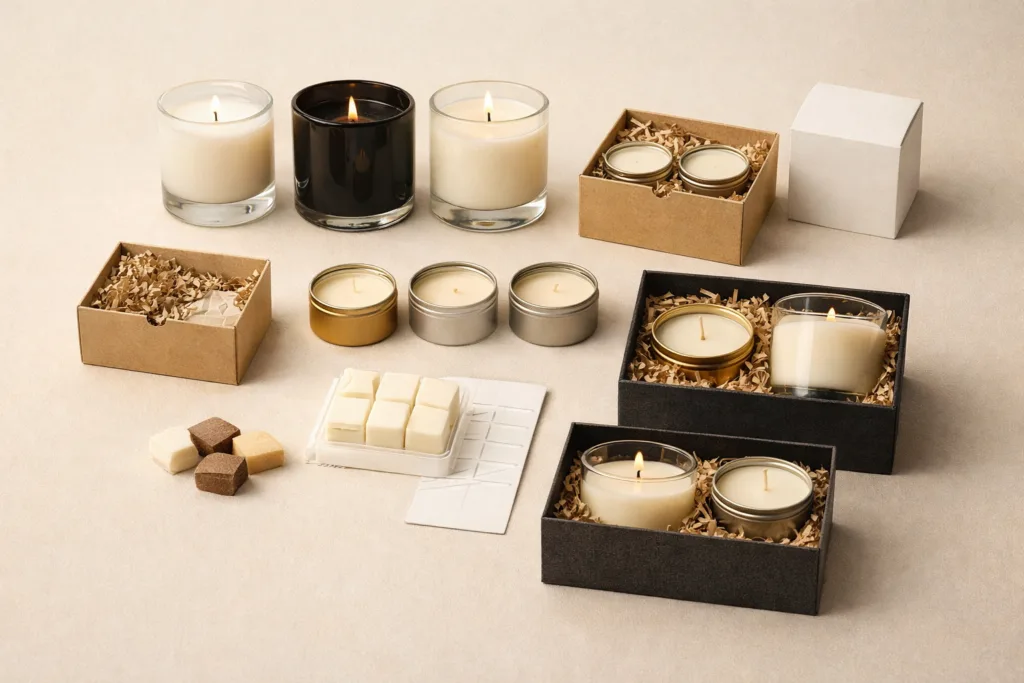 One of the most important insights in launching a candle line is that buyers do not purchase isolated candles. They buy a coherent product system.
Even when the first release is small, the brand needs logic behind it. That logic includes vessel consistency, scent naming structure, packaging proportions, label hierarchy, and a clear idea of what future extensions might look like.
For this client, we advised against launching too many disconnected SKUs. Instead, we built the line around a tighter architecture:
- One hero vessel format
- One core fill size
- A controlled fragrance range
- One packaging structure that could be adapted later
- A visual identity strong enough to scale into future variants
This made the line easier to produce, easier to cost, easier to photograph, easier to merchandise, and easier to explain to buyers.
That same principle matters even more for mature clients. If a retailer already sells candles but wants to expand, the goal is not just to add more products. The goal is to build extensions that feel intentionally connected. A new holiday collection, spa collection, or interior-design capsule should still sit within a system that the customer recognizes.
Launching a candle line successfully often means designing not just the first SKU, but the rules that future SKUs will follow.
Lesson 2: Simplify the First Collection Without Making It Feel Small
There is a difference between a focused collection and an underdeveloped one.
A focused collection feels curated. An underdeveloped collection feels incomplete. The line between the two is decided by strategy.
For the startup we supported, the earliest concept had too many scent ideas and too many packaging possibilities. Reducing scope was necessary, but it had to be done without making the brand look reduced. The answer was to concentrate value in the right places.
Instead of launching many mediocre variations, we encouraged the client to concentrate on three areas:
1. A strong vessel
The vessel sets the visual identity immediately. It is often the first thing a buyer notices in a photo or on a shelf.
2. A disciplined scent lineup
A smaller number of high-quality fragrance directions creates clarity and reduces inventory complexity.
3. Packaging that supports the price point
The packaging does not need to be excessive. It needs to feel correct.
This allowed the brand to look more premium than its SKU count suggested.
The same lesson applies when a mature brand expands its range. More SKUs do not automatically create more authority. In many cases, a tighter launch with stronger merchandising logic will perform better than a broad but fragmented one.
Lesson 3: Vessel Selection Is a Commercial Decision, Not Just a Design Choice
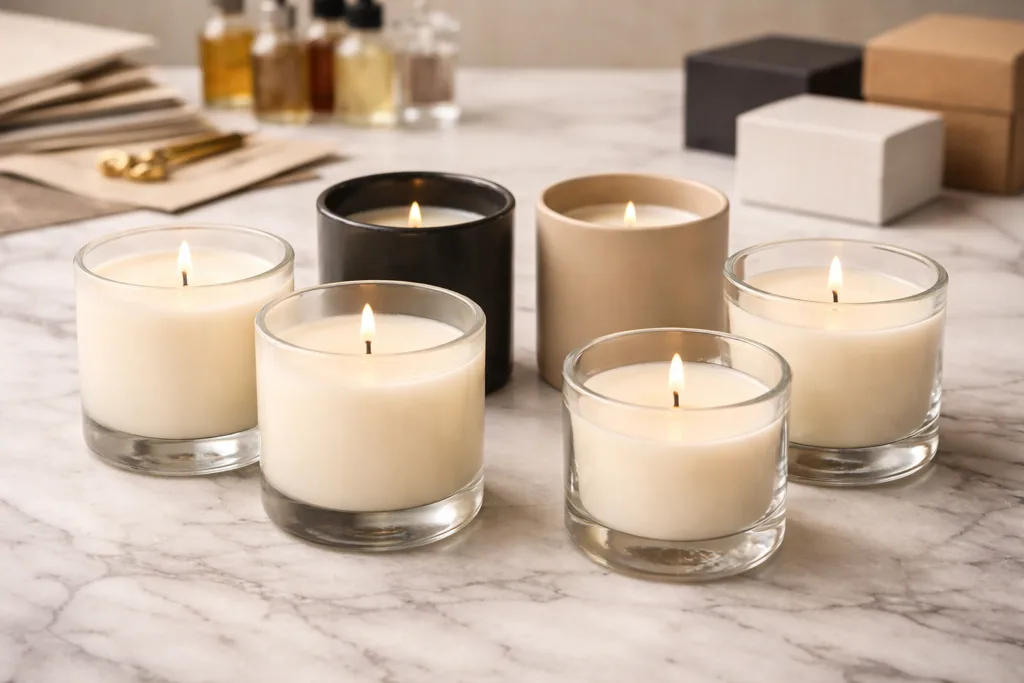 When clients begin launching a candle line, they often lead with appearance: glossy ceramic, thick matte glass, ribbed vessels, electroplated interiors, tinted translucent glass, stone-like textures, minimalist clear jars, or highly custom silhouettes. All of those options can work. But the right choice depends on the business model.
For this project, we evaluated vessel direction against five practical criteria:
- MOQ feasibility
- Production stability
- Lead time
- Shipping risk
- Brand positioning
This is why we often say that custom ceramic and decorative vessels are not simply packaging upgrades. They are supply chain decisions.
A startup may love custom ceramic because it feels distinctive. But ceramic development typically involves more tooling complexity, color control issues, greater variation risk, and usually a higher volume threshold to become commercially viable. Standard or semi-custom glass, by contrast, often offers faster decision-making, better repeatability, easier decoration options, and better launch efficiency.
So rather than choosing the most visually ambitious option immediately, we helped the client choose a vessel path that could balance premium appearance with reasonable production discipline.
This is particularly relevant for established brands planning to expand a candle line. If the core business already works, there may be a strong temptation to push heavily customized decorative packaging. Sometimes that is the right move. But sometimes the smarter route is a modular system: one dependable vessel family, multiple label or carton variations, and controlled decorative upgrades depending on collection tier.
That kind of structure keeps development risk lower while preserving room for design differentiation.
Lesson 4: Candle Size Strategy Shapes Pricing, Merchandising, and Repeatability
Candle size is often treated as a technical detail. It is not. It affects nearly every commercial layer of the line.
When launching a candle line, the chosen size influences:
- perceived value
- shelf presence
- shipping cost
- label area
- burn performance expectation
- giftability
- price ladder opportunities
- future cross-selling options
For the client in this case, we reviewed several possible size directions. Instead of offering too many fill weights, we recommended centering the line on one commercially efficient size that could function well for both retail display and e-commerce fulfillment.
Why is this important? Because a first launch should make reordering easy. If the first order works, the client should be able to replenish without reinventing the line every time.
For more mature brands, size strategy becomes even more useful when creating a range architecture:
- standard single-wick candle
- elevated larger-format candle
- travel or gift size
- boxed gift set variant
- seasonal special edition
A smart candle line expansion is rarely random. It usually begins with one repeatable size standard and grows outward deliberately.
Lesson 5: Fragrance Strategy Should Be Commercially Sharp, Not Emotionally Overloaded
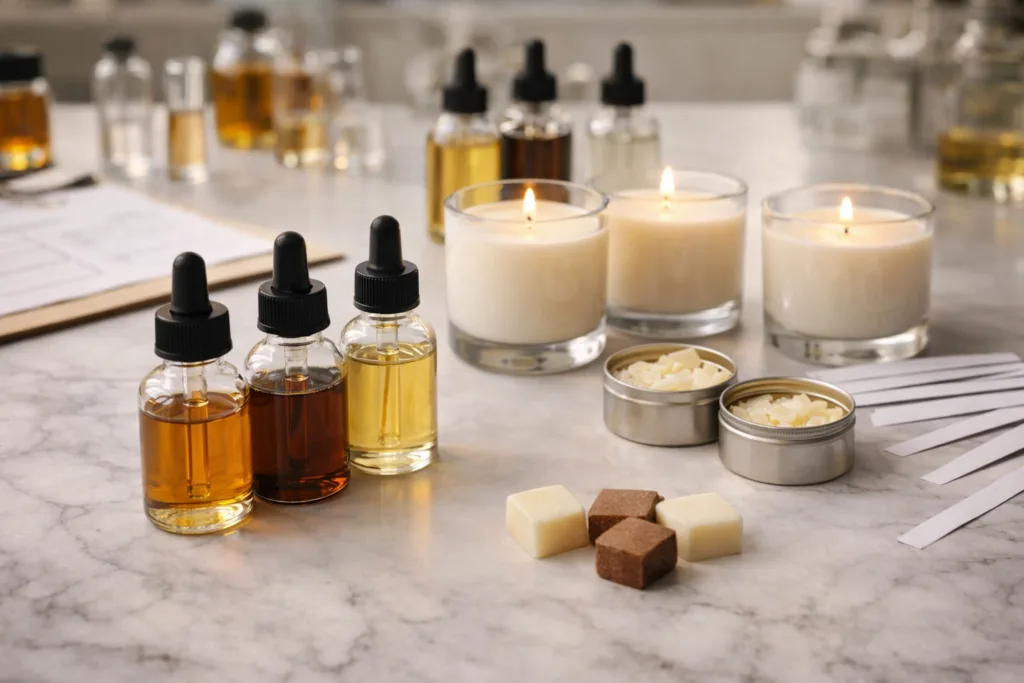 Fragrance is where many candle lines become overcomplicated. Founders love scent development because it feels creative, emotional, and brand-defining. They are right. Scent is often the heart of the collection. But it also creates serious operational complexity.
Each additional fragrance can increase:
- raw material planning complexity
- sample rounds
- testing time
- inventory fragmentation
- MOQs across packaging components
- forecasting uncertainty
That does not mean a line should be scent-poor. It means the scent lineup needs logic.
For this startup, the initial fragrance ambition was broad. We guided the client toward a tighter lineup built around hero directions rather than a long list. The goal was not to limit identity. The goal was to sharpen it.
A disciplined fragrance strategy often works better when it includes a few clearly defined scent roles, such as:
- a grounding woody or amber scent
- a brighter fresh or green scent
- a softer floral or comforting skin-like scent
This kind of structure helps the line speak to different customer moods without becoming chaotic.
For established brands, fragrance strategy matters even more during expansion. When extending an existing candle line, the question is not only what smells good. It is whether the new scents reinforce the brand world, create merchandising clarity, and justify new shelf space.
Adding fragrances without structure often leads to diluted positioning. Adding them with clear intent leads to stronger collection storytelling.
Lesson 6: Packaging Should Protect Margin, Not Destroy It
One of the fastest ways to break a young candle project is packaging inflation.
Luxury packaging is seductive. Magnetic rigid boxes, custom inserts, foil details, layered unboxing sequences, specialty papers, complex internal trays, embossing, debossing, textured wraps, wax seals, ribbons, and high-density gift structures all look impressive. But they can consume cost very quickly.
That is why packaging strategy must be tied directly to retail channel and price point.
In this case, we helped the client distinguish between three different packaging jobs:
Retail presentation
What helps the product look premium on shelf or in photography?
Shipping protection
What prevents damage during fulfillment and transport?
Gifting enhancement
What adds emotional value when the candle is intended as a present?
These three functions do not always need to be solved by one expensive structure.
Often, the best candle lines are built using layered packaging logic. A clean label and strong vessel carry the core identity. A practical carton provides transport and retail utility. A more premium gift box is reserved for selected bundles, promotional sets, or holiday launches.
This model is especially valuable for mature clients expanding their candle line. It creates multiple commercial tiers without requiring a full redesign of every product.
In other words, not every candle needs the most expensive box. But every candle does need packaging logic.
Lesson 7: Sampling Is Not a Formality. It Is the Real Product Development Phase
Many buyers speak about samples as if they are just a checkpoint before production. In reality, sampling is where the line either becomes viable or reveals its weaknesses.
When launching a candle line, a serious sample process should evaluate more than aesthetics. It should test whether the product can survive repeat production.
For this project, the sample phase focused on multiple interconnected variables:
- vessel appearance and finish consistency
- wax surface quality
- fragrance throw expectations
- wick performance
- burn pool behavior
- label application fit
- carton proportion and presentation
- overall impression against the intended price point
This stage is where commercial judgment matters. A beautiful sample that burns poorly is not a successful sample. A perfect fragrance in a vessel that creates logistics problems is not a production-ready result. A premium box that photographs well but destroys margin is not a wise approval.
For large clients, this stage is even more important because errors scale. A small mismatch in the sample phase can become an expensive issue during volume production.
That is why experienced buyers often value a manufacturer not only for making samples, but for challenging them during the sample process. The right development partner does not just execute. They identify where future problems may emerge.
From Startup Thinking to Mature Brand Thinking
Although this article begins with a startup case, the most useful lesson is what happens when you stop thinking like a startup.
A startup often asks, “How do I launch this candle?”
A mature brand asks, “How does this category fit into the wider business?”
That shift changes everything.
For a more established client, launching a candle line or expanding one typically connects to broader goals such as:
- increasing average order value
- building a gifting program
- creating a seasonal retail story
- adding a home category to an existing fashion or beauty brand
- improving hotel, spa, or boutique exclusivity
- introducing a private label range for a chain or concept store
- building a cross-category lifestyle offering
Once the conversation moves to this level, product development becomes less about one candle and more about line architecture.
This is where Circe Home can support clients beyond simple manufacturing. We help clients think through the business implications of the collection itself.
What Large Buyers and Expanding Brands Usually Need Most
In practice, larger clients are rarely looking for just a candle. They are looking for a dependable commercial framework.
That usually means they care about questions such as:
- Can the supplier maintain consistency across repeat runs?
- Can the packaging system be adapted across multiple collections?
- Can the line support multiple fragrance families without losing brand coherence?
- Can the manufacturer handle compliance and documentation for target markets?
- Can the supplier support warehouse programs, split shipments, or multi-SKU coordination?
- Can future extensions like wax melts, room sprays, or gift sets be built from the same design logic?
This is why a case study about launching a candle line can be highly relevant to mature brands. The same framework that helps a startup avoid chaos also helps larger clients scale intelligently.
How We Structured the Line for Future Expansion
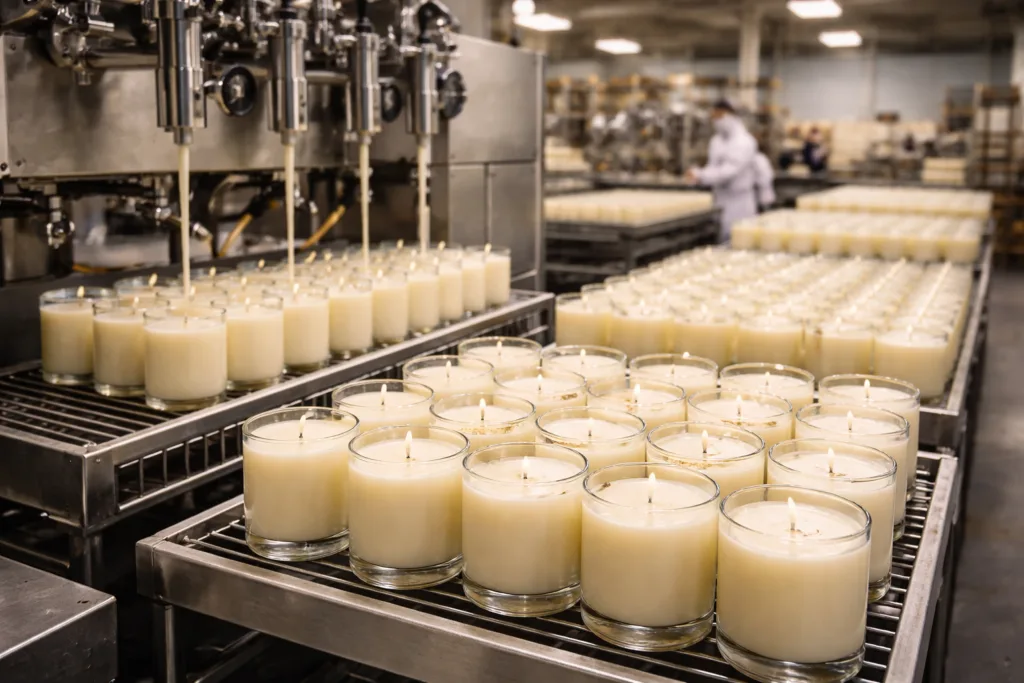 One of the strongest outcomes of this project was that we did not treat the first launch as an endpoint. We treated it as a base platform.
That meant several strategic decisions were made with future expansion in mind:
A vessel direction that could support additional editions
Instead of choosing an overly narrow format, we aimed for a vessel family that could be refreshed through label, carton, finish, or scent variation.
A scent structure that could grow
Rather than launching every idea at once, the brand gained room for future seasonal or limited-edition additions.
Packaging logic that could tier upward
The client could begin with a commercially sensible setup, then introduce more premium gift formats later without rebuilding the entire collection.
A visual identity that could stretch
This matters greatly for brands that eventually want to add wax melts, diffusers, room sprays, or home accessories around the candle line.
For established companies, this kind of modular planning is often what separates a tactical product launch from a scalable category strategy.
Common Mistakes Brands Make When Launching a Candle Line
Whether the client is a startup or an established retailer, the same mistakes appear again and again.
Trying to customize everything at once
Too many simultaneous custom decisions increase cost, lead time, and development risk.
Launching too many fragrances
A wide scent range may feel exciting internally but often weakens the commercial clarity of the launch.
Overinvesting in packaging before validating sales
Packaging should support the business model, not consume it.
Choosing a vessel based only on mood boards
The right vessel must also work in manufacturing, shipping, pricing, and repeat orders.
Treating the first launch like the final brand expression
A launch should create a strong foundation. It does not need to express every future possibility at once.
Ignoring how the line might expand later
Even a small first launch should leave room for future product families and merchandising logic.
Why the Right Manufacturing Partner Matters More as the Client Gets Bigger
Small clients often think they need a factory that can simply make the product. Larger clients usually realize they need much more than that.
As the business scales, the manufacturer becomes part of category management. They influence not only production, but assortment planning, packaging feasibility, compliance workflow, lead time discipline, and margin protection.
At Circe Home, our role is not to overwhelm clients with unnecessary customization. It is to help build the right candle line for the stage of business they are actually in.
For a startup, that may mean advising where to simplify. For a growing retailer, it may mean designing a cleaner SKU structure. For an established brand, it may mean building a premium line extension that feels elevated without becoming operationally messy.
That is the difference between development that looks exciting in a sample room and development that works in the market.
How Circe Home Supports Brands Launching or Expanding a Candle Line
We work with brands that need more than product sourcing. We support the wider commercial process behind launching a candle line, including:
- private label candle development
- custom vessel and packaging coordination
- fragrance direction planning
- wax, wick, and burn evaluation
- packaging structure recommendations
- sampling and iteration management
- production execution
- scalable thinking for future line extensions
Our clients range from startups entering the home fragrance category to more mature businesses expanding an existing product universe. In both cases, the principle is the same: the line should be beautiful, but it should also be buildable.
That means asking the right questions early. Where will the candles sell? What retail price must they support? What margins need to be preserved? What level of customization is actually justified? Which elements should carry the premium signal, and which should remain disciplined?
When those decisions are made well, the result is not just a better candle. It is a stronger business asset.
Final Thoughts: Launch the Line You Can Actually Scale
The market does not reward complexity for its own sake. It rewards coherence, quality, timing, and repeatability.
That is the clearest lesson from helping a startup launch its candle line. The strongest launch was not the one with the most ideas packed into it. It was the one built on the clearest commercial logic.
And that lesson matters even more for brands that are already established.
If you already have a product line and are considering a candle extension, the goal is not to mimic startup energy. The goal is to build a category that supports your broader brand strategy: giftability, visual merchandising, margin, repeat purchase, and room for growth.
Launching a candle line the right way means understanding where to customize, where to standardize, and where to leave room for future evolution.
That is exactly where the right manufacturing partner can create the most value.
If your brand is planning a new candle collection, a private label launch, or a category expansion into home fragrance, Circe Home can help you turn the idea into a commercially viable line with the structure needed for long-term growth.
FAQ
1. What is the biggest mistake when launching a candle line?
The biggest mistake is trying to customize too many elements at once. Too many vessels, scents, packaging structures, and finishes can quickly increase cost, complexity, and production risk.
2. How many fragrances should a new candle line launch with?
For most brands, a smaller, more strategic fragrance lineup is better than launching too many scents. A focused range is easier to produce, merchandise, and scale.
3. Can established brands use the same strategy when expanding a candle line?
Yes. The same principles apply to mature brands. The difference is that expansion projects usually require stronger assortment logic, more packaging discipline, and better planning for future line extensions.