
Introduction: Why Bespoke Scent Development Is Often Misunderstood
 In recent years, the phrase custom scent has become almost meaningless. It is used to describe everything from choosing a fragrance oil from a catalog to lightly tweaking an existing formula and calling it “exclusive.” In reality, true bespoke scent development is neither quick nor decorative. It is a structured, deliberate process that sits at the intersection of brand strategy, material science, and long-term production planning.
For a luxury candle brand, scent is not an accessory. It is not something added at the end of product development to make the candle more appealing. Scent is the product. It shapes how a space feels, how a brand is remembered, and whether a customer comes back months later to reorder the same candle—not because it is trendy, but because it feels essential.
This article explains how we develop custom scents for bespoke luxury candle brands. Not as a romanticized story, but as a practical, repeatable system designed for brands that care about longevity, consistency, and control.
1. We Begin With Brand Context, Not Fragrance Notes
 Most clients come to us believing the process starts with scent notes: sandalwood, fig, leather, bergamot. In practice, those details come much later.
The first stage of bespoke scent development is understanding the brand itself. We ask questions that have nothing to do with fragrance at first:
- Who is your customer, and where will they encounter this candle?
- Is the candle meant for daily use, occasional rituals, or gifting?
- Is the brand expressive or restrained? Contemporary or timeless?
- What should the space feel like after the candle is lit?
A candle developed for a boutique hotel lobby has very different requirements from one designed for a small lifestyle brand selling online. A gift candle must be immediately pleasant and broadly acceptable. A core collection candle can afford more nuance and restraint.
Without this context, even a beautifully crafted scent can feel misplaced. A fragrance that smells wonderful in isolation may feel wrong once it is attached to a brand identity. Our goal at this stage is alignment, not inspiration.
2. Translating Abstract Brand Language Into Olfactive Direction
Brand owners rarely speak in the language of perfumery. They describe their vision using emotional or aesthetic terms: quiet, warm, clean, elevated, ritualistic. These words are meaningful, but they are not actionable on their own.
Our role is to translate abstract language into a clear olfactive direction. This does not mean assigning one note to one word. “Clean” does not automatically mean citrus, and “warm” does not always mean vanilla.
Instead, we look at structure:
- Should the scent open quickly or unfold slowly?
- Is the focus on freshness, depth, or texture?
- Should the fragrance sit close to the body, or project into a room?
We also spend time identifying what the brand wants to avoid. Many luxury brands are defined as much by what they reject as by what they embrace. Overly sweet profiles, sharp synthetic freshness, or overly familiar commercial accords are often ruled out early.
This stage is about narrowing possibilities. A successful bespoke scent does not try to do everything. It commits to a specific emotional lane and stays there.
3. Reference Building: Direction Before Creation
Before any original formulation begins, we often work with references. These are not meant to be copied. They are tools for calibration.
References might include:
- Existing candles or fragrances the client feels close to, even if imperfect
- Non-candle scent experiences such as hotels, boutiques, or private homes
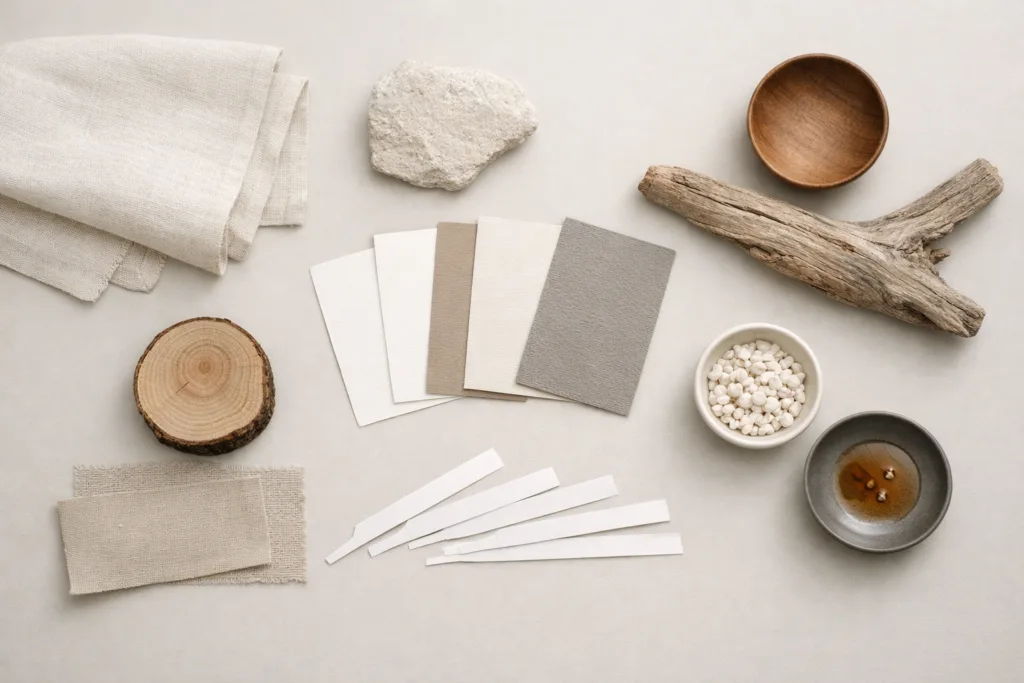
- Textural references: raw wood, stone, linen, leather
By discussing what works and what does not in these references, we establish a shared language. This dramatically reduces misalignment later in the process. Rather than guessing what a client means by “soft” or “luxurious,” we anchor those words to real sensory experiences.
This step saves time, reduces frustration, and creates a clearer creative brief for development.
4. Controlled Fragrance Development, Not Trial and Error
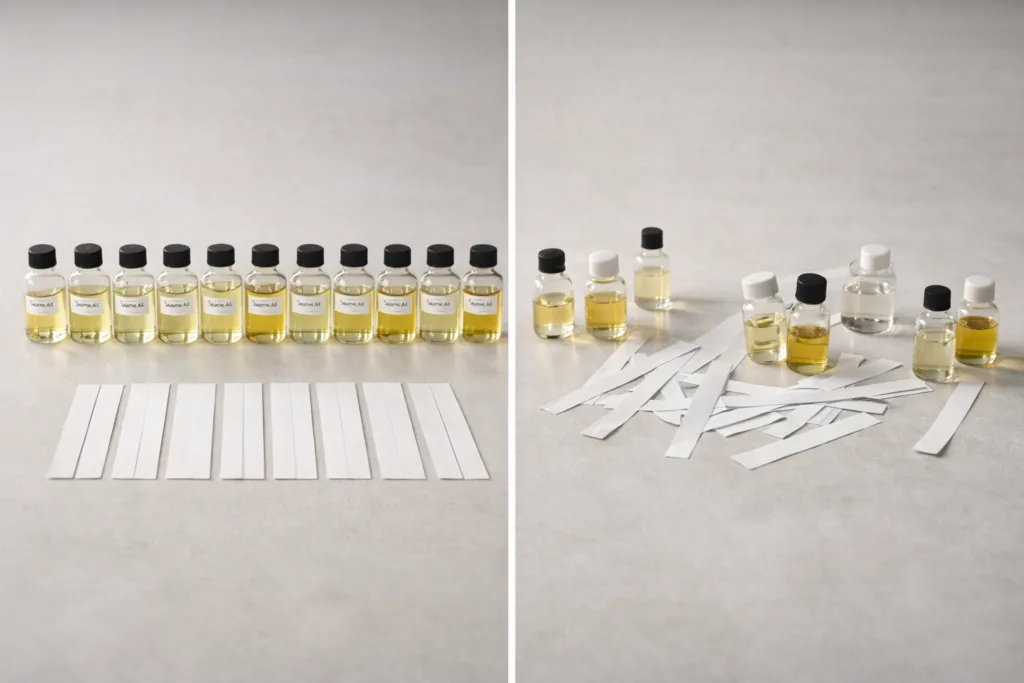 Once the direction is clear, fragrance development begins. This is where many suppliers rely on trial and error, presenting multiple options and hoping one will resonate.
Our approach is more controlled. Each development round has a purpose. We do not present a large number of wildly different options. Instead, we work within a defined framework and adjust specific variables:
- Balance between top, heart, and base
- Overall intensity
- Texture and smoothness
- Emotional tone
This allows feedback to be precise. Instead of vague reactions, clients can say: this is too sharp, this feels heavy, or the dry-down is closer to what we want. Each comment leads to a measurable adjustment.
The goal is not speed. The goal is accuracy.
5. Testing Scents in Real Candle Conditions
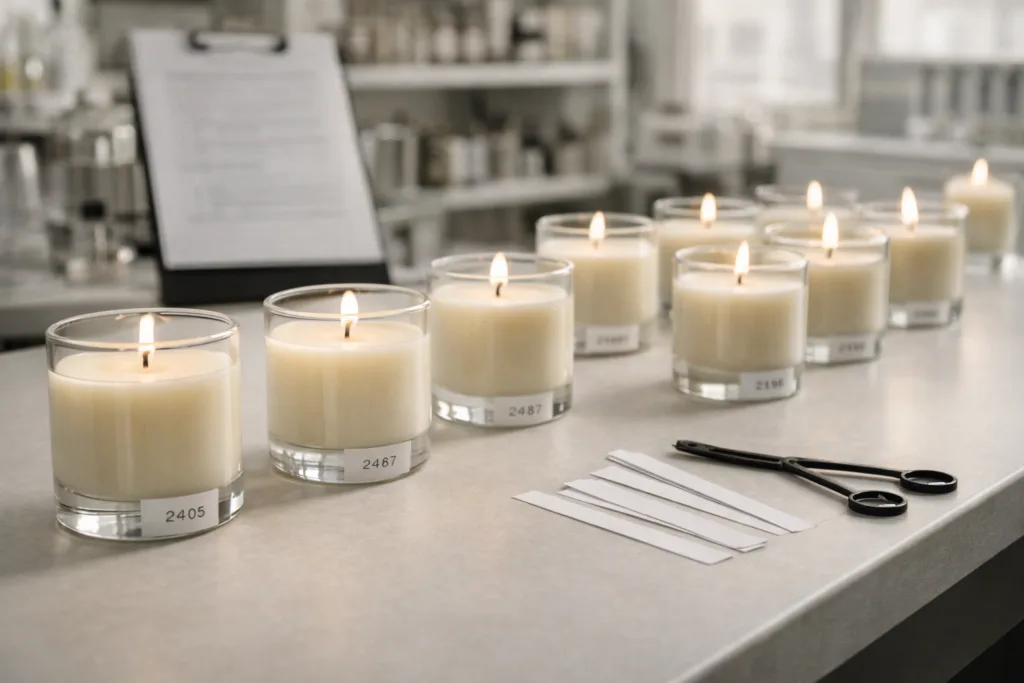 A fragrance that smells refined on a blotter can behave very differently once it is burned in wax. Heat changes everything.
This is why we test every bespoke scent in real candle conditions:
- The actual wax blend
- The intended container
- The correct wick configuration
We evaluate both cold throw and hot throw. We observe how the scent evolves over time, how it fills a room, and how it settles after the flame is extinguished.
Some scents lose clarity when heated. Others become overpowering. Some reveal unwanted sharpness only after extended burn time. These issues cannot be predicted from fragrance oil alone.
Real testing ensures that the final scent performs as intended—not just in theory, but in use.
6. Refinement Over Perfection
One of the most important principles we share with clients is this: perfection is not the goal. Stability is.
Luxury brands often fall into the trap of endlessly tweaking a scent in pursuit of an idealized version. In reality, a scent that performs consistently and supports the brand’s identity over time is far more valuable than one that feels perfect but unstable.
Refinement focuses on:
- Removing distractions
- Improving balance
- Ensuring consistency across batches
At a certain point, further changes do not add value. Knowing when to stop is part of the craft.
7. Compliance, Safety, and Long-Term Viability
A bespoke scent must be more than beautiful. It must be viable.
We consider:
- Regulatory compliance for target markets
- Raw material availability
- Batch-to-batch consistency
- Scalability for future growth
A scent that cannot be reproduced reliably or requires unstable materials becomes a liability as a brand grows. From the beginning, we design scents with longevity in mind.
This ensures that the fragrance can support not just an initial launch, but years of reorders, expansions, and new product formats.
8. From Signature Scent to Brand Asset
The final outcome of bespoke scent development is not a single candle. It is a brand asset.
A well-developed signature scent can extend across products, spaces, and seasons. It becomes part of how customers recognize the brand, often subconsciously.
When done correctly, the scent does not need explanation. It simply feels right—familiar without being obvious, distinctive without being loud.
Conclusion: Building a Scent That Lasts
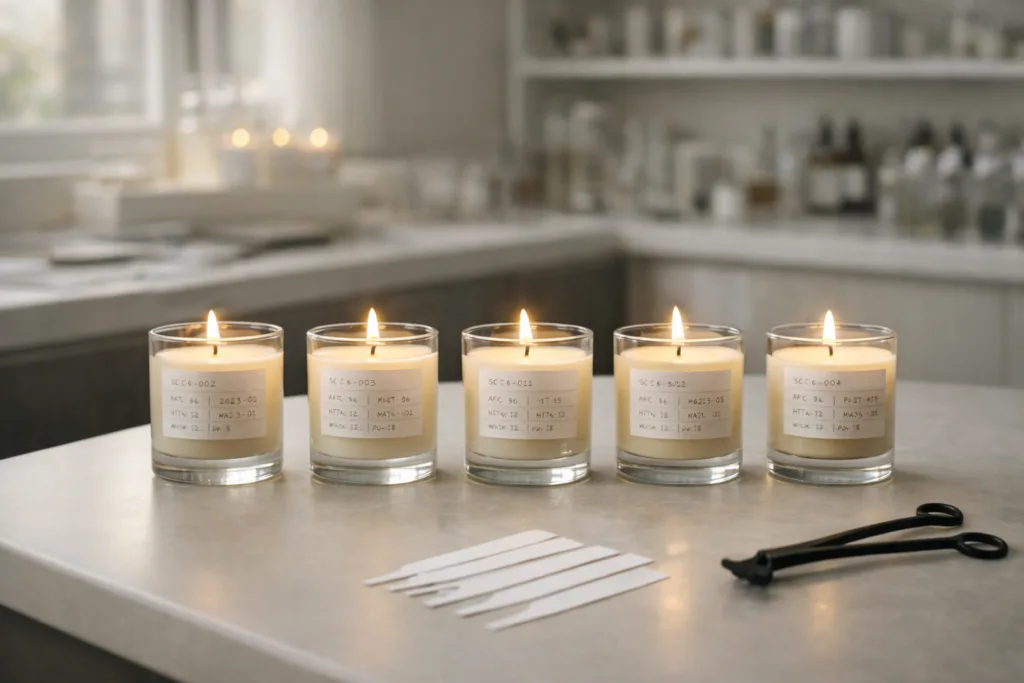 Bespoke scent development is not about chasing trends or creating novelty. It is about building something quiet, consistent, and deeply aligned with a brand’s identity.
For luxury candle brands, scent is not decoration. It is structure.
When developed thoughtfully, it becomes one of the most powerful and enduring elements of the brand—long after packaging changes or collections evolve.
That is what we aim to create with every bespoke scent we develop.
Frequently Asked Questions (FAQ)
1. What is the difference between a bespoke candle scent and a custom scent?
A custom scent usually starts from an existing fragrance formula that is adjusted or renamed for a brand. A bespoke candle scent, on the other hand, is developed from the ground up based on brand context, usage scenarios, and long-term production needs. At Circe Home, bespoke scent development focuses on structure, performance in wax, and scalability—not simply selecting notes from a catalog.
2. How long does bespoke scent development typically take?
True bespoke scent development is not an instant process. Depending on the clarity of the initial direction and the number of refinement rounds required, development can take several weeks. This timeline allows for real candle testing, controlled adjustments, and stability checks, ensuring the final scent performs consistently and can support long-term reorders.
3. Can a bespoke scent be reproduced consistently for future orders?
Yes—when developed correctly. One of the core goals of our process is repeatability. Every bespoke scent is designed with batch consistency, raw material stability, and future scalability in mind. This ensures that the scent your customers fall in love with today can be reliably reproduced months or years later.
4. Is bespoke scent development suitable for small or emerging brands?
Bespoke scent development is not only for large brands. It is suitable for emerging brands that value long-term positioning and want to avoid frequent scent changes as they grow. Starting with a well-developed signature scent helps build brand recognition early and reduces the risk of costly reformulations later.