
For experienced candle buyers, burn time is more than a number printed on a product page. It is a promise. It tells the retailer whether the product can justify its shelf price. It tells the hotel buyer whether the candle can survive multiple guest-use cycles. It tells the gift set distributor whether the product feels premium after the first burn, not only when it is photographed for a catalog. Most importantly, it tells the final consumer whether the candle was engineered properly or simply poured into an attractive vessel.
Many buyers begin with a simple question: “How many hours does this candle burn?” It sounds straightforward, but in professional candle manufacturing, the answer is never based on wax weight alone. A 220 g candle can burn beautifully for many hours, tunnel badly after the first use, smoke because the wick is too large, or lose fragrance impact because the wick is too weak to create a complete melt pool. Two candles with the same wax weight can deliver very different burn times depending on wick size, wick quantity, vessel diameter, wax formula, fragrance load, dye content, and burn test results.
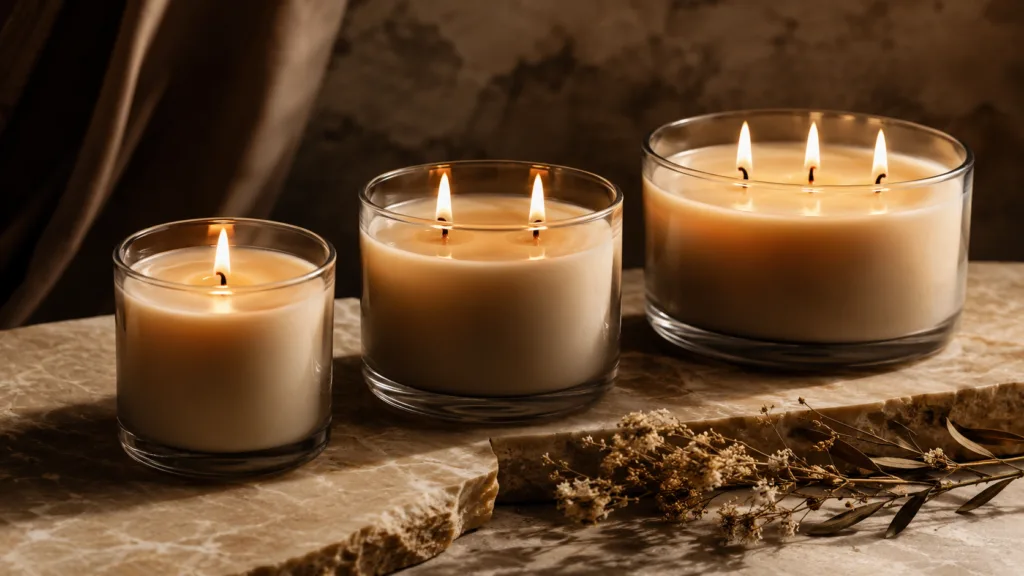
This is why serious private label candle buyers should not treat wick configuration as a factory detail. It is a procurement decision. It affects safety, customer reviews, repeat purchases, return rates, perceived value, shipping economics, and even whether a candle line can be expanded into a profitable collection.
If your brand is developing scented candles for retail, hospitality, corporate gifting, Amazon, boutique stores, department stores, or seasonal gift sets, mastering candle burn time means understanding how wick configuration controls the product’s real-life performance.
Why Candle Burn Time Matters in B2B Candle Sourcing
For a consumer, burn time may look like a simple value comparison: a 40-hour candle feels better than a 25-hour candle. For a buyer, the calculation is more complicated.
Burn time influences the way a candle is positioned and priced. A luxury candle buyer may need a longer-lasting product to support a higher retail price. A hotel or spa buyer may care more about a clean, consistent burn and safe flame behavior than the maximum possible hours. A gift set buyer may need predictable performance across multiple fragrances because one failed SKU can damage the whole collection. An Amazon seller may need accurate burn time claims to avoid negative reviews, complaints, and return issues.
The key point is this: longer burn time is not always better if the candle burns poorly. A candle that technically lasts 60 hours but tunnels down the center, leaves heavy wax on the glass wall, and produces weak fragrance throw will disappoint customers. A candle that burns for fewer hours but creates an even melt pool, stable flame, good scent release, and clean vessel appearance may feel more premium.
For mature buyers, the real procurement goal is not “the longest burn time at the lowest price.” The goal is controlled burn performance.
A well-developed candle should answer these questions:
- Does it burn evenly across the vessel?
- Does the flame remain stable throughout the candle’s life?
- Does it avoid excessive soot, mushrooming, and smoke?
- Does it produce enough hot throw for the target room size?
- Does the vessel remain within safe temperature expectations?
- Does the burn time match the positioning of the product?
- Does the product perform consistently across all fragrances in the line?
These are the questions that separate a sample-room candle from a scalable private label candle program.
What Wick Configuration Really Means
Wick configuration is often misunderstood. Some buyers think it only means whether a candle uses one wick, two wicks, or three wicks. That is only part of the story.
In professional candle development, wick configuration includes several decisions:
- Wick material, such as cotton wick, paper-core wick, wood wick, or specialty wick.
- Wick size, meaning how much fuel the wick can draw from the wax pool.
- Wick count, meaning single wick, double wick, triple wick, or more.
- Wick placement, especially in wide vessels or irregular shapes.
- Wick treatment, including priming and compatibility with wax and fragrance.
- Wick series selection, because different wick families behave differently in soy wax, coconut wax, beeswax blends, paraffin blends, and gel formulas.
- Wick testing method, because the same wick may behave differently after curing, during repeated burns, or near the bottom of the vessel.
A wick is not just a piece of string. It is the engine of the candle. It controls how wax becomes fuel, how the melt pool develops, how fast the candle consumes wax, how fragrance is released, and how much heat transfers to the container.
For B2B sourcing, the important question is not “Which wick do you use?” A better question is:
“Which wick configuration has been tested for this exact vessel, wax blend, fragrance load, and target burn time?”
That question immediately moves the discussion from commodity pricing to product engineering.
The Relationship Between Wick Configuration and Burn Time
Candle burn time is generally influenced by the rate at which wax is consumed. The wick controls that rate by drawing melted wax upward, where it vaporizes and burns in the flame. A stronger wick usually creates a larger flame and consumes wax faster. A weaker wick consumes wax more slowly, but may not produce enough heat to melt the wax across the vessel.
This creates a balancing act.
If the wick is too small, the candle may appear to last longer at first, but the performance is not actually better. The flame may be weak, the melt pool may remain narrow, and the candle may tunnel. As tunneling continues, wax on the sides becomes unusable. The customer sees wasted wax, poor fragrance release, and an ugly burn pattern. Technically, the candle may burn slowly, but it fails as a product.
If the wick is too large, the candle may create a fast full melt pool and strong fragrance throw, but it may consume wax too quickly. The flame may become too tall, the vessel may become too hot, soot may collect on the glass, and the candle may finish much sooner than expected. In extreme cases, over-wicking creates safety concerns.
The best wick configuration is not the one that burns slowest. It is the one that achieves the right melt pool, flame stability, scent throw, vessel temperature, and total burn time for the intended product category.
Single Wick Candles: Longer Burn Potential, But Only for the Right Vessel
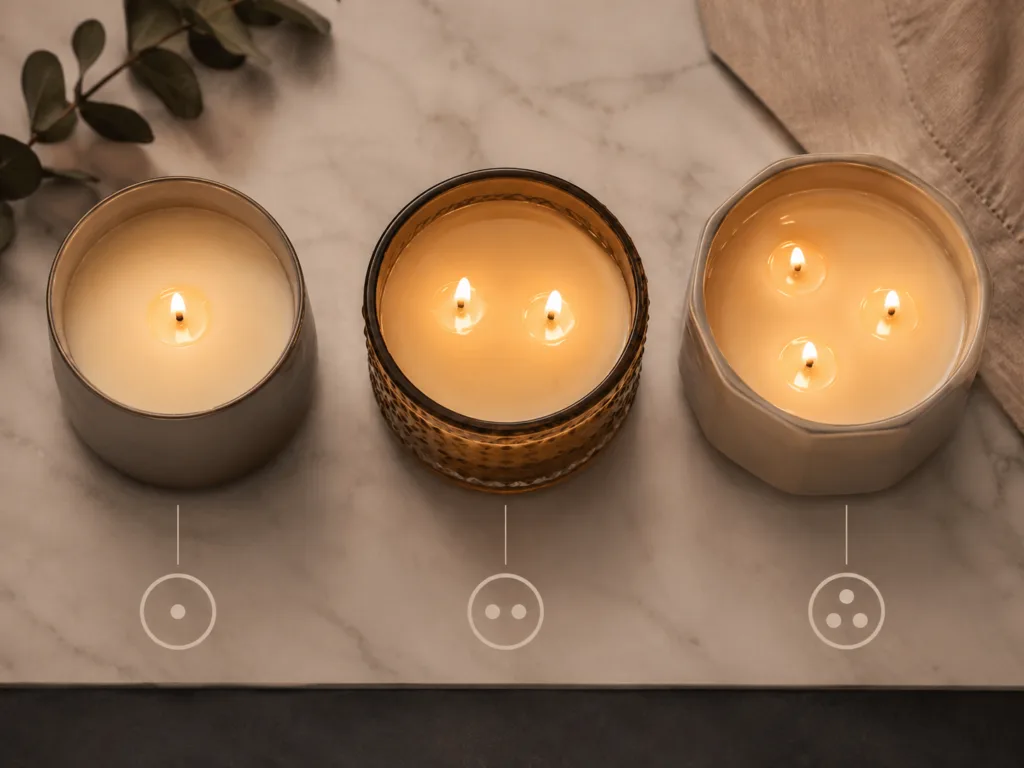
Single wick candles are common in small and medium-sized jars because they are simple, cost-efficient, and often capable of delivering a longer burn time. With only one flame consuming wax, the burn rate is usually slower than a multi-wick candle of the same wax weight.
For travel candles, small glass jars, tin candles, mini gift candles, and many standard retail candles, a properly selected single wick can deliver stable performance. It can also help buyers maintain a more attractive unit cost because there is less material cost and less labor complexity during production.
However, single wick candles have limits.
The most common problem appears when the vessel diameter is too wide for one wick. A single wick may not generate enough heat to melt wax from edge to edge. The result is tunneling: the center melts down while the outer wax remains solid. This creates several commercial problems.
First, the customer feels cheated because visible wax remains unused. Second, the fragrance throw becomes weaker because the melt pool is too small. Third, the candle looks lower quality after a few burns. Fourth, online reviews may mention uneven burning, wasted wax, or poor performance.
For a buyer placing a large order, this is not a small technical issue. It can become a brand reputation issue.
Single wick candles are usually a good choice when:
- The vessel has a small to moderate diameter.
- The target is longer burn time rather than maximum fragrance intensity.
- The design is intended to feel clean, minimal, and practical.
- The product is positioned as a daily-use candle.
- The wax formula and fragrance load can be supported by one wick.
- Burn testing confirms a full or acceptable melt pool over repeated burns.
Single wick candles are usually risky when:
- The vessel is wide.
- The glass has thick walls or unusual heat distribution.
- The wax blend has a higher melting point.
- The fragrance load is heavy.
- The buyer expects strong hot throw in a large room.
- The candle is intended to look highly premium but burns with a weak flame.
In short, single wick candles can support longer candle burn time, but only if the vessel and formula are suitable.
Double Wick Candles: Faster Melt Pool, Stronger Throw, Shorter Lifespan
Double wick candles are often used when a vessel is too wide for one wick but does not require three wicks. From a buyer’s perspective, double wick candles can feel more premium because they create a fuller flame presentation and a faster melt pool.
The benefit is clear: two wicks distribute heat across a wider surface area. This helps reduce tunneling and improves fragrance release. For larger living room candles, spa candles, gift candles, and premium private label collections, double wicks can improve the user experience.
But buyers need to understand the trade-off. A double wick candle usually consumes wax faster than a single wick candle of the same wax weight. It may create better scent throw and a more beautiful burn, but the total burn time may be shorter.
This matters when building a product line. If a brand compares two candles by wax weight alone, the burn time expectations may be wrong. A 300 g single wick candle and a 300 g double wick candle should not automatically carry the same burn time claim. The double wick version may burn hotter, wider, and faster.
Double wick candles are often suitable when:
- The vessel diameter is too large for one wick.
- The product needs stronger fragrance throw.
- The buyer wants a more luxurious flame effect.
- The candle is designed for living rooms, lounges, spas, or gifting.
- The brand accepts a slightly shorter burn time in exchange for better performance.
- Burn testing confirms that the two flames do not create excessive heat.
Double wick candles require careful placement. If the wicks are too close, they may behave like one oversized flame and overheat the center. If they are too far apart, they may leave unmelted wax in the middle or near the vessel wall. If the wick size is too strong, the candle may burn too aggressively.
For bulk orders, the buyer should request clear burn test observations before approving mass production. Double wick candles are not automatically better. They are better only when the vessel requires them and the configuration is tested.
Three Wick Candles: Premium Appearance with Higher Consumption
Three wick candles are strongly associated with premium home fragrance, large jar candles, holiday candles, and decorative centerpieces. They look impressive, photograph well, and create a stronger sensory experience. For retailers, they can support a higher price point because the product appears substantial and giftable.
However, three wick candles are often misunderstood by buyers. A three wick candle is not simply a bigger candle. It is a different burn system.
Three flames generate more heat, create a larger melt pool, and release fragrance more quickly. This can be excellent for open spaces and strong scent performance, but it also means the candle consumes wax faster. A three wick candle may have a shorter burn time per gram of wax than a properly wicked single wick candle.
For mature buyers, this is not a problem as long as the positioning is clear. A three wick candle is often purchased for ambiance, fragrance impact, visual luxury, and gifting value. It does not need to compete only on burn hours. But the burn time claim must be realistic.
Three wick candles are best suited for:
- Large diameter vessels.
- Premium gift sets.
- Holiday and seasonal collections.
- Strong fragrance performance.
- Home decor and centerpiece use.
- Higher retail price points.
- Brands that want a visually rich flame experience.
They require extra testing because multiple flames increase complexity. The manufacturer must check whether the vessel becomes too hot, whether the flames merge under certain conditions, whether soot appears on the glass, whether the final stage remains safe, and whether the candle performs consistently across all fragrances.
This is especially important for colored glass, ceramic vessels, metal tins, thick glass, irregular vessels, and candles with decorative elements. What looks beautiful in a product photo may behave differently during a four-hour burn cycle.
For large orders, buyers should never approve a three wick candle based only on appearance. A three wick design must be tested as a complete system.
Wick Size: The Hidden Variable Behind Longevity
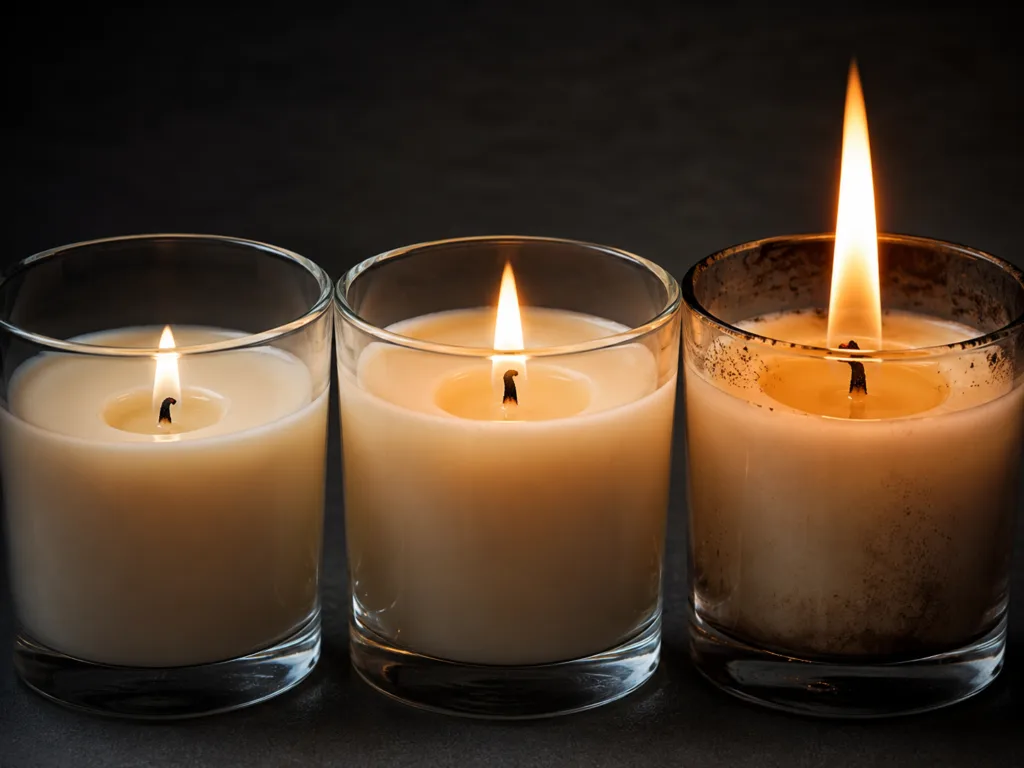
Wick count is easy to see. Wick size is harder to evaluate but often more important.
A small change in wick size can change the entire burn behavior of a candle. Moving one size up may solve tunneling but reduce burn time. Moving one size down may improve longevity but weaken hot throw. This is why professional candle development often tests several wick sizes before final confirmation.
An under-wicked candle often shows these signs:
- Small or weak flame.
- Incomplete melt pool.
- Tunneling.
- Poor hot throw.
- Wax remaining on the vessel wall.
- Flame drowning in wax during later burns.
- Customer complaints about wasted wax.
An over-wicked candle often shows these signs:
- Flame too tall.
- Constant flickering.
- Excessive melt pool depth.
- Fast wax consumption.
- Black soot on the glass.
- Mushrooming carbon at the wick tip.
- Vessel becoming too hot.
- Shorter burn time than expected.
A properly wicked candle usually shows:
- Stable flame.
- Controlled melt pool.
- Good fragrance release.
- Minimal soot.
- Reasonable wax consumption.
- Safe vessel temperature.
- Consistent performance through repeated burns.
For procurement teams, wick size should be treated as a performance specification, not a hidden factory choice. When evaluating suppliers, ask how many wick sizes they tested and why the final size was selected.
A serious candle manufacturer should be able to explain the logic, not just say “this wick is okay.”
Vessel Diameter: Why Wax Weight Alone Is Misleading
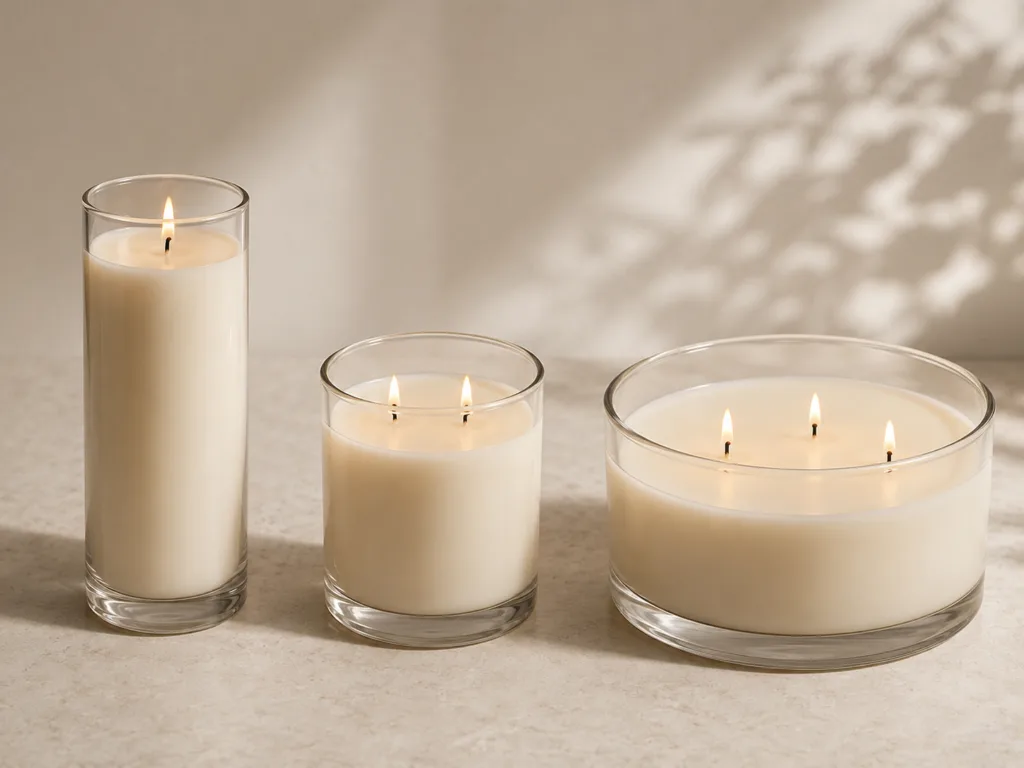
One of the most common technical blind spots in candle sourcing is assuming that wax weight determines burn time and wick selection. In reality, vessel diameter is often more important.
A tall, narrow 250 g candle may work well with one wick and burn slowly. A short, wide 250 g candle may require two wicks and burn faster. The same wax weight can produce very different burn performance because the surface area is different.
This is especially important for brands developing custom vessels. Buyers may choose a vessel based on aesthetics, packaging fit, or perceived luxury, without realizing that the shape changes the burn system.
Important vessel factors include:
- Inner diameter at the widest point.
- Vessel height.
- Wall thickness.
- Glass or ceramic thermal behavior.
- Tapered shape.
- Square or irregular shape.
- Mouth width compared with base width.
- Whether the vessel traps heat.
- Whether the vessel is painted, coated, frosted, or metallic.
A wide vessel may require multiple wicks to avoid tunneling. A narrow vessel may overheat if the wick is too strong. A thick ceramic vessel may need a different wick approach from thin glass. A tapered vessel may burn differently near the top and bottom.
This is why a professional custom candle manufacturer should not confirm burn time before testing the actual vessel. If the buyer changes the jar, changes the wax fill, or changes the fragrance load, the wick configuration may need to be tested again.
For mature buyers, this is a useful way to judge supplier quality. A weak supplier gives a quick burn time number. A professional supplier asks about the vessel.
Wax Type and Wick Configuration
Wax type affects how easily the wax melts, how it travels up the wick, how it releases fragrance, and how quickly the candle burns. This means wick configuration must be matched to the wax system.
Soy wax is popular for natural and clean-positioned candles. It usually burns relatively slowly and has a soft, creamy appearance. However, soy wax can be sensitive to fragrance load and may require careful wick testing to achieve good hot throw.
Coconut wax and coconut blends are often used for premium candles because they offer a smooth surface, attractive texture, and elegant burn profile. They may burn beautifully, but the wick must be chosen carefully to avoid weak flame performance or excessive melt pool depth.
Beeswax has a higher melting point and different burn behavior. It may require a stronger wick than softer waxes. For buyers developing beeswax candles or beeswax-blend candles, wick testing becomes especially important because the formula may not behave like standard soy wax.
Paraffin and paraffin blends can offer strong fragrance throw and predictable performance, but wick selection still matters. A wick that performs well in soy wax may not perform the same way in a paraffin blend.
Wax blends are common in commercial candle manufacturing because they allow brands to balance appearance, burn time, fragrance throw, cost, and production stability. But every blend changes the burn system.
For procurement, the practical lesson is simple: do not separate wax discussions from wick discussions. When a supplier recommends a wax formula, ask how the formula affects wick selection and burn time.
Fragrance Load: More Scent Is Not Always Better
Many buyers request stronger fragrance because they assume a higher fragrance load means a better candle. In reality, fragrance load must be balanced with wax type and wick configuration.
A high fragrance load can affect burn performance. Some fragrance oils are heavier, thicker, or more difficult for the wick to handle. Some may contribute to carbon buildup. Some may change the melt pool behavior. Some may work beautifully in one wax blend but perform poorly in another.
A wick can become clogged or unstable if the formula is not balanced. The candle may smoke, mushroom, burn unevenly, or lose consistency across fragrance SKUs. This becomes a serious issue when a brand launches a collection with multiple scents.
For example, one fragrance in a six-scent collection may contain materials that make it burn hotter or soot more easily. Another may weaken hot throw. If the supplier uses the exact same wick configuration for every fragrance without testing, the buyer may receive inconsistent products.
For mature buyers, this is a key technical question:
“Will each fragrance be burn-tested individually, or will all scents use the same wick by default?”
In low-end production, the same wick may be applied across all scents to save time. In professional private label candle development, fragrances should be tested because each formula can behave differently.
Melt Pool: The Visual Evidence of Wick Performance
The wax pool tells the truth. Buyers do not need to be candle engineers to understand basic melt pool behavior.
A proper melt pool means the wax has melted across the surface in a controlled way. It should not be too shallow, too deep, too narrow, or too aggressive. The melt pool affects fragrance throw because fragrance is released from melted wax. It also affects burn time because the depth and width of the pool influence how quickly wax is consumed.
A narrow melt pool usually means the candle may be under-wicked. It may tunnel and leave wax on the sides. A very deep melt pool may indicate over-wicking, which can shorten burn time and create safety or soot issues.
For buyers reviewing samples, photos of the candle before burning are not enough. Ask for burn-stage photos:
- After first burn.
- After several hours of use.
- Mid-life burn stage.
- Near the end of the candle.
- Vessel wall condition after repeated burns.
- Wick condition after cooling.
This gives a more realistic view of product performance. A candle can look perfect at delivery and still fail after three burns.
Burn Testing: The Step Buyers Should Never Skip
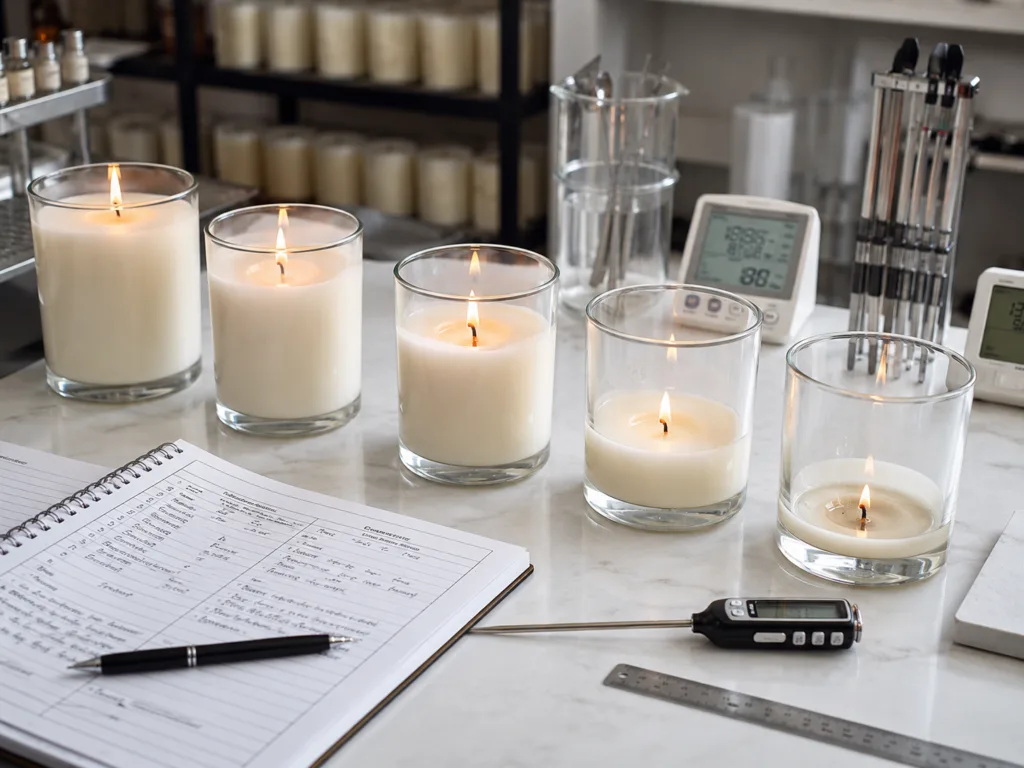
Burn testing is where candle design becomes candle reality.
For private label candles, burn testing should be done before mass production, especially when the project includes custom vessels, custom wax blends, high fragrance load, unusual colors, large jar sizes, multi-wick designs, wood wicks, decorative surfaces, or premium gift packaging.
A practical burn test should observe:
- Initial flame behavior.
- Time required to form a full or acceptable melt pool.
- Melt pool depth.
- Wax consumption rate.
- Flame height.
- Soot level.
- Wick mushrooming.
- Hot throw.
- Container temperature.
- Tunneling or hang-up wax.
- Performance over repeated burn cycles.
- End-of-life safety.
For B2B buyers, the most important point is repeatability. One good sample does not always guarantee stable mass production. Raw materials vary. Fragrance oils vary. Wax batches vary. Vessel thickness can vary. Even wick centering affects performance.
For large orders, especially 500, 1,000, 3,000, or 10,000 units, buyers should confirm that the supplier has a repeatable testing and production control process.
Ask for:
- Wick specification.
- Wax formula confirmation.
- Fragrance load percentage.
- Vessel inner diameter.
- Burn test photos or report.
- Recommended burn instructions.
- Safety label wording.
- Final sample approval before bulk production.
This is not bureaucracy. It protects the buyer’s brand.
How Wick Configuration Affects Cost
Wick configuration also affects cost, though not always in obvious ways.
A single wick candle is usually simpler and cheaper to produce. It requires less wick material, less placement labor, and fewer centering controls. It may also support longer burn time if the vessel is suitable.
A double wick or three wick candle increases labor and quality control requirements. Each wick must be positioned correctly. The wick spacing must be consistent. During pouring and cooling, the wicks must remain centered and upright. If one wick is off-position, the candle may burn unevenly or create excessive heat near one side of the vessel.
Multi-wick candles may also require more testing because the heat system is more complex. If the buyer uses custom vessels or packaging, the development cost and timeline may increase.
However, multi-wick candles can also support higher retail prices. They look more substantial, produce stronger fragrance impact, and often feel more luxurious. For many brands, the higher product value can justify the added manufacturing complexity.
The buyer’s job is not to choose the cheapest wick configuration. The buyer’s job is to choose the configuration that matches the product’s commercial strategy.
For a budget-friendly everyday candle, single wick may be the best choice. For a premium holiday gift candle, three wicks may make more sense. For a medium-large private label candle, double wick may provide the right balance.
Burn Time Claims: Why Buyers Need Realistic Numbers
Burn time claims should be handled carefully. Overstating burn time can create customer disappointment and compliance risk. Understating burn time can weaken the product’s marketing value. The best approach is to base the burn time claim on actual testing.
Buyers should avoid asking suppliers to promise unrealistic burn hours just because competitors list high numbers. Some online burn time claims are optimistic, inconsistent, or based on ideal conditions. Real customer use varies. Consumers may burn candles too long, fail to trim the wick, place candles near drafts, or extinguish them before a full melt pool forms.
A professional burn time claim should consider:
- Wax weight.
- Wick configuration.
- Vessel diameter.
- Wax type.
- Fragrance load.
- Recommended burn session length.
- Testing method.
- Realistic consumer behavior.
It is often better to claim a credible range than an inflated exact number. For example, “approximately 40–45 hours” can be more trustworthy than a precise but questionable “52 hours.”
For B2B candle sourcing, accuracy builds trust. A buyer who sells to retailers, hotels, or distributors needs product claims that can survive real use.
Common Buyer Mistakes When Evaluating Candle Burn Time
Mistake 1: Comparing Burn Time by Wax Weight Only
A 200 g candle is not always comparable to another 200 g candle. Vessel diameter, wick count, wax type, and fragrance load can change the burn rate dramatically.
Mistake 2: Choosing Multi-Wick Designs Only for Appearance
Multi-wick candles look premium, but they burn faster and require more safety testing. They should be selected for performance, not only for visual appeal.
Mistake 3: Ignoring Vessel Shape
A beautiful vessel can create burn problems if the shape is not compatible with the wick configuration. Wide, shallow, tapered, or irregular containers require extra testing.
Mistake 4: Assuming One Wick Works for All Fragrances
Different fragrance oils can change burn behavior. A six-scent collection may need individual testing for each scent.
Mistake 5: Approving Samples Without Burn Photos
Cold appearance does not prove burn quality. Buyers should review burn performance before mass production.
Mistake 6: Prioritizing Longer Burn Time Over Better Burn Quality
A candle that burns longer but tunnels badly is not a better product. The customer pays for usable wax, fragrance, safety, and experience.
Mistake 7: Forgetting Consumer Instructions
Even a well-made candle can perform poorly if consumers do not trim the wick, burn it long enough during the first use, or keep it away from drafts. Packaging and warning labels should educate users.
Procurement Questions to Ask Before Placing a Large Candle Order
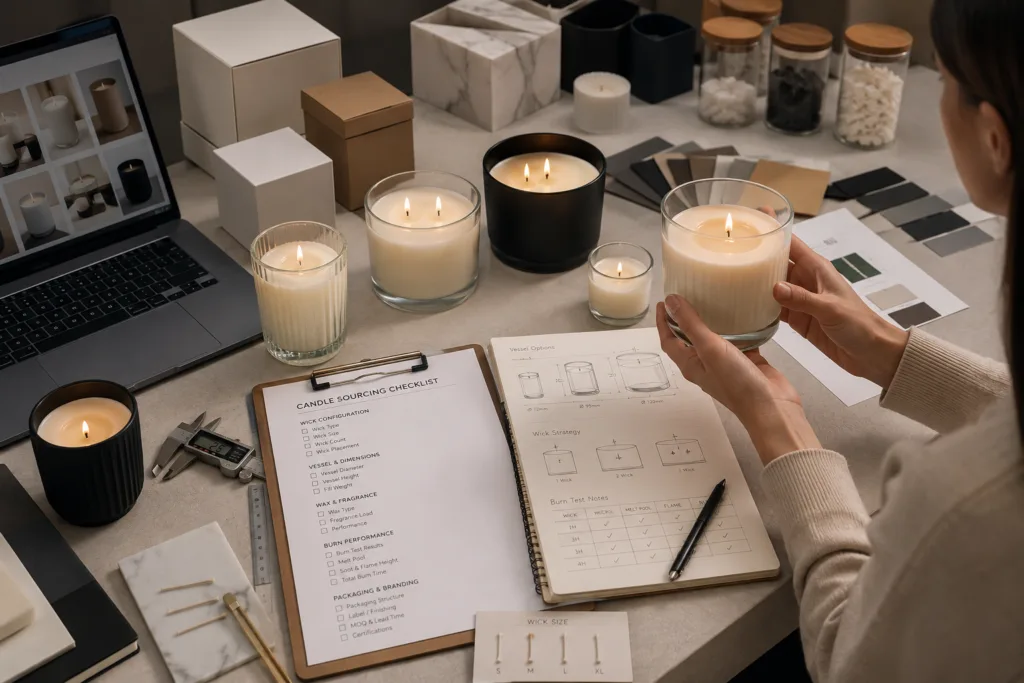
Before approving a private label candle order, buyers should ask suppliers clear technical questions. These questions help avoid vague promises and reveal whether the supplier understands candle engineering.
- What wick configuration do you recommend for this vessel, and why?
- Is the candle single wick, double wick, or three wick based on vessel diameter or only based on appearance?
- What wick sizes were tested before final selection?
- What is the wax blend, and how does it affect burn time?
- What fragrance load will be used?
- Will each fragrance be burn-tested separately?
- What is the expected burn time range based on testing?
- How long should the first burn be for this candle size?
- What are the recommended consumer burning instructions?
- Do you provide burn test photos or a burn test summary?
- Does the vessel remain safe during repeated burn cycles?
- Is the glass or ceramic vessel suitable for candle use?
- What safety labels and warning instructions can be applied?
- What happens if burn testing shows tunneling or overheating?
- Will the final pre-production sample match bulk production materials?
A serious supplier should be able to answer these questions without treating them as unusual. For large buyers, these questions are basic due diligence.
How Wick Configuration Supports Premium Candle Positioning
Premium candles are not premium because they are expensive. They are premium because the customer experience remains strong after purchase.
The consumer may first notice the vessel, fragrance name, label design, and packaging. But after lighting the candle, the real quality becomes visible. A luxury candle should burn evenly, release fragrance elegantly, avoid heavy soot, and look attractive even after multiple uses.
Wick configuration supports this premium experience. A properly engineered wick system allows the candle to perform as designed. It turns product design into product satisfaction.
For buyers building a luxury candle brand, the wick should support:
- Clean flame behavior.
- Consistent hot throw.
- Even wax consumption.
- Attractive glass appearance after burning.
- Realistic burn time claims.
- Lower complaint risk.
- Repeat purchase confidence.
This is why professional candle sourcing cannot stop at fragrance selection and packaging design. The technical core of the candle must be right.
How Wick Configuration Affects Different Sales Channels
Different sales channels have different burn time priorities.
Retail and Boutique Stores
Boutique buyers often care about storytelling, design, fragrance uniqueness, and giftability. However, repeat sales depend on performance. A candle that tunnels or smokes will not become a stable retail item. For boutique lines, balanced wick configuration is essential because customers expect both beauty and quality.
Amazon and Online Marketplaces
Online buyers leave direct reviews. Complaints about tunneling, smoke, weak scent, or short burn time can quickly damage conversion rates. Accurate burn time claims and clear use instructions matter. Marketplace sellers should avoid overpromising and should test products carefully before launch.
Hotels, Spas, and Hospitality
Hospitality buyers may prioritize safety, clean burn, and consistent ambiance. They may use candles in controlled environments where smoke, soot, or overheating are unacceptable. For this channel, wick configuration should support stability rather than only strong fragrance.
Corporate Gifting
Gift candles must look good and perform reliably for a broad audience. The end user may not be a candle expert, so the candle should be forgiving and well-labeled. A simple, stable wick configuration may be better than a dramatic but sensitive design.
Luxury Gift Sets
Luxury gift sets often use custom vessels, rigid boxes, inserts, and high-end fragrance concepts. The buyer may focus heavily on packaging, but candle performance still matters. A gift set becomes more valuable when the candle burns beautifully and safely.
When to Choose Single, Double, or Three Wicks
There is no universal answer, but buyers can use a practical decision framework.
Choose a single wick when:
- The vessel diameter is small or moderate.
- Longer burn time is a priority.
- The product is designed for daily use.
- The candle does not need extremely strong room-filling fragrance.
- Cost efficiency matters.
- Testing confirms the melt pool is acceptable.
Choose double wicks when:
- One wick cannot create a proper melt pool.
- The vessel is medium-wide.
- The product needs stronger hot throw.
- The buyer wants a more premium flame presentation.
- A modest reduction in burn time is acceptable.
- Testing confirms safe heat distribution.
Choose three wicks when:
- The vessel is large and wide.
- The product is positioned as premium or decorative.
- Strong fragrance impact is a selling point.
- Visual flame effect matters.
- The buyer accepts faster wax consumption.
- The supplier can prove safe multi-wick performance.
This framework helps buyers avoid the two most common extremes: using one wick to save cost in a vessel that needs two, or using three wicks for aesthetics in a vessel that becomes too hot.
Why Professional Candle Manufacturers Test Instead of Guess
In candle manufacturing, experience matters, but testing still matters more. A supplier may have general wick charts, past production records, and standard recommendations. These are useful starting points, not final proof.
Every candle is a system. Change the vessel, and the system changes. Change the fragrance, and the system changes. Change the wax blend, and the system changes. Change the dye, wick series, fill weight, or curing time, and the system may change again.
This is why professional manufacturers test before scaling.
A good supplier does not simply say, “We always use this wick.” A good supplier says, “Based on the vessel diameter and wax formula, we will start with this wick range, test the burn performance, and adjust if needed.”
For buyers placing serious orders, that difference matters. It reduces risk before money is committed to bulk production, packaging, shipping, and inventory.
Building a Better Private Label Candle Program
If you are developing a private label candle collection, the best approach is to align product design, wick configuration, and commercial positioning from the beginning.
Start with the target customer. Is the candle for everyday use, luxury gifting, hotel ambiance, seasonal retail, aromatherapy, or home decor? Then define the vessel size, wax type, fragrance direction, packaging level, target burn time, and price point.
Only after these decisions are clear should the wick configuration be finalized.
For example:
- A minimalist 180 g candle for boutique retail may use a single wick and focus on clean design, longer burn time, and stable fragrance.
- A 300 g living room candle may need double wicks to achieve better melt pool and hot throw.
- A 500 g holiday gift candle may use three wicks for visual impact and strong fragrance experience.
- A hotel candle may prioritize low soot, controlled flame, and safety over dramatic scent throw.
- A high-end ceramic vessel may require extra testing because ceramic heat behavior differs from glass.
The stronger your product brief, the better the manufacturer can engineer the candle.
Final Thoughts: Candle Burn Time Is Product Engineering
Candle burn time is not a simple number. It is the result of engineering choices. Wick configuration sits at the center of those choices because it controls how the candle consumes wax, releases fragrance, forms a melt pool, and behaves over repeated burns.
For mature buyers, understanding wick configuration helps prevent costly mistakes. It allows you to compare suppliers more intelligently, evaluate samples more professionally, and create products that perform well after they leave the showroom.
The best candle is not always the one with the longest burn time. The best candle is the one that burns evenly, safely, beautifully, and consistently while delivering the experience your target customer expects.
If you are planning a private label candle order, do not ask only for price and wax weight. Ask about vessel diameter, wick size, wick count, fragrance load, burn testing, and realistic burn time. These details determine whether your candle becomes a repeat-purchase product or another item that looks good only before it is lit.
At Circe Home, we support private label and custom candle development with vessel selection, wax and fragrance matching, wick testing, packaging development, and bulk production planning. Whether you are building a boutique candle line, a luxury gift set, a hotel candle program, or a seasonal retail collection, the right wick configuration can help your product burn longer, perform better, and earn stronger customer trust.
For buyers preparing a serious candle project, send your target vessel size, wax preference, fragrance direction, packaging concept, and expected order quantity. Our team can help evaluate the right wick configuration and develop a candle collection designed for real market performance.
FAQ
1. Does a bigger wick always make a candle burn better?
No. A bigger wick may create a larger flame and faster melt pool, but it can also consume wax too quickly, shorten burn time, produce soot, cause mushrooming, and make the vessel too hot. The best wick is the one that matches the vessel diameter, wax type, fragrance load, and target burn performance.
2. Do three wick candles burn longer than single wick candles?
Not necessarily. Three wick candles often look more premium and produce stronger fragrance throw, but they usually consume wax faster than single wick candles of the same wax weight. They are best for large vessels and strong sensory impact, not necessarily maximum burn time.
3. Why should buyers request burn testing before bulk candle production?
Burn testing confirms whether the candle burns evenly, safely, and consistently. It helps identify tunneling, weak flame, excessive soot, overheating, poor fragrance throw, or unrealistic burn time before mass production. For custom private label candles, burn testing is essential for reducing product risk.