
 For experienced retail operators, revenue growth is rarely constrained by product quality or customer demand. The limiting factor is often transaction structure. Specifically, how much value is captured per customer interaction.
Average Order Value (AOV) is one of the most powerful and controllable drivers of retail profitability. Unlike traffic acquisition, which requires ongoing marketing investment, AOV optimization improves revenue efficiency from existing demand. It increases revenue without increasing customer acquisition cost.
Among all structural strategies available to retail buyers, private label programs, and brand operators, gift sets represent one of the most reliable and scalable methods to increase AOV while simultaneously strengthening brand positioning.
This is particularly true in categories such as candles, home fragrance, personal care, and gifting-oriented products, where packaging, presentation, and perceived value significantly influence purchasing behavior.
This guide explains, from a structural and economic perspective, how gift sets increase Average Order Value, why experienced buyers prioritize them, and how they function as both revenue multipliers and brand positioning tools.
Understanding Average Order Value and Its Strategic Importance
Average Order Value (AOV) is defined as:
Total Revenue ÷ Total Number of Orders
While simple in definition, AOV has a profound impact on profitability, operational efficiency, and scalability.
Consider two retail environments with identical customer traffic.
Retailer A
Average Order Value: $28
Monthly Orders: 3,000
Monthly Revenue: $84,000
Retailer B
Average Order Value: $52
Monthly Orders: 3,000
Monthly Revenue: $156,000
The difference in revenue is $72,000 per month, without any increase in customer count.
This difference is not driven by traffic, advertising, or product quality. It is driven by transaction structure.
Gift sets directly influence transaction structure by increasing the value captured per purchase decision.
From a profitability perspective, this is one of the most efficient forms of revenue expansion available.
Why Gift Sets Structurally Increase Average Order Value
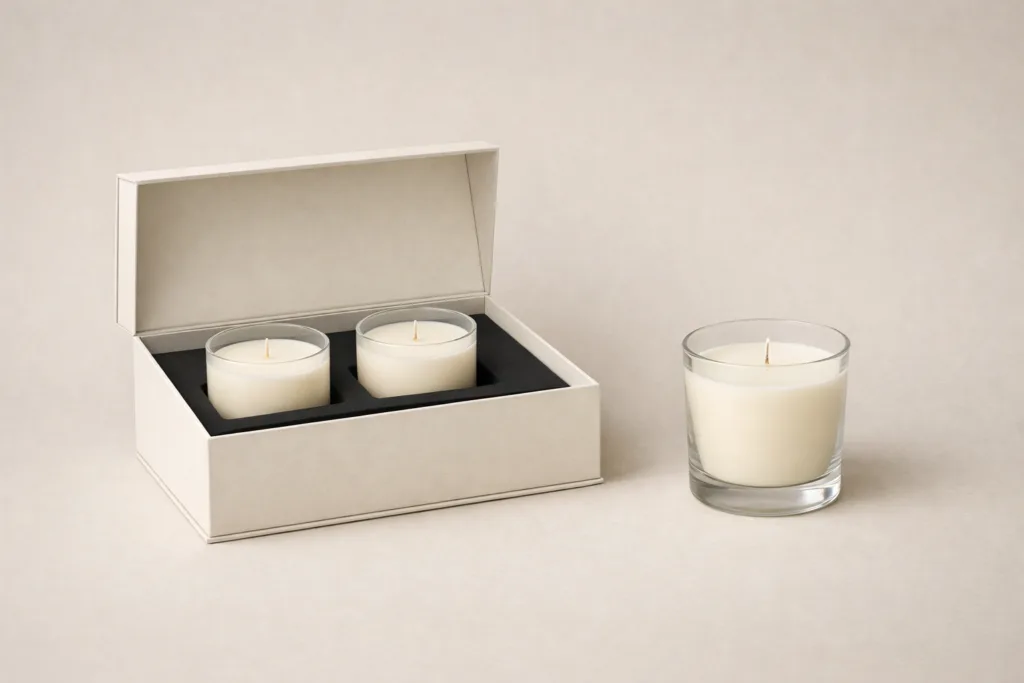 Gift sets increase AOV through multiple reinforcing mechanisms. These mechanisms operate simultaneously at psychological, operational, and economic levels.
1. Bundling Increases Transaction Size Without Increasing Decision Complexity
Customers are more likely to purchase structured bundles than assemble equivalent combinations individually.
When products are presented as curated gift sets, the purchase decision becomes simplified. Instead of evaluating multiple individual items, the customer evaluates a single complete solution.
This reduction in decision complexity increases purchase confidence and encourages higher-value transactions.
For example:
Single candle retail price: $32
Two-candle gift set retail price: $68
The gift set increases revenue per transaction by 112%, while the decision process remains simple.
This structural efficiency is one of the primary reasons gift sets outperform individual units in retail environments.
2. Gift Sets Increase Perceived Value Faster Than Production Cost
The perceived value of a product is not determined solely by its manufacturing cost. It is heavily influenced by presentation, packaging, and completeness.
For example:
Single candle production cost: $6
Rigid box packaging cost: $4
Total gift set production cost (2 candles + packaging): $16
Retail pricing comparison:
Single candle retail price: $32
Gift set retail price: $78
Cost increase: 166%
Revenue increase: 244%
Margin expansion occurs because packaging and presentation amplify perceived value faster than they increase production cost.
This creates favorable margin expansion conditions for retail operators.
3. Gift Sets Move Products Into Higher Retail Price Tiers
Retail price tiers function as psychological anchors.
For example:
$20–$35 range: Everyday purchases
$40–$60 range: Premium individual items
$65–$120 range: Gift products
$120+ range: Luxury gifting and premium positioning
Individual candles typically occupy lower price tiers. Gift sets allow the same core product to enter higher-value retail categories.
This repositioning enables higher revenue per transaction without fundamentally changing the core product.
For professional buyers, this represents a strategic lever rather than a cosmetic packaging change.
4. Gift Sets Align With High-Intent Purchasing Scenarios
Gift purchasing behavior differs structurally from self-use purchasing behavior.
Gift buyers prioritize:
• completeness
• presentation quality
• perceived value
• appropriateness for gifting occasions
Gift sets directly address these criteria.
As a result, customers entering retail environments with gifting intent naturally gravitate toward bundled products.
This increases conversion rates at higher price points.
Revenue Impact: Transaction-Level Economics of Gift Sets
To understand the full impact of gift sets, it is necessary to analyze transaction-level economics.
Consider a retail environment with 1,000 monthly candle transactions.
Scenario 1: Individual Units Only
Average candle retail price: $32
Monthly revenue: $32,000
Scenario 2: Mixed Sales With Gift Sets
600 individual candles: $32 × 600 = $19,200
400 gift sets: $78 × 400 = $31,200
Total monthly revenue: $50,400
Revenue increase: 57.5%
Customer count remains unchanged.
This revenue increase is driven purely by transaction structure optimization.
For professional retail buyers, this is one of the most predictable and controllable methods of increasing revenue.
Margin Expansion: Gift Sets Improve Profit Efficiency
Gift sets do not merely increase revenue. They improve profit efficiency.
Fixed operational costs such as:
• rent
• staffing
• logistics
• marketing
are distributed across higher-value transactions.
This increases profit per transaction and improves operational efficiency.
For example:
Individual candle profit: $18
Gift set profit: $42
Even if gift sets represent only 40% of transactions, they may represent over 60% of total profit contribution.
This is why experienced buyers prioritize bundled product structures.
Packaging as Revenue Infrastructure
Packaging plays a critical role in enabling gift set performance.
Rigid box packaging, in particular, transforms product perception.
Rigid boxes provide:
• structural integrity
• premium tactile experience
• superior visual presentation
• improved gift suitability
Unlike folding cartons, rigid boxes create a lasting physical impression associated with luxury products.
This enables higher retail pricing while reinforcing brand positioning.
From a retail economics perspective, rigid packaging functions as revenue infrastructure rather than cost.
Shelf Performance and Retail Environment Impact
 Retail shelf presence significantly influences customer purchasing behavior.
Gift sets provide stronger shelf impact due to:
• larger physical footprint
• visual prominence
• structured presentation
• perceived completeness
These characteristics increase product visibility and encourage higher-value transactions.
Retail buyers frequently observe that gift sets outperform individual units in premium retail environments.
Gift Sets Improve Brand Positioning and Perceived Authority
Brand perception influences pricing power.
Brands offering structured gift sets are perceived as more established and professionally developed.
This perception supports:
• higher price ceilings
• increased customer trust
• stronger brand authority
Gift sets signal maturity and brand completeness.
This positioning is especially important for private label programs serving retail chains, hospitality groups, and corporate clients.
Gift Sets Enable Scalable Revenue Growth Without Increasing Operational Complexity
One of the key advantages of gift sets is scalability.
Gift sets use existing product components while creating higher-value retail configurations.
This allows revenue expansion without requiring entirely new product development.
From a manufacturing and supply chain perspective, gift sets leverage existing production capabilities while increasing revenue output.
This makes gift sets highly scalable for large-volume retail programs.
Gift Sets Are Essential for Seasonal and Corporate Gifting Programs
Seasonal demand represents a disproportionate share of annual retail revenue.
Key gifting periods include:
• Christmas
• corporate gifting season
• Mother’s Day
• Valentine’s Day
• hospitality gifting programs
During these periods, customer purchasing intent shifts toward gift-ready products.
Retailers with structured gift set programs capture significantly higher revenue during these peak demand cycles.
Gift sets enable retail buyers to fully monetize seasonal demand.
Why Professional Buyers Prioritize Gift Sets in Private Label Programs
 Private label buyers operate with margin targets, price positioning strategies, and brand development objectives.
Gift sets align directly with these objectives.
They enable:
• higher retail pricing
• margin expansion
• stronger brand positioning
• increased shelf presence
• improved customer perception
Gift sets transform individual products into structured retail systems.
This structural advantage is why gift sets are standard components of mature retail programs.
Strategic Implementation Considerations for Large-Scale Retail Programs
For professional buyers implementing gift sets at scale, several structural considerations are critical.
Packaging quality and structural integrity
Packaging must support premium positioning.
Rigid box construction is widely used in premium retail programs due to its durability and presentation quality.
Product consistency and manufacturing scalability
Gift sets require consistent product quality across production volumes.
Manufacturing systems must support large-scale repeatability.
Brand alignment and retail positioning
Gift sets must align with overall brand positioning and pricing strategy.
Packaging, labeling, and presentation must reinforce brand identity.
Long-Term Revenue Impact of Gift Set Integration
Gift sets do not produce one-time revenue improvements.
They permanently increase revenue efficiency.
Retailers integrating gift sets into core product strategy often experience sustained increases in:
• AOV
• profit margins
• customer lifetime value
• brand positioning strength
Gift sets become structural components of revenue architecture.
Conclusion: Gift Sets Function as Revenue Multipliers, Not Product Variations
Gift sets represent one of the most effective structural tools available to retail buyers and private label programs.
They increase Average Order Value by:
• increasing transaction size
• improving perceived value
• enabling higher retail price tiers
• strengthening brand positioning
• improving profit efficiency
Unlike marketing-driven growth, which requires ongoing investment, gift set integration produces sustainable structural improvements in revenue performance.
For professional buyers, gift sets are not optional additions. They are essential components of scalable retail strategy.
FAQ
1. Why do candle gift sets increase Average Order Value more than individual candles?
Gift sets increase AOV because they combine multiple products into a single transaction while improving perceived value through premium packaging and presentation. Customers purchasing gifts are structurally more willing to spend at higher price points than self-use buyers.
2. Do gift sets improve profit margins or only increase revenue?
Gift sets improve both revenue and profit margins. Packaging and bundling increase perceived value faster than production cost increases, enabling higher retail pricing and improved profit per transaction.
3. Are gift sets important for private label candle brands targeting retail chains?
Yes. Gift sets are essential for private label candle brands because they enable higher price positioning, stronger shelf presence, and improved brand perception. They are widely used by retail chains, hospitality groups, and corporate gifting programs to maximize revenue efficiency.