
A beautiful candle can still be a poorly engineered product.
The fragrance may be appealing, the glass may look expensive and the packaging may photograph perfectly, yet an unsuitable wick or an unbalanced formula can produce an excessive flame, heavy carbon buildup, rising container temperatures or unsafe behaviour near the end of the candle’s life.
For brands and importers, candle safety testing is therefore not a final formality. It is part of product development, supplier qualification, quality control and commercial risk management.
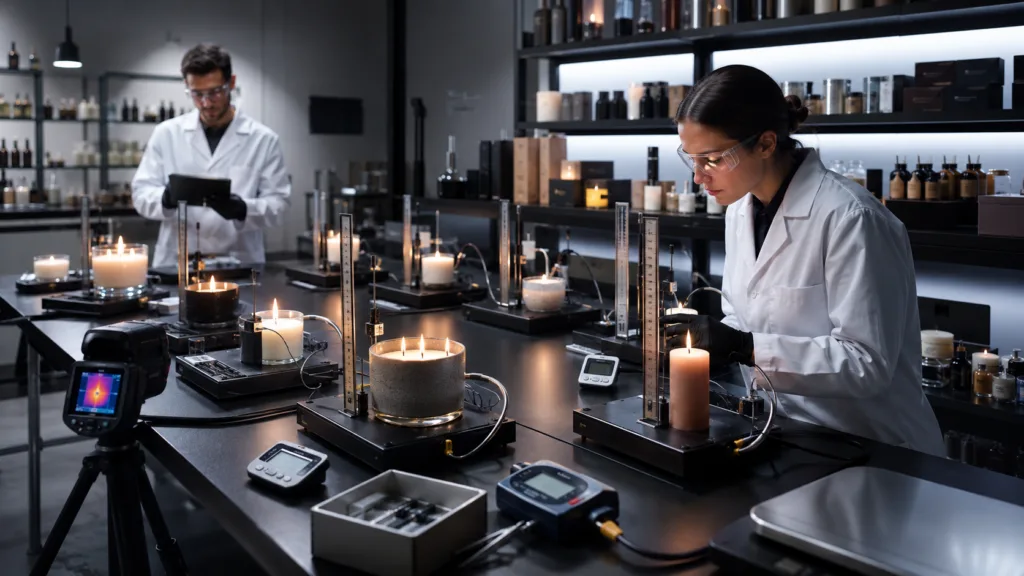
A professional testing program evaluates the entire candle system:
- Wax formulation
- Fragrance concentration
- Wick type and wick size
- Vessel dimensions
- Container material
- Dye and additives
- Decorative components
- Consumer burn instructions
- Expected burn duration
- End-of-life behaviour
Changing any one of these variables can change the way the candle burns. A test report from one fragrance, vessel or wick combination cannot automatically be applied to another.
This guide explains the essential elements of a professional candle burn test, the major candle fire safety standards, the records importers should request and the point at which independent laboratory testing becomes necessary.
1. Why Candle Safety Testing Is a Commercial Requirement
The primary purpose of candle testing is to reduce foreseeable fire, burn and container-related risks during normal use.
However, mature buyers also use testing to answer commercial questions:
- Will the candle perform consistently throughout its useful life?
- Can the supplier reproduce the approved sample in mass production?
- Is the vessel suitable for repeated heating and cooling?
- Will the product meet retailer or marketplace requirements?
- Can the importer trace a complaint back to a production batch?
- Is there sufficient evidence to support the brand’s safety claims?
- Could the design create recalls, returns or product-liability exposure?
The U.S. Consumer Product Safety Commission lists ASTM standards relevant to candle burning performance, safety labeling, visible emissions, glass containers and candle accessories. ASTM describes its fire-safety specification as a set of minimum safety requirements intended to provide a reasonable degree of safety during normal candle use.
Testing cannot make an open-flame product risk-free. It can, however, identify avoidable design failures before thousands of units enter the market.
2. Search Trends Show Growing Buyer Interest in Safer Candles
The exact phrase “candle safety testing” is a specialised B2B query. Its search volume is naturally lower than broad consumer terms such as “candle safety,” “safe candles,” “clean-burning candles” or “how to burn a candle.”
Low volume does not mean low commercial value.
Google Trends notes that very specific queries may display limited or zero data because the platform reports relative interest rather than exact monthly search volume. Its figures are normalised on a scale from 0 to 100, and low-volume terms may fall below the reporting threshold.
For SEO purposes, this creates a useful distinction:
- Broad terms attract consumers seeking usage advice.
- Technical terms attract manufacturers, importers, compliance teams and brand founders preparing to place orders.
- Standards-based terms such as ASTM F2417 or EN 15493 often signal advanced sourcing intent.
- Problem-based searches such as “candle jar too hot” or “candle flame too high” indicate an immediate product-development concern.
Pinterest Trends uses search, save and shopping behaviour to identify emerging visual and commercial interests. Pinterest’s own business resources describe the platform’s trend data as a tool for understanding what users are searching for, saving and preparing to purchase.
On visual platforms, demand tends to concentrate around attractive vessels, natural wax, wellness fragrances, decorative candles and premium gift presentation. These trends increase the need for testing because unusual shapes, botanical decorations, multiwick formats and custom containers introduce additional variables.
Amazon provides search-query and shopping-funnel data to eligible brand owners through Brand Analytics rather than publishing universal keyword volumes. Its Search Query Performance tools are designed to show how customers discover a brand or ASIN through search.
Facebook and LinkedIn also do not publish dependable universal search-volume figures for individual candle-testing terms. Their practical value is different:
- Facebook reveals recurring consumer and maker concerns about wick sizing, jar heat, soot and decorative materials.
- LinkedIn reflects professional interest in compliance, private-label production, quality assurance and retailer requirements.
The overall pattern is clear: consumers search for safe use, while serious buyers search for proof that safety has been engineered into the product.
3. What Candle Safety Testing Actually Covers
Candle testing is frequently confused with fragrance testing.
A candle with a strong hot throw is not necessarily a safe or technically successful candle. In fact, increasing fragrance load or wick size to improve scent performance can destabilise combustion.
A complete testing program normally contains several separate evaluations.
Performance Testing
Performance testing examines:
- Melt-pool development
- Wax consumption
- Burn rate
- Tunnelling
- Residual wax
- Wick centring
- Flame stability
- Fragrance throw
Fire-Safety Testing
Fire-safety testing focuses on:
- Flame height
- Secondary ignition
- Stability
- End-of-life behaviour
- Self-extinguishing performance where claimed
- Ignition of decorations or surrounding components
- Container breakage or cracking
Soot and Visible-Emission Testing
This examines smoke and soot generated during combustion.
ASTM F2326 provides a method for collecting and comparing visible emissions from indoor candles. ASTM specifically notes that the method supports formulation comparisons and does not itself establish universal pass-or-fail limits.
Container Testing
Container evaluation may include:
- Annealing quality
- Thermal shock resistance
- Dimensional consistency
- Cracks, chips and scratches
- Surface-temperature mapping
- Compatibility with the wick and wax system
ASTM F2179 covers minimum performance requirements for certain glass containers manufactured for use as filled candle vessels, including annealing and thermal-shock considerations.
Chemical and Emission Evaluation
Depending on the destination market, formula and retailer, additional work may cover:
- Fragrance documentation
- Restricted substances
- Allergen or hazard communication
- Indoor-air emissions
- Heavy metals in coatings or decorations
- Packaging and labeling compliance
Safety must therefore be assessed as a system rather than as one isolated burn test.
4. Candle Fire Safety Standards in Major Markets
The standards requested by a buyer will depend on the destination country, retailer, candle format and intended use.
United States
The current ASTM candle standards listed by ASTM include:
- ASTM F2417-26: Fire Safety for Candles
- ASTM F2058-07(2021): Candle Fire Safety Labeling
- ASTM F2326-04(2021): Collection and Analysis of Visible Emissions
- ASTM F2179-26: Annealed Glass Containers for Candle Use
- ASTM F2601-25: Fire Safety for Candle Accessories
ASTM F2417 addresses hazards including excessive flame height, tip-over risk, secondary ignition and end-of-life performance.
European Markets
Commonly referenced European standards include:
- EN 15493:2019: Fire safety for indoor candles
- EN 15494:2019: Product safety labels
- EN 15426:2018: Sooting behaviour
- EN 16738:2015: Emissions from combustible air fresheners
- EN 17616:2021: Fire safety for outdoor candles
EN 15493 covers indoor candle fire-safety requirements, while EN 15426 addresses the evaluation of soot behaviour. EN 15494 concerns the presentation of safety information to consumers.
Importers should not write “EU certified” or “ASTM certified” merely because a factory has conducted an internal test. A standard may be used as a test method or design reference without creating a formal product certification.
The report should identify:
- The exact standard and edition
- The candle model tested
- The laboratory or testing location
- The test dates
- The sample quantity
- The test conditions
- The results for each requirement
- Any deviations from the standard
5. How to Build a Reliable Candle Burn Test Plan
A reliable candle burn test begins before the candle is lit.
Testing uncontrolled samples in an uncontrolled room can generate inconsistent results and hide meaningful differences between formulations.
Sample Selection
Test samples should represent the final commercial product, including:
- Final wax blend
- Final fragrance percentage
- Final wick
- Final vessel
- Final dye
- Final decoration
- Final fill weight
- Final curing conditions
For multi-SKU collections, the highest-risk products should receive particular attention. These may include the widest container, strongest fragrance load, darkest dye, largest wick, multiwick design or most complex decorative treatment.
Conditioning
Candles should be conditioned under a documented environment before testing. Temperature affects wax hardness, fragrance distribution, ignition and melt-pool development.
Record:
- Production date
- Cure duration
- Storage temperature
- Test-room temperature
- Relative humidity
- Air movement
Test Environment
The candle should be tested:
- On a level, noncombustible surface
- Away from direct drafts
- With adequate spacing between test candles
- Under controlled ventilation
- With fire-suppression equipment available
- Under continuous observation
Test Equipment
A professional setup may include:
- Flame-height scale
- Stopwatch
- Digital scale
- Thermocouples or calibrated temperature probes
- Infrared imaging equipment
- Incline platform
- Callipers
- Camera
- Test log
- Heat-resistant enclosure
Every measurement should be connected to a time point in the burn cycle.
6. Flame Height and Flame Behaviour
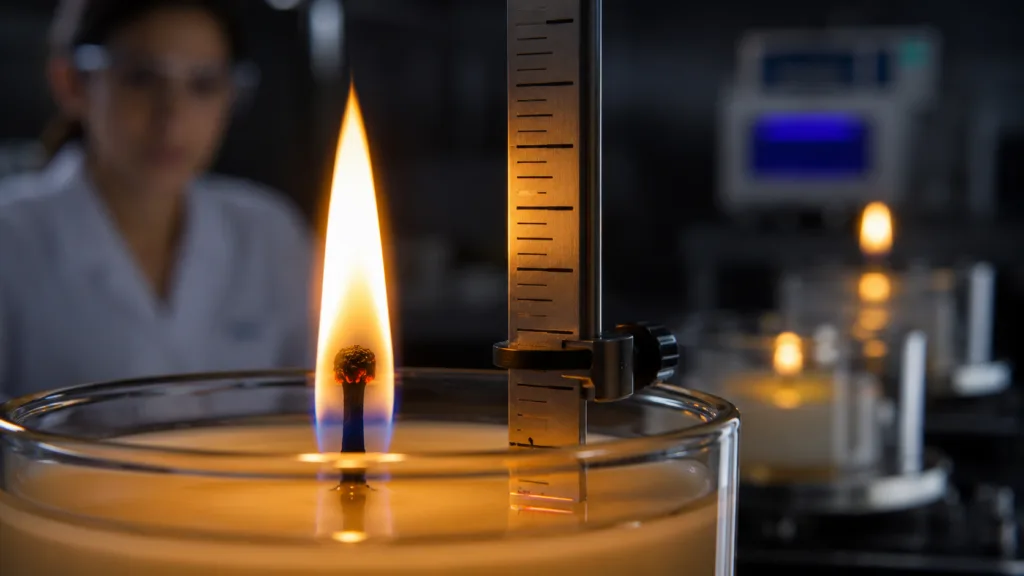
Flame height is one of the clearest indicators of whether the wick and fuel system are balanced.
An oversized wick can draw excessive melted wax and fragrance into the combustion zone. This may produce:
- An abnormally high flame
- Rapid wax consumption
- Heavy carbon formation
- Smoke
- Excessive container heating
- Increased risk of secondary ignition
A wick that is too small may produce tunnelling, weak scent throw and incomplete wax consumption. These are performance problems, but attempts to correct them by simply increasing the wick size can create a safety problem.
Under EN 15493, the commonly cited maximum is 75 mm for most indoor candles and 30 mm for tea lights. Exact requirements and exemptions depend on the candle category and applicable standard edition.
ASTM requirements also address excessive flame height, with product-specific provisions that should be checked in the current standard rather than copied from an old online checklist.
A test record should document:
- Flame height at defined intervals
- Maximum recorded flame height
- Flame width
- Flickering or surging
- Leaning direction
- Contact with the vessel wall
- Smoke events
- Behaviour following wick trimming
A momentary fluctuation caused by minor room movement is not equivalent to a continuously unstable flame. The tester must distinguish environmental disturbance from repeatable product behaviour.
7. Afterglow, Aftersmoke and Wick Extinguishing
Testing does not end when the flame is blown out.
After extinguishing, the wick can continue to glow, consume fuel and emit smoke. Excessive residual combustion may create odour, soot and a possible ignition source near combustible decorations.
Under EN 15493:2019, the wick should not continue to glow or smoke for an average period exceeding 30 seconds after extinguishing under the specified test method.
The following should be recorded separately:
- Afterglow: Visible glowing of the wick after the flame disappears
- Aftersmoke: Smoke emitted following extinguishing
- Reignition: The return of a visible flame without deliberate relighting
- Ember drop: Glowing carbon falling into the melt pool or onto another component
The extinguishing method must also remain consistent. Blowing, using a snuffer and dipping the wick can produce different results. Standardised tests should follow the method stated in the applicable protocol.
8. Carbon Buildup and Wick Mushrooming
A carbon “mushroom” forms when partially combusted material accumulates at the wick tip.
Small amounts of carbon do not automatically mean that a candle is dangerous. Persistent or rapidly growing carbon, however, may indicate that the wick is supplying fuel faster than the flame can burn it cleanly.
Possible causes include:
- Wick size is too large
- Wick construction is unsuitable
- Fragrance load is too high
- Fragrance contains difficult-to-burn components
- Dye or additives interfere with combustion
- Wick has not been trimmed correctly
- Burn sessions are excessively long
Carbon accumulation matters because it can increase flame size, create smoke, detach as a hot particle or contribute to unstable burning.
Evaluation Criteria
Inspect:
- Carbon diameter
- Carbon growth rate
- Symmetry
- Frequency of detachment
- Flame change after buildup
- Smoke produced
- Contamination of the melt pool
Test Data to Record
Record carbon behaviour during every burn cycle, not only at the end of the first test session.
Buyer Question
Ask the supplier whether the wick specification was validated across every fragrance in the collection. Different fragrance oils can require different wick solutions even when the vessel and wax remain unchanged.
9. Candle Container Temperature
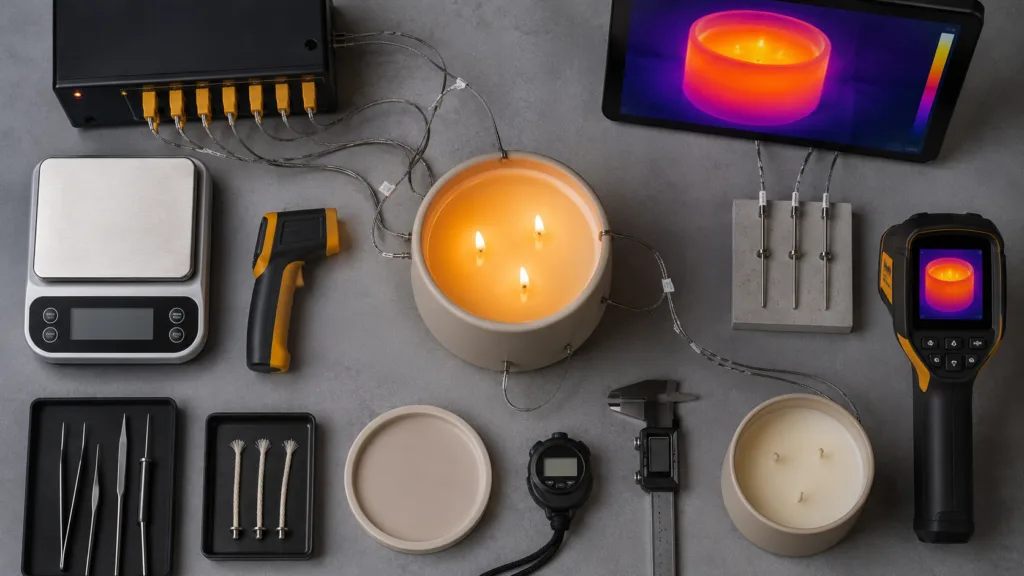
Container temperature is one of the most misunderstood areas of candle development.
There is no single temperature that can be applied as a universal legal pass-or-fail value to every glass, ceramic, concrete or metal candle vessel. Material conductivity, wall thickness, shape, handle design, contact area and intended consumer use all matter.
The goal is to understand where heat accumulates and whether the combination creates a foreseeable burn, breakage or surface-damage risk.
Where to Measure
Temperature should be mapped at several points:
- Vessel rim
- Upper wall
- Mid-wall
- Lower wall
- Base
- Label area
- Surface beneath the candle
- Point closest to each wick
When to Measure
Measurements are particularly important:
- After the melt pool reaches full width
- During the longest recommended burn
- When the wax level reaches the midpoint
- During the final burn cycles
- Immediately before self-extinguishing
- During abnormal flame behaviour
The final third of a container candle can be more thermally demanding because the flame is positioned deeper inside the vessel. Heat may become concentrated within the container rather than dispersing freely into the room.
Multiwick candles require additional attention because wick spacing affects combined heat output. Two or three acceptable individual flames may still create excessive total heat when placed too close together.
For glass candles, vessel quality cannot be judged only by appearance. Annealing, thermal-shock resistance, scratches, wall consistency and base construction all influence performance. ASTM F2179 specifically addresses glass containers produced for candle use and places responsibility on the glass manufacturer or processor to maintain supporting test documentation.
10. Stability and Tip-Over Resistance
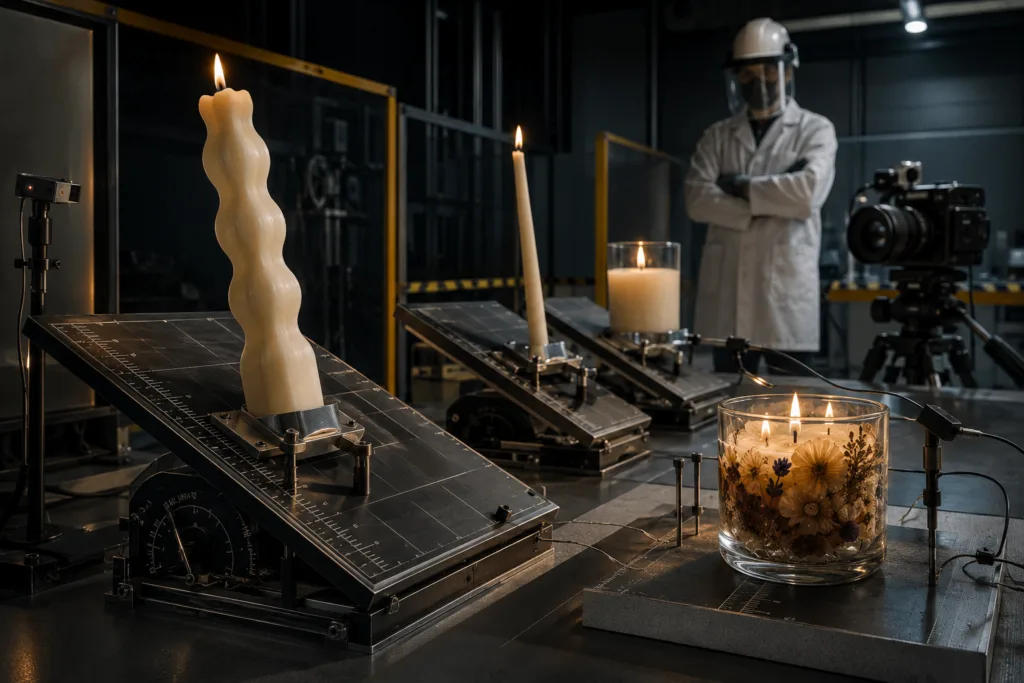
A candle can have a controlled flame and still be unsafe if it is mechanically unstable.
Tall tapers, sculptural candles, narrow containers and top-heavy gift designs should be evaluated on an incline. EN fire-safety testing commonly uses a 10-degree incline when assessing stability.
Testing should consider:
- Candle without packaging
- Candle in the supplied holder
- Candle with decorative accessories
- Candle after wax has softened
- Uneven wax consumption
- Dripping that changes the centre of gravity
- Base deformation from heat
The base must resist tipping, sliding and rocking.
Importers should also confirm that accessories shown in marketing photography are compatible with the candle. A vessel may perform correctly on its own but become unsafe inside a decorative lantern, ring or holder that traps heat or places combustible material near the flame.
11. Secondary Ignition and Decorative Materials
Secondary ignition occurs when something other than the intended wick catches fire.
Potential sources include:
- Dried flowers
- Herbs
- Coffee beans
- Wood pieces
- Paper decorations
- Fabric
- Loose glitter
- Painted coatings
- Labels extending above the wax
- Multiple wick tabs
- Debris left in the melt pool
Decorative botanical candles may perform safely during their first hour and become hazardous later as decorations shift toward the flame or enter the melt pool.
Under EN 15493 testing, secondary ignition must not continue beyond the permitted period; published test summaries commonly identify a maximum of 10 seconds under the relevant method.
For large commercial programs, decorative materials should be treated as functional components, not merely styling.
Each material should have:
- Approved specification
- Controlled placement
- Maximum quantity
- Defined distance from the wick
- Incoming inspection criteria
- Burn-test evidence
Natural-looking does not mean noncombustible.
12. Why the Complete Burn Cycle Must Be Tested
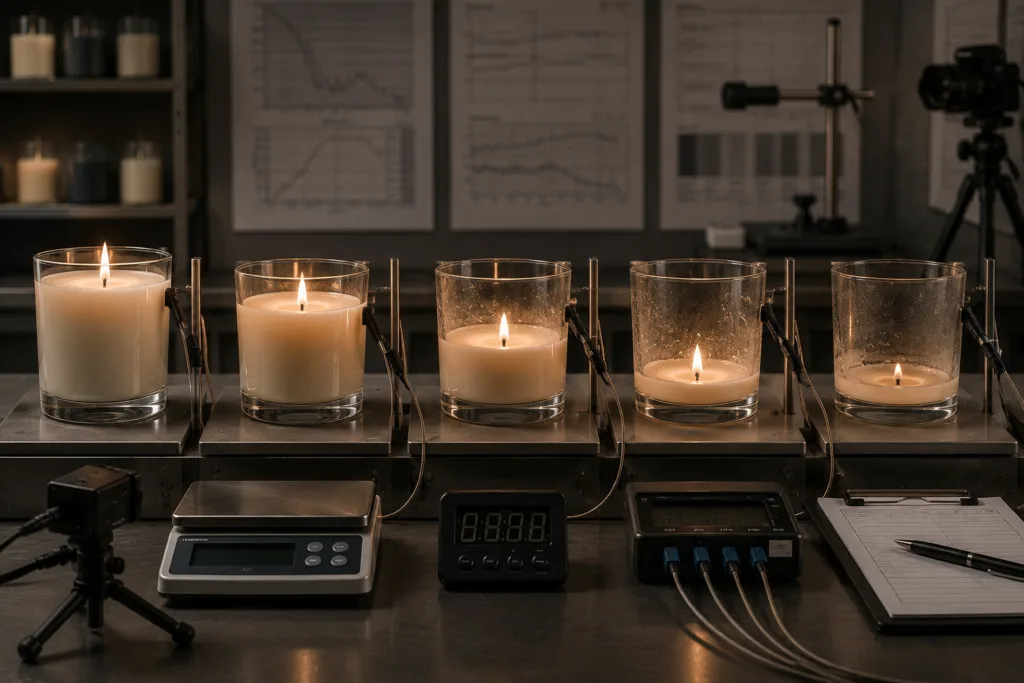
Testing only the first burn provides incomplete evidence.
The candle’s thermal and combustion behaviour changes as the wax level falls. A formula that appears balanced at the top of the vessel may become overwicked later.
Full-cycle testing evaluates the candle from first ignition to its designed end of life.
A typical internal protocol divides the total life into repeated burn sessions. The exact duration should reflect the test standard, retailer protocol and consumer instructions.
For every cycle, record:
- Starting weight
- Ending weight
- Burn duration
- Wax consumption
- Flame height
- Melt-pool diameter
- Melt-pool depth
- Wick condition
- Carbon formation
- Visible smoke
- Vessel temperature
- Extinguishing behaviour
- Cooling behaviour
The end-of-life test is critical because it reveals whether:
- The flame extinguishes at a safe wax level
- Wick tabs remain secured
- The vessel overheats
- The base becomes scorched
- The glass cracks
- The flame contacts the vessel
- Excessive residual wax remains
- Decorative parts ignite
A candle should never be approved solely because the first two burns look attractive in a product-development video.
13. Soot, Smoke and Indoor Emissions
Every hydrocarbon-based flame can generate combustion products. The relevant question is whether the candle has been engineered to burn in a controlled manner under its intended conditions.
Visible soot is influenced by:
- Wick selection
- Wick length
- Fragrance chemistry
- Dye
- Wax composition
- Air movement
- Oxygen availability
- Burn duration
- Flame impingement
- Consumer maintenance
ASTM F2326 offers a standardised method for comparing visible-emission behaviour between candle formulations. The method is useful for development and relative ranking, but ASTM explicitly states that it does not set a universal pass-or-fail emission level.
EN 15426 establishes requirements and a method for evaluating the sooting behaviour of certain indoor single-wick candles. Its stated scope covers single-wick products up to 100 mm in diameter or an equivalent cross-sectional area.
Broader indoor-emission testing may also be considered for premium retailers or markets with more detailed air-quality expectations. EN 16738 provides a chamber-based method for evaluating emissions from combustible air fresheners. UL Solutions lists this method among its candle-emissions testing capabilities.
Brands should be cautious with claims such as:
- Soot-free
- Smoke-free
- Toxin-free
- Non-toxic
- Zero emissions
- Completely clean burning
These absolute claims are difficult to substantiate and may create unnecessary regulatory or reputational risk. More defensible communication focuses on tested performance, material selection and recommended use.
14. Batch Records and Product Traceability
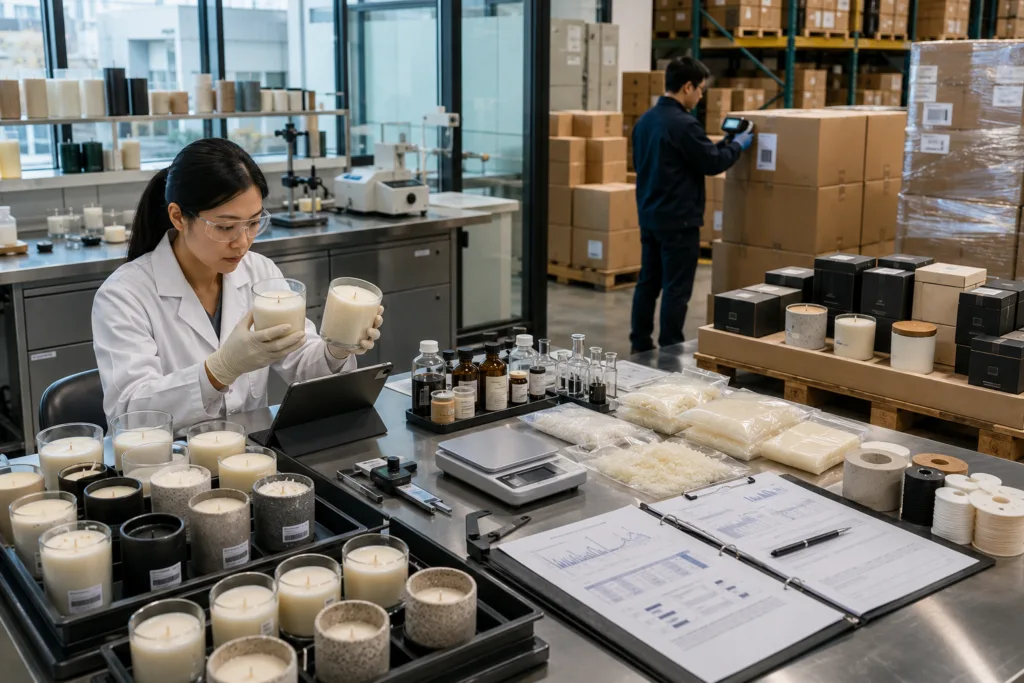
A laboratory report is valuable only when the tested sample can be connected to the product actually shipped.
Every approved candle should have a product specification that records:
- SKU and product name
- Vessel supplier
- Vessel batch
- Wax type and supplier
- Wax batch number
- Fragrance name and code
- Fragrance supplier
- Fragrance batch number
- Fragrance percentage
- Wick series and size
- Wick supplier
- Wick lot number
- Wick-tab specification
- Dye or additive details
- Fill weight
- Pouring temperature
- Cooling conditions
- Cure time
- Production date
- Testing date
- Tester
- Test result
- Approval status
Commercial production records should also connect the finished cartons to:
- Production order
- Filling date
- Packing date
- Inspection results
- Retained samples
- Shipping batch
This traceability allows a manufacturer to investigate whether a complaint relates to one production lot, one component supplier or the entire product design.
Without batch records, repeating a successful candle is partly guesswork.
15. When to Use a Third-Party Candle Testing Laboratory
Internal testing is essential during development because dozens of wick, wax and fragrance combinations may need to be screened.
Third-party testing becomes particularly important when:
- A major retailer requires an independent report
- The order value is commercially significant
- The candle uses a new custom vessel
- The product contains unusual decorations
- The candle has multiple wicks
- The importer is entering a new market
- The supplier has limited testing documentation
- A previous design has failed
- The product will be sold under a well-known brand
- The buyer needs independent evidence for due diligence
Where possible, select a laboratory accredited to ISO/IEC 17025 for the relevant testing scope. Accreditation is an independent evaluation of laboratory competence, but the buyer must still confirm that candle testing or the requested method appears within the laboratory’s accredited scope. ILAC explains that accredited reports support confidence in test results and can improve cross-border recognition.
A professional laboratory request should specify:
- Destination market
- Applicable standards
- Candle type
- Number of wicks
- Vessel material
- Sample quantity
- Required test items
- Required report language
- Retailer-specific protocol
- Whether photos and raw measurements are needed
Do not send an arbitrary showroom sample without confirming that it is representative of the final production design.
16. Candle Safety Testing Checklist for Importers
Before approving a private-label candle order, buyers should confirm the following.
Product Development
- Has every wax, wick, fragrance and vessel combination been tested?
- Were the test samples made with production materials?
- Was the complete burn life evaluated?
- Were the final burn cycles documented?
Fire Performance
- Was maximum flame height recorded?
- Was flame stability observed?
- Was secondary ignition evaluated?
- Were afterglow and aftersmoke recorded?
- Was end-of-life behaviour acceptable?
Container and Construction
- Was container temperature mapped?
- Is the glass or ceramic suitable for candle use?
- Were stability and tip-over risks tested?
- Are wick tabs secure?
- Are multiple wicks correctly spaced?
Emissions and Appearance
- Was soot or visible smoke evaluated?
- Was carbon buildup documented?
- Were claims such as “clean burning” reviewed?
- Were decorative materials tested as part of the final product?
Documentation
- Does the report identify the exact SKU?
- Are component batch numbers traceable?
- Is the standard edition clearly stated?
- Are retained samples available?
- Can the supplier reproduce the approved formula?
How Circe Home Supports Safer Private-Label Candle Programs
At Circe Home, candle development is approached as an integrated manufacturing project rather than a simple fragrance-and-packaging exercise.
Our private-label programs can coordinate:
- Natural and plant-based wax options
- Fragrance development
- Wick selection and optimisation
- Glass, ceramic and concrete vessels
- Custom vessel moulds
- Multiple-wick configurations
- Luxury gift boxes
- Recyclable packaging components
- Product safety labeling
- Internal burn testing
- Batch documentation
- Pre-shipment inspection
- Third-party laboratory coordination
- International shipping support
For mature brands, wholesalers, retailers and importers, safety should be built into the quotation and sampling process.
Circe Home can develop production samples, adjust wick and wax combinations, record full-cycle burn performance and coordinate independent testing based on the destination market and buyer protocol.
A large candle order should not begin with the question, “How quickly can production start?”
It should begin with a more important question:
Has the exact candle we are ordering been proven to burn safely and consistently from the first lighting to the final extinguishing point?
Frequently Asked Questions
1. What is included in candle safety testing?
Candle safety testing normally evaluates flame height, flame stability, secondary ignition, wick behaviour, afterglow, aftersmoke, soot, carbon buildup, container temperature, stability and end-of-life performance. The exact scope depends on the candle format, destination market and applicable standard.
2. How many candles should be used for a candle burn test?
There is no single sample quantity suitable for every project. Internal development should use enough samples to compare different wick and formula combinations and confirm repeatability. Formal testing must follow the sample requirements of the selected standard, laboratory or retailer protocol.
3. Does every fragrance need a separate candle burn test?
Yes. Fragrance oils can differ in viscosity, volatility and combustion behaviour. Two fragrances used at the same percentage in the same wax and vessel may require different wick sizes. Every final fragrance and colour combination should therefore be validated.
4. Is third-party candle testing legally required?
Requirements vary by country, retailer and product. Independent testing is not universally mandatory for every candle, but it may be required by retailers, marketplaces, insurers or importers. It is strongly recommended for large orders, custom vessels, complex decorations and higher-risk designs.