
Global Trade Realities in Home Fragrance Logistics Sourcing
Importing candles from China is no longer only a matter of finding the right fragrance, vessel, wax blend, and packaging design. For B2B buyers, the real cost of a bulk candle order is shaped by customs classification, tariff exposure, anti-dumping rules, ocean freight risk, documentation quality, and the supplier’s ability to support compliance before shipment leaves the factory.
China remains one of the most important sourcing hubs for scented candles, private label candles, ceramic jar candles, glass container candles, pillar candles, gift box candles, and seasonal candle collections. The structural advantage is clear: mature wax blending factories, glass and ceramic vessel supply chains, fragrance oil suppliers, label printing, gift box packaging, export carton production, and logistics forwarders are often located within the same industrial ecosystem.

For importers, this creates strong advantages in cost control, sampling speed, packaging flexibility, and product customization. However, customs clearance has become more complex. A candle order may look simple on a purchase order, but at the border, customs authorities will look at the product’s HTS code, country of origin, material declaration, commercial value, packaging structure, and whether the goods fall under any additional trade remedies.
This is why professional candle sourcing should begin with logistics planning, not after production is finished. Before placing a bulk order, importers should confirm:
- Product type: candle, taper, wax melt, reed diffuser, room spray, or gift set
- Wax composition: paraffin, soy wax, beeswax, palm wax, coconut wax, blended wax, or other vegetable wax
- Container material: glass, ceramic, metal tin, concrete, stoneware, or no container
- Packaging format: individual box, retail gift set, display carton, master carton, palletized shipment
- Target destination: United States, European Union, United Kingdom, Canada, Australia, or other market
- Incoterm: EXW, FOB, CIF, DDP, or DAP
- Importer of record responsibility
- Applicable HTS/CN code and Chapter 99 tariff overlays
- Possible anti-dumping duty exposure
- Summer transit and wax melting risk
For buyers who need predictable landed cost, working with a supplier that understands both production and logistics can reduce delays, rework, and unexpected duty exposure. Circe Home supports customized candle production, export packaging, and shipping coordination for bulk buyers. You can also review our fulfillment and logistics support before planning your next shipment.
Mastering HTS Code Classification for Scented Candles
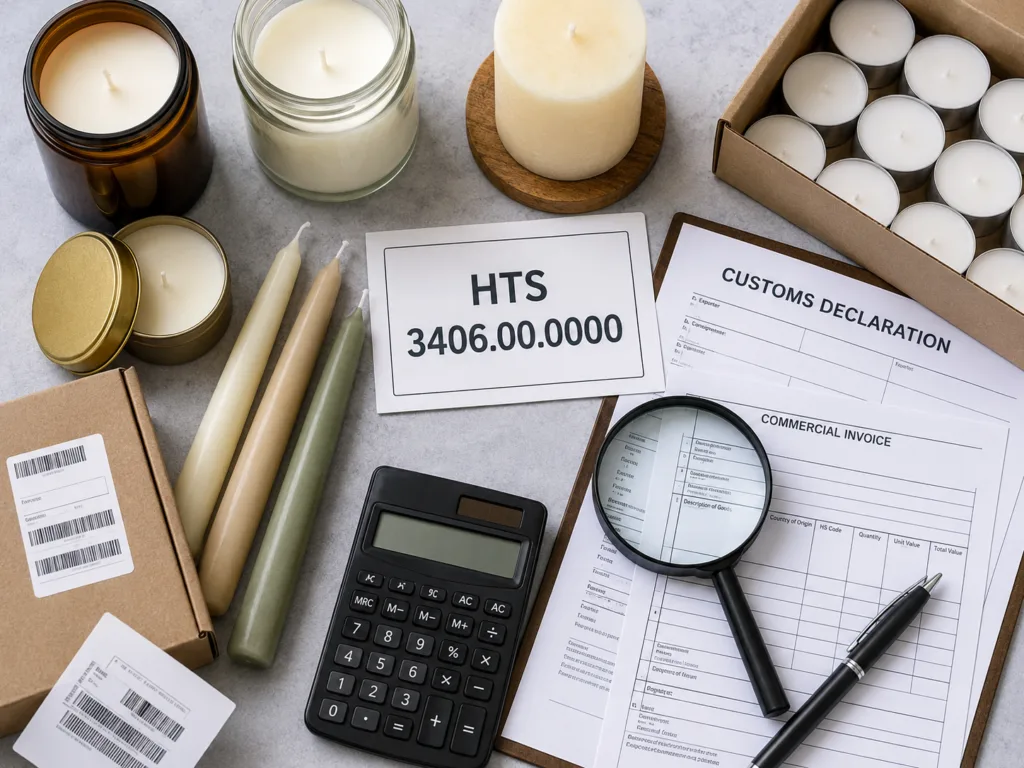
For U.S. imports, the primary classification for standard candles is generally:
HTS 3406.00.0000 — Candles, tapers, and the like
This classification normally covers many common candle formats, including scented jar candles, unscented candles, pillar candles, taper candles, votive candles, tea lights, container candles, and similar products with a wick.
For EU imports, the common CN/TARIC classification is generally:
CN 3406 00 00 — Candles, tapers, and the like
At first glance, this looks simple. In practice, classification can become more complicated when the product is not a straightforward candle. Importers should pay attention to these common classification risks:
1. Candle vs. Wax Melt
A candle normally includes a wick and is designed to be burned directly. A wax melt does not have a wick and is designed to be melted by an external warmer. Depending on composition and presentation, wax melts may require different classification analysis.
2. Candle vs. Home Fragrance Gift Set
If a gift set includes a candle, reed diffuser, room spray, lighter, ceramic tray, matches, incense, or decorative accessories, customs may not automatically classify the entire set as a candle. The classification may depend on the “essential character” of the set, the value of each component, the function of each item, and how the set is marketed.
For example, a small candle packaged together with a higher-value lighter may not necessarily be classified as a candle set if the lighter provides the essential character.
3. Candle Container Does Not Always Change the Candle Code
A candle poured into a glass jar, ceramic vessel, or metal tin is still commonly classified as a candle when the wax and wick are the essential product. However, if the container is unusually valuable, reusable, decorative, or separately marketed, buyers should ask their customs broker to review the classification before shipment.
4. Scented Candles Are Still Usually Classified as Candles
The presence of fragrance oil normally does not move a finished candle into a fragrance or essential oil classification. A scented candle is still generally treated as a candle when the product is designed to burn as a candle.
Misclassification can create serious consequences. If an importer declares the wrong code, customs may issue duty bills, penalties, post-entry audits, cargo holds, or requests for additional documentation. For high-volume e-commerce importers and retail brands, the cost of a classification error can be much higher than the duty difference itself.
The safest approach is to confirm the HTS/CN code with a licensed customs broker before mass production, especially for new gift sets, mixed-material products, or multi-item retail packaging.
Navigating US Tariffs, Section 301 Duties, and EU Customs

When importing candles from China, the customs duty calculation is not limited to the base HTS rate. Importers must also check additional duty programs, temporary surcharges, anti-dumping duties, and destination taxes.
United States: Base Duty and Additional Tariffs
For HTS 3406.00.0000, the U.S. general duty rate has historically been free. However, Chinese-origin goods may still be subject to additional duties under Chapter 99 provisions.
For Chinese-origin candles classified under HTS 3406.00.0000, importers should verify whether Section 301 duties apply. Many candle entries from China have been associated with the additional Section 301 Chapter 99 subheading 9903.88.15, which has carried an additional duty rate.
In addition, the U.S. tariff environment has changed significantly in recent years. Temporary or emergency tariff programs may be introduced, changed, suspended, invalidated, or replaced by new authorities. For this reason, importers should not rely on old landed-cost spreadsheets. The correct duty stack should be checked again at the time of booking and again before entry filing.
A practical U.S. candle duty review should include:
- Base HTS classification: 3406.00.0000
- Country of origin: China or another country
- Section 301 applicability
- Any current Chapter 99 temporary surcharge
- Anti-dumping duty scope
- Merchandise Processing Fee
- Harbor Maintenance Fee for ocean freight
- Customs bond cost
- Broker entry fee
- Final delivery cost
For importers comparing FOB, CIF, and DDP pricing, remember that a low FOB candle price does not equal low landed cost. Duties, tariffs, customs bond, drayage, port charges, delivery, warehouse receiving, and compliance review must all be included in the final cost model.
European Union: Customs Duty, Import VAT, and Anti-Dumping Risk
For EU imports, candles are generally classified under CN 3406 00 00. Importers must review customs duty, import VAT, and anti-dumping measures at the destination member state.
EU import VAT is not the same across all member states. The importer must calculate VAT based on the destination country’s rules. In many cases, import VAT is calculated on the customs value plus duty, freight, insurance, and other import-related costs up to the point of entry.
As of 2026, EU buyers sourcing candles from China must also pay close attention to anti-dumping measures on candles, tapers, and similar products originating in China. This makes EU candle import planning much more sensitive than a simple “customs duty + VAT” calculation.
For EU importers, the checklist should include:
- CN/TARIC code: 3406 00 00
- Country of origin
- Import VAT rate by destination country
- Anti-dumping duty applicability
- Supplier-specific duty rate, if applicable
- Customs value basis
- Incoterm and freight responsibility
- Product safety and labeling requirements
- Packaging waste and extended producer responsibility obligations, where applicable
Before confirming a large order for the EU market, buyers should request a full landed-cost estimate and ask their broker to verify current TARIC measures.
The Specter of Anti-Dumping Duties: Keeping Sourcing Compliant

Anti-dumping duty is one of the most important risks when importing candles from China. Unlike normal customs duties, anti-dumping duties can be very high and can apply based on product scope, material composition, shape, origin, and regulatory interpretation.
U.S. Anti-Dumping Risk: Petroleum Wax Candles
The U.S. has a long history of anti-dumping measures involving petroleum wax candles from China. The key issue is not only whether the product is called a “candle,” but whether it falls within the scope of the anti-dumping order.
For buyers, wax composition matters. Petroleum paraffin candles are more sensitive. Mixed-wax candles that contain petroleum-based wax can also create scope concerns. A supplier saying “soy blend” is not enough. Importers should request a clear wax composition statement and supporting documents.
If your brand is positioning itself around clean, plant-based, or eco-conscious candles, using 100% plant waxes such as soy wax, coconut wax, beeswax, or other non-petroleum formulas can help reduce U.S. petroleum wax anti-dumping exposure. However, this must be supported by documentation. The importer should keep formula records, supplier declarations, technical sheets, and purchase records.
A strong compliance file may include:
- Wax composition declaration
- Supplier material statement
- SDS/MSDS for wax and fragrance
- Fragrance allergen or IFRA documents, if required by buyer policy
- Production batch records
- Photos of finished candles
- Commercial invoice with clear product description
- Packing list
- Purchase order and contract
- Broker classification memo
- Any applicable scope ruling or legal review
EU Anti-Dumping Risk: Broader 2026 Measures
EU buyers should not assume that plant wax automatically removes anti-dumping risk. The EU’s 2026 measures on Chinese candles are broader and should be reviewed carefully by importers, especially for high-volume retail or wholesale shipments.
For brands importing into both the U.S. and EU, the safest strategy is to treat each market separately. A formula or classification that reduces risk in the U.S. may not produce the same result in the EU.
Sea Freight Logistics Mitigation: Preventing Wax Melting in Transit

Candles are not ordinary dry cargo. They are temperature-sensitive consumer products. A shipment that clears customs perfectly can still arrive unsellable if the wax sweats, melts, pulls away from the vessel, leaks fragrance oil, stains the gift box, or deforms during summer transit.
This is especially important for:
- Soy wax candles
- Coconut wax candles
- Soft wax blends
- Pillar candles without containers
- Tin candles shipped in hot lanes
- Candles with high fragrance load
- Luxury gift-box candles
- Matte ceramic or paper-tube packaging
- Long transit routes to inland warehouses
Dry containers can become extremely hot during summer ocean freight, port waiting time, rail transfer, and truck delivery. The risk is higher when containers sit under direct sun, when cartons are loaded near the roof or wall, or when shipment moves through hot ports.
A professional candle shipping plan should include both production controls and logistics controls.
1. Choose the Right Wax Blend
The wax formula should be selected based on the product type and destination. A soft wax blend may give a beautiful cold throw and smooth surface, but it may not be suitable for long summer sea freight unless the supplier adjusts the formula.
For pillar candles, the wax must hold shape without slumping. For container candles, the wax should resist sweating and oil separation. For high-end gift sets, the wax should remain visually stable after transit.
2. Use Strong Inner Packaging
Each candle should be packed to prevent movement, collision, and leakage. Common solutions include:
- Individual rigid box
- Insert card or molded pulp tray
- Bubble bag or paper wrap
- Divider inside master carton
- Sealed polybag for high-risk products
- Heat-resistant warning label and orientation mark
- Drop-test-ready export carton
For glass and ceramic candles, impact protection is just as important as temperature protection.
3. Consider Thermal Blankets or Container Liners
For summer shipments, thermal pallet covers, insulated cargo blankets, or container liners can help reduce temperature fluctuation and radiant heat exposure. They are not the same as refrigeration, but they can reduce risk for many standard shipments.
This is useful when the shipment is valuable but does not justify a full reefer container.
4. Use Reefers for High-Risk Shipments
A refrigerated container is more expensive, but it may be justified for luxury candles, very soft wax blends, large orders, or high-temperature lanes. If the value of the cargo is high, the cost of a reefer may be lower than the cost of product damage, customer claims, relabeling, repacking, or total rejection.
5. Avoid Peak Heat When Possible
If the buyer has flexibility, avoid shipping soft wax candles during the hottest weeks of the year. Production planning should work backward from the desired delivery window, including:
- Sample approval time
- Packaging production
- Bulk candle curing time
- Final inspection
- Booking
- Export customs
- Ocean transit
- Destination customs
- Inland delivery
- Warehouse receiving
6. Use Temperature Loggers for Key Shipments
For large orders, a temperature logger can provide evidence of transit conditions. This helps the buyer, supplier, forwarder, and insurer understand whether damage was caused by production, packaging, container loading, or transit exposure.
Practical Customs Documentation Checklist for Candle Importers
For U.S. and EU candle imports, prepare documents before shipment, not after the vessel has sailed.
A typical customs file should include:
- Commercial invoice
- Packing list
- Bill of lading or air waybill
- Purchase order
- Sales contract
- Product photos
- HTS/CN code
- Country of origin
- Product description
- Wax composition declaration
- SDS/MSDS
- IFRA certificate, if fragrance compliance is required
- Label artwork and warning label
- Carton marks
- Pallet information
- Insurance document, if applicable
- Importer of record details
- Customs bond information for U.S. importers
- ISF filing data for U.S. ocean shipments
- Broker instruction sheet
- Anti-dumping scope review, where needed
For DDP shipments, the buyer should still understand who is acting as importer of record and who is responsible for duty, tax, customs bond, and compliance declarations. DDP can simplify delivery, but it should not be used to hide unclear compliance responsibilities.
How to Build a Safer Candle Sourcing Strategy
A professional candle sourcing strategy should connect product development, compliance, and logistics from the beginning.
Before confirming production, ask your supplier these questions:
- What is the recommended HTS/CN classification for this product?
- Is the candle 100% plant wax, paraffin wax, or mixed wax?
- Can you provide wax composition documentation?
- Can you provide SDS/MSDS and fragrance documents?
- Has this product type been exported to the U.S. or EU before?
- What packaging is recommended for ocean freight?
- Can the candle survive summer container transit?
- Can you support FOB, CIF, or DDP shipping?
- Can you estimate duty, tax, freight, and delivery cost?
- Can you help prepare customs documents before shipment?
The best sourcing partner should not simply say “yes” to every request. For candles, professional suppliers should identify risks early, test materials, review packaging, and explain the trade-offs between cost, appearance, compliance, and logistics safety.
Request a DDP/CIF Shipping & Customs Quote

If you are importing candles from China for wholesale, retail, e-commerce, hotel supply, corporate gifting, or private label home fragrance collections, Circe Home can help you review the product, packaging, shipping route, and customs documentation before bulk production.
We support custom scented candles, ceramic candles, glass jar candles, pillar candles, gift box candles, private label packaging, and export-ready bulk shipments.
To estimate your landed cost, please send us:
- Product type
- Quantity
- Candle size and wax weight
- Wax preference
- Vessel material
- Packaging requirements
- Destination country and ZIP/postcode
- Preferred Incoterm: FOB, CIF, DDP, or DAP
- Target delivery date
Request your DDP/CIF shipping and customs quote through our contact page.
FAQs
1. Are soy candles subject to paraffin ADD?
In the U.S., petroleum wax candle anti-dumping risk is mainly connected with petroleum wax candles and certain mixed-wax candles from China. A 100% soy wax candle may reduce that risk, but importers should not rely only on the product name. The wax composition must be documented clearly. For EU imports, 2026 anti-dumping measures on Chinese candles should be reviewed separately and may not depend only on whether the wax is soy or paraffin.
2. What documents are required for U.S. customs clearance?
For U.S. candle imports, the common documents include commercial invoice, packing list, bill of lading, customs bond, importer of record information, HTS code, country of origin, product description, value declaration, and ISF data for ocean shipments. Importers should also prepare wax composition documents, SDS/MSDS, product photos, and anti-dumping scope support when needed.
3. How are duties calculated for multi-item gift sets?
Multi-item gift sets are not always classified by the candle. Customs may apply the General Rules of Interpretation and determine the essential character of the set. If the candle is the main component, the set may be classified as a candle. If another component, such as a lighter, diffuser, ceramic accessory, or other item provides the essential character, another classification may apply. Importers should ask a customs broker to review gift sets before shipment.
4. What are standard ocean transit times from China to the U.S.?
Port-to-port ocean transit from China to the U.S. West Coast is often around 14–22 days, while China to the U.S. East Coast may take around 28–40 days depending on route, carrier, congestion, and season. Door-to-door delivery usually takes longer because it includes production handover, export customs, sailing schedule, destination customs, port handling, drayage, and final delivery. For candles, summer shipping should include extra time and temperature-risk planning.