
Introduction: A Profitable Home Fragrance Range Is Built, Not Collected
Many home fragrance brands start with a simple idea: launch a beautiful candle, add a few scents, then expand into reed diffusers, room sprays, wax melts, and gift sets when sales begin to grow.
That sounds logical. In real production, it often becomes expensive very quickly.
The problem is not that candles and diffusers are difficult products. The problem is that many brands treat them as separate products instead of one connected product line. They develop one candle jar, one diffuser bottle, one box, one label, one fragrance, and one gift set without thinking about how all these parts work together across MOQ, packaging cost, retail price, shelf display, shipping weight, and reorder planning.
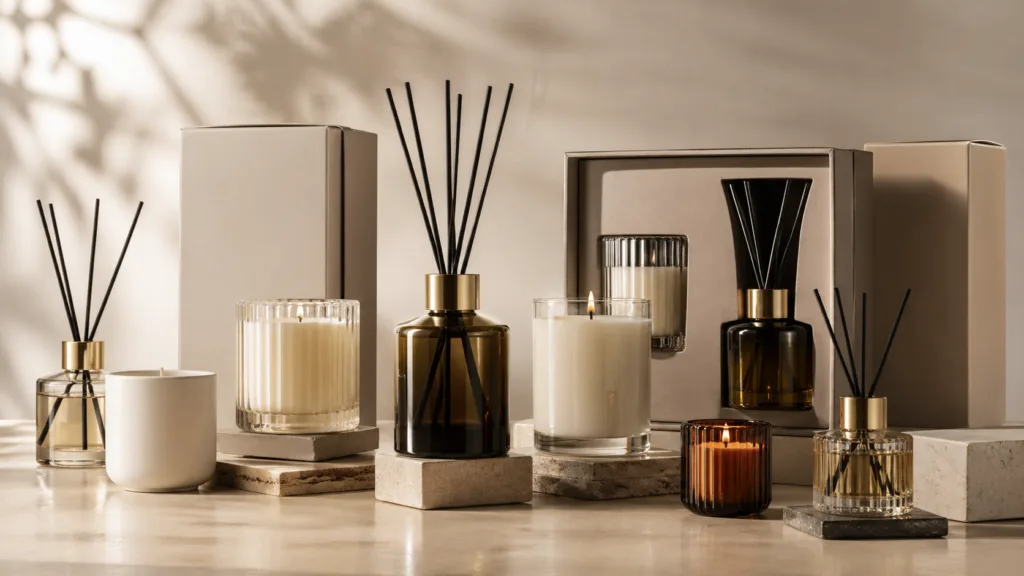
A profitable candle + diffuser range is not built by adding more SKUs. It is built by choosing the right SKUs in the right order.
For mature buyers, wholesalers, retailers, hotel groups, boutique lifestyle brands, and private label operators, the real question is not “Should we make candles or diffusers?” The better question is:
How can candles and diffusers work together to increase average order value, improve reorder rates, reduce development risk, and create a stronger retail story?
This article explains how to build a candle + diffuser product line from a B2B purchasing point of view. It covers product roles, SKU planning, MOQ reality, packaging strategy, fragrance architecture, margins, logistics, and how to scale from a small launch to a larger production order.
If you are planning a private label home fragrance range, this guide will help you avoid the most common mistakes and design a product line that can actually make money.
1. Why Candle + Diffuser Is a Stronger Strategy Than Selling One Product Alone
Candles and reed diffusers solve different problems for consumers.
A candle creates atmosphere. It is emotional, visual, ritual-based, and giftable. Customers buy candles because they want mood, warmth, design, comfort, and a sensory moment.
A reed diffuser works differently. It offers continuous fragrance without flame. It is easy to use, long-lasting, and suitable for bathrooms, bedrooms, offices, hotel rooms, reception areas, and retail spaces. Customers buy diffusers because they want low-maintenance scent.
This difference is exactly why the two products work well together.
A candle can attract attention. A diffuser can support repeat purchase. A gift set can raise perceived value. Together, they create a more complete home fragrance system.
For a B2B buyer, this matters because a product line needs more than beauty. It needs a clear commercial function.
A strong candle + diffuser range can:
- Increase average order value
- Improve shelf presentation
- Create more giftable options
- Allow fragrance extension across formats
- Support seasonal promotions
- Reduce dependency on one single SKU
- Help retailers build better merchandising stories
- Improve brand recall through repeated scent exposure
For example, a customer may first buy a scented candle for a cozy evening. If they like the scent, they may later buy a reed diffuser for daily fragrance. During holidays, they may buy a candle + diffuser gift set. This is not random product expansion. This is product line architecture.
The best home fragrance brands do not simply sell “a candle” or “a diffuser.” They sell a fragrance world.
2. Candles and Diffusers Play Different Roles in the Product Line

Before deciding how many products to launch, a brand should define what each product is supposed to do.
Candle: The Emotional Entry Product
Candles are highly visual and emotional. A candle has a vessel, wax color, label, lid, wick, fragrance, box, and burning experience. It can sit on a table as a decor object even before it is used.
This makes candles powerful for brand building.
A candle is often the product that introduces the brand’s aesthetic. It communicates whether the brand is luxury, minimalist, natural, spa-inspired, romantic, colorful, artistic, hotel-style, or eco-conscious.
From a retail point of view, candles are also easy to understand. Customers know how to buy them. They can smell them, hold them, compare vessel design, and imagine them in their homes.
However, candles also have supply chain challenges:
- Glass and ceramic vessels can be fragile
- Wax weight increases shipping cost
- Burn testing takes time
- Safety labels must be considered
- Packaging must protect the vessel
- Custom vessels may require higher MOQ
- Multiple scents can complicate production
So candles are excellent for brand identity and emotional value, but they must be planned carefully.
Reed Diffuser: The Continuous Fragrance Product
Reed diffusers are less dramatic than candles, but they are commercially powerful.
They provide fragrance over a longer period. They do not require flame. They are easier to use in shared spaces, hospitality environments, rental homes, offices, and bathrooms.
For retailers, diffusers are useful because they offer a different buying reason. A candle may be for ambiance. A diffuser may be for daily scent.
Diffusers can also support stronger reorder behavior because customers replace them when the fragrance liquid is finished. Refill options can further increase repeat purchase.
Diffusers have their own development challenges:
- Bottle shape affects visual positioning
- Cap and collar design affect cost
- Reed quality affects fragrance throw
- Fragrance formula must perform without burning
- Liquid leakage prevention is critical
- Packaging must handle glass and liquid safely
- Some destinations may require careful shipping documentation
A diffuser is not just a candle fragrance poured into a bottle. It needs separate testing for scent throw, evaporation speed, reed absorption, leakage, packaging safety, and user experience.
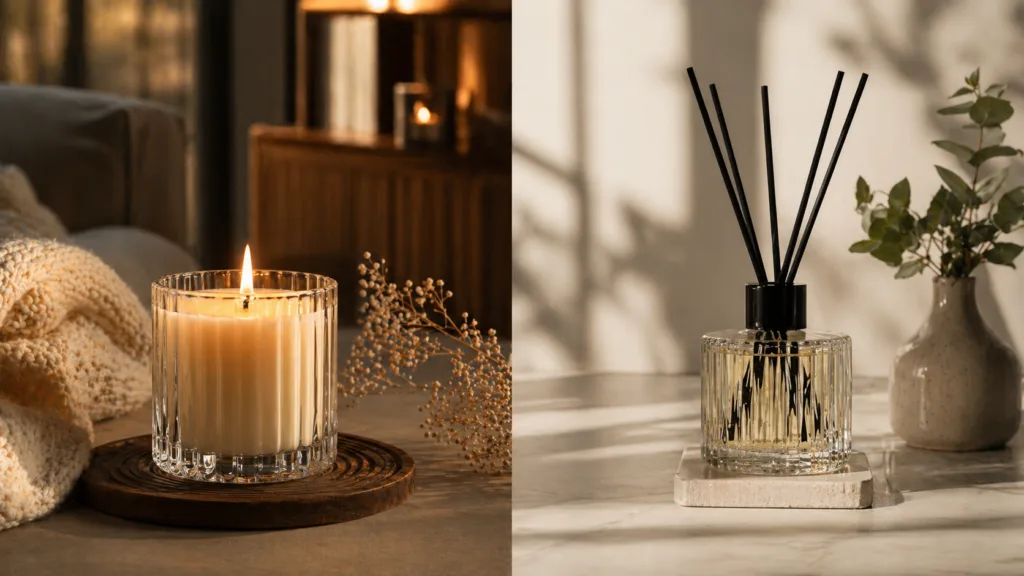
Gift Set: The Value Multiplier
A candle + diffuser gift set can transform two standard products into a premium retail offer.
This is important for brands that sell through:
- Boutique stores
- Department stores
- Hotel gift shops
- Spa retail shelves
- Holiday gift campaigns
- Corporate gifting
- Subscription boxes
- Online lifestyle stores
A gift set increases perceived value because it feels complete. A customer is not just buying fragrance. They are buying a coordinated experience.
But gift sets also increase complexity. The box structure, insert, product weight, outer carton, shipping method, and MOQ must all be planned before production.
This is where many brands make mistakes. They design a beautiful gift set visually, then discover later that the box MOQ, insert cost, product weight, or assembly labor makes the project expensive.
A profitable gift set starts with structure, not decoration.
3. The Biggest Mistake: Launching Too Many SKUs Too Early
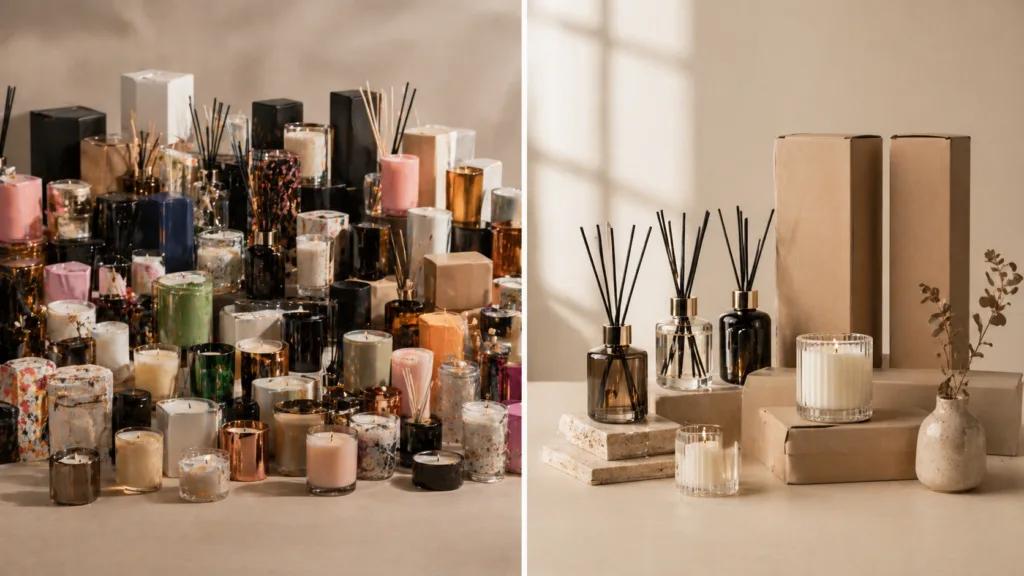
New brands often believe that more choices create more sales. In home fragrance, too many choices can create confusion, high MOQ, slow inventory movement, and cash flow pressure.
A common mistake is launching something like this:
- 5 candle scents
- 5 diffuser scents
- 5 different boxes
- 3 vessel colors
- 2 label designs
- 1 gift set format
On paper, that sounds like a full collection. In production, it can become a problem.
Every variation can affect MOQ. Every scent is a separate filling plan. Every vessel color may have a separate supply requirement. Every box design may require its own printing setup. Every label version adds another production control point.
The buyer may think they are ordering 1,000 units. The factory sees 10 or 20 small production runs.
That is why the real production question is not only total quantity. It is quantity per SKU, per design, per fragrance, per packaging version.
A better starting point is usually much simpler:
- 2 or 3 core fragrances
- 1 candle vessel style
- 1 diffuser bottle style
- 1 shared label system
- 1 shared packaging direction
- Optional gift set after validation
This creates a clean range without splitting the order into too many small parts.
For mature buyers, this is especially important. A large order should not be large only in total units. It should also be efficient in production structure.
A 3,000-piece order split across 18 SKUs may be less efficient than a 2,000-piece order split across 4 strong SKUs.
The goal is not to look big. The goal is to build a line that can sell through and reorder.
4. The Best Product Line Model: Hero Scent, Core Range, Gift Extension
A strong candle + diffuser range usually has a clear hierarchy.
The best structure is not flat. Every product should not have equal importance. Some products should drive brand identity. Some should support daily sales. Some should support gifting.
A practical model is:
Level 1: Hero Scent
The hero scent is the signature fragrance of the brand or collection.
It should be easy to remember, commercially safe, and suitable for both candle and diffuser formats. It should not be too strange, too heavy, or too narrow unless the brand already has a strong audience.
Good hero scent directions often include:
- Sandalwood + amber
- Fig + cedar
- White tea + bergamot
- Vetiver + citrus
- Lavender + sage
- Vanilla + musk
- Peony + soft woods
- Sea salt + sage
The hero scent can appear as:
- Standard candle
- Reed diffuser
- Candle + diffuser gift set
- Refill later
- Seasonal limited packaging later
This creates consistency. It also helps the brand avoid reinventing everything for every new SKU.
Level 2: Core Range
The core range usually includes 2 to 4 scents.
For a first serious B2B launch, 3 scents is often a practical number. It gives enough choice without creating too much production complexity.
A simple structure could be:
- Fresh / clean scent
- Warm / woody scent
- Floral / soft scent
This covers different customer preferences and retail moments.
For example:
- White Tea & Bergamot — fresh, clean, hotel-style
- Santal & Vetiver — warm, woody, premium
- Peony & Musk — soft, floral, giftable
Each scent can be used across candle and diffuser formats. The same scent name, color code, label system, and packaging style help the line feel connected.
Level 3: Gift Extension
After the core SKUs are confirmed, the brand can build a gift set.
The gift set should not be treated as a completely separate product. It should be a value-added structure using existing components.
For example:
- 1 candle + 1 diffuser in the same scent
- 1 candle + 1 diffuser in complementary scents
- 2 mini candles + 1 diffuser
- 1 full-size candle + 1 mini diffuser
The best first gift set is usually the easiest to produce and explain.
A candle + diffuser in the same scent is simple, clean, and strong for retail. It helps the buyer understand the value immediately.
5. Candle-First, Diffuser-First, or Hybrid: Which Strategy Fits Your Brand?
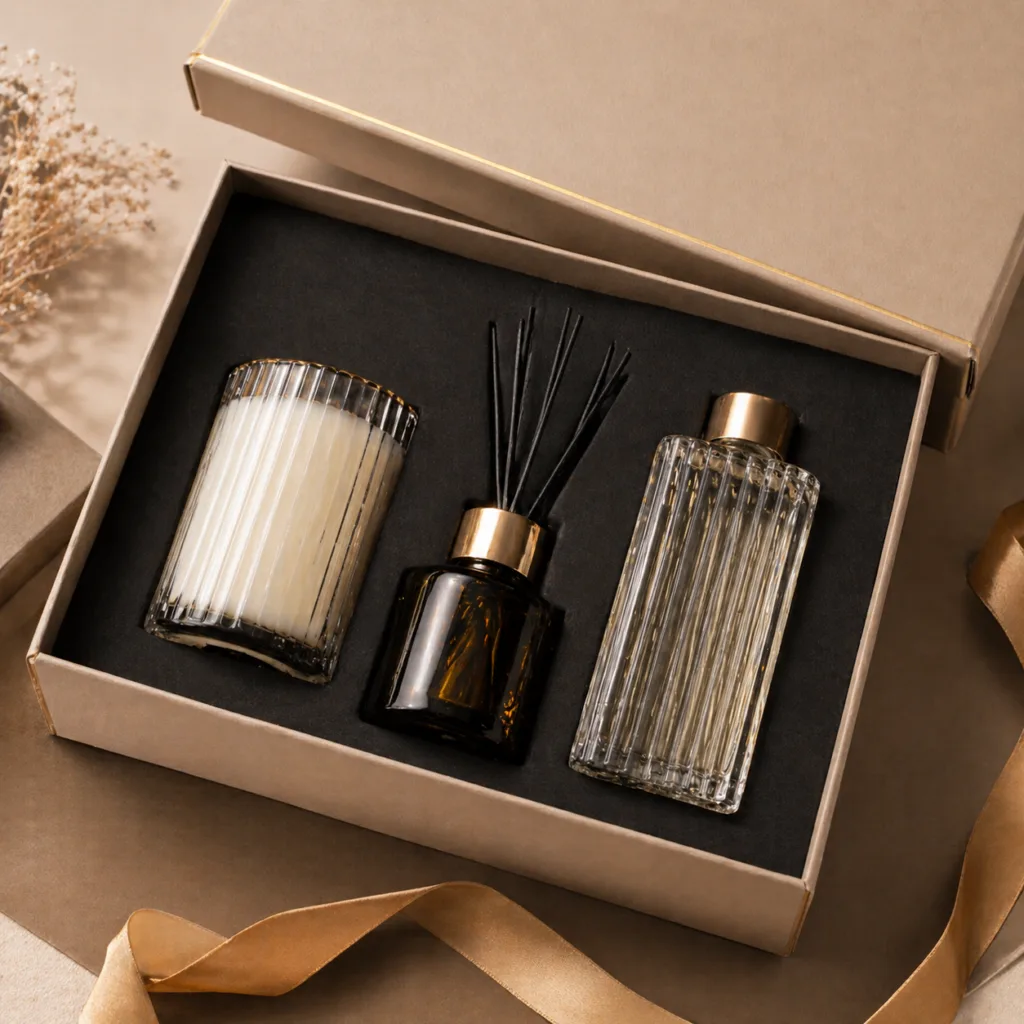
There is no single correct launch strategy. The right choice depends on the buyer’s channel, budget, brand stage, and sales model.
Strategy 1: Candle-First Launch
A candle-first launch is suitable for brands that need strong visual identity.
This works well for:
- New lifestyle brands
- Boutique retail brands
- Design-led brands
- Gift brands
- Brands selling through social media
- Brands that want strong photography and shelf appeal
The advantage is that candles are easier to position emotionally. A beautiful candle can create strong product images, brand storytelling, and gifting value.
The risk is that candles involve more physical complexity than they appear to. Vessel selection, wax formula, wick testing, fragrance load, burn performance, label material, box protection, and shipping all matter.
A good candle-first launch should stay focused:
- 1 vessel style
- 2 or 3 scents
- 1 packaging style
- 1 label system
- Standard glass first if budget is limited
- Upgrade to ceramic or custom molds after market validation
For buyers who want to start with 100 or 200 units, a candle-first approach usually works only if they use standard vessels and simple branding. Full custom vessels and luxury rigid boxes usually require higher quantities.
Strategy 2: Diffuser-First Launch
A diffuser-first launch is suitable for brands that want long-lasting fragrance and easier daily use.
This works well for:
- Spa and wellness brands
- Hotel and hospitality buyers
- Interior lifestyle stores
- Corporate gifting suppliers
- Brands focused on home scent rather than candle rituals
- Markets where flame products are less suitable
The advantage of diffusers is their long usage period and low-maintenance appeal. They also fit bathrooms, offices, bedrooms, hotel rooms, and reception areas.
The risk is that diffusers may feel less emotionally rich than candles if packaging and bottle design are weak. A diffuser needs good visual presentation to justify premium pricing.
A good diffuser-first launch should focus on:
- A clean bottle shape
- Strong cap or collar detail
- High-quality reeds
- Reliable fragrance throw
- Leak-safe packaging
- Clear scent names
- Optional refill strategy later
Diffuser-first can be a smart strategy for mature retailers that already know their customer prefers practical home fragrance.
Strategy 3: Hybrid Candle + Diffuser Launch
A hybrid launch means launching candles and diffusers together under one fragrance system.
This is the strongest strategy for mature buyers who have enough budget and sales channels.
It works well for:
- Established retailers
- Importers
- Boutique chains
- Department store suppliers
- Hotel retail programs
- Premium gift companies
- Brands preparing for wholesale distribution
The advantage is that the range looks complete from the beginning. Retailers can merchandise candle and diffuser together. Sales teams can offer multiple price points. Gift sets can be created more easily.
The risk is higher upfront planning. The buyer must control SKU count, packaging structure, scent selection, and order allocation.
A good hybrid launch might look like this:
- 3 scents
- Each scent available as candle and diffuser
- 6 total core SKUs
- 1 optional gift set using the hero scent
- Shared design language across all products
- Same outer carton logic where possible
This gives the brand enough range depth without becoming chaotic.
For serious B2B buyers, this is often the most scalable model.
6. How to Structure SKUs Without Killing MOQ
MOQ is one of the most misunderstood parts of home fragrance development.
Many buyers ask, “What is your MOQ?” But in reality, MOQ depends on the product structure.
A candle may involve several suppliers or production steps:
- Vessel supplier
- Wax and fragrance supplier
- Wick supplier
- Label supplier
- Box supplier
- Insert supplier
- Filling workshop
- Assembly team
- Carton supplier
- Freight forwarder
A diffuser may involve:
- Bottle supplier
- Cap or collar supplier
- Reeds supplier
- Fragrance liquid supplier
- Label supplier
- Box supplier
- Insert supplier
- Filling and sealing process
- Leakage testing
- Carton and shipping
Each part may have its own MOQ.
That is why the best SKU strategy is to reduce unnecessary variation.
Rule 1: Keep the Same Vessel or Bottle Across Scents
Changing fragrance is already one layer of variation. If you also change vessel shape, color, lid, label size, and box structure for each scent, MOQ and cost increase quickly.
For the first launch, use one vessel family.
For example:
- Same glass candle jar for all scents
- Same diffuser bottle for all scents
- Different label color for scent identification
- Same box structure for all scents
This keeps the line visually consistent and production-friendly.
Rule 2: Use One Packaging Structure
Packaging is often where MOQ becomes painful.
A buyer may want each scent to have a different printed box. That can look beautiful, but it may create separate MOQ for each design.
A more efficient approach is:
- Use one main box structure
- Keep the same box size
- Use one shared brand design
- Change only scent sticker, label, belly band, or small printed area
This allows the brand to create variety without rebuilding the packaging system every time.
For gift boxes, this is even more important. Rigid boxes, inserts, foil stamping, embossing, magnetic closures, and custom structures can all increase cost and MOQ.
A shared box structure is one of the simplest ways to make a product line scalable.
Rule 3: Limit First-Run Fragrance Count
Fragrance is the soul of home fragrance, but too many scents can hurt the first order.
For a first production run, 2 to 3 scents is usually safer than 6 to 8 scents.
A strong first range can include:
- One fresh scent
- One woody scent
- One floral or warm scent
This gives retail variety while keeping production manageable.
After sales data comes in, the brand can expand based on proven demand.
Rule 4: Think in Collections, Not Random SKUs
A product line should feel intentional.
Instead of launching random scents, build a collection theme.
Examples:
- Hotel Collection: White Tea, Cedarwood, Neroli
- Coastal Collection: Sea Salt, Driftwood, Citrus Sage
- Wellness Collection: Lavender, Eucalyptus, Sandalwood
- Holiday Collection: Fir, Amber Spice, Vanilla Woods
- Boutique Floral Collection: Peony, Rose Musk, Fig Blossom
A collection helps buyers present the range to consumers. It also helps sales teams explain why the products belong together.
7. MOQ Reality: Total Quantity Is Not the Same as Production Efficiency
A common B2B misunderstanding is thinking that a large total quantity automatically means easy production.
For example, a buyer may say:
“We want 2,000 units total.”
But then the details show:
- 5 candle scents
- 5 diffuser scents
- 5 box designs
- 2 vessel colors
- 2 bottle styles
- 1 gift set
Now the 2,000 units are divided into many small runs.
From the supplier side, this is not one simple order. It is a complex order with many low-volume variations.
A more efficient 2,000-unit order could be:
- 1 candle vessel
- 1 diffuser bottle
- 3 scents
- 3 candle SKUs
- 3 diffuser SKUs
- 1 shared packaging system
This structure is easier to produce, easier to inspect, easier to pack, easier to ship, and easier to reorder.
Mature buyers understand that MOQ is not only about supplier rules. It is about production logic.
A supplier may be able to support low MOQ for standard glass candles with simple labels. But if the buyer wants custom ceramic vessels, new molds, rigid gift boxes, multiple printed designs, and special inserts, the MOQ will rise because the project requires more setup.
This is why it is important to ask better questions:
- Is the vessel standard or custom?
- Is the packaging standard or custom?
- Is the box printed or labeled?
- How many scents are included?
- How many designs are included?
- Is the MOQ per order, per scent, per vessel, or per packaging design?
- Can the same structure be used across multiple SKUs?
These questions help buyers avoid surprises later.
8. Packaging Strategy: The Fastest Way to Improve Perceived Value
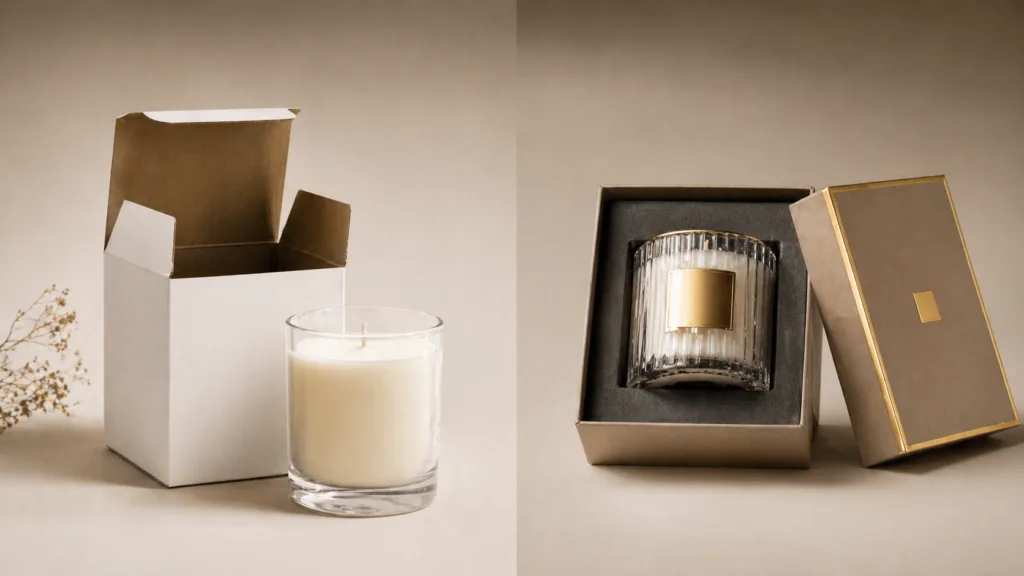
In home fragrance, packaging is not only protection. It is part of the product.
A candle in a plain carton and the same candle in a rigid gift box can feel like two different price levels. A diffuser with a weak box can feel cheap, even if the fragrance is good.
Packaging affects:
- Shelf impact
- Giftability
- Retail price
- Brand positioning
- Damage rate
- Customer reviews
- Unboxing experience
- Wholesale buyer confidence
But packaging must be matched to the brand stage.
For Market Testing
Use simple packaging.
A new brand testing a scent or concept does not always need a luxury rigid box. A standard glass vessel, simple label, and clean folding carton may be enough for early validation.
This reduces cost and helps the buyer learn what sells.
For Wholesale Retail
Use stronger shelf packaging.
Retail buyers usually care about presentation. The product must look complete on the shelf. The box should communicate scent, brand, product type, and quality clearly.
A good wholesale-ready package should have:
- Clear product name
- Scent name
- Net weight or volume
- Usage instructions
- Safety information
- Barcode if required
- Durable structure
- Consistent brand style
For Gift Sets
Use premium structure, but keep it practical.
A candle + diffuser gift set often needs an insert to hold both products securely. Foam, paperboard, molded pulp, or pearl cotton inserts may be used depending on brand positioning and shipping risk.
The insert must be designed around real product dimensions, not only visual mockups.
A beautiful gift box that cannot protect glass during transport is not a good packaging solution.
The Best Packaging Strategy for Scaling
The most scalable strategy is to create one packaging system that can support multiple SKUs.
For example:
- Same candle box size for all scents
- Same diffuser box size for all scents
- Same gift box structure for hero sets
- Scent differentiation through labels or color bands
- Unified outer carton packing method
This keeps the line premium but manageable.
9. Fragrance Architecture: How to Make the Range Feel Like a Brand
Fragrance selection is not only about choosing nice smells. It is about building a scent architecture.
A good fragrance range should feel balanced.
If every scent is woody, the range may feel too heavy. If every scent is floral, it may feel too narrow. If every scent is unusual, the range may be hard to sell.
A practical B2B fragrance structure could be:
Fresh / Clean
This scent type is easy to sell and suitable for hotels, bathrooms, offices, and everyday use.
Examples:
- White tea
- Bergamot
- Neroli
- Green tea
- Sea salt
- Eucalyptus
- Linen
Warm / Woody
This scent type gives premium value and works well for candles, winter collections, masculine-leaning lines, and luxury interiors.
Examples:
- Sandalwood
- Cedarwood
- Vetiver
- Amber
- Cashmere woods
- Oud-style accords
- Smoked vanilla
Soft / Floral / Giftable
This scent type is useful for gifting, spring collections, lifestyle boutiques, and feminine retail stories.
Examples:
- Peony
- Rose musk
- Jasmine
- Fig blossom
- Tuberose
- Magnolia
- Orange blossom
Seasonal or Limited Scent
Seasonal scents can create urgency, but they should not dominate the first launch.
Examples:
- Fir and pine for holiday
- Pumpkin spice for autumn
- Citrus herbs for summer
- Amber spice for winter
A mature product line usually has a stable core range plus seasonal extensions.
The core range supports repeat business. Seasonal products support campaigns.
10. Candle and Diffuser Pricing: Build a Margin Ladder
A profitable product line should have a price ladder.
Not every customer buys at the same price point. A candle + diffuser range can offer different levels without changing the entire brand.
A simple retail ladder may look like this:
- Small candle: entry price
- Standard candle: core product
- Reed diffuser: long-lasting fragrance product
- Candle + diffuser gift set: premium gift price
- Large candle or luxury set: highest price point
For wholesale and private label buyers, this matters because it creates different selling opportunities.
A boutique retailer may use candles as impulse purchases and gift sets as holiday promotions. A hotel may use diffusers for rooms and candles for retail shelves. An importer may sell standard candles in volume and use gift sets for seasonal campaigns.
The goal is not always to maximize the margin of each single SKU. The goal is to build a product system where the whole range creates stronger sales.
Example Product Ladder
A brand could structure its line like this:
- 100ml reed diffuser — everyday scent product
- 200g scented candle — core visual product
- 300g candle — premium home decor product
- Candle + diffuser set — gift product
- Seasonal limited gift box — campaign product
This gives buyers a reason to order more than one SKU.
It also gives retailers a better merchandising story.
11. How Candle + Diffuser Sets Increase Average Order Value
Average order value is one of the strongest reasons to combine candles and diffusers.
A single candle may sell well, but it limits the transaction size. A diffuser adds a practical reason to spend more. A gift set makes the purchase feel more complete.
For example:
- Candle only: one product purchase
- Diffuser only: one product purchase
- Candle + diffuser: coordinated home fragrance experience
- Candle + diffuser + gift box: premium gifting solution
This is especially powerful during:
- Christmas
- Mother’s Day
- Valentine’s Day
- Wedding season
- Corporate gifting season
- Hotel holiday retail campaigns
- New home gift promotions
For B2B buyers, a gift set also makes purchasing easier. Instead of buying separate products and building a set later, the buyer receives a finished retail-ready item.
This can reduce handling work, improve presentation, and support higher retail pricing.
However, gift sets should be introduced carefully. If the brand has not validated scent preference or price acceptance, producing too many gift sets too early can create inventory risk.
A safer route is:
- Launch core candle and diffuser SKUs
- Identify best-selling scent
- Build gift set around the hero scent
- Use the gift set for seasonal or wholesale campaigns
- Expand gift sets only after reorder data confirms demand
This is how brands move from product testing to scalable range building.
12. Logistics and Shipping: The Hidden Cost Behind Product Line Decisions

Home fragrance products are beautiful, but they are not always light or easy to ship.
Candles contain wax and often use glass or ceramic vessels. Diffusers contain liquid and glass bottles. Gift sets combine multiple fragile products into one larger box.
This affects:
- Carton weight
- Carton size
- Breakage risk
- Freight cost
- Shipping method
- Warehouse handling
- Customs documents
- Delivery timeline
A product line strategy should consider logistics before finalizing design.
Candle Logistics
Candles are usually heavier because of wax and vessel weight. Thick glass and ceramic vessels increase perceived value but also increase freight cost.
For e-commerce brands, this can affect shipping margins. For wholesale buyers, it affects landed cost.
Diffuser Logistics
Diffusers are lighter than many candles but involve liquid. Leakage prevention is critical. Caps, plugs, bottle sealing, inner packaging, and carton orientation must be considered.
Gift Set Logistics
Gift sets can be excellent for retail value but costly in shipping because of box size and insert structure.
A rigid gift box with foam insert may look premium, but it increases volume. If the gift set box is too large, air freight becomes expensive. If the insert is weak, breakage risk increases.
A smart supplier should help the buyer balance appearance, protection, and freight efficiency.
For mature buyers, the best question is not only “What is the unit price?”
It is:
What is the landed cost after packaging, freight, duty, warehousing, and damage risk?
A low unit price can become expensive if the product is poorly packed or inefficient to ship.
13. Compliance and Label Planning
Candles and diffusers need proper labeling and documentation.
The exact requirements depend on destination market, product formula, and sales channel. But from a planning point of view, buyers should prepare compliance information early.
For candles, labels may need:
- Product name
- Net weight
- Burning instructions
- Safety warnings
- Manufacturer or importer details
- Batch information if required
- Material or wax information
- Country of origin
For diffusers, labels may need:
- Product name
- Volume
- Ingredients or hazard information where required
- Usage instructions
- Warning statements
- Manufacturer or importer details
- Batch information if required
- Country of origin
For B2B orders, buyers may also request:
- SDS / MSDS
- IFRA-related fragrance information
- Allergen declaration where applicable
- Packaging specifications
- Carton marks
- Barcode support
- Amazon FBA label support if needed
This is not only a legal issue. It is a wholesale readiness issue.
Retailers and importers prefer suppliers who understand documents, labeling, packaging details, and shipment requirements. A product line that looks beautiful but lacks documentation may be difficult to place in serious channels.
14. A Practical Launch Plan for a Profitable Candle + Diffuser Range
Here is a practical product line roadmap for a serious home fragrance brand.
Phase 1: Market Validation
Goal: Test scent, design direction, and price acceptance.
Recommended structure:
- 1 standard candle vessel
- 2 or 3 scents
- Simple label branding
- Standard or simple custom box
- Limited production quantity if feasible
This phase is about learning. Do not over-invest in custom molds or complex packaging before the concept is proven.
Phase 2: Core Range Development
Goal: Build a stable retail-ready collection.
Recommended structure:
- 3 candle SKUs
- 3 diffuser SKUs
- Same scent names across both formats
- Unified visual identity
- Improved packaging
- Clear product photography
- Wholesale-ready labels and cartons
This phase turns the idea into a real product line.
Phase 3: Gift Set Creation
Goal: Increase average order value and prepare for seasonal campaigns.
Recommended structure:
- Hero scent candle + diffuser set
- Shared rigid gift box
- Secure insert
- Premium but practical finishes
- Retail-ready outer carton
This phase is where brands often move into larger B2B orders because gift sets are easier to sell in volume for holidays, corporate gifting, and retail promotions.
Phase 4: Scale and Optimize
Goal: Improve reorder planning and expand only where data supports it.
Actions:
- Keep best-selling scents
- Remove weak SKUs
- Add refills if diffuser demand is strong
- Add larger candle size if premium demand exists
- Add seasonal scent only after core range is stable
- Negotiate better cost through higher volume
- Improve packaging based on sales channel feedback
This is how a brand becomes more profitable over time.
15. Example: A Smart First B2B Product Line
Here is an example of a clean, scalable launch structure.
Collection Name
The Essential Home Fragrance Collection
Fragrance Structure
- White Tea & Bergamot — fresh and clean
- Santal & Vetiver — warm and woody
- Peony & Soft Musk — floral and giftable
Candle Format
- 220g soy blend scented candle
- Standard glass jar
- Same jar for all scents
- Scent label variation only
- Folding carton or rigid box depending on channel
Diffuser Format
- 100ml reed diffuser
- Same bottle for all scents
- Natural reeds
- Matching scent label system
- Individual retail box
Gift Set
- 1 candle + 1 diffuser
- Hero scent: Santal & Vetiver
- Rigid lid-and-base box
- Protective insert
- Suitable for holiday and corporate gifting
Why This Works
This range is not too small and not too complex. It gives the buyer enough products to create a retail story, but it does not split production into too many variations.
It also creates a clear path for scaling:
- If White Tea sells well, add refill diffuser
- If Santal sells well, create a premium large candle
- If Peony sells well, build Mother’s Day gift set
- If the gift set sells well, expand into two-scent gift sets
This is product line strategy, not random product development.
16. Common Product Line Mistakes to Avoid
Mistake 1: Starting With Custom Everything
Custom ceramic vessel, custom bottle, custom box, custom insert, custom fragrance, custom lid, custom color, and low quantity do not usually work well together.
Customization is powerful, but it needs volume.
For the first launch, decide what really needs to be custom and what can be standard.
Mistake 2: Treating Packaging as an Afterthought
Packaging should be planned at the same time as product size and product line structure.
If the candle jar and diffuser bottle are chosen without thinking about gift set packaging, the final set may become too large, too heavy, or too expensive.
Mistake 3: Too Many Scents, Too Little Depth
A brand with eight weak scents is often less powerful than a brand with three strong scents.
Depth matters. Reorder potential matters. Clear scent identity matters.
Mistake 4: Ignoring Landed Cost
Unit price is only one part of the decision.
A mature buyer should consider:
- Product cost
- Packaging cost
- Freight cost
- Duties and taxes
- Breakage risk
- Warehouse handling
- Retail margin
- Sell-through speed
Mistake 5: Launching Gift Sets Before Knowing the Hero Scent
Gift sets are best when built around proven scents.
If the brand does not know which scent customers prefer, the gift set may lock too much inventory into the wrong combination.
Mistake 6: No Reorder Plan
A product line should be easy to reorder.
If every SKU uses a different vessel, box, insert, and supplier, reorders become slow and complicated.
The best product lines are designed for repeat production.
17. What Mature Buyers Should Ask Before Placing a Large Order
Before placing a large candle + diffuser order, buyers should ask suppliers practical questions.
Product Questions
- Which vessel and bottle options are standard?
- Which options require molds or higher MOQ?
- Can the same fragrance be used in both candle and diffuser?
- Will the candle and diffuser require separate fragrance testing?
- What wax options are available?
- What reed options are available?
Packaging Questions
- What is the MOQ for each box design?
- Can one box structure support multiple scents?
- What insert options are available?
- Can the packaging pass shipping requirements?
- Are luxury finishes available, such as foil stamping or embossing?
- What is practical for sample stage versus mass production?
Compliance Questions
- Can SDS or MSDS be provided?
- Can warning labels be supported?
- Can barcode or FBA labels be applied?
- Can carton marks be customized?
- What documents are available for import?
Logistics Questions
- What is the estimated carton size and weight?
- What shipping methods are available?
- Can DDP shipping be supported?
- What is the estimated delivery time?
- How is breakage prevention handled?
Scaling Questions
- Which SKUs are easiest to reorder?
- Which components have long lead times?
- Can the supplier support future gift sets?
- Can the supplier help simplify the line to reduce MOQ pressure?
These questions help buyers move from idea to commercial order.
18. Why Supplier Selection Matters
A candle + diffuser line needs more than a factory that can fill wax or liquid.
It needs a supplier that understands product development, packaging, fragrance matching, MOQ planning, sampling, mass production, inspection, and logistics.
A strong supplier should help the buyer:
- Choose realistic product structures
- Avoid unnecessary MOQ pressure
- Match packaging to sales channel
- Plan scent architecture
- Prepare samples correctly
- Manage production details
- Support export documents
- Arrange safe shipping
- Improve the line for future reorders
For mature buyers, this is valuable because the supplier becomes part of the product strategy.
A low-cost supplier who only says “yes” to every idea may create problems later. A better supplier will explain which ideas are practical, which need higher volume, and which can be simplified without damaging the brand.
In home fragrance, honest production advice can save money.
19. Final Thoughts: Build Less, Sell More
A profitable candle + diffuser product line is not about launching as many products as possible.
It is about building the right structure.
Candles create emotion. Diffusers create continuous use. Gift sets create higher perceived value. When these products share the same fragrance logic, packaging system, and brand language, they become stronger together.
For new brands, the safest route is usually to start with a focused range, validate the market, and expand step by step.
For mature B2B buyers, the best opportunity is to build a scalable product line that supports retail, gifting, repeat purchase, and larger orders without unnecessary production complexity.
The most profitable home fragrance ranges are not the most complicated. They are the most clearly planned.
If your goal is to build a candle + diffuser collection for wholesale, retail, hotel, or private label channels, start with the product line strategy first. The right structure will make every later decision easier: scent selection, packaging, MOQ, pricing, logistics, and reorder planning.
Build the system before you build the SKUs.
That is how a home fragrance range becomes profitable.
FAQ
1. Should a new brand launch candles and diffusers at the same time?
A new brand can launch both candles and diffusers at the same time if it has enough budget, clear sales channels, and a focused SKU plan. For smaller brands, it is often safer to start with candles or diffusers first, validate the best scents, and then expand into the second format. If both products are launched together, keep the same fragrance names, packaging style, and visual identity to reduce complexity.
2. How many scents should a candle + diffuser range start with?
For most first B2B launches, 2 to 3 scents are enough. A strong structure may include one fresh scent, one woody scent, and one soft floral or warm scent. This gives customers choice without creating too many SKUs. After sales data confirms demand, the brand can add seasonal scents, refills, larger candle sizes, or gift sets.
3. What is the best way to reduce MOQ pressure in a home fragrance product line?
The best way to reduce MOQ pressure is to simplify the product structure. Use the same candle vessel across scents, the same diffuser bottle across scents, one shared packaging system, and limited fragrance count for the first order. Avoid custom molds, multiple box designs, and too many scent variations before the range has been validated by the market.