
Launching a candle brand looks easy from the outside. You pick a scent, choose a nice jar, design a box, and place an order. For many first-time buyers, the logic seems straightforward: if the product is small and the wax is inexpensive, why can’t the order quantity also be small?
That is where many projects go wrong.
One of the most common questions suppliers receive is this: “Can we start with 100 custom candles?” On paper, it sounds like a cautious and reasonable way to test the market. In practice, however, it often collides with the real structure of candle manufacturing.
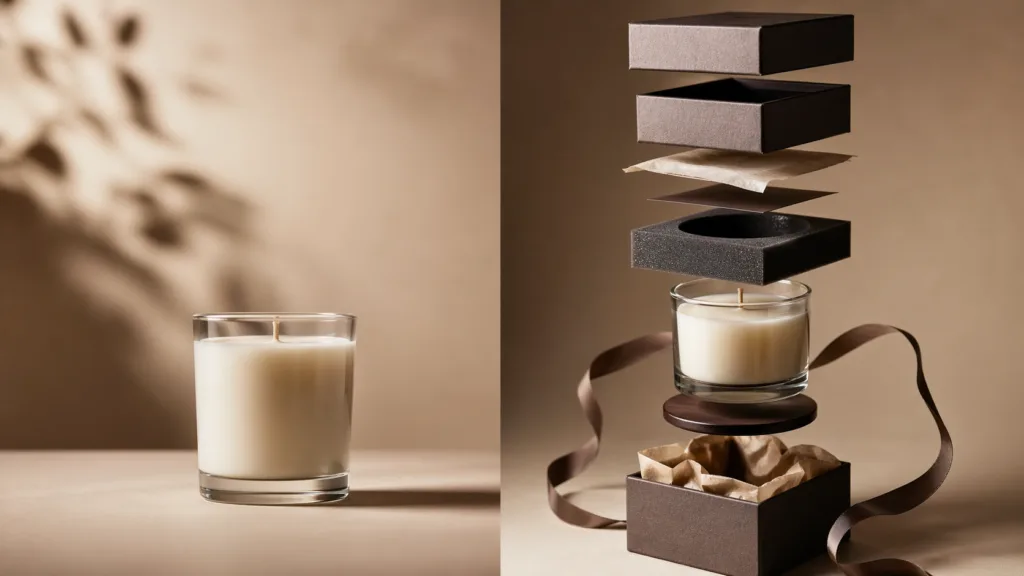
The short answer is simple: you usually can’t order 100 truly custom candles because the wax is not the real limitation. The biggest constraints almost always come from the container and the packaging box, followed by decoration methods, inserts, and production coordination across multiple vendors.
This is the part many buyers do not see early enough. A candle is not just wax poured into a vessel. In B2B manufacturing, a custom candle is a system product. At minimum, it is the combination of three separate product chains working together:
- The container system — glass jar, ceramic vessel, tin, lid, coating, color, finish
- The packaging system — folding box, rigid gift box, insert, label, print finishing
- The wax and fragrance system — wax formula, fragrance oil, wick, burn testing, filling
Once you understand that a candle is not a single product but a coordinated supply chain system, MOQ starts to make sense.
This article explains why 100-unit custom candle orders often fail, what actually drives MOQ, and how serious buyers structure projects in a way that suppliers can support profitably and consistently.
The First Misunderstanding: Buyers Think They Are Buying Wax
When buyers are new to candle sourcing, they usually focus on the most visible product element: the candle itself. They think about scent, wax type, and jar size. If the wax is soy, beeswax, or a blend, they assume cost is mainly tied to raw material weight.
That assumption is incomplete.
Wax is usually one of the least restrictive parts of the project. In most cases:
- Wax can be purchased and melted in scalable volumes
- Fragrance can be adjusted across small or large batches
- Wicks are standardized items with relatively flexible sourcing
- Filling itself is not the main bottleneck unless the formulation is unusually complex
In other words, the wax is rarely the reason a supplier refuses a 100-unit fully customized order.
What creates the real limitation is everything wrapped around the wax: the jar, the lid, the label, the box, the insert, the logo decoration, the tooling, the print setup, and the factory’s willingness to allocate time and material to a run that is too small to justify the setup cost.
This is why a supplier may be able to make 100 candles in theory, but still cannot support 100 custom candles in the format the buyer wants.
That difference matters.
A Custom Candle Is a Supply Chain Assembly, Not a Single SKU
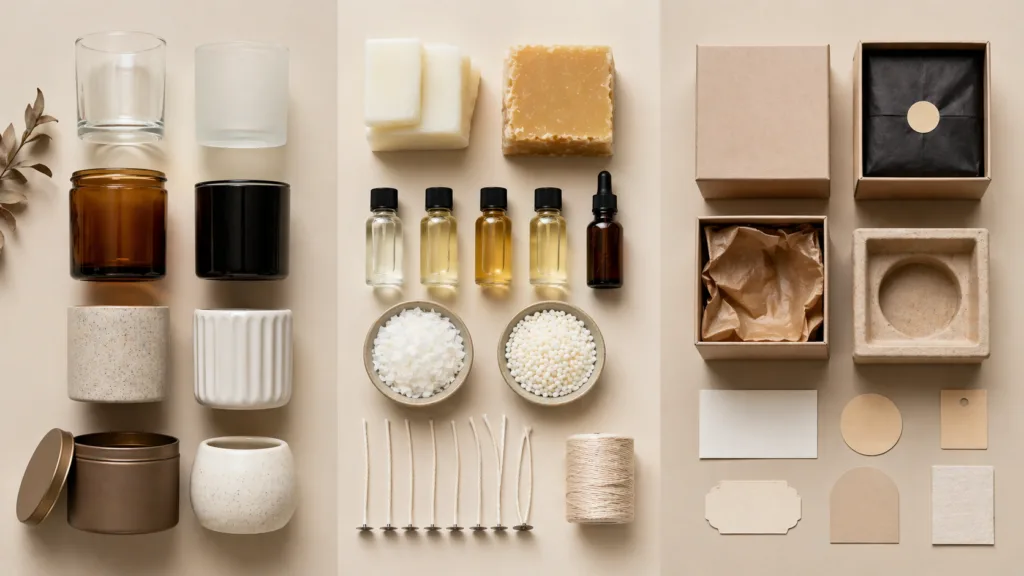
From a B2B perspective, a candle project is not one SKU in the way many buyers imagine. It is at least a three-layer assembly process.
1. The Container Supply Chain
The vessel is not a neutral component. It shapes the look, market positioning, price perception, and manufacturing feasibility of the candle.
Container options may include:
- Standard clear glass jars
- Amber glass jars
- Frosted glass
- Painted glass
- Ceramic vessels
- Concrete vessels
- Tins or metal containers
- Custom molded glass shapes
Each of these options belongs to a different manufacturing logic.
A standard glass jar already exists in a supplier’s ecosystem. It may be stocked or sourced from a factory that runs the same shape repeatedly. That makes it relatively MOQ-friendly.
A custom ceramic vessel is completely different. It may require mold development, glaze testing, color confirmation, kiln scheduling, and a higher scrap tolerance. That pushes MOQ much higher.
2. The Packaging Supply Chain
This is where many small orders break down.
Packaging is not just “a box.” It may include:
- Folding carton
- Rigid lid-and-base box
- Drawer box
- Mailer box
- Foam insert
- Pearl cotton insert
- EVA insert
- Molded pulp tray
- Tissue wrap
- Sleeves
- Stickers
- Foil stamping
- UV coating
- Embossing
Every packaging choice affects MOQ, cost, and feasibility.
A custom rigid gift box is one of the most common reasons that a 100-unit candle order becomes impossible. Buyers often assume that if the candle itself is easy to make, the box should be easy too. In reality, premium boxes are often more restrictive than the candle filling itself.
3. The Wax and Fragrance Supply Chain
The wax system includes:
- Wax base type
- Fragrance compatibility
- Colorants
- Wick selection
- Burn performance testing
- Pouring and curing
This part is technically important, but from an MOQ standpoint, it is often not the hardest piece.
The real problem is that buyers tend to look at the candle from the center outward, while factories look at it from the structure inward.
Factories ask:
- Which vessel is being used?
- Is it standard or custom?
- What is the packaging structure?
- Is logo application by sticker, print, engraving, or foil?
- Is there an insert?
- Is this a sample-stage presentation or a true production-stage configuration?
- How many separate suppliers must be coordinated?
That is why candle sourcing is fundamentally not just product sourcing. It is component system integration.
Why Containers Are One of the Biggest MOQ Drivers
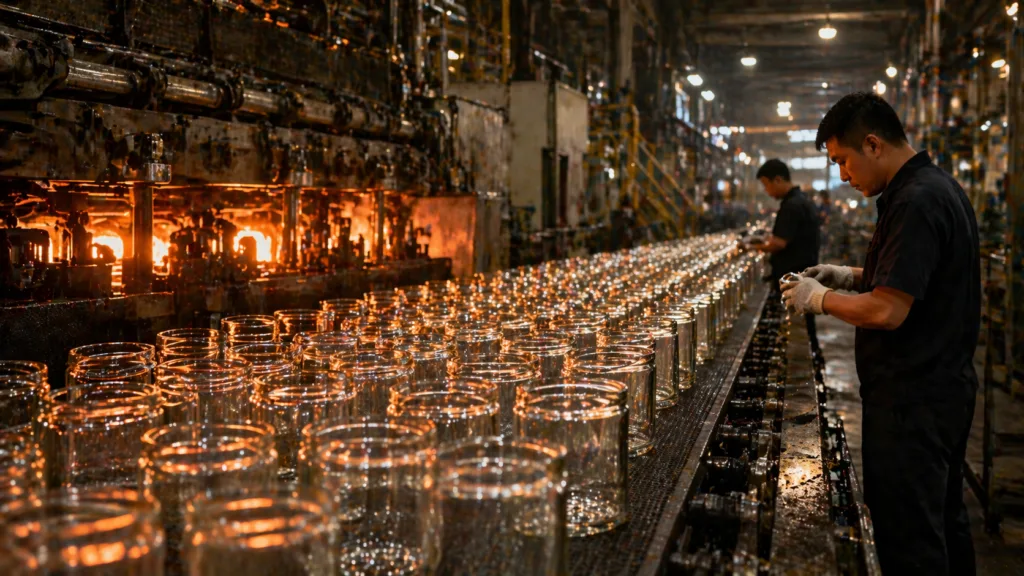
Let’s start with the vessel.
Buyers often underestimate how much the container determines whether a project is feasible at low volume. The problem is not only material cost. It is production structure.
Standard Containers vs Custom Containers
If you choose a standard glass vessel from an existing production line, the supplier may be able to support a lower MOQ. That is because:
- The mold already exists
- The size is already in regular production
- The supplier may already keep it in stock or source it quickly
- The defect tolerance and production rhythm are already known
This is why stock glass is often the best option for brands that want to test the market with a smaller quantity.
But once you move into custom territory, the economics change.
Custom vessels may require:
- New mold development
- Color matching
- Surface treatment testing
- Lid fit testing
- Stability confirmation
- Increased breakage allowance
- Dedicated production scheduling
Even if the buyer only wants 100 pieces, the vessel factory is not thinking in terms of 100. It is thinking in terms of whether this order justifies interrupting or allocating a production run.
Why Small Quantities Don’t Work for Container Factories
A glass or ceramic factory does not build its operation around boutique experimentation for very low-volume buyers. Its economics depend on repetition, throughput, and process efficiency.
What the buyer sees as “just a jar” is, for the factory, a line item that may involve:
- Setup labor
- Machine or kiln allocation
- Color variation risk
- Packaging for safe transport
- Quality control
- Waste percentage
At small quantity, all of these fixed costs are spread over too few units.
That is why a supplier may say yes to 100 pieces for a standard glass jar with a sticker, but no to 100 pieces for a custom ceramic vessel with a premium finish.
The material is not the issue. The production structure is.
Why Packaging Boxes Are Often the Biggest Restriction of All
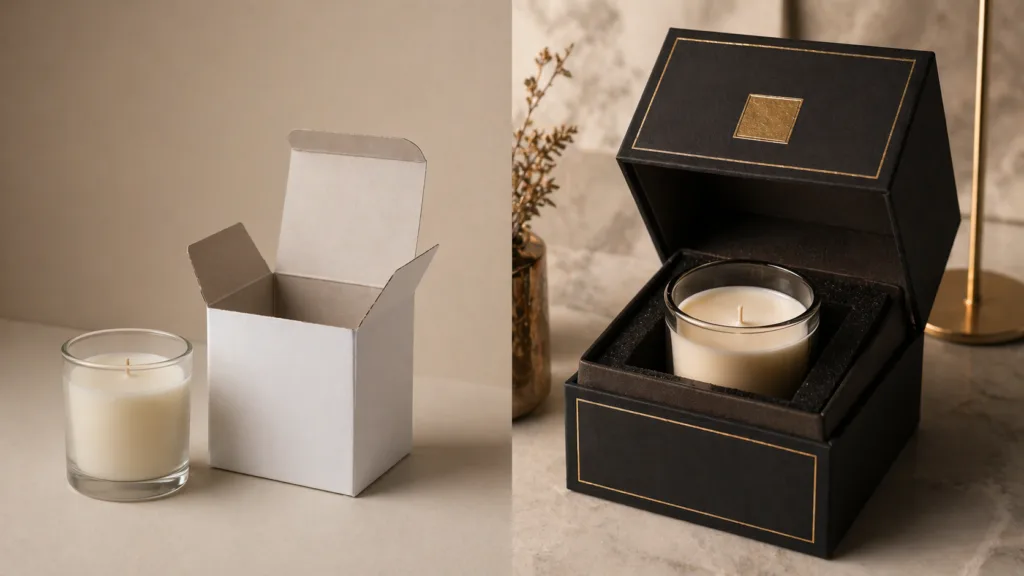
Now we get to the most important point in this article.
For many custom candle projects, the largest MOQ limitation does not come from the wax or even the vessel. It comes from the packaging box.
This is the part many buyers discover too late.
Packaging Has Fixed Setup Costs
A box factory does not simply “print 100 boxes” the way a retail printer makes 100 flyers.
Packaging production may involve:
- Artwork checking and layout setup
- Film or plate preparation
- Die line confirmation
- Material sourcing
- Board cutting
- Wrapping or laminating
- Manual assembly
- Insert cutting and fitting
- Foil stamping setup
- Quality control for alignment and finish
For rigid gift boxes, the production flow is even more labor-intensive. The structure must be cut, wrapped, assembled, dried, and finished. If there is an insert, that insert also has its own sourcing and cutting requirement.
In luxury candle packaging, the box is not a secondary cost. It is often one of the primary cost drivers and one of the strongest MOQ drivers.
Why 100 Boxes Is So Hard
Suppose a buyer wants:
- One candle in a rigid lid-and-base box
- Custom print color
- Gold foil logo
- Protective insert
- Outer sleeve or tissue
That sounds normal for a premium candle brand.
But from the packaging factory’s side, this means setting up a production process for a quantity so small that the setup cost cannot be properly absorbed.
Even if the supplier agrees, the result will usually be one of these:
- The unit price becomes unreasonably high
- The supplier refuses because the order is not efficient
- The packaging is simplified and no longer matches the original brand vision
- The sample uses digital print, but mass production methods cannot be justified at 100 units
In other words, the project may be technically possible, but it is not commercially sensible.
Packaging Boxes Are More Restrictive Than Many Buyers Expect
A buyer may think: “I only need 100 candles, so I only need 100 boxes.”
But the factory thinks:
- How many sheets need to be run?
- What is the waste allowance?
- Is foil stamping worth setting up?
- How much labor is required for hand assembly?
- Is the insert custom-sized?
- Is this a one-time job with no repeat order visibility?
This is why mature buyers understand a crucial point early on:
The more branded and giftable the candle looks, the more likely the packaging system will define the MOQ.
Decoration Methods Quietly Push MOQ Higher
Another reason buyers miscalculate MOQ is that they underestimate decoration methods.
From a buyer’s perspective, logo application may seem like a minor choice. From the supplier’s perspective, it changes the economics of the project.
Common Decoration Options
- Sticker label
- Silkscreen printing
- Decal application
- Engraving
- Foil stamping
- Embossing or debossing
- UV spot coating
Sticker application is flexible and relatively MOQ-friendly. That is why many suppliers recommend stickers for first orders or market testing.
But once the buyer wants direct printing or foil stamping, setup costs go up.
Foil stamping, for example, may require:
- Tooling or plate preparation
- Heat and pressure calibration
- Alignment setup
- Material testing
- Batch consistency control
This is why premium-looking candles often require a higher MOQ than the buyer expects. It is not that the supplier dislikes small orders. It is that the branding method itself is structurally better suited to medium or large runs.
Put simply:
The more “finished brand” you want your product to look, the less small-batch friendly it becomes.
Why Candle MOQ Is Not a Raw Material Problem
At this point, the pattern should be clear.
MOQ in candle manufacturing is rarely about whether the factory can physically melt enough wax for 100 pieces. It is about whether the entire project stack makes sense operationally.
The project stack includes:
- Vessel sourcing
- Lid compatibility
- Surface finish
- Outer packaging
- Insert protection
- Label or print decoration
- Carton packing method
- Compliance label handling
- Freight breakage risk
This is why candles must be understood as a three-product supply chain system at minimum:
- The vessel
- The packaging
- The wax/fragrance fill
And in many premium projects, it is really closer to four or five subsystems once lid suppliers, insert suppliers, and print vendors are included.
If even one subsystem has a high MOQ, the whole project inherits that restriction.
That is the real reason many custom candle inquiries fail at low volume.
What Happens When a Buyer Tries to Order 100 Fully Custom Candles
Let’s walk through a realistic example.
A buyer says they want:
- 280g soy wax candle
- Two custom scents
- Painted glass jar in a specific Pantone-like tone
- Gold foil logo on jar
- Matching rigid gift box
- Black foam insert
- Warning label
- Premium unboxing feel
And the quantity is 100 units.
At first glance, this sounds like a modest test order. But look at what is actually being requested.
System Breakdown
Container side
- Is the jar standard or custom?
- Is the color painted or sprayed?
- Is the jar stocked or made to order?
Decoration side
- Is foil on the glass possible at this volume?
- Is alignment acceptable at low quantity?
Packaging side
- Can the rigid box factory make 100 only?
- Is the insert custom-shaped?
- Is foil stamping on the box required?
Filling side
- Two scents means batch split
- Wick testing may differ by fragrance load and vessel
- Labeling must be applied separately by SKU
This is no longer a simple 100-piece order. It is a small, fragmented production job that creates setup cost across multiple suppliers and leaves too little volume to spread those costs properly.
That is why suppliers often respond in one of three ways:
- They quote a very high price
- They recommend simplifying the project
- They decline the order entirely
None of those outcomes is irrational. They are a direct result of how the supply chain is structured.
How Serious B2B Buyers Approach MOQ Differently
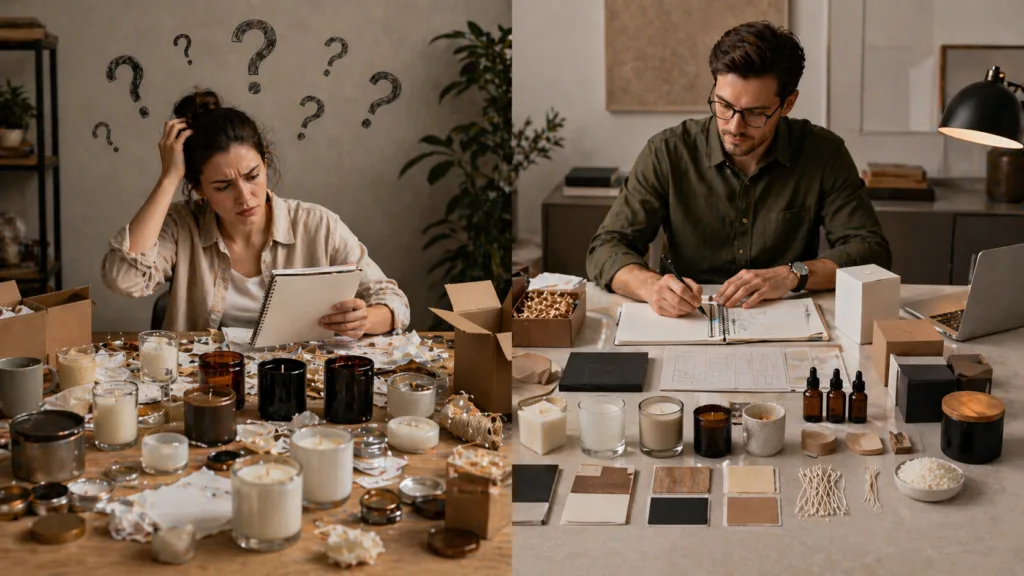
The most experienced buyers do not argue emotionally with MOQ. They redesign the project around it.
That is a major difference between early-stage buyers and mature buyers.
Immature buyers say:
- “But I only need 100 to test.”
- “Why is the MOQ so high if the candle is simple?”
- “Can’t you make an exception?”
Mature buyers ask:
- “Which part of the project drives the MOQ?”
- “Can we standardize the vessel first?”
- “Can we simplify the box for launch and upgrade later?”
- “Which customization creates the biggest cost jump?”
This is the right way to think.
Strategy 1: Use Standard Vessels First
For market testing, a standard glass jar is often the smartest route.
Why?
Because it removes one of the most rigid supply chain constraints. The brand can still test:
- Scent preference
n- Market positioning - Label design
- Price point
- Consumer feedback
without taking on unnecessary tooling or vessel MOQ risk.
Strategy 2: Separate Product Validation from Packaging Ambition
One of the biggest mistakes new buyers make is trying to validate the product and fully express the final brand vision in the same first order.
That is usually too much.
The smarter route is often:
Phase 1
- Standard vessel
- Sticker logo
- Simple carton or stock box
- Test the scent and market response
Phase 2
- Upgrade to printed or foiled vessel
- Develop rigid packaging
- Add insert and premium presentation
This staged approach is not a compromise. It is a professional procurement method.
Strategy 3: Hybrid Customization
Not every part of the project has to be custom from day one.
A buyer can choose to customize:
- Fragrance
- Label artwork
- Outer visual identity
while standardizing:
- Vessel shape
- Box structure
- Insert style
This is often the best path for emerging brands that still want a strong identity without carrying an unrealistic MOQ burden.
Strategy 4: Build for Repeatability, Not Just Launch Photos
A lot of early-stage buyers unconsciously design for aesthetics first and production second. They optimize for the first photoshoot, not for a sustainable reorder model.
Mature buyers do the opposite.
They ask:
- Can this vessel be reordered consistently?
- Is this packaging scalable?
- Will this finish create lead time instability?
- Does this configuration still work at 500, 1000, 3000 units?
Those questions lead to healthier projects and more reliable supplier relationships.
MOQ Is Not a Barrier. It Is a Structural Signal.
MOQ often feels like a rejection to buyers. In reality, it is usually a signal.
It tells you something important about the product you are trying to build.
It may signal that:
- Your packaging is too complex for your launch volume
- Your container choice belongs to a higher-volume product tier
- Your branding method is not small-batch friendly
- Your project is mixing test-order budget with mass-market presentation expectations
This is not bad news. It is useful information.
The earlier you accept this, the faster you can redesign the project into something commercially workable.
MOQ is not there to punish small brands. It exists because factories run on process logic, not startup emotion.
Once buyers understand that, conversations with suppliers become far more productive.
The B2B Reality: You Are Not Buying a Candle, You Are Coordinating a System
This is the key takeaway.
A custom candle is not just wax in a jar. It is a coordinated assembly of multiple manufactured components, often supplied by different vendors with different minimums and different timing.
At minimum, it is a three-part supply chain system:
- Container product
- Packaging product
- Wax/fragrance product
And every serious buyer should think that way.
When you say you want 100 custom candles, what the supplier hears may actually be:
- 100 jars with a specific finish
- 100 decorations or branded applications
- 100 custom boxes
- 100 inserts
- 100 filled candles
- multiple setup events for a very small run
That is why the supplier does not evaluate your inquiry based on wax weight alone. They evaluate it based on system feasibility.
The more premium and customized the project becomes, the less it behaves like a simple product and the more it behaves like a coordinated manufacturing program.
That is where mature buyers stand apart. They understand that they are not just sourcing candles. They are managing a supply chain architecture.
Final Thoughts
If you’ve been told that 100 custom candles are not feasible, the answer is usually not about the wax.
It is about the structure behind the candle.
The largest MOQ limitations usually come from:
- The container, especially if it is custom or highly finished
- The packaging box, especially if it is rigid, printed, foiled, or insert-based
- The branding method, especially when it moves beyond simple labels
That is why many candle projects succeed only after the buyer stops thinking of the candle as one product and starts treating it as a supply chain system.
The strongest B2B buyers do not ask, “Why can’t I order 100?”
They ask, “Which part of the structure is driving the MOQ, and how do we redesign around it?”
That shift in thinking saves time, saves money, and leads to projects that are far more likely to scale.
If your goal is to build a candle line that can grow—not just produce a beautiful first sample—this is the mindset you need.
Because in candle manufacturing, wax is rarely the hardest part.
The real challenge is everything around it.
FAQ
1. Why is the MOQ for custom candles usually high?
Because MOQ is mainly driven by containers, packaging boxes, and branding methods rather than by wax itself. These parts involve fixed setup costs and batch production.
2. Can I order 100 custom candles at all?
Yes, but usually only if the project is simplified. Standard glass jars, sticker labels, and basic packaging are much more feasible than fully custom vessels and rigid gift boxes.
3. What is the best way to launch a candle brand with a lower MOQ?
Start with standard components, validate scent and market demand first, and then upgrade to more customized containers and packaging once reorder volume becomes clearer.