
 If you’ve ever walked into a hotel lobby and instantly felt calmer, you already understand the power of scent.
It happens fast. Faster than a logo, a song, or a social post. A smell reaches you and your brain reacts before you can even name what you’re smelling. One note of clean linen can make you feel “safe.” A warm vanilla can feel like home. A smoky wood can feel like a private club. You can be standing in the same place, wearing the same clothes, holding the same phone—and yet your mood changes because the air changed.
That’s why scent isn’t just a product category. It’s an emotional tool.
And when you look at buying behavior through that lens, one thing becomes very clear:
People don’t buy scent only to smell good. They buy scent to feel something.
This is what I mean by the emotional economics of scent. It’s the money we spend to shape our emotions, our memories, our comfort, and our sense of self.
In the past, perfume sat at the center of this world. Perfume was the “main character.” It was personal, intimate, and expensive. But in the last decade—especially with the rise of home-based living—candles moved from a small accessory to a major emotional purchase.
So why is it that many consumers won’t buy a $150 perfume often, but will repeatedly buy $35–$80 candles?
This article answers that question in a practical way. We’ll break down:
- Why scent is linked to memory and emotion
- How perfume and candles serve different emotional jobs
- Why home fragrance culture keeps growing
- Why candles are a form of affordable luxury
- How emotional storytelling drives candle sales
- What this means for brands building a private label candle line
And at the end, I’ll show you how to turn these ideas into a product line your customers actually reorder—plus how Circe Home can support you with compliant, design-forward candle manufacturing.
1) Scent Is Not Just a Product — It’s an Emotional Trigger
 Most products compete on features.
- A phone competes on camera quality.
- A jacket competes on fabric and fit.
- A blender competes on power.
Scent competes on something deeper.
A smell can trigger a memory you didn’t even know you still had.
You smell sunscreen and suddenly you’re eight years old again, sitting in the back seat of a car, sticky from the beach. You smell rose and it takes you to a wedding where you felt hopeful. You smell a certain kind of soap and you remember a grandparent’s house.
This isn’t poetic guesswork. It’s how the brain works.
The olfactory system (your sense of smell) is closely tied to brain areas involved in emotion and memory. That’s why scent can bypass “logic” and go straight to feeling. You can argue with a bad review. You can ignore an ad. But you can’t easily ignore a smell that touches something personal.
This is also why scent is one of the strongest tools in branding.
A scent can become a shortcut.
- Shortcut to comfort
- Shortcut to energy
- Shortcut to intimacy
- Shortcut to focus
- Shortcut to nostalgia
When a consumer buys a scented product, they are often buying the shortcut.
This is the emotional economics part: people are willing to pay to control their emotional environment.
And that’s where candles become powerful.
Perfume mostly stays on the body.
Candles shape the room.
A room is where people live. Where they rest. Where they work. Where they date. Where they heal.
So the emotional influence of home scent can be bigger than personal scent.
2) Perfume vs Candles: Two Different Emotional Roles
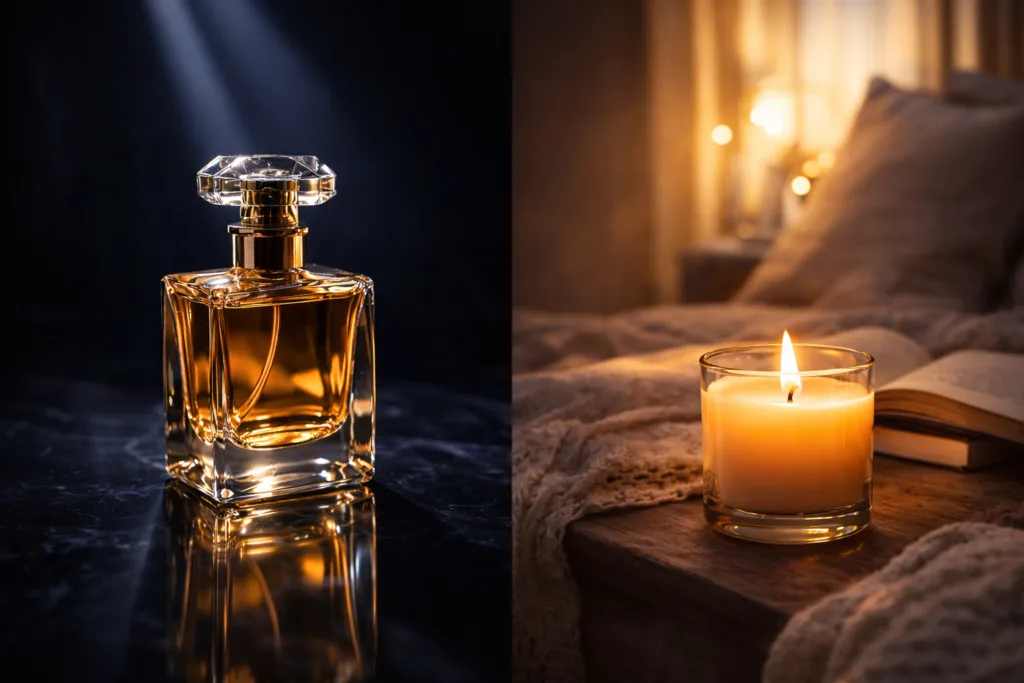 Perfume and candles both use fragrance, but they don’t compete in the same way.
They serve different emotional jobs.
Perfume: “Who I Am”
Perfume is identity.
It’s what you put on your skin before you meet the world.
Perfume can feel like:
- confidence
- attractiveness
- status
- mystery
- taste
Perfume is also tied to social life. You often wear it when you leave home.
It can be a signal:
- “I’m polished.”
- “I’m seductive.”
- “I’m expensive.”
- “I’m creative.”
Even when people say they wear perfume “for themselves,” it still lives in a social space. It sits close to the body. It belongs to the public-facing self.
Candles: “How I Want to Feel”
Candles are mood.
They are not about identity first. They’re about atmosphere.
A candle is something you light when you want to change the emotional tone of your space.
People light candles when:
- they want to relax after work
- they want the home to feel clean and calm
- they want to romanticize an ordinary night
- they want the bathroom to feel like a spa
- they want a dinner table to feel warm
- they want to focus
- they feel lonely and want comfort
Candles create a private emotional world.
And because that world is private, people are more likely to buy candles repeatedly.
The Key Difference
Here’s the simplest way to remember it:
- Perfume is self-expression in public.
- Candles are self-care in private.
Another way:
- Perfume: personal identity
- Candle: environmental mood
That’s why a consumer might own one “signature perfume” for a long time, but buy multiple candles each season.
Candles fit into everyday routines.
Perfume often feels like a bigger commitment.
3) Why Home Fragrance Culture Keeps Growing
Home fragrance is not a passing trend. It is built on long-term cultural shifts.
A) We Spend More Time at Home
Work-from-home habits, hybrid schedules, and home-based entertainment changed how people view their space.
When home becomes your office, your gym, your theater, and your weekend plan, you start caring more about how it feels.
And “how it feels” is not only about furniture.
It’s about light.
It’s about sound.
And it’s about scent.
B) Wellness Culture Made Mood a Purchase
In the last decade, self-care turned into a category.
People now buy:
- supplements
- skincare routines
- meditation apps
- therapy
- matcha
- weighted blankets
Candles fit perfectly into this mindset.
They are a small ritual.
They signal, “I’m taking care of myself.”
C) Interior Design Became Emotional Design
People don’t just decorate for looks anymore.
They decorate for feeling.
A living room can be “cozy.”
A bedroom can be “calm.”
A bathroom can be “spa-like.”
Scent is part of that design language.
A candle is basically interior design you can smell.
D) Luxury Brands Pushed Candles as Lifestyle Objects
Look at the behavior of luxury fragrance houses.
Many of them have built home fragrance lines:
- candles
- diffusers
- room sprays
Why?
Because candles allow them to extend a fragrance story beyond the body and into the home.
And for consumers, buying a candle from a luxury brand can feel like participating in that brand’s lifestyle—without paying perfume-level prices.
This leads directly to the next point.
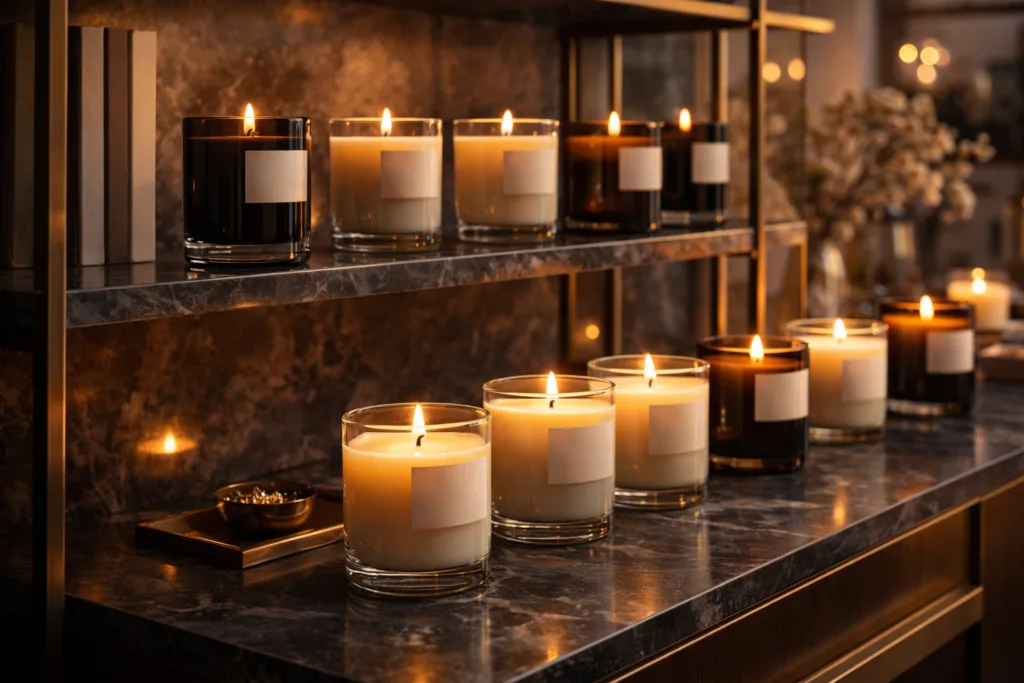
4) Candles as Affordable Luxury (Why They Sell Even in Tough Times)
 When money is tight, you might expect people to stop buying “non-essential” products.
But something interesting happens.
People often stop buying big luxuries first—like expensive handbags.
But they keep buying small luxuries.
This is sometimes called the lipstick effect.
The idea is simple:
When people feel stressed, they want something that makes them feel better—but they still want it to be affordable.
Candles sit in the perfect place:
- They are not too expensive.
- They feel indulgent.
- They make daily life feel better.
A $150 perfume might be a “big purchase.”
A $45 candle can feel like a treat you deserve.
And unlike many treats, a candle doesn’t disappear in one moment.
It can last 30–60 hours.
So the consumer feels:
“I’m not wasting money. I’m upgrading my life.”
This is why candles are often called “entry luxury.”
They are a gateway into premium living.
And that’s also why gift sets sell so well.
When you give someone a candle, you are giving them a feeling.
You’re saying:
- rest
- warmth
- comfort
- care
Not just wax.
5) Why Candle Brands Win With Emotional Storytelling
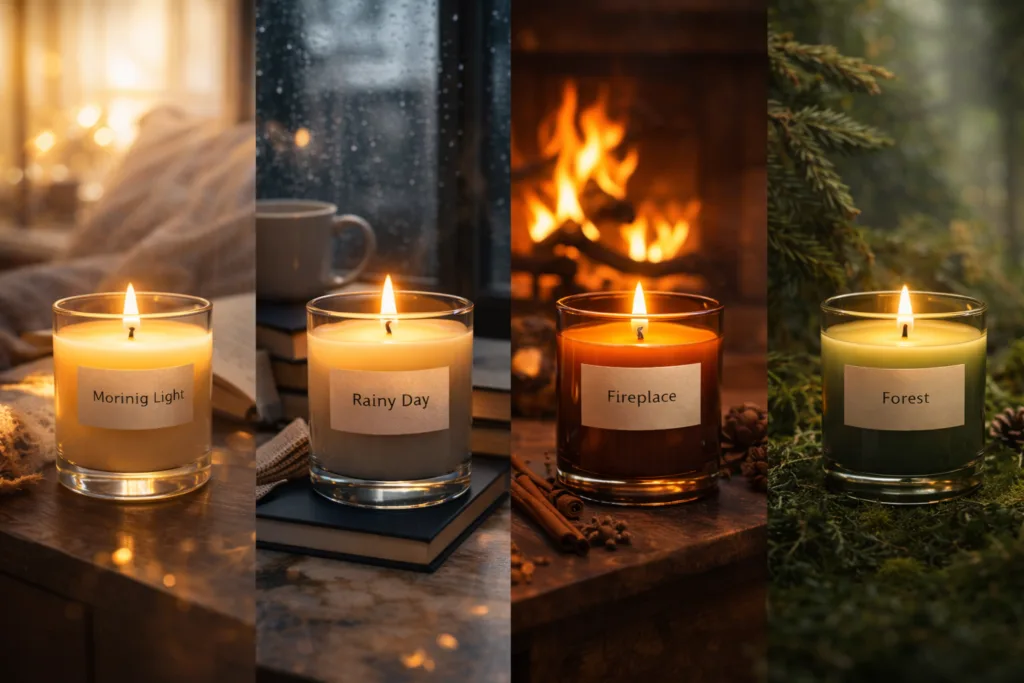 Many candle brands make a mistake.
They describe their products like a technical sheet:
- top notes
- middle notes
- base notes
- wax type
- burn time
Those details matter.
But they don’t sell the first candle.
Story sells the first candle.
And emotional experience sells the second candle.
Why Naming Matters
Look at the best-selling candle names in the market.
They are rarely “Bergamot + Cedar.”
They are more like:
- Sunday Morning
- Clean Sheets
- After Rain
- Library
- Fireplace
- Cashmere
- Paris Café
These are not notes.
These are scenes.
When a consumer reads “Library,” they don’t just imagine wood and paper.
They imagine:
- quiet
- intelligence
- focus
- comfort
- privacy
That emotional picture is what they buy.
Why Packaging Matters
Candles are visual products.
Even if the buyer comes for the scent, the packaging helps them justify the purchase.
A candle is often displayed:
- on a bedside table
- on a coffee table
- in a bathroom
So it must look like part of the home.
That’s why premium brands invest in:
- thick glass or ceramic vessels
- clean typography
- matte finishes
- structured rigid boxes
Packaging is not just protection. It is a signal.
It tells the buyer:
“This is worth paying for.”
Why Ritual Matters
Candles are often tied to behavior.
Light candle → change mood.
That is a ritual.
Strong candle brands build rituals into their marketing:
- evening wind-down
- bath ritual
- reading ritual
- hosting ritual
- seasonal reset
This creates repeat purchase because the candle becomes part of the person’s routine.
And when something becomes routine, it becomes a habit.
Habits are profitable.
6) The Business Opportunity Behind Emotional Scent
Now let’s shift into a brand builder’s view.
If you are a retailer, a boutique owner, a distributor, a gift company, or a fragrance brand thinking about candles, here’s why this category is attractive.
A) Candles Have Strong Repeat Purchase Potential
Perfume is often slow to repurchase.
A candle can be repurchased every month.
That alone changes the business model.
B) Candles Are Easier to Position as Collections
Perfume can be hard to launch because you need strong sampling and a lot of marketing to build trust.
Candles can be built as collections more easily:
- seasonal collections
- mood collections
- room collections
- gifting collections
And collections encourage multiple-item purchases.
C) Candles Are Gift-Friendly
People gift candles when they don’t know what else to buy.
Because candles are:
- safe
- beautiful
- emotionally positive
- useful
Gift sets, especially in Q4, can become a major sales engine.
D) The Story Is Easier to Show Online
Candles are easier to photograph than perfume.
A candle can be staged in a home.
It can be styled with:
- books
- towels
- flowers
- coffee
This makes candles powerful for:
- ecommerce
And now, with AI-driven search and shopping, strong imagery and clear story angles matter more than ever.
7) What This Means for Private Label Candle Brands
If you want to build a candle line that sells, don’t start with wax.
Start with emotion.
Here are practical steps.
Step 1: Choose an Emotional Territory
Pick a clear territory that matches your target customer.
Examples:
- “Modern spa” (clean, herbal, airy)
- “Dark luxury” (smoke, leather, oud)
- “Cozy home” (vanilla, amber, bakery)
- “Coastal calm” (salt, citrus, driftwood)
- “Botanical fresh” (green leaves, fig, garden)
Your territory will guide everything:
- fragrance direction
- vessel style
- label design
- photo styling
Step 2: Build a Small, Strong Core Line
Many new brands launch too many scents.
A better approach:
- 3–6 core scents
- 1–2 seasonal drops
- 1–2 gifting sets
This keeps your first production manageable and your brand message clear.
Step 3: Design for the Room, Not Just the Nose
Candles live in a space.
Ask:
- Will this vessel look good in a modern home?
- Does the label feel premium at 2 meters away?
- Does the box look gift-ready?
A candle can smell great and still fail if it looks cheap.
Step 4: Make Compliance Part of the Brand Promise
In many markets, compliance is not optional.
And in premium retail, buyers care.
A serious candle supplier should support:
- proper labeling guidance (depending on destination)
- fragrance compliance standards
- safety documentation where applicable
This is one reason retailers prefer working with experienced manufacturers.
Step 5: Plan Logistics Like a Real Business
Candles are heavy and fragile.
Your margins depend on:
- packaging engineering
- carton strength
- pallet strategy
- lead times
If you treat candles like lightweight fashion accessories, you can lose money fast.
8) Turning Emotional Economics Into Products That Sell (A Simple Framework)
Here is a framework you can use immediately.
The 3-Layer Candle Value Stack
A candle wins when it delivers three layers at once:
- Scent — it smells right and performs well
- Design — it looks like it belongs in the customer’s space
- Story — it makes the customer feel something before they even light it
If you only have scent, you become a commodity.
If you have scent + design, you can be premium.
If you have scent + design + story, you become a brand.
Brands get:
- higher price tolerance
- better repeat purchase
- stronger word-of-mouth
9) How Circe Home Helps Brands Build Candles People Reorder
At Circe Home, we work with brands that want more than “a candle.”
They want a product line with:
- consistent quality
- clean design language
- strong storytelling support
- compliance-ready fragrance development
- stable production and packaging execution
What We Can Support
Depending on your concept and order volume, we can help you build:
- private label scented candles
- luxury candle gift sets (rigid boxes, inserts)
- wax melts and coordinated home fragrance accessories
- custom label and packaging systems
- global warehousing support (for smoother distribution)
What You Get in a Real Development Process
When you reach out, we typically align on:
- your brand positioning and target customer
- your desired vessel look (glass / ceramic / other)
- fragrance direction (mood and notes)
- packaging level (folding carton vs premium rigid box)
- production plan (MOQ, lead time, sampling)
Then we move into sampling and production with clear structure.
Why Brands Choose Us
Our clients choose Circe Home because they need:
- high quality that can stand in North America, Europe, and Oceania
- customization without chaos
- price advantages that still protect premium perception
- innovative design options for vessels and packaging
- eco-conscious materials where possible
- full certification support for Western markets
If your goal is to launch a candle line that feels like a real brand—not a generic supplier product—this is exactly what we do.
Ready to Build Your Candle Line?
If you’re planning a new collection, send us:
- your target market (US / EU / AU)
- your ideal product photos or moodboard
- your estimated order quantity per scent/design
- your packaging expectations (standard vs luxury gift-ready)
We’ll reply with a clear proposal for sampling, lead time, and pricing—and help you turn “a scent idea” into a product customers actually want to light again and again.
FAQ
1) Why do people buy candles more often than perfume?
Because candles shape the mood of a space, and many people use them as part of daily routines—relaxing, hosting, working, or winding down. Perfume is more tied to personal identity and is usually repurchased less often.
2) Are candles considered luxury products?
They can be. Candles are often “affordable luxury,” meaning they feel premium and emotional while staying within a reachable price range. Packaging, vessel quality, fragrance complexity, and brand storytelling all influence whether a candle is perceived as luxury.
3) What should a private label candle brand focus on first?
Start with emotion and positioning before technical details. Choose an emotional territory (spa, cozy, dark luxury, coastal, etc.), then develop a small core line with strong design and storytelling. After that, optimize wax, wicks, packaging engineering, and compliance for your destination market.