
 Seasonal candle collections look like an easy win.
You design a Christmas label, pick a “holiday” scent, shoot a cozy photo, and watch the orders roll in—right?
Sometimes, yes.
But here’s the uncomfortable truth: seasonal collections can also become a quiet, repeated loss. They can steal your cash flow, trap you in dead stock, and blur your brand identity until nothing feels clear anymore.
That’s why smart brands treat seasonal candles like a power tool—not a lifestyle.
Used the right way, they drive attention, higher average order value, and gift sales.
Used the wrong way, they create a business that depends on a few weeks of the year to survive.
This article breaks down the top weaknesses of seasonal candle collections—and the best ways to fix them, so you can grow without building a fragile brand.
What “Seasonal Candle Collection” Really Means
A seasonal candle collection is a set of candles designed around a time window:
- Holidays: Christmas, Halloween, Valentine’s Day, Mother’s Day
- Seasons: Spring florals, Summer fruits, Autumn spices, Winter woods
- Events: wedding season, graduation, back-to-school, New Year reset
Most seasonal collections share a few features:
- New label or packaging artwork
- Limited-time scent names
- Gift-ready presentation (boxes, inserts, bundles)
- A hard selling deadline (the season ends)
The deadline is the point.
Seasonal is not only about smell. It’s about urgency.
And urgency can be a gift—until it becomes the whole strategy.
Weakness #1: Revenue Concentration Risk
 Seasonal candles often create sales cliffs.
You sell a lot in a short time, then you drop.
It can feel like:
- September: planning
- October: ramp-up
- November: peak
- December: peak
- January: silence
If too much of your revenue depends on one season, your business becomes fragile.
Why it’s dangerous
- Cash flow becomes unstable
- You can’t plan staffing or production smoothly
- You overreact to slow weeks
- One bad season can ruin the year
A strong candle brand is like a strong building: it needs support beams.
Your evergreen core line is the beam.
Seasonal should be the decoration—not the foundation.
Simple rule:
If your brand can’t survive without Q4, you don’t have a stable product system yet.
Weakness #2: Forecasting Is Harder Than People Admit
Forecasting is the silent killer of seasonal collections.
Because seasonal demand is not steady. It’s emotional.
A few factors can flip your demand overnight:
- weather changes
- social media trends
- a competitor’s viral launch
- shipping delays
- a big retailer promotion
- economic news
And you only have a small window to sell.
Two bad outcomes
- Over-forecast: you’re stuck with leftover inventory.
- Under-forecast: you sell out too early and miss the best weeks.
Selling out early sounds good—until you realize:
- you paid for design, packaging, and ads
- you trained customers to expect the product
- you can’t replenish fast enough
Seasonal candles punish slow replenishment.
Weakness #3: Dead Stock Turns into “Calendar Trash”
 This is the weakness most people feel in their bones.
When the holiday passes, the product doesn’t just become “less popular.”
It often becomes socially awkward.
A Christmas-themed gift set in February feels off.
A “Spooky Pumpkin” candle in April feels like leftover candy.
It creates a cheap, expired feeling.
Why seasonal leftovers are worse than normal leftovers
- the theme looks outdated
- gift buyers move on fast
- stores don’t want “last season energy” on shelves
- customers expect discounts
Even if the candle is still perfectly good, the story is not.
And in retail, story is value.
New reality: seasonal gift products must be sold before the season ends.
If not, they become discount stock.
And discount stock can quietly train your customers to wait.
Weakness #4: Margin Illusion
Seasonal candles often look profitable on paper.
Higher retail price.
Gift set bundles.
Limited edition positioning.
But net profit is not the same as retail price.
Hidden costs people forget
- repeated sampling for new packaging
- label changes, approvals, printing setup
- more QC steps
- higher packaging damage rate
- extra fulfillment labor
- discounting after the season
You can charge more and still make less.
Seasonal collections often create margin leakage—tiny costs that add up until you realize the “best-selling” item didn’t build real cash.
Weakness #5: Packaging Complexity Explodes
Seasonal collections love fancy packaging.
- rigid boxes
- magnetic closure
- inserts
- foil stamping
- sleeves
- ribbons
All of this can look amazing.
But it also increases risk.
What can go wrong
- box supplier delays
- color mismatch across batches
- insert size errors
- higher shipping weight
- higher damage rate
And when packaging fails in Q4, you can’t fix it slowly.
Seasonal time windows are short.
If your box arrives late, you don’t just lose time.
You lose the season.
Weakness #6: Too Many SKUs Create Operational Chaos
Seasonal collections often multiply SKUs:
- 4 scents
- 3 sizes
- 2 label colors
- gift box + no gift box
Suddenly you have 48 SKUs.
That complexity hits every part of the business:
- purchasing
- production planning
- warehouse picking
- inventory counting
- customer service
And the worst part is: you’re doing it for products that may only sell for 6–10 weeks.
Seasonal collections punish messy systems.
If your operations are not tight, seasonal will expose it.
Weakness #7: Brand Positioning Gets Diluted
 Seasonal themes can blur your identity.
Today you’re “minimal quiet luxury.”
Next month you’re “candy cane sparkle.”
Then you’re “tropical mango party.”
After that you’re “pumpkin chaos.”
If your brand personality changes every three months, customers don’t know what you stand for.
And when customers don’t know what you stand for, they don’t remember you.
Luxury brands win through consistency
Luxury is not only price. It’s a stable point of view.
Seasonal can support a luxury brand—but only if:
- the design still feels like your brand
- the packaging stays in your system
- the scents feel connected to your identity
Seasonal should not replace your brand voice.
It should speak your brand voice—just with a holiday accent.
Weakness #8: Retailers Hate Slow-Moving Seasonal Stock
Retailers have limited shelf space.
They want products that:
- sell through quickly
- don’t need heavy discounting
- look fresh every week
Seasonal candles can be great for retailers—when planned correctly.
But they can also become a shelf problem.
Retailers often face:
- leftover seasonal units after the holiday
- customers asking for discounts
- a messy display once new season starts
So retailers become cautious.
And cautious retailers order less.
That means your seasonal collection can force you into smaller runs, higher unit costs, and lower profit.
Weakness #9: Lead Times Collide with Reality
Seasonal collections require long planning.
But many brands plan late.
Here’s what planning should look like for Q4:
- April–May: concept, vessel decisions
- June: scent development
- July: packaging proofing
- August: sampling + final approvals
- September: production
- October: shipping + receiving
- November–December: selling
Now compare that to real life:
- “We want to launch in November. Can we start sampling in October?”
That’s how seasonal collections fail.
Because production and logistics do not care about your marketing calendar.
If you start late, you will either:
- pay premium rush costs
- accept weaker packaging
- ship by air at painful rates
- or miss the season entirely
Weakness #10: Quality Risk Increases Under Time Pressure
When you push seasonal deadlines, quality suffers.
- wax adhesion issues
- scent throw inconsistency
- label placement mistakes
- packaging scuffs
- rushed QC
The fastest way to damage a candle brand is to ship a holiday gift that feels cheap.
Gift buyers are not forgiving.
They are buying for someone else.
If the product disappoints, it’s not just a return.
It’s embarrassment.
And embarrassment kills repeat purchase.
Weakness #11: Discounting Trains Bad Customer Behavior
If customers learn that:
- seasonal candles go 40% off after the holiday
they will wait.
That can destroy your pricing power.
Seasonal becomes a predictable discount event.
And once pricing power is gone, it’s hard to rebuild.
The brand feels less premium.
Retailers feel less confident.
And your next “limited edition” doesn’t feel limited.
It feels like a future clearance item.
Weakness #12: Creativity Addiction (Yes, It’s Real)
Seasonal is exciting.
You get to design new art.
Name new scents.
Plan shoots.
Post new content.
That creative rush can become addictive.
But a business cannot run on excitement alone.
A strong product strategy is boring on purpose.
- repeatable vessels
- stable suppliers
- consistent packaging system
- predictable reorder cycles
Seasonal should sit on top of that boring foundation.
If you skip the foundation, seasonal becomes an expensive hobby.
The Best Fix: Build Seasonal on an Evergreen Core
Seasonal collections are not “bad.”
They’re powerful.
But only when they are built on a stable base.
Here are the best models brands use to win.
Best Model #1: The 80/20 Strategy
- 80% evergreen core line
- 20% seasonal drops
Your core line keeps cash flow stable.
Seasonal gives you peaks.
This model also helps retailers:
- core line stays on shelf year-round
- seasonal becomes a limited add-on
Retailers love that.
Best Model #2: Repackage, Don’t Rebuild
Instead of creating totally new candles every season:
- keep the vessel
- keep the wax system
- keep the core scent base
- change the label or outer box
This reduces:
- sampling time
- MOQ pressure
- QC risk
- inventory confusion
It also keeps your brand identity consistent.
You’re not becoming a different brand every quarter.
Best Model #3: Limited Drops with Hard SKU Control
Set strict rules:
- max 2–4 seasonal scents
- max 1–2 sizes
- keep packaging components shared
Small SKU counts protect operations.
You can still look fresh.
But you stay sane.
Best Model #4: Pre-Order or Reservation Windows
If you’re a DTC brand or have a strong email list, consider:
- 2–3 week pre-order
- “ships by” date
- small batch run based on demand
Pre-order reduces inventory risk.
It turns seasonal into a planned production—not a gamble.
Best Model #5: Modular Vessel + Packaging System
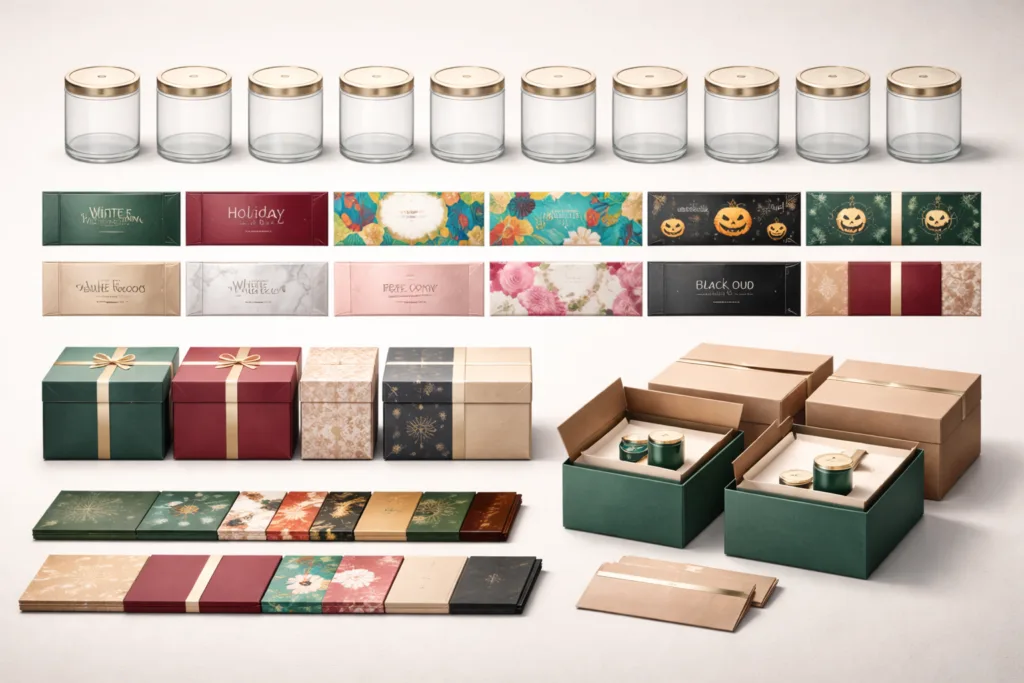 This is the model most scalable private label brands use.
A modular system means:
- one vessel family
- shared lids
- shared box structure
- shared inserts
Then you rotate:
- label design
- sleeve artwork
- scent name cards
This protects:
- cost
- lead time
- shipping weight
- supplier stability
It also makes reorders fast.
Fast reorders are your hidden advantage in seasonal.
A Practical Timeline for 2026 Holiday Launch
If you want to sell strongly in November–December 2026, here’s the safe timeline.
April–May
- choose vessel + size
- confirm packaging structure
June
- finalize scents (or choose from tested profiles)
- start first sample round
July
- packaging proof + insert fit test
- finalize label files
August
- final sampling + QC checklist
- confirm order quantity
September
- mass production
October
- shipping + receiving
November–December
- sales season
If you start in September, you are already late for gift-grade production.
That’s not drama.
That’s physics.
How to Keep Seasonal From Feeling “Expired” After the Holiday
This is one of the most important realities.
Holiday gifting products get outdated fast.
Even if the candle is beautiful, the theme can feel “over.”
To reduce the expired feeling, use one of these approaches:
Option A: Use Seasonal Mood, Not Seasonal Symbols
Instead of:
- Santa
- reindeer
- snowman
Use:
- deep winter palette
- evergreen woods
- warm amber glass
- quiet luxury typography
Mood-based seasonal design can still sell after the holiday.
Symbol-based design usually cannot.
Option B: Separate the Gift Wrap From the Candle
Make the candle evergreen.
Make the outer gift box seasonal.
Then after the season:
- sell candle as core product
- use neutral packaging
This protects your inventory value.
Option C: Create “Winter” Instead of “Christmas”
Winter can sell from October to February.
Christmas often ends on December 26.
Wider selling window = lower risk.
Conversion: Want a Seasonal Collection That Actually Scales?
If you’re planning a holiday candle collection for 2026, the smartest move is to build it on a modular system:
- stable vessel options (glass or ceramic)
- tested wax performance
- compliant fragrance development
- packaging that looks premium but stays repeatable
That’s how you:
- hit the season on time
- reduce dead stock
- protect your margins
- and keep your brand identity clear
If you want, we can help you map the best structure for your seasonal line based on:
- your target market (North America / Europe / Oceania)
- your price position (mid / premium / luxury)
- your preferred packaging tier (standard box vs rigid gift box)
- your shipping model (bulk / warehouse stocking)
Reach out with your reference images and target launch month, and we’ll suggest a seasonal strategy that fits your budget and timeline—without turning your business into a one-season gamble.
FAQ
1) Why do seasonal candle collections often lead to dead stock?
Because they have a short selling window. Once the holiday or season passes, the theme feels outdated, and customers expect discounts. Without accurate forecasting and strict SKU control, leftovers become hard to sell.
2) What is the best way to reduce risk for a Christmas candle collection?
Build Christmas as a layer on top of an evergreen system: reuse the same vessel, box structure, and inserts, then rotate artwork and scent cards. Keep SKUs limited and plan early so production and shipping finish before October.
3) Should a new brand focus on seasonal candles or an evergreen core line first?
Start with an evergreen core line first. Seasonal drops work best when you already have stable operations, proven product performance, and consistent brand identity. Seasonal should amplify your foundation, not replace it.