
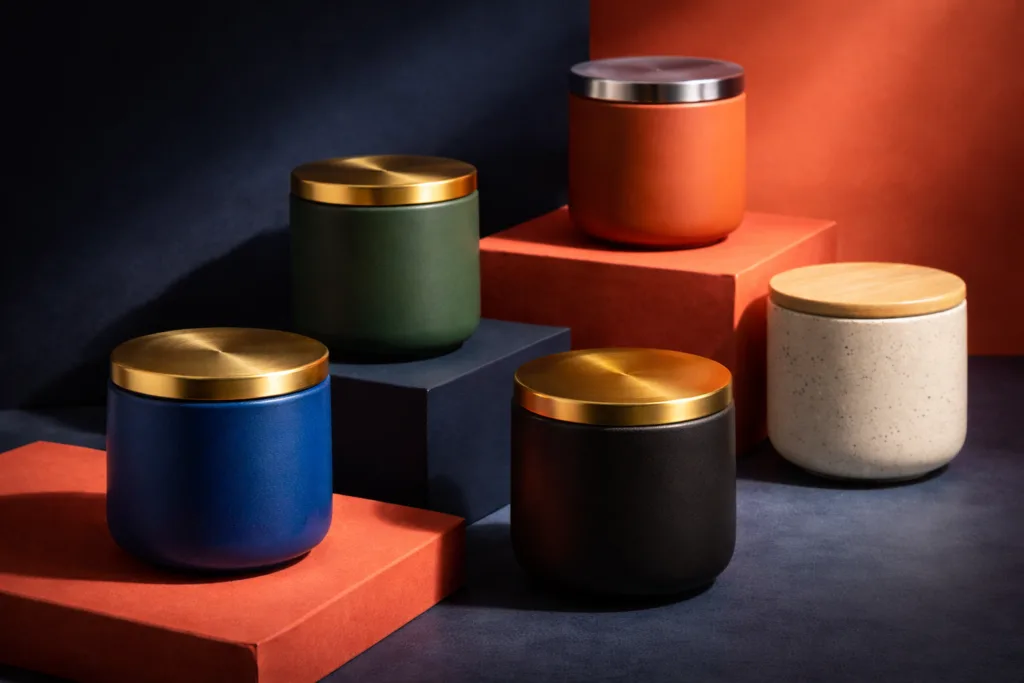
 Who This Article Is For
This is written for experienced retail, wholesale, and private label buyers who already know the basics:
- You understand that “custom” is not a mood—it’s a cost structure.
- You manage multiple SKUs, multiple doors, multiple seasons.
- You are judged on sell-through, margin, and delivery reliability, not on how unusual the vessel shape looks in a pitch deck.
If your program needs distinctive design and commercial resilience, the smartest path is usually not a new mold.
The strategy is simpler and more scalable:
Use standard candle jars as a stable platform, then concentrate your budget on the levers that actually drive consumer conversion and repeat purchase.
That is how you get “most personalized” with “lowest structural cost.”
The Core Idea: Lowest Structural Cost, Highest Design Individuality
Buyers often ask for a “unique jar.” What they really want is:
- A product that looks unmistakably theirs in a crowded category.
- A price point that protects margin.
- A supply chain that can replenish.
Those three goals conflict when you anchor uniqueness on vessel geometry.
Custom mold development (ceramic or glass) concentrates money into the wrong place:
- Upfront tooling
- High MOQs
- Sampling cycles
- Higher defect and breakage risk
- Re-engineered packaging
- Reduced flexibility
Standard candle jars—proven shapes already running on stable production lines—let you redirect spend into high-return differentiation:
- Finish and surface engineering
- Color and material storytelling
- Lid systems and tactile cues
- Label architecture and typography discipline
- Rigid-box presentation or engineered cartons
- Fragrance structure and naming systems
- Merchandising logic and giftability
In other words:
Keep the vessel stable. Make everything on it distinctive.
This is how mature buyers create signature design with lowest total risk.
1) Why Custom Molds Are Often the Wrong “Innovation Budget”
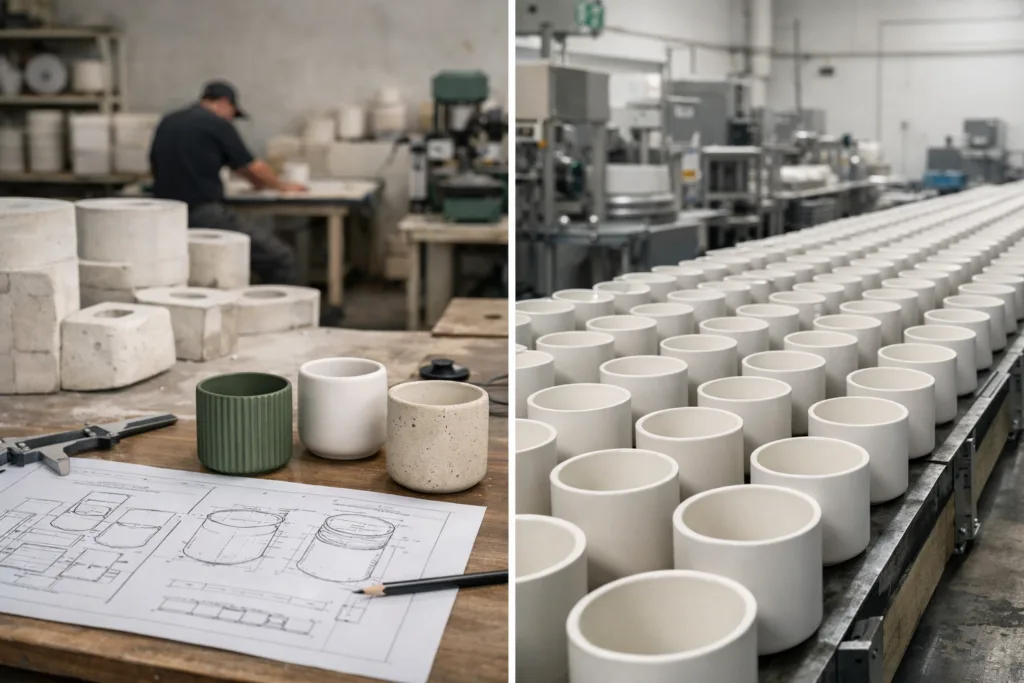 1.1 Tooling Is Not Just a Fee—It’s a Commitment
Tooling isn’t only “extra cost.” It’s a commitment that reshapes your entire program.
When you invest in a new mold, you are making assumptions:
- You will keep this vessel for multiple seasons.
- Sell-through will justify volume.
- The jar will not create production instability.
- You can carry inventory without freezing cash.
That may be true for a flagship hero SKU in a long-term distribution model.
But for most private label programs—especially those that rely on frequent fragrance refresh—a mold is a rigid anchor.
1.2 The Hidden Costs That Don’t Show on a Quote
Quotes typically show unit price and sometimes mold fee.
What does not show up clearly:
- Extra sampling rounds and internal time cost
- Delays from specification changes
- Packaging redesign (insert, carton, casepack)
- Higher carton air gaps and protective materials
- Freight inefficiency from irregular shapes
- Claims and replacement labor
Experienced buyers don’t evaluate vessel design by aesthetic alone.
They evaluate by a question that matters more:
Will this vessel still be the best decision after two replenishment cycles?
Most programs cannot answer “yes” with confidence.
That is why the more scalable method is to innovate within standard jars.
2) Standard Jars Are Not “Generic”—They’re a Platform
A standard jar is not a finished design. It is a blank architecture.
A mature buyer sees it like a retail fixture system:
- The silhouette is stable.
- The identity is created through the system layered onto it.
In high-performing programs, the vessel shape is often deliberately calm.
The excitement—and the conversion—comes from:
- color logic
- texture cues
- label hierarchy
- unboxing moment
- scent story
This creates a product that is both:
- instantly recognizable
- operationally reproducible
And that combination is rare.
3) What Actually Sells: Design That Reads Fast on Shelf
A candle buyer has seconds.
When a shopper stands in front of a shelf or clicks through a grid of product tiles, they are not evaluating your mold sophistication.
They are reading:
- silhouette (simple vs messy)
- color field (quiet vs noisy)
- label structure (premium vs cheap)
- finish (tactile “worth it” cue)
- giftability (would I give this?)
Most custom molds do not improve any of those signals.
In many cases, they harm them:
- irregular curves that read inconsistent
- awkward proportions that make labels look small
- lids that don’t align visually across SKUs
- packaging that looks “forced” because the jar is hard to support
Standard vessels, on the other hand, give you a clean canvas for the signals that matter.
4) The Real Differentiation Levers: Where to Spend for Maximum Uniqueness
This is the section most articles skip. “Finish” is not one thing. “Design” is not one thing.
If your goal is:
Use a standard jar but create a candle that looks intensely brand-specific,
then you need a map of what creates uniqueness visually, tactically, and systemically.
Below are the levers that repeatedly win in retail programs.
4.1 Surface Engineering: The Fastest Way to Look Custom
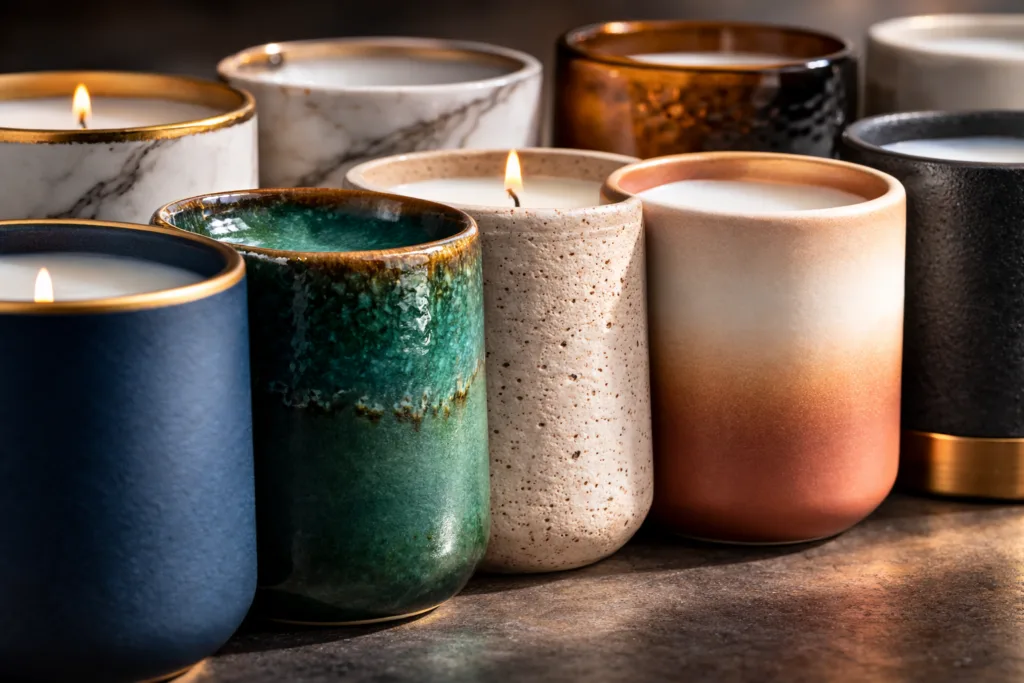 Surface finish is where a candle becomes “premium” in the shopper’s hand.
A standard jar can look completely different depending on finish engineering.
High-performing finish families (standard jar compatible):
- Exterior matte + interior glaze contrast
- Reads modern and architectural
- Hides fingerprints
- Feels intentional under warm light
- Reactive glaze (ceramic) / etched frosting (glass)
- Adds micro-variation without losing coherence
- Signals craft and “limited” without being fragile
- Soft-touch coatings
- A tactile “luxury cue” that elevates perceived price
- Gradient / ombré fields
- Creates a signature look without structural changes
- Scales across colorways as a coherent collection
- Speckled / terrazzo-inspired textures
- Photographs well
- Makes a simple silhouette feel designed
Buyer note:
Finish choices also influence defect tolerance and visual consistency.
- Matte can hide minor ceramic body inconsistencies.
- High gloss can exaggerate imperfections.
This is exactly why finish is a smarter innovation budget: you get uniqueness while managing risk.
4.2 Color System Design: Don’t Pick Colors—Build a Palette Strategy
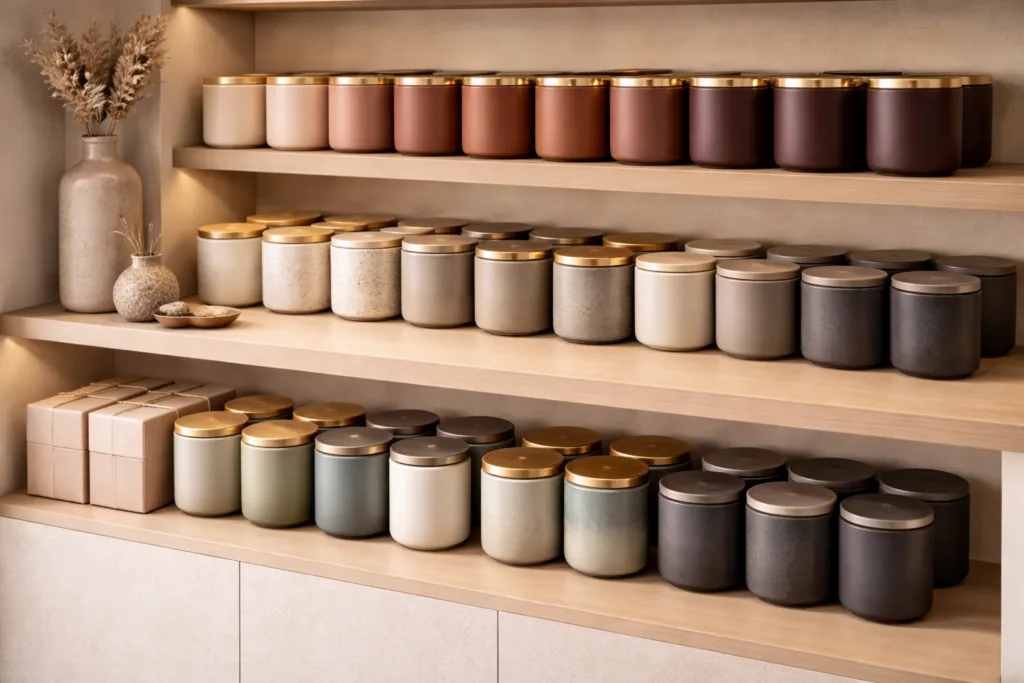 A mature candle line is not “a bunch of colors.” It is a palette strategy with internal rules.
If you want strong design identity at low cost, you need repeatable color logic.
Three scalable palette models:
- Monochrome discipline
- One base color family (stone, cream, charcoal)
- Variation is in finish and label materials
- Seasonal rotation
- Same vessel silhouette all year
- Color shifts by season (spring pastel, fall earth, holiday metallic)
- Fragrance-family mapping
- Citrus = warm neutrals
- Floral = muted blush
- Woody = deep clay/olive
- Gourmand = cream/caramel
- Fresh = fog grey/blue
Why this sells better:
- Consumers understand the line faster.
- Shelves look curated.
- Social photos look “brand-coded.”
Why this costs less:
- Same jar architecture, same packaging die-lines.
- You rotate color without rebuilding everything.
4.3 Lid Systems: Small Component, Big Perceived Value
Lids are one of the highest ROI personalization points.
They create:
- tactile premium cues
- a “set” feeling
- brand consistency across SKUs
- giftability
High-ROI lid directions:
- FSC wood lids with consistent grain tone
- Brushed metal lids (champagne, graphite)
- Ceramic lids that match jar body
- Two-part lid systems (inner seal + decorative top)
Design discipline tip:
Keep lid geometry consistent across the collection.
Shoppers read the lid line as a brand signature.
4.4 Label Architecture: Where Most ‘AI-Looking’ Products Fail
If your candle looks generic, it’s usually not the jar.
It’s the label.
Most private label candles lose premium perception through:
- overcrowded copy
- inconsistent typography
- weak hierarchy
- cheap paper choice
- mis-sized labels that look “temporary”
A mature label system has rules:
- consistent margin space
- limited fonts
- strict hierarchy (brand → scent → details)
- controlled white space
Materials that elevate immediately:
- cotton paper
- textured uncoated stock
- soft-touch laminate
- subtle foil accents (used sparingly)
Buyer-level reality:
A disciplined label system can make a standard jar look like a designer object.
A custom mold cannot fix a weak label.
4.5 Packaging Engineering: Giftability Is a Sales Multiplier
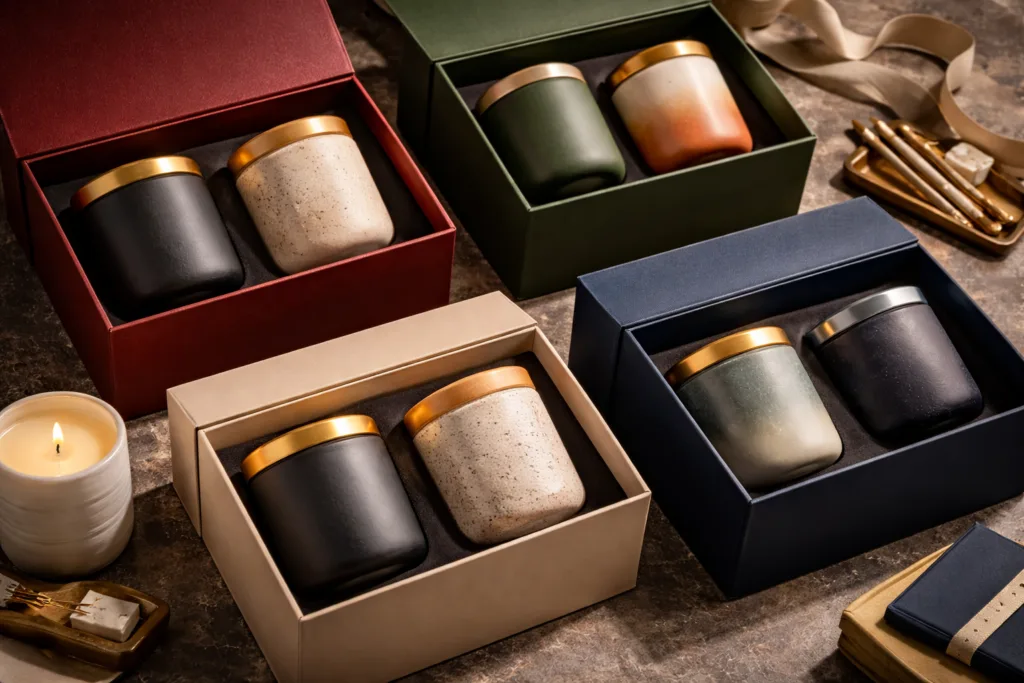 If you want “better sales,” you must think like a retailer:
Giftability raises conversion and average order value.
And packaging is usually the difference between:
- “nice candle”
- “I can gift this”
Two-tier packaging strategy for mature programs:
- Standard folding carton as the base
- optimized for shipping
- protects margin
- supports daily replenishment
- Rigid gift box for premium moments
- holiday sets
- corporate gifting
- VIP bundles
This lets you keep the core program cost-efficient while creating premium upsell moments.
Key point:
A standard jar becomes “luxury” not through shape, but through presentation + system.
5) How This Strategy Improves Sell-Through (Not Just Cost)
The user goal isn’t merely “cheaper.”
It’s:
Lowest structural cost so the product can be more personalized and sell better.
Here’s how standard-jar innovation improves sell-through.
5.1 Faster Assortment Refresh
When you don’t have mold constraints, you can:
- release seasonal scents faster
- test limited editions with lower exposure
- react to trend signals without retooling
Retailers reward programs that refresh without operational chaos.
5.2 Better Shelf Cohesion
Same silhouette means:
- stronger merchandising blocks
- easier planogram execution
- better visual rhythm
Cohesion improves conversion.
5.3 Stronger Brand Recognition
Repeated shape + consistent label system = brand memory.
A weird jar shape is not brand memory.
A consistent system is.
5.4 Better Photo Performance Online
Standard vessels photograph predictably.
- Labels sit clean.
- Shadows behave.
- Multiple SKUs look curated in one frame.
This matters because your product tile is your first shelf.
6) The Supply Chain Benefits Mature Buyers Actually Care About
6.1 Lower Breakage Risk
Irregular shapes often create more void space and stress points.
Standard jars typically:
- pack denser
- require fewer protective materials
- travel better
Lower breakage protects both margin and buyer confidence.
6.2 Replenishment Reliability
Standard jars are already running.
That means:
- fewer production surprises
- stable yield
- predictable lead time
For multi-door programs, reliability is not a feature—it’s the requirement.
6.3 MOQ Flexibility Across Scents
Standard jar programs allow:
- split scent runs
- mixed palette runs
- shared components
That supports SKU breadth without inventory paralysis.
7) A Practical “Customization Menu” for Buyers
If you want to guide buyers toward this strategy, give them a menu.
Instead of asking:
“Do you want a custom mold?”
Ask:
“Which customization level fits your retail plan?”
Level 1 — Fast Differentiation (Low Complexity)
- standard jar
- one finish option
- standard lid
- strong label architecture
Best for:
- first wholesale programs
- quick launches
- testers
Level 2 — Design-Led Collection (High Shelf Impact)
- standard jar
- finish system (matte + speckle + gradient)
- upgraded lid materials
- palette strategy
- improved carton
Best for:
- established retailers
- boutique chains
- importers scaling assortment
Level 3 — Premium Giftable Program (Highest Retail Ceiling)
- standard jar as platform
- engineered rigid box sets
- premium inserts
- coordinated color architecture
- fragrance storytelling system
Best for:
- corporate gifting
- holiday programs
- premium private label lines
This menu reframes “custom” from a mold question into a merchandising strategy.
8) When You Should Consider a Custom Mold
This article is not anti-custom.
Custom molds make sense when:
- your annual volume is high enough to amortize tooling comfortably
- the vessel is central to brand IP
- you have predictable replenishment and stable distribution
- you will keep the vessel for multiple years
Even then, mature buyers often start with a standard jar system first.
They validate:
- scent performance
- price elasticity
- packaging ROI
- channel fit
Then they decide whether a mold is worth the lock-in.
9) What to Say in Buyer Conversations (So You Attract Bigger Clients)
If you want to naturally guide buyers toward larger, more scalable orders, your language matters.
You don’t say:
“We can’t do custom molds.”
You say:
- “For scalable programs, we recommend using a proven jar platform and investing in high-ROI customization.”
- “This approach reduces MOQ pressure and keeps replenishment fast.”
- “We can build a signature finish + packaging system that looks fully custom without the mold risk.”
- “It’s how many established buyers protect margin while still delivering a strong design identity.”
This positions you as a partner to serious buyers.
Not a factory waiting for instructions.
Conclusion: The Smartest Customization Is the One That Scales
If your priority is:
- lowest structural cost
- highest brand individuality
- faster launches
- better sell-through
- fewer supply chain surprises
then the best strategy is usually:
Standard candle jars + design system innovation.
The vessel becomes a stable platform.
The brand becomes the differentiator.
And the buyer gets what they actually want:
A candle that looks unique, sells better, and scales without regret.
FAQs
1) Can a standard candle jar still look fully “custom” at retail?
Yes—often more effectively than a custom mold. A disciplined system of surface finish, palette strategy, lids, label architecture, and packaging can create a highly proprietary look while keeping production stable.
2) What is the most cost-effective customization that improves sell-through?
Surface engineering (matte/gloss contrast, gradient, speckle) plus a strong label hierarchy typically delivers the fastest visible upgrade. Pair this with a curated color system and you create immediate shelf impact.
3) When does a custom mold become commercially reasonable?
When annual volume is high and consistent, the vessel is long-term brand IP, and you can amortize tooling across multiple replenishment cycles without locking cash into slow-moving inventory.