
 Packaging is one of the most misunderstood profit drivers in retail.
Many buyers, especially those early in brand development, focus on minimizing packaging cost. Mature brands and experienced retail buyers take the opposite approach. They understand that packaging is not merely a protective layer. It is a pricing tool, a positioning mechanism, and one of the most powerful drivers of retail margin expansion.
The decision between rigid box packaging and standard folding box packaging is not a cosmetic choice. It directly influences retail price ceilings, perceived product value, conversion rates, and long-term brand positioning.
This guide provides a structured, numbers-driven comparison designed specifically for professional buyers, retail chains, private label programs, and established brands operating at scale.
Understanding the Structural Difference
Before analyzing profit impact, it is essential to define what separates rigid box packaging from standard folding box packaging at a structural and manufacturing level.
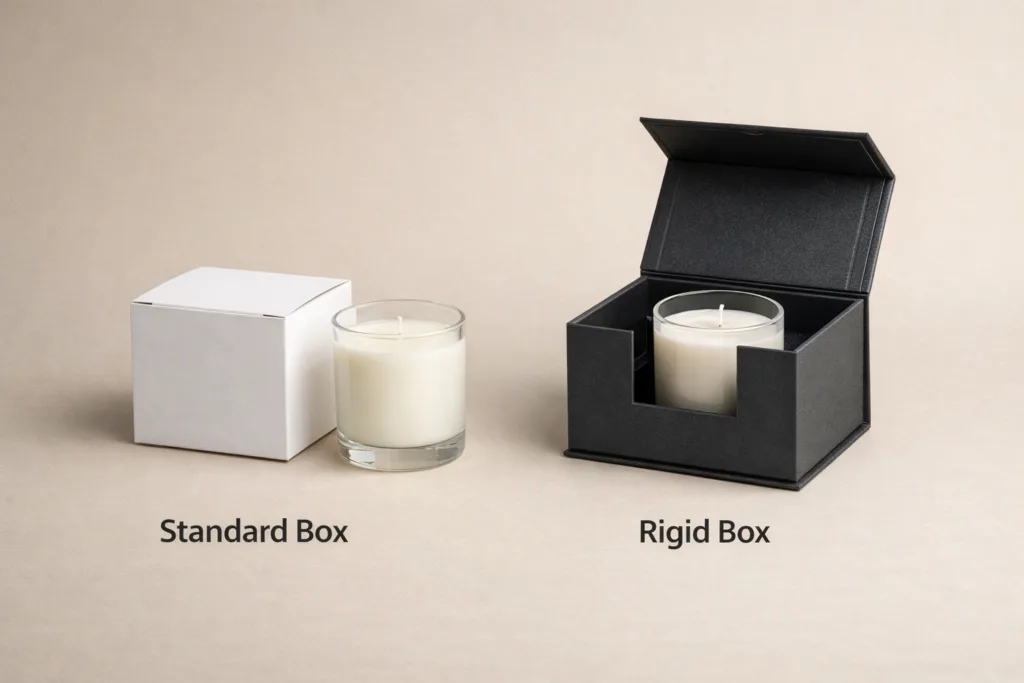
Standard Folding Box: Efficiency-Oriented Packaging
Standard boxes, also known as folding cartons, are constructed from thinner paperboard, typically between 250gsm and 400gsm. These boxes are die-cut, creased, and shipped flat, then folded into shape during packing.
Key characteristics:
• Flat-packed for efficient transportation
• Lightweight structure
• Lower raw material usage
• Automated high-speed assembly
• Low per-unit cost
These boxes are widely used across:
• Supermarket candle programs
• Mass retail distribution
• Entry-level private label products
• E-commerce fulfillment
• High-volume, price-sensitive product lines
Their primary advantage is supply chain efficiency.
However, efficiency-oriented packaging has inherent limitations when it comes to perceived value and retail price expansion.
Rigid Box: Value-Oriented Packaging
Rigid boxes are manufactured using thick chipboard cores, typically ranging from 1.5mm to 3mm in thickness. These structures are permanently fixed and cannot be folded flat.
They are wrapped with printed paper, fabric, textured paper, or specialty finishes.
Key characteristics:
• Non-collapsible fixed structure
• Substantially higher structural rigidity
• Significantly higher perceived value
• Premium tactile experience
• Gift-ready presentation
Rigid boxes are standard in:
• Luxury candle collections
• Holiday gift programs
• Boutique retail
• Department store candle lines
• High-end private label programs
Rigid box packaging is not designed for minimal cost. It is designed to enable higher retail pricing and stronger margin expansion.
Cost Comparison: Real Wholesale Numbers
To understand profit implications, we begin with direct packaging cost comparison.
For a typical 10 oz private label candle at wholesale production volume between 1,000 and 5,000 units, realistic packaging costs are as follows:
Standard folding box cost:
$0.35 to $0.80 per unit
Rigid box cost:
$1.50 to $3.50 per unit
Cost difference:
$1.15 to $2.70 per unit
At first glance, rigid box packaging appears significantly more expensive.
However, this analysis becomes incomplete unless viewed within the context of wholesale pricing structure and retail margin expansion.
Professional buyers evaluate packaging cost based on return on packaging investment, not absolute packaging cost.
Wholesale Pricing Impact
Packaging influences wholesale pricing because it alters perceived product value and brand positioning.
Consider a candle with identical internal components:
• Same wax formulation
• Same fragrance concentration
• Same vessel
• Same fill weight
The only difference is packaging.
Standard box version wholesale pricing:
Typical wholesale price: $8 to $11
Rigid box version wholesale pricing:
Typical wholesale price: $13 to $18
Packaging cost increase:
+$2
Wholesale price increase enabled:
+$5 to $7
This is the first stage of profit expansion.
The rigid box enables higher wholesale pricing without increasing internal product cost.
Retail Pricing Expansion: The Core Profit Multiplier
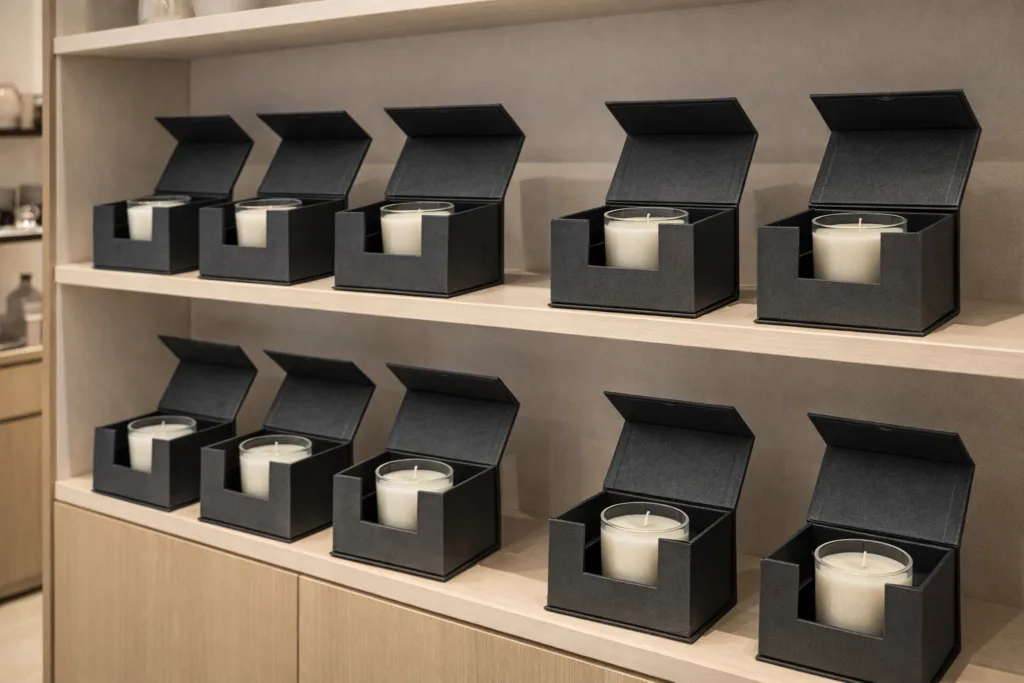 Retail pricing is heavily influenced by perceived value, not production cost.
Consumers do not evaluate candles by calculating wax cost, fragrance cost, or vessel cost. They evaluate perceived value through visual presentation, weight, and packaging structure.
Standard box candle retail pricing:
$18 to $26
Rigid box candle retail pricing:
$32 to $48
Retail price increase enabled:
+$12 to $22
Packaging cost increase:
+$2
This creates a direct profit multiplier effect.
Retail Margin Comparison: Numerical Breakdown
Let us examine the full margin structure.
Scenario A: Standard Folding Box Candle
Production cost breakdown:
Candle manufacturing: $4.00
Standard packaging: $0.50
Total production cost: $4.50
Wholesale price: $9.50
Retail price: $24.00
Retail margin:
$24.00 – $9.50 = $14.50
Scenario B: Rigid Box Candle
Production cost breakdown:
Candle manufacturing: $4.00
Rigid box packaging: $2.50
Total production cost: $6.50
Wholesale price: $15.00
Retail price: $38.00
Retail margin:
$38.00 – $15.00 = $23.00
Retail margin increase enabled by rigid packaging:
+$8.50 per unit
Packaging cost increase:
+$2.00 per unit
Return on packaging investment:
425 percent
This is why experienced buyers view rigid packaging as a profit expansion mechanism rather than a cost burden.
Conversion Rate and Sell-Through Rate Impact
Retail profit is not determined by margin alone. Sell-through rate is equally important.
Rigid box packaging improves conversion rate through several mechanisms.
First, it increases shelf visibility.
Rigid boxes maintain structural integrity, creating stronger shelf presence. Folding cartons often deform during transportation and shelf stocking, reducing visual impact.
Second, rigid packaging improves perceived product legitimacy.
Consumers subconsciously associate structural rigidity with product quality and brand credibility.
Third, rigid packaging increases gift purchase likelihood.
Gift-ready products sell significantly faster during peak retail periods such as:
• Christmas
• Mother’s Day
• Valentine’s Day
• Holiday retail season
Gift purchases represent one of the highest-margin segments in candle retail.
Psychological Pricing Thresholds Enabled by Packaging
Retail pricing operates in psychological tiers.
Common candle price tiers:
$18–$24: entry level
$26–$32: mid tier
$34–$48: premium tier
$50+: luxury tier
Standard packaging struggles to justify premium tier pricing.
Rigid packaging enables access to premium tiers.
This pricing tier access is often more valuable than marginal cost reduction.
Shipping and Logistics Efficiency Analysis
Rigid boxes increase volumetric weight, which increases shipping cost per unit.
However, shipping cost must be evaluated as a percentage of retail value, not absolute cost.
Example:
Standard box candle shipping cost per unit:
$0.90
Retail value:
$24
Shipping cost ratio:
3.75 percent
Rigid box candle shipping cost per unit:
$1.40
Retail value:
$38
Shipping cost ratio:
3.68 percent
Despite higher absolute shipping cost, rigid packaging maintains similar cost ratio relative to retail value.
Higher value density improves overall supply chain efficiency.
Brand Positioning and Channel Access
Packaging determines which retail channels a product can enter.
Standard packaging is typically limited to:
• Mass retail
• Discount retail
• Commodity positioning
Rigid packaging enables entry into:
• Boutique retail
• Department stores
• Museum stores
• Luxury lifestyle retail
• Premium online retail
These channels support significantly higher pricing and margin structures.
Channel access is often more valuable than unit cost savings.
Long-Term Brand Equity Impact
Packaging decisions influence brand trajectory.
Brands that consistently use rigid packaging establish premium positioning.
This allows for:
• Higher future product pricing
• Stronger customer loyalty
• Increased perceived brand authority
• Improved retailer willingness to carry products
Brand equity compounds over time.
Packaging is one of the earliest and most controllable drivers of brand perception.
When Standard Boxes Are Still the Correct Choice
Rigid packaging is not universally optimal.
Standard folding boxes remain appropriate for:
High-volume replenishment SKUs
Core inventory products designed for frequent replacement benefit from lower packaging cost and optimized logistics.
Price-sensitive retail environments
Mass retail channels prioritize cost efficiency over presentation.
Subscription box programs
Subscription economics often prioritize shipping efficiency and cost control.
Hybrid packaging strategies are common among mature brands.
Standard packaging for core SKUs.
Rigid packaging for premium collections.
This approach maximizes profit while maintaining operational efficiency.
Strategic Packaging Allocation Model Used by Mature Brands
Most established candle brands divide product lines into tiers.
Core line:
Standard packaging
Price range: $18–$26
Premium line:
Rigid packaging
Price range: $34–$48
Limited edition or gift line:
Enhanced rigid packaging with specialty finishes
Price range: $42–$65
This tiered structure maximizes total brand revenue and margin potential.
ROI Calculation Framework for Buyers
Professional buyers evaluate packaging using ROI metrics.
Calculation example:
Additional packaging cost:
+$2 per unit
Retail margin increase:
+$8 per unit
ROI:
400 percent
Payback period:
Immediate, realized upon first retail sale
This ROI profile is unusually strong compared to most operational investments.
Manufacturing Scalability Considerations
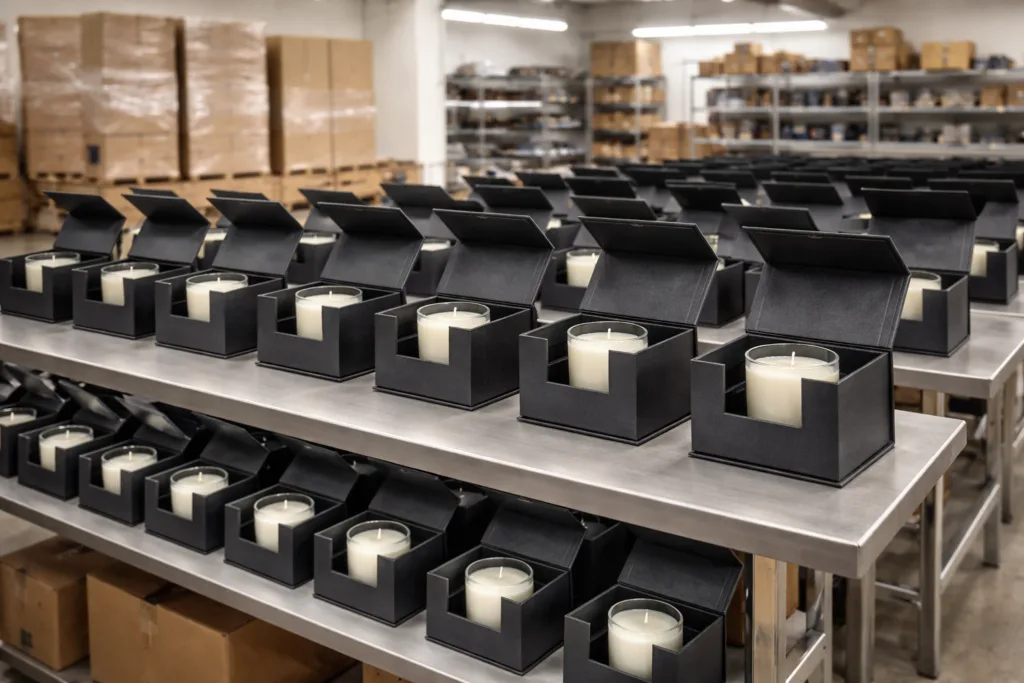 Rigid packaging becomes more cost-efficient at higher volumes.
Typical cost reductions:
At 1,000 units:
$3.20 per rigid box
At 5,000 units:
$2.40 per rigid box
At 10,000 units:
$1.80 per rigid box
Volume scaling improves ROI further.
This is why larger retail programs increasingly rely on rigid packaging for premium product lines.
Decision Framework for Professional Buyers
Rigid packaging is recommended when:
Retail price target exceeds $30
Product positioned as gift-oriented
Brand pursuing premium positioning
Selling through boutique or department store channels
Standard packaging is recommended when:
Retail price target below $25
Product positioned as commodity
Shipping efficiency is primary objective
Targeting high-volume replenishment
Conclusion: Packaging Is a Retail Profit Multiplier
Rigid packaging increases unit packaging cost.
However, it enables disproportionately larger increases in wholesale pricing, retail pricing, and retail margin.
It expands channel access, improves sell-through rates, strengthens brand positioning, and compounds long-term brand equity.
For professional buyers and mature retail programs, rigid packaging is not an expense category.
It is a revenue and profit expansion tool.
FAQ
Is rigid box packaging worth the higher cost for private label candles?
Yes, when the retail price target exceeds $30. The increase in retail margin typically exceeds the additional packaging cost by 3 to 5 times, making rigid packaging one of the highest ROI upgrades available.
Does rigid packaging significantly increase shipping cost?
Rigid packaging increases volumetric shipping cost slightly, but because retail price increases substantially, the shipping cost ratio remains similar or improves relative to total retail value.
Should all candle products use rigid packaging?
No. Most mature brands use rigid packaging selectively for premium lines and gift collections while using standard packaging for core replenishment SKUs to maintain operational efficiency and pricing flexibility.