
Introduction: Selling Candles Is Easy. Making Money From Gift Sets Is Not.
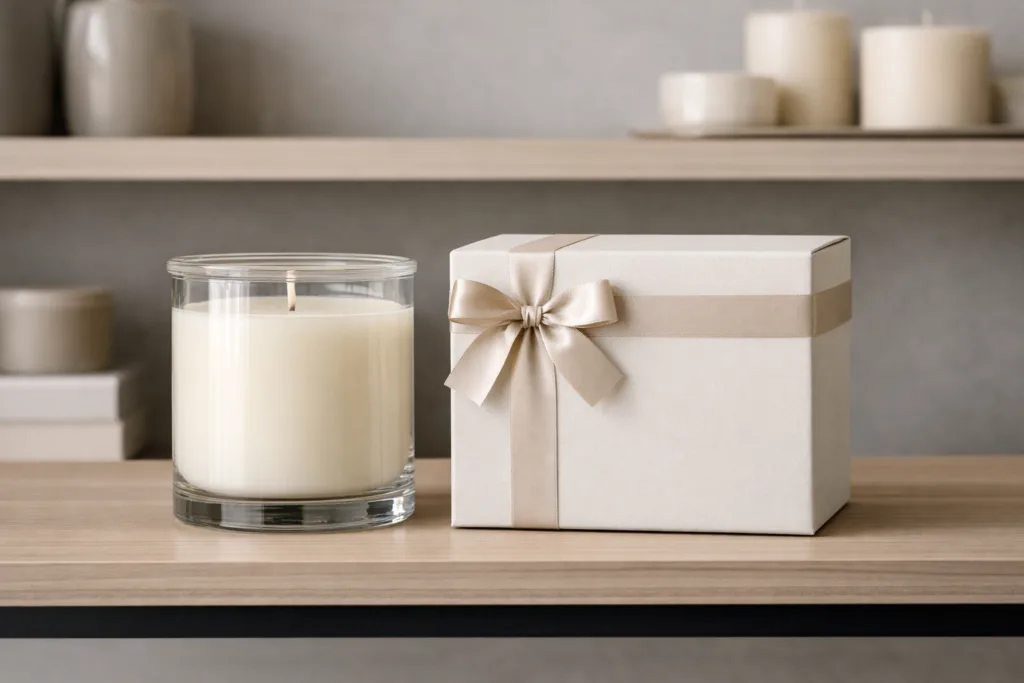 Walk into any gift store, lifestyle boutique, or concept shop, and you’ll see candle gift sets everywhere. They look good. They smell nice. They photograph well. And yet, most of them do not make consistent money.
The reason is simple: many candle gift sets are designed from an aesthetic or trend-driven mindset, not from a retail performance mindset.
A best-selling scented candle gift set is not the one that looks the most artistic or complex. It is the one that:
- Is easy for customers to understand at a glance
- Is easy for retailers to price, display, and explain
- Has a strong perceived value relative to cost
- Can be reordered, scaled, and repeated without friction
This article is written from a commercial perspective. Not for hobbyists. Not for one-off holiday projects. But for retailers, buyers, and brand owners who want gift sets that actually generate profit, not just likes on social media.
We will break down the gift set combinations that consistently sell, explain why they work, and show how these structures help retailers increase margin, reduce inventory risk, and improve sell-through.
What “Actually Make Money” Means in Retail
Before discussing combinations, we need to clarify what “making money” really means in a retail context.
A profitable candle gift set is not necessarily the one with the highest retail price. Instead, it is the one that balances:
- Healthy margin: Room for wholesale markups without pushing retail price beyond the comfort zone
- High perceived value: Customers feel they are getting more than what they pay for
- Low explanation cost: Staff don’t need to explain it for two minutes
- Low inventory complexity: Easy to restock, reorder, and replicate
- Repeatability: Performs not just once, but season after season
In other words:
Best-selling ≠ trending
Best-selling = repeatable, understandable, and commercially realistic
With that lens in mind, let’s look at the combinations that consistently work.
Combination 1: Single Large Candle With Clear Usage Positioning
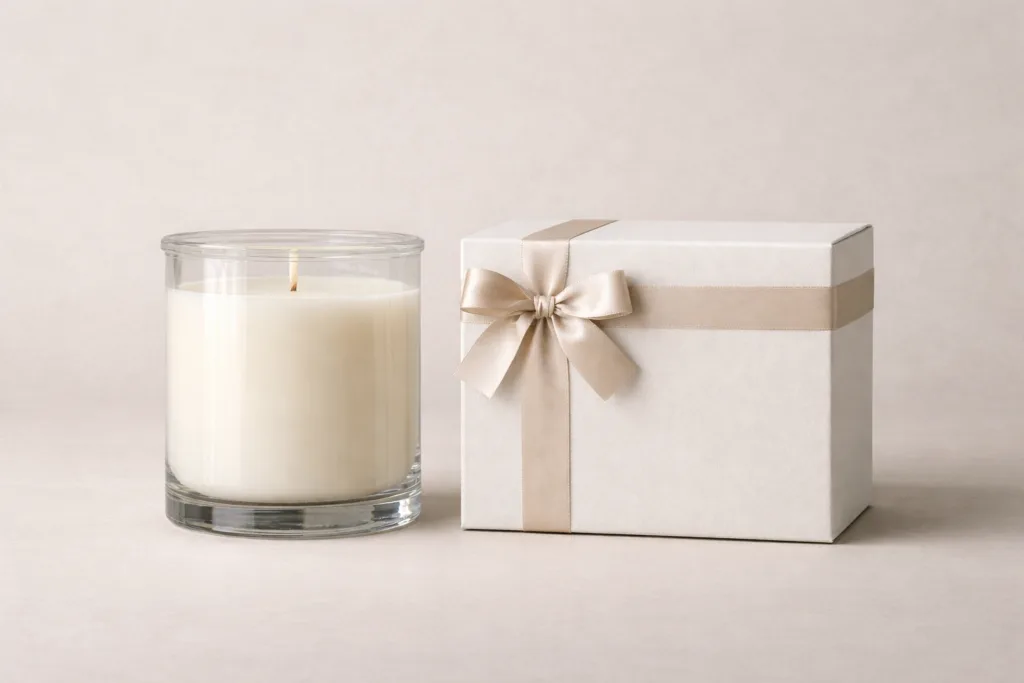 If there is one gift set structure that almost never fails, it is this:
One well-sized, well-positioned scented candle, packaged as a complete gift.
Why This Works
From a retail perspective, a single large candle solves multiple problems at once:
- It simplifies decision-making for customers
- It simplifies inventory for retailers
- It concentrates perceived value into one hero product
Customers intuitively understand a large candle. They associate size with longevity, value, and luxury. There is no confusion about how to use it, where to place it, or what it is for.
The Commercial Logic
Compared to multi-candle sets, a single large candle:
- Requires fewer SKUs
- Reduces packaging complexity
- Lowers the risk of uneven scent preferences
- Keeps production and QC simpler
For retailers, this means:
- Easier pricing
- Less staff training
- Better shelf presentation
Positioning Matters
The key is usage clarity. The candle should be clearly positioned as:
- A home décor anchor
- A self-care ritual item
- A housewarming gift
When customers understand where and how the candle fits into their life, the purchase becomes intuitive.
This structure may look simple, but simplicity is exactly why it sells.
Combination 2: Candle + Functional Accessory (Experience Upgrade)
 Adding an accessory can dramatically increase perceived value — if done correctly.
The Rule: Functional, Not Decorative
The most profitable candle gift sets do not include decorative fillers. They include functional accessories that enhance the candle experience.
Examples include:
- Wick trimmers
- Candle snuffers
- Match strikers
These items do not distract from the candle. They support it.
Why Retailers Love This Structure
From a buyer’s perspective, this combination works because:
- Accessories are low-cost relative to perceived value
- They justify a higher retail price without resistance
- They turn a single product into a “complete ritual”
Customers don’t feel upsold. They feel upgraded.
Margin Advantage
Accessories often have:
- Stable sourcing costs
- Low return rates
- Minimal size or fragrance risk
This makes them ideal tools for margin expansion without complicating inventory.
The result is a gift set that feels thoughtful, premium, and well-considered — without being expensive to execute.
Combination 3: Candle Duo With Clear Scent Logic
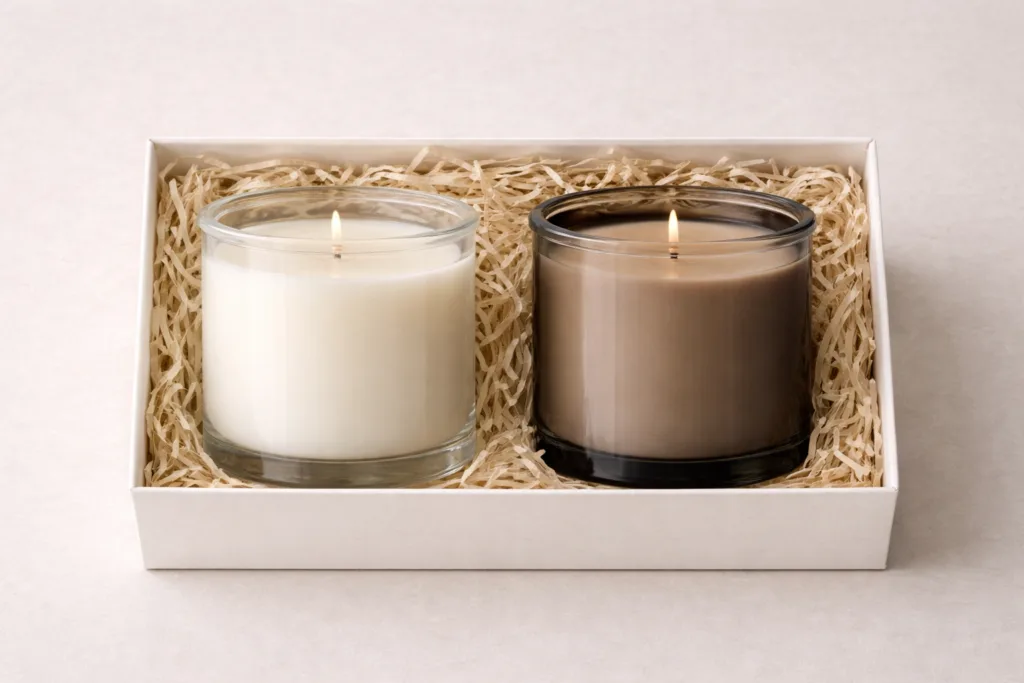 Multi-candle sets can work — but only when restraint and logic are applied.
Why Two Is the Sweet Spot
Two-candle sets consistently outperform larger assortments because they:
- Offer variety without confusion
- Keep cost and packaging manageable
- Allow for clear scent storytelling
Three or four candles often dilute the message and increase decision fatigue.
Successful Pairing Logic
Best-selling candle duos usually follow one of these frameworks:
- Day / Night: Fresh, light scent paired with a warmer evening scent
- Seasonal Contrast: Spring-summer freshness with fall-winter depth
- Mood Balance: Energizing + calming
The key is not the scent complexity, but the story clarity.
Customers should understand the pairing within seconds.
Retail Benefit
For retailers, candle duos:
- Encourage gifting without overwhelming
- Allow upsell over single candles
- Reduce scent return risk
They also perform well in curated gift zones, where customers want a sense of abundance without clutter.
Combination 4: Candle + Lifestyle Care Products (Complete Sensory Experience)
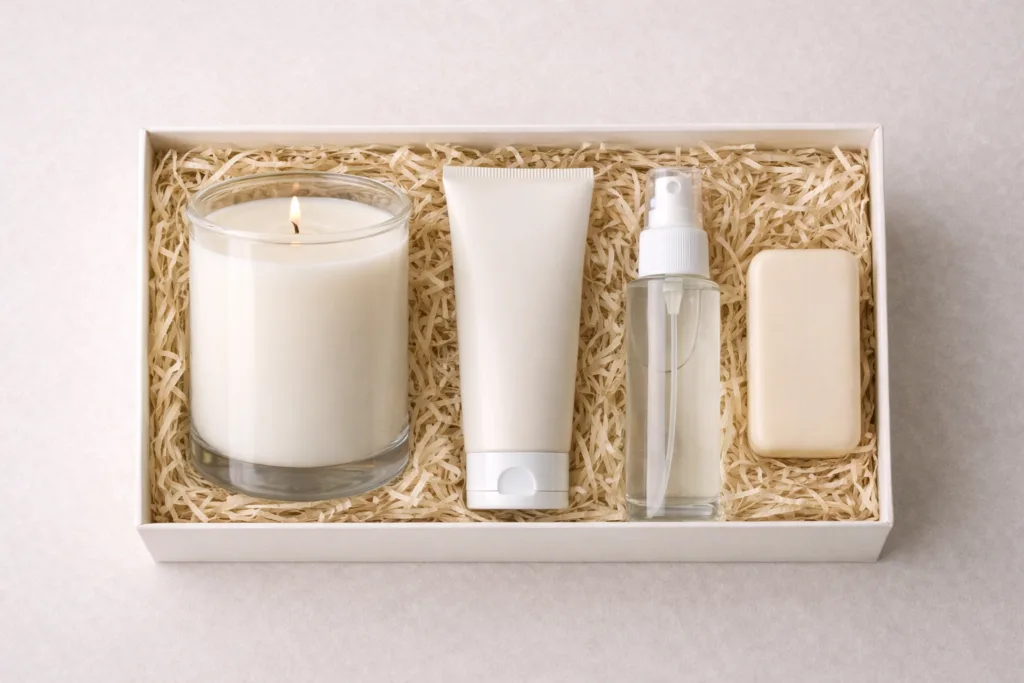 This is where many gift sets unlock their highest profit potential.
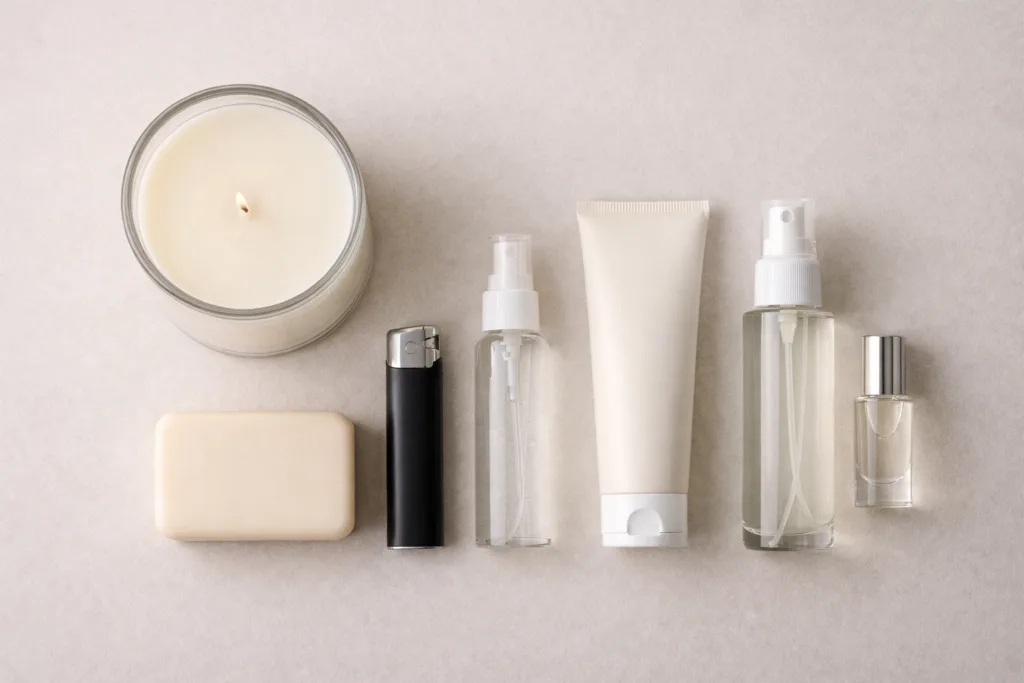
Pairing candles with everyday scented care products creates a holistic experience that extends beyond the burn time.
High-Performing Pairings
Some of the most successful combinations include:
- Candle + scented hand cream
- Candle + solid soap
- Candle + alcohol-free room or linen spray
These products share one critical trait: they integrate naturally into daily life.
Why This Combination Sells
Customers don’t see this as a candle set. They see it as:
- A lifestyle upgrade
- A self-care moment
- A ready-made gift solution
This emotional framing dramatically increases willingness to pay.
Commercial Advantages for Retailers
From a profit perspective:
- Care products are compact and lightweight
- They extend brand presence beyond a single-use item
- They support repeat purchases
Most importantly, they create continuity.
A candle burns out. A hand cream or spray becomes part of daily routine. That keeps the brand visible long after the candle is gone.
Practical Execution
To keep this combination commercially viable:
- Match scent profiles across products
- Avoid overly complex formulations
- Use unified but flexible packaging
The goal is consistency, not novelty.
Why Retailers Prefer These Combinations
Retail buyers think differently from consumers.
They prioritize:
- Predictability
- Margin stability
- Ease of reordering
The combinations discussed above meet these needs because they:
- Are easy to explain to customers
- Don’t require trend forecasting
- Can be sold year-round
As many buyers will quietly admit:
Retailers don’t want the most creative gift set.
They want the least risky one that still looks premium.
These structures minimize risk while maximizing sell-through.
What Usually Doesn’t Make Money (Despite Looking Good)
Some gift sets photograph beautifully but fail commercially.
Common pitfalls include:
- Too many items in one box
- Over-customized packaging
- Heavy reliance on trends
- Inconsistent scent stories
These sets increase:
- Production costs
- Inventory pressure
- Staff explanation time
They may work once, but they rarely scale.
Conclusion: Design Gift Sets Backward — From Profit, Not Mood Boards
Best-selling scented candle gift sets are not accidents.
They are the result of:
- Clear usage logic
- Controlled complexity
- Retail-friendly design
When gift sets are built from commercial reality rather than visual trends, everyone wins:
- Customers feel confident buying
- Retailers feel confident stocking
- Brands build sustainable growth
At the end of the day, the gift sets that actually make money are not the loudest or most elaborate.
They are the ones that quietly work — again and again.
FAQs
1. What makes a scented candle gift set truly best-selling in retail?
A best-selling candle gift set is defined less by how artistic it looks and more by how easily it sells. In retail, the strongest performers are gift sets that customers understand instantly, feel confident purchasing, and perceive as good value for the price. Clear usage positioning, controlled product count, consistent scent logic, and a strong sense of “complete experience” are far more important than novelty or complexity. Retailers favor sets that can be reordered easily and perform consistently across seasons.
2. Are multi-item candle gift sets always more profitable than single-candle sets?
Not necessarily. In many cases, a single large candle packaged as a gift outperforms multi-item sets because it concentrates value into one hero product and keeps pricing straightforward. Multi-item sets become profitable only when each added item clearly enhances the experience and justifies a higher retail price. Adding products without a clear role often increases cost and confusion rather than profit.
3. Why do candle gift sets combined with care products sell better than candle-only sets?
Candle + care product combinations work because they extend the experience beyond the candle’s burn time. Items like hand cream, soap, or alcohol-free scented sprays integrate into daily routines, keeping the brand present long after the candle is finished. From a retail perspective, these products raise perceived value, support higher price points, and encourage repeat purchases—making the overall set more profitable.
4. What is the biggest mistake brands make when designing candle gift sets for retail?
The most common mistake is overdesigning. Gift sets with too many items, overly customized packaging, or unclear scent stories often look impressive online but perform poorly in stores. They increase production cost, complicate inventory, and slow down purchasing decisions. The most profitable candle gift sets are simple, repeatable, and built around real retail behavior rather than mood boards or trends.