
Introduction
 Gel candles captivate instantly with their crystal-clear appearance, their ability to suspend decorative elements, and the dramatic way light travels through their bodies. From shells and botanicals to metallic accents, gel candles feel more like illuminated objects than traditional candles. For many brands, especially those seeking differentiation in home décor and gifting, gel candles appear to be an irresistible opportunity.
However, from a supplier and manufacturer perspective, gel candles are among the most technically demanding and operationally risky candle formats to produce at scale. What appears simple on a retail shelf conceals complex chemistry, narrow safety margins, labor-intensive processes, and high rejection rates. Unlike wax candles, which are forgiving and scalable, gel candles expose every production flaw.
This article provides an honest supplier insight into why gel candles are difficult to manufacture at scale. It is written for B2B buyers, private-label brands, and wholesalers who want to understand the real production implications before committing to gel candles as part of a long-term product strategy.
Understanding Gel Candle Composition
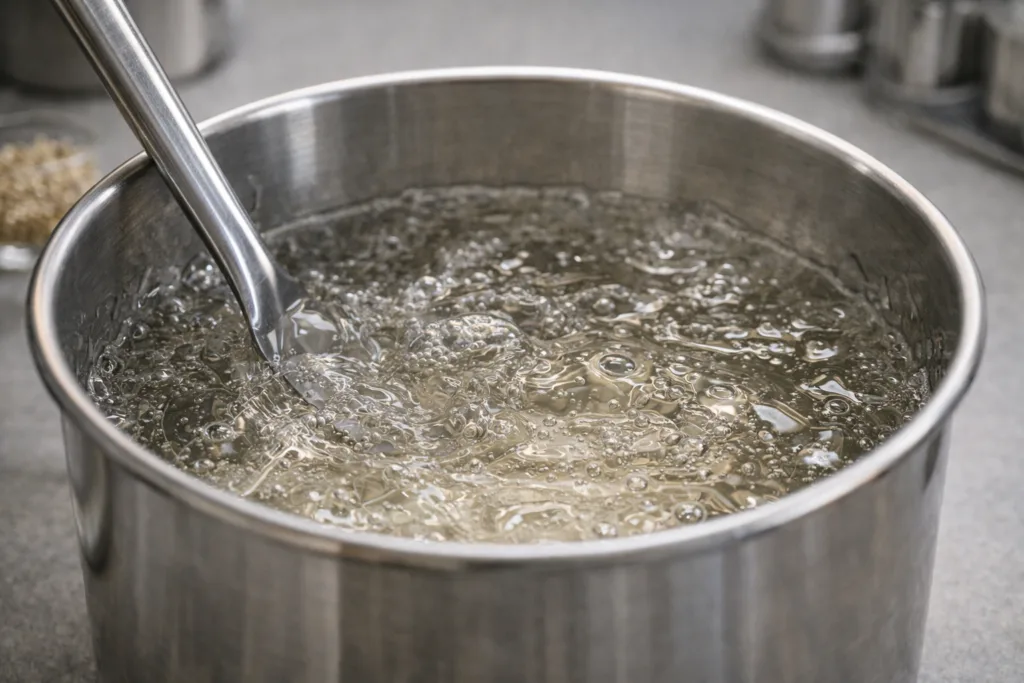 Gel candles are not made from traditional candle waxes such as soy, paraffin, or beeswax. Instead, they are produced from a mineral-oil-based polymer resin that forms a clear, elastic gel when heated and cooled correctly. This material behaves very differently from wax, both chemically and mechanically.
Unlike wax, which crystallizes as it cools and naturally hides minor imperfections, gel remains optically transparent. This transparency means every bubble, speck of dust, wick shift, or temperature inconsistency becomes immediately visible. From a quality-control perspective, gel candles are unforgiving.
Additionally, gel has a viscous, almost liquid-like behavior for much longer during cooling. This increases the risk of movement, settling, and separation within the container. At small artisan scale, makers can correct these issues manually. At industrial scale, where hundreds or thousands of units are poured per day, this sensitivity becomes a serious constraint.
Raw Material Volatility and Supply Constraints
Scaling any candle product requires reliable access to consistent raw materials. Gel candles face challenges here that wax candles largely avoid.
The global supplier base for gel candle polymers is relatively small. Fewer manufacturers mean higher minimum order quantities, less pricing flexibility, and greater vulnerability to supply disruptions. For brands planning seasonal launches or rapid expansion, this limited supply chain can quickly become a bottleneck.
Even when supply is stable, batch-to-batch variation is common. Slight differences in viscosity or clarity can affect fragrance compatibility, bubble formation, and cooling behavior. In scaled production, these variations can lead to entire batches being rejected for visual defects, increasing waste and cost.
Temperature Control at Scale
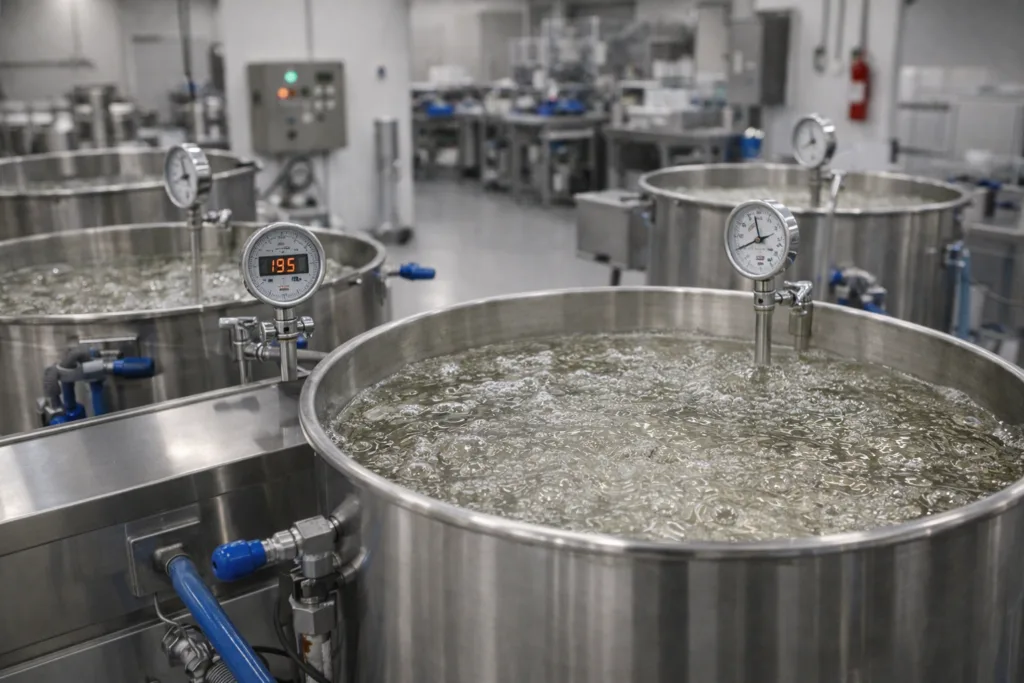 Temperature management is one of the most critical and challenging aspects of gel candle manufacturing. Gel must be heated hot enough to flow clearly but not so hot that the polymer degrades, yellows, or becomes unsafe.
The safe temperature window for gel is much narrower than for wax. In large melting tanks, temperature stratification often occurs, meaning the top and bottom of the batch behave differently during pouring. This results in inconsistent clarity, wick adhesion issues, and uneven cooling across units.
Cooling is another major limitation. Gel candles cool slowly and unevenly, tying up production space and reducing daily throughput. In high-volume environments, slow cooling directly limits scalability and increases overhead costs.
Bubble Formation and Clarity Defects
Air bubbles are one of the most common reasons gel candles fail quality inspection. In wax candles, small bubbles are often invisible. In gel candles, they are immediately noticeable and considered defects.
Bubbles can form from over-agitation during fragrance mixing, moisture contamination, wick insertion, or the addition of decorative elements. Automated mixing and pouring systems, while efficient for wax, often introduce micro-bubbles into gel.
Degassing systems can reduce bubbles, but they add significant equipment costs, slow production, and require skilled operators. Even with advanced controls, rejection rates remain higher than wax candles, making large-scale gel production financially risky.
Fragrance Load Limitations
Gel candles cannot hold fragrance oils in the same way wax candles can. Many fragrance oils cloud gel, separate over time, or compromise burn safety. As a result, the usable fragrance palette for gel candles is much smaller.
Every fragrance must be extensively tested for clarity, stability, and safety, often over several weeks. This slows product development and limits customization for private-label clients.
Additionally, gel candles typically produce a lighter scent throw than wax candles. Both cold throw and hot throw can be inconsistent, which may conflict with consumer expectations in the premium home fragrance market.
Decorative Embeds and Safety Compliance
One of the most attractive features of gel candles is their ability to suspend decorative objects. Unfortunately, this feature also introduces significant compliance and safety risks.
Decorative elements can shift during burning, heat unevenly, or act as secondary wicks. At scale, ensuring that every unit meets fire safety standards becomes extremely difficult, especially when selling across multiple regions with different regulations.
Each variation in embed material, placement, or container shape requires new burn testing. As SKU counts increase, testing costs multiply, making large-scale production increasingly complex and expensive.
Container Stress and Breakage Risks
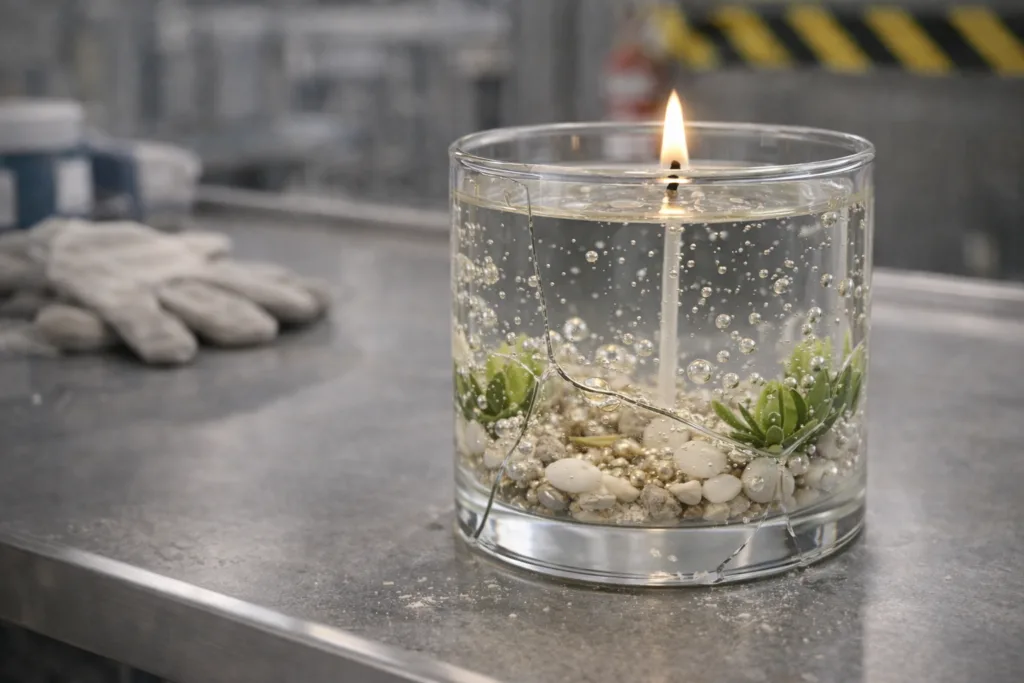 Gel candles burn hotter than many wax candles, placing additional stress on containers. Manufacturers must use thicker, heat-resistant glass to reduce the risk of cracking or breakage.
Higher-grade glass increases material costs, shipping weight, and lead times. Even with appropriate containers, thermal shock can occur if filling or cooling temperatures fluctuate, leading to micro-cracks or delayed breakage.
At scale, these risks require slower production speeds and additional inspection steps, further reducing efficiency.
Labor Intensity and Automation Limits
While wax candles adapt well to semi-automated production lines, gel candles resist full automation. Manual intervention is often required to adjust pour speeds, remove surface bubbles, realign wicks, and visually inspect clarity.
This reliance on skilled labor increases production costs and limits scalability, particularly in regions with rising wages. For many manufacturers, gel candles simply do not align with efficient, high-volume production models.
Waste Rates and Financial Impact
Across scaled gel candle production, waste and rejection rates are significantly higher than for wax candles. Common issues include clarity defects, bubble formation, fragrance incompatibility, and container failure.
These losses erode margins quickly, even when gel candles are positioned at premium price points. For suppliers, the financial risk often outweighs the potential reward.
Market Demand Versus Operational Reality
Gel candles perform best as limited-edition décor pieces or specialty items. While visually striking, they often have lower reorder rates due to higher retail prices, lighter scent performance, and perceived safety concerns.
For manufacturers, this creates unpredictable demand and makes long-term capacity planning difficult. Scaling infrastructure for a product with uncertain repeat volume is rarely attractive.
Why Many Manufacturers Decline Gel Candle Projects
From a supplier perspective, gel candles present a challenging combination of high complexity, low scalability, elevated liability, and limited long-term demand. Many factories that accept gel candle projects do so only in small batches, with strict minimums and premium pricing.
This approach protects the manufacturer but often surprises brands expecting gel candles to scale like traditional wax products.
Strategic Alternatives for Brands
For brands drawn to the visual appeal of gel candles, manufacturers often recommend alternatives such as clearer wax blends, embedded wax designs, or layered candles that combine translucent and opaque sections.
These options preserve visual interest while maintaining more scalable, cost-effective production processes.
Conclusion
Gel candles are undeniably beautiful, but their production reality is complex and demanding. Understanding why gel candles are difficult to manufacture at scale allows brands to make informed decisions that protect margins, ensure safety, and align design ambition with operational reality.
When approached strategically as specialty items rather than mass-market products, gel candles can still play a meaningful role in curated collections. Transparency between brand and supplier is the key to success before the first pour ever begins.
FAQ
Why are gel candles difficult to manufacture at scale compared to wax candles?
Gel candles are difficult to manufacture at scale because their transparent gel material is far less forgiving than traditional wax. Even minor issues—such as air bubbles, temperature fluctuations, or wick misalignment—become highly visible in finished products. At scale, automated mixing and pouring increase agitation and inconsistency, leading to higher rejection rates, slower production, and significantly higher costs compared to wax candle manufacturing.
Are gel candles safe for large-scale commercial production?
Gel candles can be produced safely, but large-scale commercial production introduces elevated safety and compliance risks. Gel burns hotter than many waxes, placing greater stress on glass containers. In addition, decorative embeds suspended in gel can shift, overheat, or interfere with flame behavior. These factors require extensive burn testing and strict quality control, making large-scale gel candle production more complex and liability-sensitive than standard candle formats.
Do gel candles perform as well as wax candles in fragrance throw?
In most cases, gel candles do not perform as strongly as wax candles in fragrance throw. Gel has limited fragrance compatibility, and many oils can cloud the gel or compromise stability. As a result, fragrance loads are typically lower, leading to lighter cold throw and less consistent hot throw. For brands positioning themselves in the premium home fragrance market, this performance gap can be a critical consideration.
Are gel candles suitable for private label or wholesale programs?
Gel candles are generally better suited for limited-edition, decorative, or specialty private-label programs rather than high-volume wholesale lines. Their higher production costs, slower throughput, increased waste rates, and compliance requirements make them challenging to scale profitably. Many suppliers recommend alternative translucent or decorative wax solutions that achieve similar visual impact with greater manufacturing efficiency and long-term scalability.