
Why Glass Jars Are the Smart Choice for Entry-Level Candle Businesses
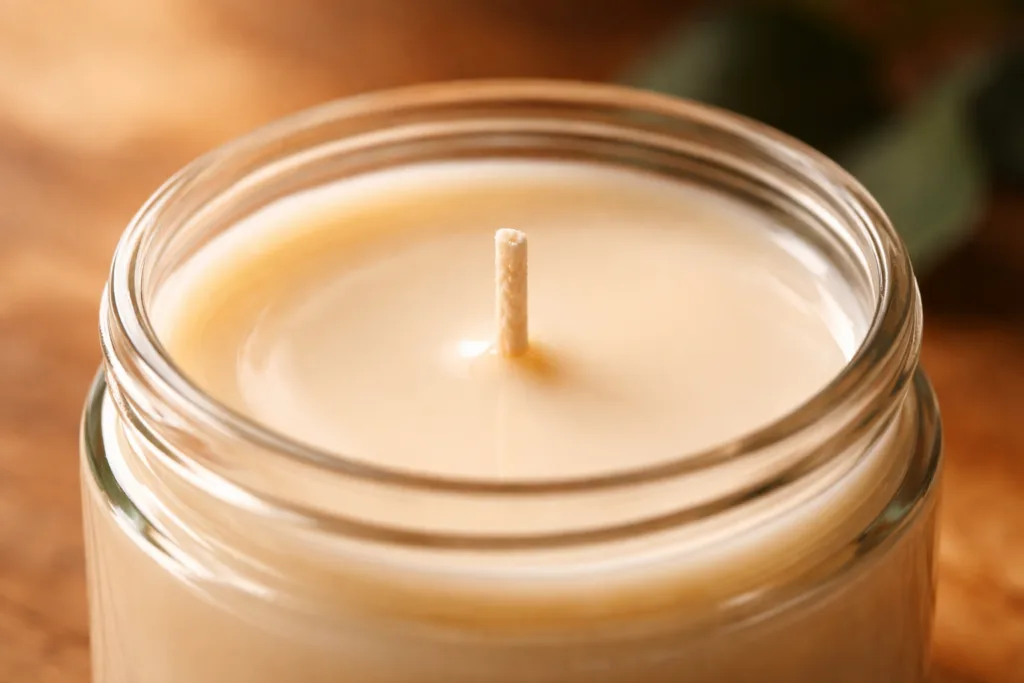
Glass jars are a staple in candle manufacturing—valued for their versatility, cost-effectiveness, and ability to create an instantly premium feel. With classic shapes and finishes readily available, brands can leverage low MOQs (minimum order quantities) while tapping into a wide array of private-label options. Compared to ceramics or metal tins, glass jars offer transparent beauty, easier scent detection, and broad compatibility with wax blends.
Key Advantages for Startups
- Low MOQ: Standard glass jars are sourced efficiently, lowering upfront costs and inventory risks.
- Branding Flexibility: Supports embossing, labeling, screen printing, and custom cap designs.
- Clean Burn Performance: Allows better wick sizing and wax temperature control for soot-free results.
- Regulatory Compliance: Meets global safety testing, ideal for scaling into retail or export.
Candle Wax Blends and Their Impact on Glass Jar Performance
Choosing the wax blend is fundamental to scent throw, burn profile, and curing time. The jar type influences fragrance diffusion and overall aesthetic. For private-label candle businesses, custom blending sets products apart—leveraging the strengths of soy, coconut, rapeseed, beeswax, or paraffin, with glass jars amplifying visual clarity and label presentation.
| Wax Type | Scent Throw | Burn Time | Visual Appearance |
|---|---|---|---|
| Soy Wax | Strong; Clean | 40–50 hrs (200g) | Frosts easily; creamy |
| Coconut Blend | Mild; Subtle | 45+ hrs (200g) | Smooth; glossy |
| Rapeseed Wax | Balanced | 35–45 hrs | Bright; semi-soft |
| Beeswax | Natural; delicate | Up to 60 hrs | Golden; smooth |
| Paraffin | Bold; adaptable | 30–40 hrs | Crisp; glassy |
Candle Wax Selection Tips
- Evaluate maximum fragrance load (up to 8–12% for soy with proper additives).
- Check flash point and melting temperature: Critical for stability and scent integrity.
- Ask for sample pours from manufacturers (Circe Home offers tailored blending for glass jar applications).
“Circe Home Lab Insight: Fine-tuning wax blends in glass jars is essential for optimal cold and hot scent throw. We recommend a staged curing period—minimum 3 days for soy and up to 7 for beeswax. This enhances both aroma diffusion and burn profile consistency.”
Steps for Private Label Production Using Glass Jars
Private labeling allows you to build a brand identity while leveraging proven manufacturing expertise. Standard glass jar formats with low MOQ let you minimize upfront investment and tap into high-impact packaging.
- Define Your Brand Aesthetic: Select jar color, cap style, and label finish. Choose a minimal, modern look or a luxury-themed feel based on your target audience.
- Develop Signature Fragrances: Work with fragrance houses or manufacturers like Circe Home to create proprietary scent blends suitable for your wax and jar type.
- Determine Wax Blend: Choose based on burn quality, scent throw, and environmental values.
- Design Packaging: Incorporate CLP/IFRA compliance on labels, outer boxes, and any additional inserts.
- Confirm Production Details: Set MOQ, approve samples, and finalize curing methods.
- Launch Quality Control: Inspect wick centering, burn time (>35hrs for 200g), and packaging integrity.
All About MOQ: How Low MOQ Enables Candle Startups with Glass Jars
Low minimum order quantities (MOQs) are vital for new candle brands seeking flexibility. Glass jars come in standard sizes and finishes, allowing manufacturers to combine runs and offer lower MOQs—even as few as 300–500 units per scent and format. This opens doors for small batch launches, limited edition collections, and market testing with manageable risk.
How to Achieve the Lowest MOQs
- Choose regular glass jar styles shared with other brands for cost savings.
- Avoid complex customizations initially (replicate proven colorways, caps, and labels).
- Work with manufacturers that support direct private-label programs under low MOQ contracts.
- Bundle scents by season—manufacturers may combine orders for reduced minimums.
Designing Your Candle Line: Fragrance Systems and Burn Performance in Glass Jars
Fragrance selection drives repeat sales and sets your candles apart. Understanding the science behind essential oils and fragrance oils—plus testing for compatibility with your chosen wax—ensures safety, compliance, and brilliant scent throws.
Fragrance Load and Curing
The ideal fragrance load ranges from 7% to 12%. Overloading can cause separation, surface pooling, or reduced burn quality. Glass jars facilitate monitoring of both cold and hot throw, enabling visual inspection of wax structure and scent release. Curing is essential—minimum three days for good diffusion, longer for oil-based blends or beeswax candles.
Burn Profile & Wick Sizing for Glass Jars
Proper wicking is critical for soot-free burning and maximizing jar safety.
- Use cotton or wood wicks; trim to 5mm before first light.
- Mushrooming (carbon buildup) signals incorrect size or wax load—adjust as needed.
- Glass diameter dictates wick width: Larger jars require thicker wicks or dual placements.
- Test for tunneling and wick centering tolerance (<3mm deviation recommended).
Glass Jar Candle Manufacturing Process: Behind the Scenes
Understanding the complete production flow is crucial for quality and compliance. Professional candle factories follow strict protocols to optimize the final product’s aesthetic, safety, and performance.
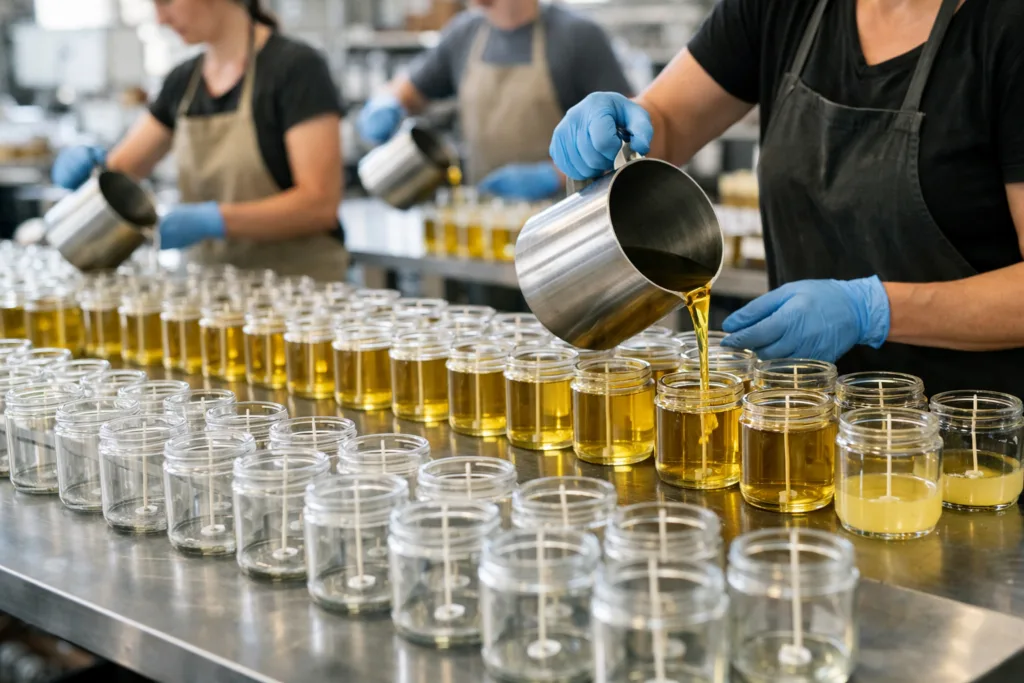
- Pre-pour Preparation: Clean jars, affix wicks, and verify vessel tolerance.
- Wax Melting: Control temperature for optimal blend homogeneity (typically 67–73°C for soy blends).
- Fragrance Incorporation: Blend oils at recommended flash points to avoid evaporation or scent softening.
- Pouring: Steady, uniform fills reduce surface defects and layering issues.
- Cooling and Curing: Allow for slow cooling to avoid frosting and ensure fragrance lock-in.
- Finishing: Cap, label, and box following CLP/IFRA guidelines.
Quality Control, Testing, and Regulatory Compliance for Glass Jar Candles
Building consumer trust starts with rigorous quality checks and verified compliance. Mandated burn-time testing (>35hrs for 200g wax is a common benchmark), soot index analysis, and wick centering checks keep your products competitive and safe.
- Check every batch for consistent fragrance dispersion and burn uniformity.
- Ensure proper allergen labeling as per IFRA 51st amendment and CLP compliance for Europe.
- Verify packaging uses eco-safe materials—soy ink, FSC cartons are increasingly favored.
Application Scenarios: From Private-Label Retail to Luxury Gifting
Standard glass jars adapt perfectly to multiple business models. Whether serving hotel spas, minimalist décor lines, or bespoke fragrance programs, glass jars facilitate rapid customization and polished presentation. Circe Home’s OEM production serves global retailers and boutique brands, offering advanced fragrance development and packaging solutions for luxury lines and gift collections.
Lifestyle Positioning Tips
- Highlight clean burn metrics and refined wax formulas in marketing materials.
- Offer refillable jar programs or sustainable package add-ons for eco-conscious buyers.
- Test scent rotation quarterly—industry data suggests consumer demand for limited editions is rapidly rising.
How to Start a Candle Business with Glass Jars: Low MOQ, Private Label Guide
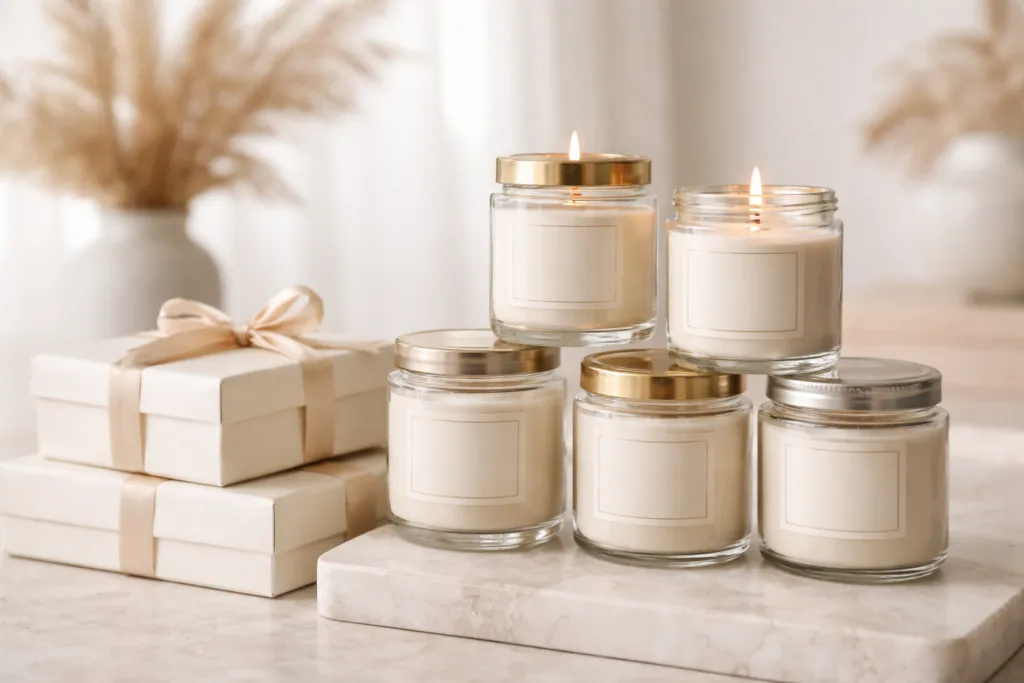
For new entrants, the pathway is clear: prioritize glass jars, leverage low MOQ offerings, establish proprietary scents, and commit to both safety and elegant branding. Partnering with expert manufacturers ensures adherence to best practices—while your creativity shapes an unforgettable sensory experience for every customer. The candle business thrives on precision, passion, and adaptability. Glass jars—with their universal aesthetic and proven performance—are the ideal starting point.
Frequently Asked Questions
What is the lowest MOQ for private label glass jar candles?
Leading manufacturers typically offer MOQs as low as 300–500 units, enabling startups to test markets and streamline inventory.
Are soy wax glass jar candles better than coconut or paraffin blends?
Soy wax candles are popular for their clean burn and strong scent throw, but coconut blends offer a smoother finish and paraffin enables bold fragrance profiles.
How do I ensure my glass jar candles comply with safety regulations?
Follow IFRA and CLP labeling requirements, verify burn time and soot index, and work with reputable factories that conduct detailed QC checks.
What are the best ways to customize glass jars for private label?
Select from screen printed labels, embossed caps, colored glass options, and branded outer boxes to create a distinctive look.
How long should candles cure before sale?
A minimum cure time of 3–7 days is recommended, varying by wax blend and fragrance load, to ensure optimal scent diffusion and surface appearance.
Can I order multiple scents with a single low MOQ?
Many manufacturers will allow mixed scent orders within one MOQ batch, provided you select standard jar and packaging formats.